MARA Reports Q1 Revenue Below Expectations, Net Loss of $1.3 Billion, Stock Plunges After Hours

marsbitPublished on 2026-05-12Last updated on 2026-05-12

Abstract

Bitcoin mining firm MARA Holdings reported disappointing Q1 2024 results, causing its stock to erase all daily gains and fall 3.44% in after-hours trading. Revenue dropped 18% year-over-year to $174.6 million, missing Wall Street estimates of $192.7 million. The company posted a net loss of $1.3 billion, a significant increase from a $533.4 million loss a year ago, primarily driven by unrealized losses on its holdings of 38,689 Bitcoin, which depreciated in value during the quarter. MARA also sold over 15,100 BTC in late March to repurchase debt at a discount. The broader mining environment remains challenging due to a 35% decline in Bitcoin's price from its all-time high and a nearly 30% increase in mining difficulty over the past year. MARA's market cap ranking among U.S. miners has slipped to seventh. Critically, the company announced a strategic pivot away from Bitcoin mining expansion. It stated it has no plans to purchase new mining equipment and is fully transitioning toward AI data centers. Its strategy involves retrofitting existing mining sites for AI and high-performance computing (HPC) and leveraging its recent $1.5 billion acquisition of Long Ridge Energy & Power, a gas-fired power plant and data center. This infrastructure could eventually support 600 MW of AI compute capacity, allowing MARA to redeploy up to 90% of its non-custodial mining power for AI and IT workloads.

Author: Brayden Lindrea

Compiled by: Deep Tide TechFlow

Deep Tide TechFlow Summary: Bitcoin miner MARA Holdings has delivered a dismal Q1 report: revenue fell 18% year-on-year, net loss expanded from $530 million to $1.3 billion, and the stock erased all its intraday gains after hours. The bulk of the loss stemmed from unrealized losses on its BTC holdings. More notably, MARA has clearly stated it will no longer purchase new mining rigs, pivoting entirely to AI data centers—its ranking as the largest miner by market capitalization has already slipped to seventh place.

MARA Holdings' stock fell 3.44% after hours on Monday, closing at $12.93, completely wiping out its 3.48% gain from the day. The reason is simple: its Q1 earnings report missed expectations across the board.

Revenue and Profit Both Miss

According to the report filed by MARA, revenue for the quarter ended March 31 was $174.6 million, down 18% year-on-year, falling short of Wall Street's expectation of $192.7 million.

Net loss was $1.3 billion, compared to a loss of $533.4 million in the same period last year, expanding by nearly 1.5 times. Loss per share was $3.31, also significantly exceeding analysts' forecast of $2.20.
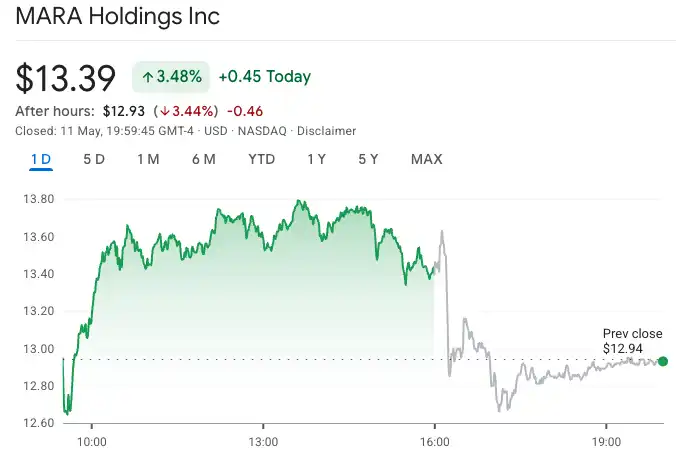
Caption: MARA's after-hours stock price movement, source: Google Finance

Where Did the $1.3 Billion Loss Come From?

The main reason for the loss was the unrealized losses on MARA's holdings of 38,689 bitcoins. Bitcoin price fell 23% in Q1, directly dragging down the book value.

MARA sold over 15,100 bitcoins in the final week of March, worth approximately $1.1 billion, to repurchase its debt at a discount.

Mining Environment Continues to Deteriorate

MARA's predicament is not an isolated case. The entire U.S. Bitcoin mining sector is sliding from profit to loss.

Two core pressures: Bitcoin is down over 35% from its all-time high of $126,080, significantly reducing miner revenue per block; simultaneously, mining difficulty has increased by nearly 30% over the past year, pushing hashing costs consistently higher.

MARA's industry standing is also declining. By market cap, it has fallen from being the largest Bitcoin miner to seventh place, as competitors move faster in their AI pivots.

Full Pivot to AI Data Centers

MARA says Bitcoin mining remains the "operational foundation" of the company, but its actions are already clear.

The company's AI strategy has two main thrusts: first, collaborating with Starwood Capital to convert existing mining sites into AI and High-Performance Computing (HPC) data centers; second, acquiring Long Ridge Energy & Power for $1.5 billion in late April, a natural gas power plant with an associated data center.

MARA's statement is:

"Our strategy is to colocate new infrastructure with our existing Bitcoin mining sites. The flexibility this creates is that we can generate revenue through mining today while preserving the option to divert power to AI and other critical IT loads."

The Long Ridge acquisition ultimately supports 600 MW of AI compute power, and approximately 90% of MARA's non-custodial mining capacity could be redeployed for AI and IT computing.

A one-sentence summary of its transformation resolve: The company explicitly stated it has no plans to purchase new mining rigs in the future.


Related Questions

QWhy did MARA Holdings' stock price drop after-hours despite a gain during the day?

AThe stock dropped because the company released its Q1 earnings report, which showed both revenue and profits missing analyst expectations. Revenue fell 18% year-over-year, and the net loss expanded to $1.3 billion, causing investors to sell.

QWhat was the primary cause of MARA's significant $1.3 billion net loss in Q1?

AThe primary cause of the $1.3 billion net loss was the unrealized loss on the company's holding of 38,689 Bitcoins, as the price of Bitcoin fell by 23% during the quarter.

QWhat strategic shift did MARA announce regarding its mining operations?

AMARA announced a strategic shift away from purchasing new mining machines and towards fully transitioning into AI data centers. The company plans to repurpose its existing mining infrastructure for AI and High-Performance Computing (HPC) workloads.

QWhat actions did MARA take regarding its Bitcoin holdings in March, and why?

AIn the final week of March, MARA sold over 15,100 Bitcoins, valued at approximately $1.1 billion, in order to repurchase its debt at a discount.

QHow has the competitive landscape changed for MARA within the U.S. Bitcoin mining sector?

AMARA's position has weakened. By market capitalization, it has fallen from being the largest Bitcoin miner to the seventh largest. The company noted that competitors are moving faster in their transitions to AI-related businesses.

Related Reads

BTC Returns to $80,000, Crypto-Related Stocks Finally Stand Tall

Bitcoin Breaches $80,000 Mark, Boosting Crypto-Related Stocks With the crypto market heating up, Bitcoin has surged back above the $80,000 level after more than a hundred days, posting nearly a 30% gain in a week. This rally has ignited bullish sentiment across the board. Concurrently, crypto-related stocks, which had been experiencing a months-long slump, are staging a powerful comeback, led by key players in digital asset treasuries, exchanges, and trading platforms. Many of these stocks have seen substantial rebounds from their recent lows. Leading the charge is MicroStrategy (MSTR), a major Bitcoin treasury company, whose stock has rebounded nearly 50% from its 52-week low. Close behind is Bitmine (BMNR), the largest public Ethereum treasury, with a staggering 88.6% rebound. Other notable performers include the stablecoin issuer Circle (CRCL), up 75.5%, and the Ethereum-focused company Sharplink (SBET), up 83.7%. While the "crypto market proxy" Coinbase (COIN) has rebounded 29%, its unique position has faced some dilution from new market entrants. Robinhood (HOOD), bolstered by strong Q2 earnings and its expanding crypto ecosystem, has risen 63.2%. The exchange Bullish (BLSH) is up 45.8%. Perhaps the most dramatic rebound belongs to Hyperliquid Strategies (PURR), linked to the Hyperliquid ecosystem, which has skyrocketed over 254% from its low. The analysis highlights that most of these stocks hit their lows around late June, marking a market bottom. It emphasizes the strategy of focusing on leading companies and notes that while the rebound is strong, many stocks remain significantly below their yearly highs. Ultimately, these public companies serve as leveraged proxies for underlying crypto assets like Bitcoin and Ethereum in the current market upswing.

Odaily星球日报9m ago

BTC Returns to $80,000, Crypto-Related Stocks Finally Stand Tall

Odaily星球日报9m ago

AI Starts Acting as Humans' AI Intermediary, Token Usage Already 5.2 Times That of Humans

On February 6, 2026, human usage of AI tokens was surpassed by AI agents for the first time on the platform OpenRouter. In just six months, this gap widened to a factor of 5.2. OpenRouter estimates that by August 10, 2026, Agent-class token consumption soared 14-fold to 7.3 trillion, while human usage grew to 1.4 trillion, a 2.8-fold increase. OpenRouter, a major model gateway handling about 1% of global inference volume, distinguishes between human and agent traffic by analyzing user behavior patterns (e.g., frequency of tool calls, response intervals) rather than identity. The dramatic divergence stems from fundamentally different usage patterns. Human interaction is typically short, involving a prompt and a response. In contrast, AI agents operate autonomously on complex tasks—reading files, calling tools, iterating outputs—generating thousands of tokens from a single initial prompt. This shift to autonomous, multi-turn operation unlocks massive scale. While agents benefit from cheaper cached tokens (constituting nearly 70% of an average request), the sheer volume explosion still drives costs sharply higher. Estimates show the cost per customer service interaction could rise 30-fold by 2026, and agentic AI could increase total token consumption 24-fold by 2030. Companies like Uber have already exhausted annual AI budgets within months. The critical differentiator is not the choice of AI model but its integration into actionable workflows. Top-tier companies see users generating 8.3x more tokens than average, largely due to higher adoption of plugins and reusable skills, which reduce redundant work. However, this surge in automated activity raises a crucial oversight issue. Many agent tasks still require human approval, but monitoring capacity hasn't scaled with usage, leading to incidents like unnoticed deletions. The key challenge is no longer whether to use AI, but establishing who verifies its work, makes final decisions, and takes responsibility. The real scarcity is shifting from execution to validation and judgment.

marsbit14m ago

AI Starts Acting as Humans' AI Intermediary, Token Usage Already 5.2 Times That of Humans

marsbit14m ago

Trading

Spot
活动图片