Major VCs Back Zcash Developers With $25 Million After ECC Split

bitcoinistPublicado a 2026-03-10Actualizado a 2026-03-10

Resumen

Zcash Open Development Lab (ZODL), formed by the team formerly known as Electric Coin Company, has raised over $25 million from major investors including a16z, Paradigm, and Coinbase Ventures. The funding will support the development of Zcash-focused wallets and protocol work without relying on the network’s development fund. According to ZODL, its wallet has driven a 400% increase in shielded pool adoption and facilitated over $600 million in ZEC swaps since October 2025. The team emphasizes continuity, with the full ECC engineering team moving to ZODL. Zcash founder Zooko Wilcox highlighted that the investment involves no new token and no control over the Zcash protocol, suggesting backers are betting on Zcash's broader adoption and long-term importance.

Zcash Open Development Lab, the company formed by the team formerly known as Electric Coin Company, has raised more than $25 million from a roster of heavyweight crypto investors including a16z, Paradigm, Winklevoss Capital, Coinbase Ventures, Cypherpunk Technologies, Maelstrom (family office of Arthur Hayes), Chapter One, David Friedberg, Haseeb Qureshi, Mert, Balaji and others.

What This Means For Zcash

The round lands just months after the ECC team regrouped under a new name, and gives the Zcash-focused builder fresh capital to expand its wallet and protocol work without leaning on the network’s development fund.
Josh Swihart, who now leads ZODL after previously serving as CEO of ECC, framed the raise as a bet on product traction rather than a brand reset. “The name is new, but our team has been building Zcash for a decade,” he wrote. “A couple of years ago, my team and I set out to change the trajectory of Zcash with an uncompromising focus on the user experience for shielded ZEC. We released Zodl (then called Zashi) and have never looked back.”

That pitch is backed by a set of numbers the team clearly wants the market to notice. According to ZODL, its wallet has helped drive adoption of the Zcash shielded pool by more than 400% since launch, while facilitating over $600 million in ZEC swaps since October 2025. Swihart said the company first shipped what he called a “normie-friendly wallet,” then layered in integrations with Flexa for retail spending, Keystone for cold storage and, more recently, NEAR-powered intents for ZEC swaps.

The capital raise is also meant to change how that work gets funded. “This funding allows us to bring these ambitions to life, without relying on Zcash dev fund grants to get there,” Swihart wrote. Alongside Zodl, the company said it is building Zallet, a full-node wallet that will serve as the foundation for new desktop software, with the longer-term goal of creating “a private, decentralized financial system as an alternative to legacy institutions.”

ZODL’s own announcement leaned heavily on continuity. The company said the full ECC team, including the engineers responsible for designing and maintaining some of Zcash’s core systems, moved over earlier this year. It added that protocol development remains central to the company’s work, but argued that future upgrades should stay tied to usability and product-market fit rather than protocol design in isolation.

Zcash founder Zooko Wilcox read the raise as something larger than a routine venture financing. “Twenty-five million dollars is a big investment! For a company that makes a wallet!?” he wrote in a thread reacting to the news. “This set of investors is a signal. They are big, sophisticated, long-standing, and reputable.”

He focused on what the deal does not appear to offer. There is no new token for investors to capture, he noted, and no control over the Zcash protocol itself. “There is no new token that the investors can get a cut of! The ZEC supply is locked in, with a 21M total supply cap, like Bitcoin,” Wilcox wrote. “The investors don’t get control of the protocol! Zcash is permissionless, open-source, and has a huge number and variety of stakeholders.”

From there, Wilcox sketched out a theory of the round: investors may see the wallet business as a monetizable entry point, but just as importantly, some may be underwriting broader ZEC adoption itself. He pointed to public disclosures from Cypherpunk Technologies, which he said already holds more than 1% of ZEC’s eventual supply, and argued that its equity stake in ZODL is smaller than its exposure to the coin.

His conclusion was blunt. “These people are betting that Zcash — not crypto, not privacy, not Bitcoin, not zero-knowledge-proofs — Zcash will be critically important for our civilization,” he wrote.

At press time, Zcash traded at $221.95.
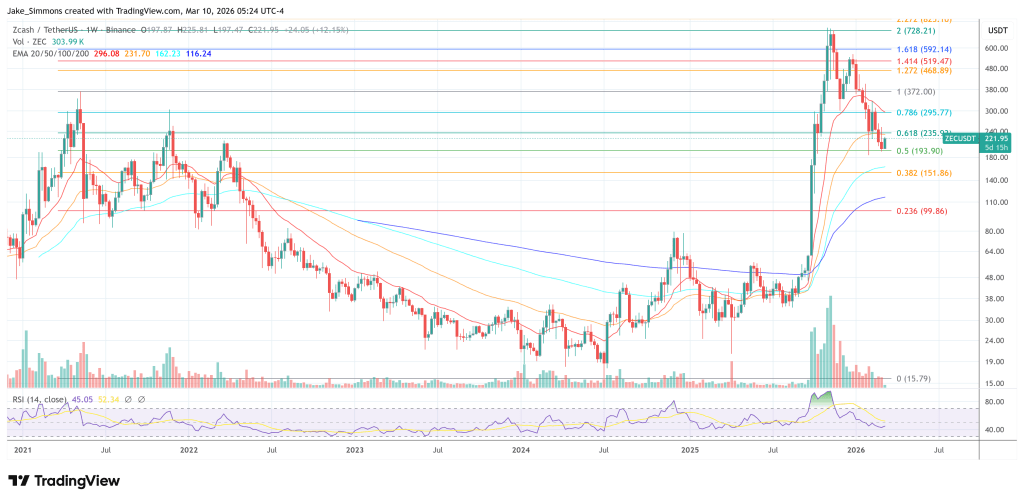
ZEC bounces from the 0.5 Fib, 1-week chart | Source: ZECUSDT on TradingView.com

Lecturas Relacionadas

DeepSeek Funding: Liang Wenfeng's 'Realist' Pivot

DeepSeek, a leading Chinese AI company, has initiated its first external funding round, aiming to raise at least $300 million at a valuation of no less than $10 billion. This move marks a significant shift from its founder Liang Wenfeng’s previous idealistic stance of rejecting external capital to maintain independence. Despite strong financial backing from its parent company, quantitative trading firm幻方量化 (Huanfang Quant), which provided an estimated $700 million in revenue in 2025 alone, DeepSeek faces mounting challenges. Key issues include a 15-month gap in major model updates, delays in its flagship V4 release, and the loss of several core researchers to competitors offering significantly higher compensation. The company is also undergoing a strategic pivot by migrating its infrastructure from NVIDIA’s CUDA to Huawei’s Ascend platform, a move aligned with China’s push for technological self-reliance amid U.S. export controls. However, DeepSeek lags behind rivals like智谱AI and MiniMax—both now publicly listed—in areas such as product ecosystem, multimodal capabilities, and commercialization. The funding round, though relatively small in scale, is seen as a way to establish a market-validated valuation anchor, making employee stock options more competitive and facilitating talent retention. It also signals DeepSeek’s transition from a pure research-oriented organization to a commercially-driven player in the global AI ecosystem.

marsbitHace 21 min(s)

DeepSeek Funding: Liang Wenfeng's 'Realist' Pivot

marsbitHace 21 min(s)

Solana Q1 Report: Revenue Plunges 68% Year-on-Year, Developers Decrease by 30%

Solana Q1 2026 Report: Key Metrics Show Significant Decline Amid Market Reset Solana experienced a substantial downturn in Q1 2026, with key performance indicators reflecting a broader market cooling. Total network revenue (REV) fell to $89.9 million, down 68% year-over-year (YoY) and 1.4% quarter-over-quarter (QoQ). This decline was driven by reduced speculative activity, which had previously fueled the network during the 2024/2025 bull market. Key revenue components saw mixed results: base fees dropped 8.7% QoQ, Jito tips (MEV) fell 19.7%, priority fees rose 23%, and vote fees declined 44.5%. The annualized real yield for stakers was just 0.17%, down 67% YoY. Network GDP, generated by top applications, fell 7% QoQ to $451 million. Pump Fun emerged as a standout, generating $103 million (up 3% QoQ), surpassing Solana's L1 revenue. However, daily active addresses averaged 2.4 million, down 4.8% YoY. Stablecoin supply on Solana reached $15.9 billion, down 2.7% QoQ but up 18% YoY. USDC and USDT remained dominant. DEX volumes averaged $3.2 billion daily, with private DEXs now accounting for 60% of all volume. The network's net dilution rate was 4.38%, while the cost to produce $1 of REV was $8.10, up 93% YoY. The number of new tokens created on launchpads grew 42% QoQ to 3 million, with Pump Fun dominating 85% of this market. Despite the downturn, Solana's core strengths remain: its position as a hub for retail trading apps, potential in perpetual markets, and growing use in stablecoin-based fintech applications, particularly in Latin America. However, developer activity declined 32% YoY, slightly worse than Ethereum's 29% drop. The network must now focus on attracting traditional finance, competing in perpetual markets, and sustaining developer ecosystem growth to drive the next expansion cycle.

marsbitHace 59 min(s)

Solana Q1 Report: Revenue Plunges 68% Year-on-Year, Developers Decrease by 30%

marsbitHace 59 min(s)

Trading

Spot
Futuros
活动图片