6,000 CEOs Admit AI 'Did Nothing', Yet It Was Used to Lay Off 40,000 People in Q1 This Year

marsbitPublicado a 2026-04-20Actualizado a 2026-04-20

Resumen

A study by the National Bureau of Economic Research (NBER) surveying 6000 executives across four countries reveals that nearly 90% of businesses report AI has had "no measurable impact" on employment or productivity over the past three years. Despite global AI investments exceeding $250 billion in 2024, only 12% of CEOs reported both cost reductions and revenue growth from AI. Contrastingly, in Q1 2026, the industry saw 78,557 tech job cuts, with 47.9% attributed to AI and automation. Critics label this contradiction an "AI version of the Solow Paradox," referencing the visible lack of AI's effect in productivity data amid widespread adoption. While some leaders, like Anthropic’s CEO, predict AI will eliminate half of entry-level white-collar jobs, others accuse firms of "AI washing"—using AI as a pretext for layoffs originally planned due to over-hiring or weak demand. However, companies like IBM and Cognizant are bucking the trend by increasing entry-level hiring and retraining staff to work alongside AI. Economists suggest a "J-curve" effect may be underway, where initial productivity stagnation is followed by significant gains, as was seen with IT in the 1990s. The transition remains challenging, with true productivity improvements expected within 6–12 months.

Author: Claude, Deep Tide TechFlow

Deep Tide Guide: A survey of 6,000 executives in four countries by the National Bureau of Economic Research (NBER) shows that nearly 90% of companies believe AI has had "no impact" on employment and productivity over the past three years. However, in Q1 2026, the tech industry laid off 78,557 people, with 47.9% attributed to AI. While productivity data remains blank, a wave of layoffs is surging in the name of AI. Economists compare this contradiction to an AI version of the "computer paradox" proposed by Robert Solow, winner of the 1987 Nobel Prize in Economics.
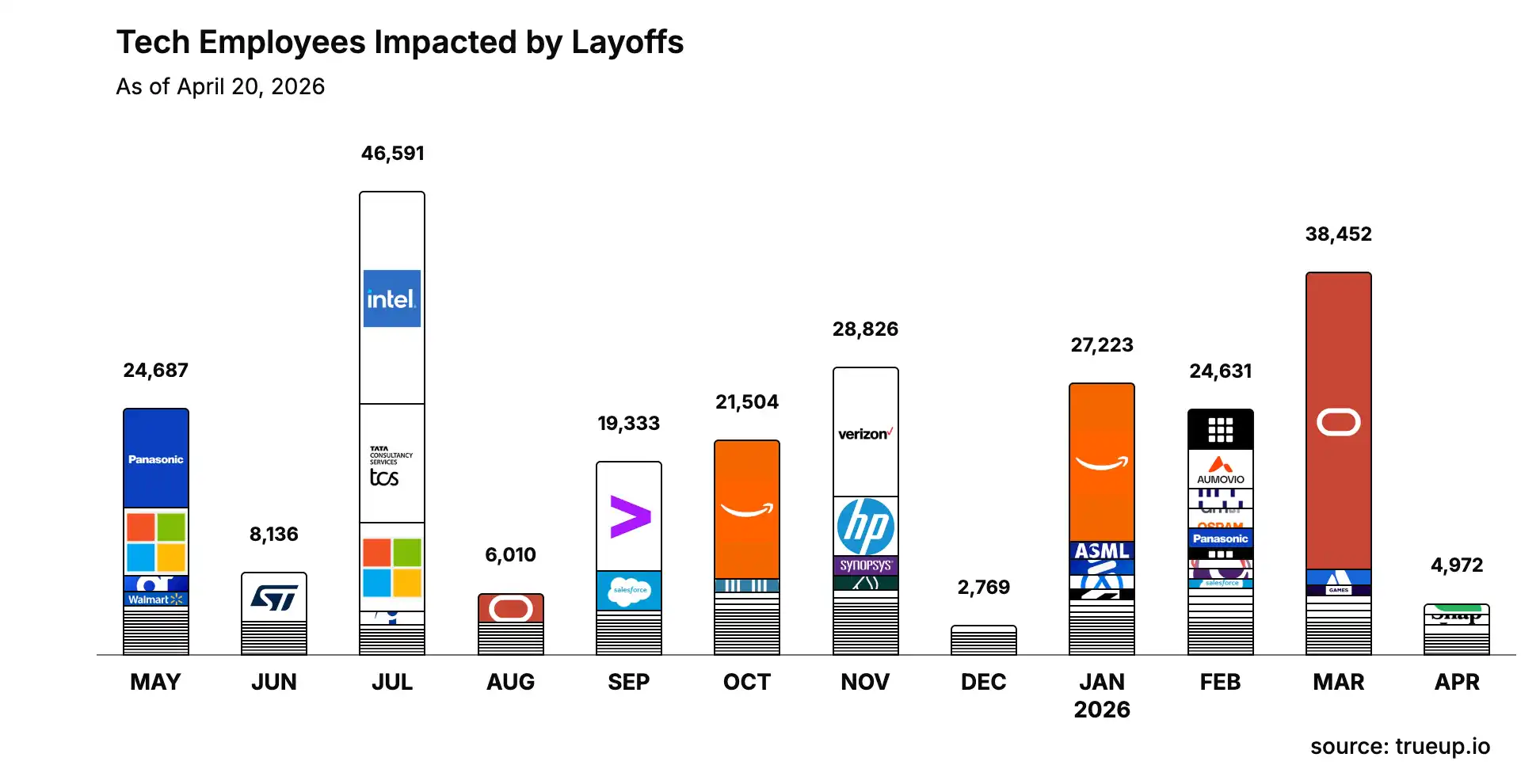
$250 billion invested, nearly 90% of companies say AI hasn't brought any productivity improvements. Meanwhile, tech companies are conducting large-scale layoffs in the name of AI.

This is the most absurd scene in the current AI industry.

According to a Fortune magazine report on April 19, a study published by NBER in February covering 6,000 corporate executives in the US, UK, Germany, and Australia found that nearly 90% of respondent companies said AI had no measurable impact on their employment and productivity over the past three years. Although two-thirds of executives are using AI, their average weekly usage is only 1.5 hours, and 25% of respondents said they don't use AI at work at all.

On the other hand, according to Nikkei Asia citing RationalFX data, from January 1 to early April 2026, the tech industry has laid off 78,557 people, with 37,638 (47.9%) explicitly attributed to AI and workflow automation. Over 76% of the layoffs occurred in the United States.

Apollo chief economist Torsten Slok directly quoted the classic statement of Robert Solow, winner of the 1987 Nobel Prize in Economics, summarizing the current situation as the AI version of the "Solow Paradox." Solow's original words were: "You can see the computer age everywhere but in the productivity statistics."

Slok's judgment almost exactly maps to today. AI is nowhere to be found in employment data, productivity data, or inflation data.

90% of Companies See No AI Effect, $250 Billion Investment Return Questioned

The data from this NBER study is quite solid. Among the four countries, 69% of companies use AI to some extent, with the US highest (78%) and Germany lowest (65%). But using it is one thing, effectiveness is another: over 90% of managers said AI had no impact on their company's employment size, and 89% said it had no impact on labor productivity (measured by sales per capita).

According to Stanford University's 2025 AI Index Report, global AI investment in 2024 exceeded $250 billion. PwC's 2026 Global CEO Survey shows that only 12% of CEOs said AI brought both cost reduction and revenue growth, while 56% of CEOs reported no significant financial benefits.

Slok pointed out in his blog post that aside from the "Magnificent Seven," AI has no visible impact on profit margins and earnings expectations.

This is not an isolated opinion. A 2024 MIT study predicted that AI would only boost productivity by 0.5% over the next decade. The study's author, Nobel laureate Daron Acemoglu, said at the time: "0.5% is better than zero. But relative to the promises of the industry and tech media, it is indeed disappointing."

A study published by Boston Consulting Group (BCG) in March this year revealed a counterintuitive phenomenon: when employees use fewer than three AI tools, productivity increases; but after using four or more tools, self-rated productivity drops significantly, with employees reporting "brain fog" and more minor errors. BCG calls this "AI Brain Overload."

ManpowerGroup's 2026 Global Talent Barometer shows that among nearly 14,000 employees in 19 countries, the routine use rate of AI rose by 13% in 2025, but confidence in AI's practicality plummeted by 18%.

Nearly 80,000 Layoffs in Q1, Is AI the Biggest "Scapegoat" or the Real Culprit?

While productivity data remains blank, the layoff wave is advancing at an alarming rate.

According to Nikkei Asia, the tech industry laid off 78,557 people in Q1 2026, with 47.9% attributed to AI implementation and workflow automation. Oracle recently quietly laid off over 10,000 people, with the saved funds redirected to data center construction. Anthropic CEO Dario Amodei and Ford CEO Jim Farley have both publicly stated that AI will eliminate half of US entry-level white-collar jobs within the next five years. Stanford University research also shows that junior programming and customer service positions are already being impacted, with related job postings dropping 13% over three years.
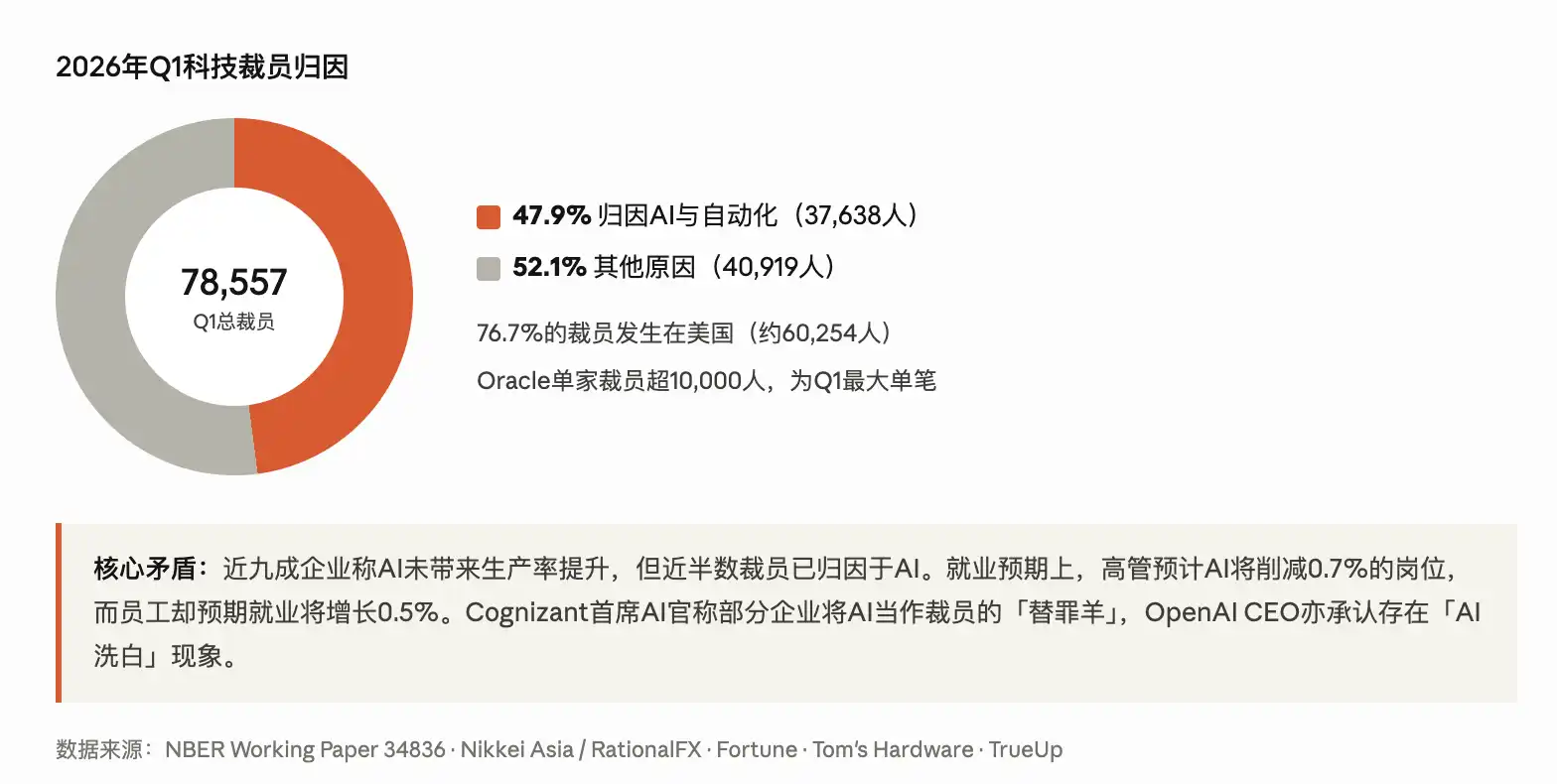
An MIT simulation study provided even more startling numbers: AI could replace 11.7% of the US workforce, involving approximately $1.2 trillion in total wages.

But how many of these layoffs are truly driven by AI?

Cognizant Chief AI Officer Babak Hodjat was blunt with Nikkei Asia: "I'm not sure if these layoffs are directly related to actual productivity gains. Sometimes, AI is just a scapegoat on the financial level—companies overstaffed, want to downsize, and then blame it on AI."

OpenAI CEO Sam Altman also acknowledged the existence of "AI washing" at the India AI Impact Summit, "There's a certain percentage of 'AI washing,' where people blame layoffs that were going to happen anyway on AI, but there are also some jobs that are being genuinely replaced by AI."

Deutsche Bank analysts directly named this phenomenon "AI redundancy washing," believing companies attribute layoffs to AI because "it sends a more positive signal to investors than admitting weak demand or previous over-hiring."

IBM Increases Entry-Level Hiring Against the Trend, Cognizant Refuses Layoffs

Not all companies are following the trend.

IBM tripled its entry-level hiring in 2026. The company's Chief Human Resources Officer, Nickle LaMoreaux, logic is: while AI can perform many entry-level tasks, eliminating these positions would destroy the talent pipeline for cultivating future middle managers, endangering the company's long-term leadership reserves.

Cognizant—a process outsourcing giant highly dependent on human resources—also stated it will not lay off people because of AI. The company has established AI labs in San Francisco and Bangalore to develop custom AI agents for clients (as off-the-shelf generic AI products don't perform well in enterprise environments, with performance and security issues), but its employees will be trained to work alongside AI, not be replaced by it.

Hodjat emphasized: "There will be a large number of young graduates who can't find jobs and lack domain expertise. You have to hire them and let them learn on the job how to use AI in various fields."

Data from the European Central Bank also supports this view from another angle: companies that deploy and invest in AI on a large scale are more likely to be expanding hiring.

J-Curve or Mirage: When Will the AI Productivity Inflection Point Arrive?

Historical experience offers some hope.

IT investment in the 1970s and 80s also seemed ineffective, but from 1995 to 2005, IT-driven productivity growth reached 1.5%. Stanford University Digital Economy Lab Director Erik Brynjolfsson wrote in the Financial Times that the AI productivity inflection point may have begun to appear: US productivity grew 2.7% last year, Q4 GDP tracking growth was 3.7%, but only 181,000 new jobs were added in the same period—this decoupling of job growth from GDP growth might be a signal that AI is starting to work. Former Pimco CEO Mohamed El-Erian also noticed the same decoupling phenomenon.

A study by the Stanford Institute for Economic Policy Research, using web browsing data from 200,000 US households, found that AI improved efficiency in online tasks like job searching, travel planning, and shopping by 76% to 176%. However, researchers found that users spent the saved time socializing and watching TV instead of working or learning new skills.

Apollo's Slok describes AI's future impact as a "J-curve": first a period of declining performance, followed by an exponential leap. But he also points out that unlike the IT era of the 80s, where innovators had monopoly pricing power, today's AI tools face fierce competition and continuously falling prices. Therefore, AI's value creation lies not in the product itself, but in "how generative AI is used and deployed across economic sectors."

Hodjat's judgment is perhaps the most practical: in another 6 to 12 months, companies will begin to see the real productivity improvements brought by AI, and "this transition period will be painful for all of us."


Preguntas relacionadas

QWhat is the main contradiction highlighted in the article regarding AI's impact on businesses?

AThe main contradiction is that while nearly 90% of surveyed companies report that AI has had no measurable impact on employment or productivity over the past three years, tech companies have attributed 47.9% of their Q1 2026 layoffs (37,638 jobs) to AI and workflow automation.

QWhat historical economic concept is used to describe the current AI productivity paradox?

AThe current situation is described as an AI version of the 'Solow Paradox,' a concept from Nobel laureate Robert Solow, who in 1987 stated, 'You can see the computer age everywhere but in the productivity statistics.'

QAccording to the article, what is 'AI redundancy washing'?

A'AI redundancy washing' is a term used by Deutsche Bank analysts to describe the phenomenon where companies attribute layoffs to AI implementation to present a more positive signal to investors, rather than admitting to weak demand or previous over-hiring.

QWhich companies are cited as examples of not following the trend of AI-driven layoffs?

AIBM and Cognizant are cited as examples. IBM tripled its entry-level hiring to preserve its future leadership pipeline, while Cognizant refuses to lay off employees and instead trains them to work alongside AI.

QWhat does the 'J curve' refer to in the context of AI's future impact?

AThe 'J curve' describes the predicted trajectory of AI's impact: an initial period of underwhelming performance and productivity data, followed by a future period of exponential growth and significant productivity gains as the technology is more effectively deployed across the economy.

Lecturas Relacionadas

How Many Tokens Away Is Yang Zhilin from the 'Moon Chasing the Light'?

The article explores the intense competition between two leading Chinese AI companies, DeepSeek and Kimi (Moon Dark Side), and the mounting pressure on Yang Zhilin, the founder of Kimi. While DeepSeek re-emerged after 15 months of silence with its powerful V4 model—boasting 1.6 trillion parameters and low-cost, long-context capabilities—Kimi has been focusing on long-context processing and multi-agent systems with its K2.6 model. Yang faces a threefold challenge: technological rivalry, commercialization pressure, and investor expectations. Despite Kimi’s high valuation (reaching $18 billion), its revenue heavily relies on a single product with low paid conversion rates, while DeepSeek’s strategic silence and open-source influence have strengthened its market position and valuation prospects, now targeting over $20 billion. Both companies reflect broader trends in China’s AI ecosystem: Kimi aims for global influence through open-source contributions and agent-based advancements, while DeepSeek prioritizes foundational innovation and hardware independence, notably shifting to Huawei’s chips. Their competition is seen as vital for China’s AI progress, with the gap between top Chinese and U.S. models narrowing to just 2.7% on the Elo rating scale. Ultimately, the article argues that this rivalry, though anxiety-inducing for leaders like Zhilin, is essential for driving innovation and solidifying China’s role in the global AI landscape.

marsbitHace 4 hora(s)

How Many Tokens Away Is Yang Zhilin from the 'Moon Chasing the Light'?

marsbitHace 4 hora(s)

TechFlow Intelligence Bureau: ChatGPT Helps Amateur Mathematician Crack 60-Year-Old Problem, CFTC Sues New York Regulator Over Coinbase and Gemini

An amateur mathematician, with the assistance of ChatGPT, has solved a combinatorial mathematics puzzle originally proposed by Hungarian mathematician Paul Erdős in the 1960s. This marks another milestone in AI-aided mathematical research, demonstrating the evolving capabilities of large language models in formal reasoning. In other AI developments, OpenAI introduced a new privacy filter tool for enterprise API usage, automatically screening sensitive data. Meanwhile, the Qwen3.6-27B model achieved 100 tokens per second on a single RTX 5090 GPU using quantization, significantly lowering the cost barrier for local AI deployment. In crypto and Web3, the U.S. CFTC sued New York’s financial regulator, challenging its oversight of Coinbase and Gemini—a first-of-its-kind federal-state regulatory clash. Following a vulnerability, KelpDAO and major DeFi protocols established a recovery fund. Tether froze $344 million in assets linked to Iran’s central bank upon U.S. Treasury request, highlighting the centralized control risks in stablecoins. Separately, Litecoin underwent a 3-hour chain reorganization to undo a privacy-layer exploit. In the U.S., former President Trump invoked the Defense Production Act to address power grid bottlenecks affecting AI data centers and dismissed the entire National Science Board, raising concerns over research independence. A retail trader gained 250% on a $600k Intel options bet amid AI-related speculation. Xiaomi announced its first performance electric vehicle, targeting rivals like Tesla. Meanwhile, iPhone users reported devices automatically reinstalling a hidden app daily, suspected to be MDM-related. A Chinese securities report noted that A-share institutional crowding has reached its second-longest streak since 2007, signaling high valuations and potential style rotation. The day’s developments reflect a dual narrative: AI is enabling unprecedented individual breakthroughs, while centralized power structures—whether governmental or corporate—are becoming more assertive, underscoring that decentralization is as much a political-economic challenge as a technical one.

marsbitHace 4 hora(s)

TechFlow Intelligence Bureau: ChatGPT Helps Amateur Mathematician Crack 60-Year-Old Problem, CFTC Sues New York Regulator Over Coinbase and Gemini

marsbitHace 4 hora(s)

Trading

Spot
Futuros

Artículos destacados

Cómo comprar PEOPLE

¡Bienvenido a HTX.com! Hemos hecho que comprar ConstitutionDAO (PEOPLE) sea simple y conveniente. Sigue nuestra guía paso a paso para iniciar tu viaje de criptos.Paso 1: crea tu cuenta HTXUtiliza tu correo electrónico o número de teléfono para registrarte y obtener una cuenta gratuita en HTX. Experimenta un proceso de registro sin complicaciones y desbloquea todas las funciones.Obtener mi cuentaPaso 2: ve a Comprar cripto y elige tu método de pagoTarjeta de crédito/débito: usa tu Visa o Mastercard para comprar ConstitutionDAO (PEOPLE) al instante.Saldo: utiliza fondos del saldo de tu cuenta HTX para tradear sin problemas.Terceros: hemos agregado métodos de pago populares como Google Pay y Apple Pay para mejorar la comodidad.P2P: tradear directamente con otros usuarios en HTX.Over-the-Counter (OTC): ofrecemos servicios personalizados y tipos de cambio competitivos para los traders.Paso 3: guarda tu ConstitutionDAO (PEOPLE)Después de comprar tu ConstitutionDAO (PEOPLE), guárdalo en tu cuenta HTX. Alternativamente, puedes enviarlo a otro lugar mediante transferencia blockchain o utilizarlo para tradear otras criptomonedas.Paso 4: tradear ConstitutionDAO (PEOPLE)Tradear fácilmente con ConstitutionDAO (PEOPLE) en HTX's mercado spot. Simplemente accede a tu cuenta, selecciona tu par de trading, ejecuta tus trades y monitorea en tiempo real. Ofrecemos una experiencia fácil de usar tanto para principiantes como para traders experimentados.

383 Vistas totalesPublicado en 2024.12.12Actualizado en 2025.03.21

Cómo comprar PEOPLE

Discusiones

Bienvenido a la comunidad de HTX. Aquí puedes mantenerte informado sobre los últimos desarrollos de la plataforma y acceder a análisis profesionales del mercado. A continuación se presentan las opiniones de los usuarios sobre el precio de PEOPLE (PEOPLE).

活动图片












