Less Than Two Weeks Left — Bitcoin's BIP-110 Countdown Begins as Miner Support Grows Ahead of Decisive Moment

cryptonews.ruОпубліковано о 2026-07-27Востаннє оновлено о 2026-07-27

Анотація

The BIP-110 activation process for Bitcoin, which proposes a temporary soft fork to limit specific data-heavy transaction types (like Ordinals inscriptions), is entering its critical final phase. As of July 27, 2026, there are roughly 1,790 blocks remaining until the mandatory signaling window begins at block 961,632 (estimated for August 9). Starting then, nodes enforcing BIP-110 will reject blocks not signaling for the proposal. While support from miners has grown from below 1% to around 3% recently, it remains concentrated among smaller pools and independent miners, with major pools like Foundry, Antpool, ViaBTC, and F2Pool largely not signaling. Foundry's stance is particularly decisive, as it holds a large share of the network's hashrate and has tied its signaling to a client vote. Without a major pool's shift, widespread activation is unlikely. If the current low signaling levels persist after the window opens, nodes enforcing BIP-110 will follow a slower, minority chain, potentially creating a chain split from the majority chain followed by legacy (e.g., Bitcoin Core) nodes. This activation mechanism differs from past soft forks like SegWit, resembling the 2017 UASF BIP-148 more closely. Proponents argue BIP-110 is necessary to curb spam-like data transactions that increase node costs and distort fee markets, framing opposition as a contentious hard fork. Critics, however, view the activation method as a radical overreaction to a minor issue. The final outcome in th...

As of writing this article at 8:40 AM Eastern Time on July 27, the tip of the blockchain was at block 959,842. Approximately 1,790 blocks remain until block 961,632 — the point at which nodes running BIP-110 software will begin rejecting blocks that do not signal support for version bit 4. Given Bitcoin's average block time of 10 minutes, this height is expected to be reached around August 9, 2026.

BIP-110, officially titled "Reduced Data Temporary Softfork," proposes limiting the size of specific data fields used in Bitcoin transactions. These rules primarily target Ordinals-style inscriptions, excessively large OP_RETURN payloads, and similar high-data-volume use cases, without affecting regular Bitcoin financial transfers, Taproot key path spends, and standard Lightning channel operations.

If activated, the restrictions would come into effect starting from block 965,664 and would automatically expire after 52,416 blocks, or approximately one year.

Support is Growing, But Not Fast Enough

The signaling charts from the past month have looked different than they might seem at first glance.

A few weeks ago, BIP-110 signaling was barely registering, fluctuating below 1% at times. Since then, the support level has climbed to around 3%. In percentage terms, this is a significant increase, but activation in the Bitcoin network depends on who is signaling, not just how many blocks contain the bit.

Screenshot of signals as of 8:40 AM Eastern Time, July 27, 2026. Source: bip110.org/monitor.

Ocean continues to account for the majority of signaling activity. The rest of the hash power comes almost entirely from independent miners and small operators. Among the miners currently signaling support for BIP-110 are Roughnecks, SoV, BIP110 Generic, Barefoot Mining, 234 Alberta, 888, Peer to Peer Money, Black Jade Advisors, Sazmining, Crestmont Fabrics, Datum Miner, SpammersGFY, Moonwalk, PyBLOCK-Datum, Just For Krypto, and JAMIN.

Meanwhile, four pools — Foundry, Antpool, ViaBTC, and F2pool, which collectively account for the majority of the network's hash rate — have largely maintained their stance. Unless one of these major operators changes course, the gradual increase in share from smaller participants is unlikely to significantly shift the activation landscape.
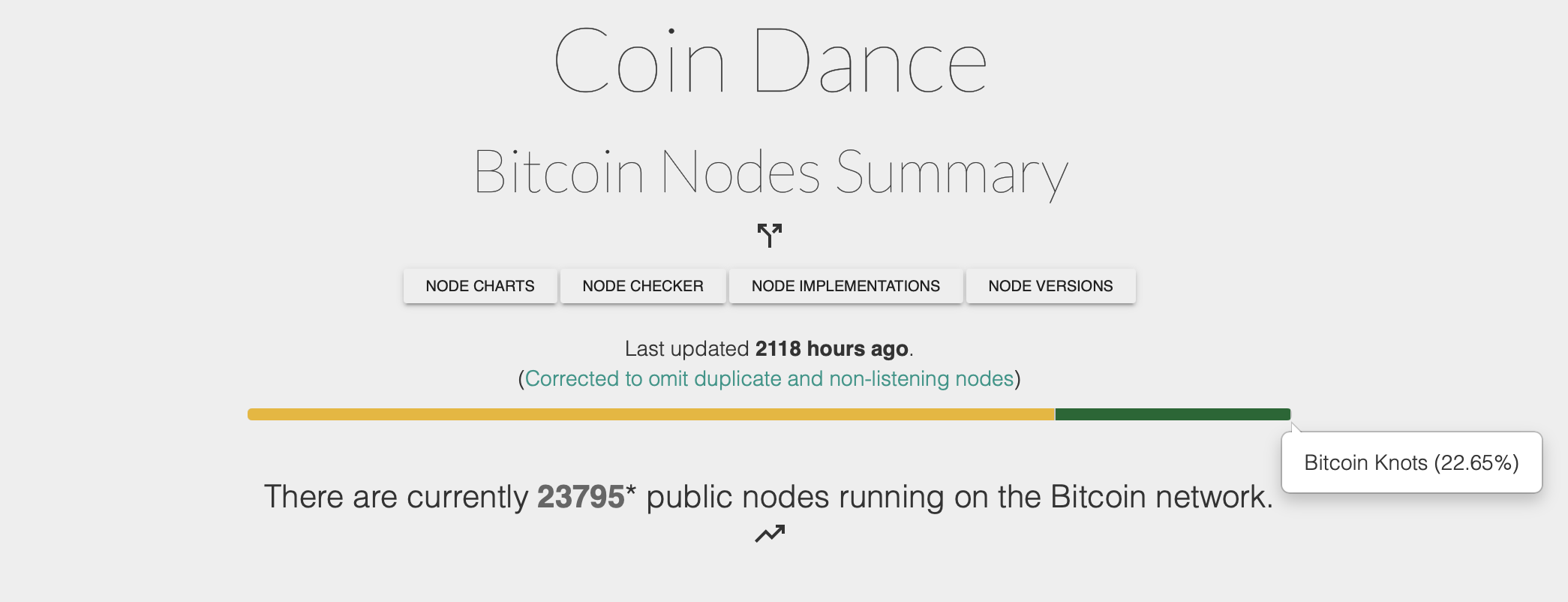
Coin Dance data on node count as of Monday, July 27, 2026, 8:40 AM Eastern Daylight Time (EDT).

The software ecosystem reflects a similar divide. The only implementation providing enforcement for the proposal is a fork of Bitcoin Knots. Available nodes running this software currently make up about 22%, resulting in enforcement being concentrated within a relatively small fraction of the network compared to Bitcoin Core nodes.

Foundry Holds the Deciding Vote

Among the large mining pools, Foundry has taken an interesting approach.

Around July 17, 2026, the company asked its clients to vote on whether the pool should begin signaling for BIP-110. Instead of making an internal decision, Foundry directly linked the vote outcome to its clients' hash rate, as indicated in an email sent to pool participants.

"The voting period for the Foundry USA PoolTM will remain open until the close of the signaling window preceding block 961,632," the Foundry USA pool wrote on its BIP-110 resource page.

The weight of a vote depends on each client's average hash rate. Clients who do not respond are automatically counted as a "No" vote, and by default, Foundry continues signaling against the proposal. Only if "Yes" votes exceed 51% of the participants' weighted hash rate will the pool switch all its blocks to signal support.

This decision is highly significant, as Foundry accounts for approximately 23% to 33% of Bitcoin's global hash rate, depending on the measurement period. If a pool of this size were to change its stance overnight, the voting charts would shift immediately.

To date, there are no signs that such a shift has occurred.

Foundry has also refrained from publicly endorsing either side. Instead, its client resource page provides links to the BIP specification, the original discussion on bitcoin-dev, criticism from Jameson Lopp, as well as comments from Adam Back, Michael Saylor, Luke Dashjr, and others, allowing clients to evaluate the proposal on their own.

What Happens If the Window Opens Without Broad Support?

The mechanism will become much more significant after block 961,632 appears.

If current signaling levels persist, nodes enforcing BIP-110 will reject blocks mined by the majority of the network because they lack the required version bit. Instead, these nodes will follow the relatively few signaling blocks.

Legacy nodes will behave differently. They will continue accepting both signaling and non-signaling blocks, following the chain with the greatest accumulated proof-of-work, as Bitcoin has always done. Several independent observers have created dedicated monitoring sites that track activation parameters, with some even modeling how this process could unfold under various scenarios.
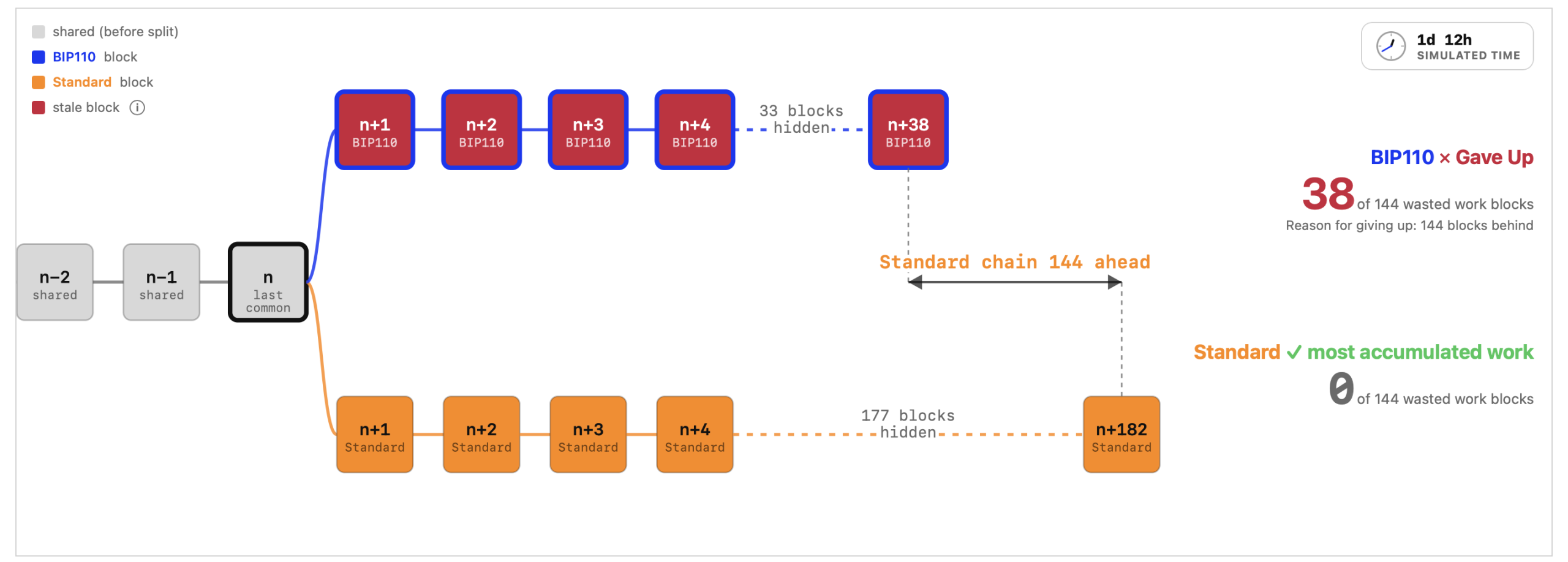
The BIP110 Situation Monitor site also models a number of possible outcomes during the mandatory signaling window. On its simulation page, users can adjust variables, including the percentage of the network's hash rate expected to support BIP-110 in August. The simulation image above shows 25% of the hash rate allocated to BIP-110, resulting in a chain split.

This creates the potential for two competing chains, but not two equally viable ones. The chain recognized by Bitcoin Core and mined by the vast majority of the hash rate will continue producing blocks at the normal pace. The minority chain, consisting solely of signaling miners, will progress much more slowly until it reaches the next difficulty adjustment of 2,016 blocks.

This potential outcome explains why much of the discussion has shifted from inscriptions to the activation process itself.

A Different Activation Strategy

BIP-110 follows an implementation path distinct from Bitcoin's last two major soft forks.

The proposal was launched on December 1, 2025, using a modified BIP-9 process. For early activation, it required that 1,109 out of 2,016 blocks (or 55%) signal support during one difficulty period. If this threshold is never reached, the proposal moves to a mandatory lock-in at block 963,648, with activation occurring one difficulty period later — at block 965,664.

Between these milestones lies the mandatory signaling window.

From block 961,632 to block 963,647, nodes enforcing BIP-110 reject every block that does not set version bit 4, regardless of which proof-of-work chain supports it. This approach differs from both SegWit and Taproot, where non-upgraded nodes continued accepting the chain with the greatest proof-of-work throughout the activation period.

The closest historical analogue is the 2017 User-Activated Soft Fork (UASF) BIP-148, which also attempted to pressure miners through mandatory signaling requirements. That confrontation ultimately concluded without a prolonged chain split, as sufficient hash rate shifted to the new chain before the deadline. The BIP-148 UASF ultimately served more as a pressure tactic than an actual activation.

Whether BIP-110 follows the same path depends largely on whether one or more large pools change their stance before August 9.

Why Proponents Want These Changes

BIP-110 was authored by Dathon Ohm. Earlier versions circulated under the designation BIP-444 before being accepted into the BIP repository.

Proponents of BIP-110 argue that inscriptions, BRC-20-style tokens, and increasingly large OP_RETURN data raise the cost of running a full node, distort Bitcoin's fee market, and divert network resources from Bitcoin's original purpose as a payment and settlement system.

"Removing rules is a hard fork," BIP-110 advocate and Bitcoin Knots developer Luke Dashjr explained on X in early July. "This applies to scheduled rules like halving the subsidy, and, yes, even BIP-110. Rejecting BIP-110 is a contentious hard fork attempt."

Dashjr added:

"And unlike soft forks, hard forks require consensus to succeed. There is no consensus to reject BIP-110."

Opponents generally agree that spam exists but disagree on whether BIP-110's activation mechanism is the appropriate solution. "OP_RETURN block space usage has not meaningfully increased since Bitcoin Core v30 was released. Large-sized OP_RETURNs may have grown slightly, but they still constitute less than 0.1% of block space," Alex Thorn, Head of Research at Galaxy Digital, wrote on X.

Thorn continued:

"BIP-110 is an extremely radical and dangerous response, given the negligible impact of these [transactions] that are targeted for removal."

The Final Days Could Still Change Everything

The next two weeks will likely hinge on three factors.

First, whether one of the largest mining pools begins signaling its support. Second, whether major exchanges provide public clarification on which chain they will recognize if competing chains emerge after block 961,632. Third, what miners actually do once the mandatory window opens, as the support percentage observed ahead of the deadline reflects only part of the picture.

The trend favors BIP-110: support has grown from below 1% to around 3% as the deadline approaches. Nevertheless, the proposal remains far from demonstrating widespread miner support. Unless one of Bitcoin's largest pools changes course in the coming days, the mandatory signaling window is poised to open with support still concentrated among a relatively small portion of the network.

end-content

Пов'язані питання

QWhat is the key activation mechanism and timeline described for BIP-110 in the article?

ABIP-110 uses a modified BIP-9 activation process with a mandatory signaling window. Nodes enforcing BIP-110 will start rejecting blocks that don't signal 'version bit 4' from block height 961,632 (estimated around August 9, 2026). If the 55% threshold (1,109 out of 2,016 blocks) for early activation isn't met, the proposal moves to a forced lock-in at block 963,648, with activation taking effect at block 965,664, roughly a year later.

QAccording to the article, which major mining pool holds a decisive vote regarding BIP-110 support and why?

AThe article identifies Foundry USA Pool as holding a decisive vote because it controls approximately 23% to 33% of the global Bitcoin hashrate. Its decision to signal or not will dramatically shift the voting charts. Foundry has chosen to poll its clients, linking the voting outcome directly to their hashrate, and will only switch its entire pool's signaling if 'Yes' votes exceed 51% of the weighted client hashrate.

QWhat is the primary technical goal of BIP-110, and which specific use cases does it target?

AThe primary technical goal of BIP-110, officially called the 'Reduced Data Temporary Softfork,' is to limit the size of certain data fields used in Bitcoin transactions. It specifically targets data-heavy use cases like Ordinals-style inscriptions, excessively large OP_RETURN payloads, and similar scenarios, while aiming not to affect ordinary Bitcoin financial transfers, Taproot key path spends, and standard Lightning channel operations.

QWhat potential network outcome is highlighted if the mandatory signaling window opens without widespread miner support?

AIf the mandatory signaling window opens without widespread support, it could lead to a chain split. Nodes enforcing BIP-110 would reject blocks mined by the majority of the network (non-signaling blocks) and follow a slower, minority chain consisting only of signaling miners. The majority chain, recognized by Bitcoin Core nodes, would continue normally, while the minority chain would progress slowly until its next difficulty adjustment.

QHow do the main arguments of BIP-110 supporters and critics differ as presented in the article?

ASupporters argue that inscriptions, BRC-20 style tokens, and large OP_RETURN data increase full node operating costs, distort Bitcoin's fee market, and divert network resources from Bitcoin's original purpose as a payment and settlement system. Critics generally acknowledge 'spam' exists but disagree on the solution, arguing that BIP-110's activation mechanism is an extremely radical and dangerous response to what they see as a negligible impact (e.g., large OP_RETURN transactions occupying less than 0.1% of block space).

Пов'язані матеріали

Take a Calm Look at Domestic Lithography Machines: 5 Units Delivered, How Far Are We from Challenging ASML?

This article analyzes recent news about China's domestic DUV lithography machines, advising a measured perspective. A state-backed enterprise plans to deliver about 5 immersion DUV systems this year, with a 2027 target of 20 units, aimed at 28nm processes. While this marks a step from R&D into initial customer validation, the author cautions against over-optimism. The piece clarifies this is DUV, not EUV technology. DUV is crucial but cannot economically solve challenges for advanced nodes like 5nm or below, where EUV is key. The 5-unit volume is minimal compared to ASML's annual output of over 130 such machines. The author highlights unverified claims regarding specs like 90% yield and warns against conflating this news with unconfirmed reports about Shanghai Micro Electronics' production. China's EUV efforts, while progressing with a prototype, remain in early testing, facing significant hurdles in core components like high-precision optics. The analogy of a "DeepSeek moment" is deemed misleading, as lithography involves slow, iterative precision engineering, not rapid software-like breakthroughs. Current progress represents establishing a potential second supply source and gaining vital engineering experience rather than an imminent industry disruption. For investors, the key indicators to watch are formal customer acceptance, stable operational performance, repeat orders, and growth in production volume and component localization. The conclusion is that this is a positive but early-stage development, far from altering the global competitive landscape.

marsbit1 год тому

Take a Calm Look at Domestic Lithography Machines: 5 Units Delivered, How Far Are We from Challenging ASML?

marsbit1 год тому

The 800x Golden Dog, "Gacha" Saves NFT Trading

Title: 800x Golden Dog: How 'Gacha' Mechanics Are Rescuing NFT Trading In the past month, the on-chain TCG (Trading Card Game) narrative, centered around "gacha" or loot box mechanics, has emerged as a major crypto-native revenue generator, second only to platforms like Hyperliquid and pump.fun. Recently, this trend hit Ethereum with Fake World Assets (FWA). Within just over a week, FWA generated approximately $1.3 million in revenue, ranking 15th in the past week's crypto app earnings. Its token, $FWA, surged from an initial market cap of ~$47,550 to a peak of ~$38.8 million—an 800x gain. Meanwhile, Collector Cards' token $CARDS declined significantly from its previous highs. FWA, developed by the team behind "PunkStrategy," operates as an NFT gacha system with a built-in token flywheel. Users deposit NFTs paired with ETH as liquidity into pools. Each deposit creates a personal pool; more ETH deposited lowers the chance of the NFT being "won" in a draw. Players spend ETH to "draw" (gacha). If they get an undesirable NFT, they can instantly sell it back to the original depositor at an 85% discount, generating income for the depositor. A 1% fee is taken on each draw and on depositor earnings when an NFT is kept. The key to FWA's momentum is its token $FWA. It cannot be bought directly externally. The primary way to acquire it is by playing the gacha and choosing to receive $FWA (instead of ETH) when selling back an unwanted NFT. This mechanism creates constant buy pressure for $FWA as players engage, especially during its price ascent. Early participants who held $FWA benefited massively from subsequent inflows. This contrasts with projects like Collector Cards, which, despite strong revenues, suffer from perceived low token utility beyond buybacks. In conclusion, while FWA's flywheel design—linking speculative token gains directly to NFT trading activity—has driven rapid growth, its sustainability is questionable. The model relies heavily on continuous $FWA price appreciation to offset the inherent negative expectancy of each draw. When price momentum stalls, activity will likely decline. The case highlights that in crypto markets, pure profitability narratives can be fleeting; understanding the relationship between attention, token buy pressure, and sustainable mechanics is crucial to avoid speculative pitfalls.

marsbit1 год тому

The 800x Golden Dog, "Gacha" Saves NFT Trading

marsbit1 год тому

The Quantum Computing Threat Approaches, Cryptocurrency May Be Exposed to Risks Before Banks

Quantum computing poses a significant threat to all cryptographic systems, including banks and governments, but decentralized cryptocurrencies with public ledgers like Bitcoin are likely the first practical target. Experts warn that a cryptographically relevant quantum computer (CRQC), capable of running Shor's algorithm to break the elliptic curve cryptography securing most crypto wallets, could emerge around 2029. Recent research shows the required quantum resources for such attacks are shrinking dramatically, potentially enabling key extraction in minutes. The core vulnerability for cryptocurrencies is not the cryptography itself—post-quantum standards are being developed—but the slow, decentralized governance required to implement upgrades. Unlike centralized banks that can swiftly transition, Bitcoin needs near-unanimous consensus among its global network, a historically difficult process as seen in past upgrades. Estimates suggest migrating all vulnerable Bitcoin funds could take at least 76 days of dedicated network time, and it must be completed before a CRQC exists to prevent "now-or-never" attacks on exposed keys. The threat is not binary; it begins when a quantum computer can decrypt data before it loses value, not necessarily in real-time. A significant portion of Bitcoin (estimated at millions of coins) already has public keys permanently exposed on-chain, making them vulnerable to eventual "static attacks." While technical solutions exist, the race is against time for decentralized networks to coordinate a defensive transition, serving as an early warning for the broader financial system.

marsbit1 год тому

The Quantum Computing Threat Approaches, Cryptocurrency May Be Exposed to Risks Before Banks

marsbit1 год тому

Торгівля

Спот
活动图片