Less Ethereum To Sell: ETH Supply On Exchanges Slides To New Multi-Year Low

bitcoinistPublished on 2025-12-18Last updated on 2025-12-18

In the midst of the waning action of the Ethereum price, investor sentiment, especially those on centralized exchanges, appears to be holding remarkably strong. Despite experiencing a pullback, causing ETH to lose the $3,000 price mark, the overall supply of the altcoin on cryptocurrency exchanges has fallen sharply, reaching a new multi-year low.

Exchange-Held Ethereum Hits New Low

Ethereum is becoming less prevalent on centralized exchanges at a rate that is difficult to ignore, indicating a significant change in the way investors are placing themselves. A CryptoQuant report from Arab Chain, a market expert and author, reveals that ETH exchange supply is steadily declining, reaching one of the lowest levels in years.

Specifically, the metric has dropped to its lowest levels since 2016, indicating a shift towards long-term holding and less selling pressure. As more ETH shifts from trading platforms to long-term storage or self-custody, the amount of available sell-side liquidity keeps getting tighter.

Arab Chain highlighted that the current state of ETH reflects a significant change in supply behavior across crypto exchanges, as indicated by the Exchange Supply Ratio across all platforms. The metric shows that the percentage of ETH held in exchanges has been steadily declining, which is important to comprehend the present supply and demand equilibrium.
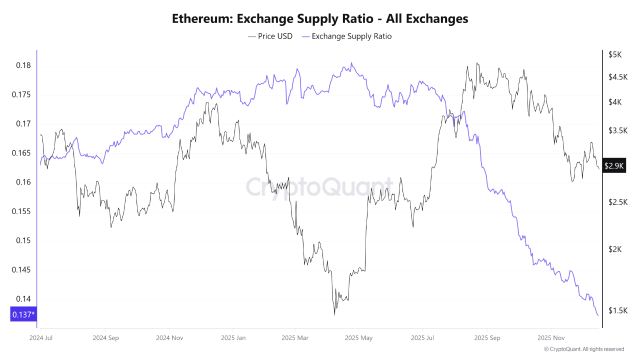
ETH leaving exchanges at unprecedented rate | Source: Chart from CryptoQuant on X

According to the chart reading, the Exchange Supply Ratio is currently at the 0.137 level, marking one of the lowest points since 2016. This decline points to a rise in ETH outflow from exchanges to external wallets, which suggests demand for immediate selling has decreased.

Historically, such behavior signaling a growing preference for long-term holdings often emerges during periods of reaccumulation. It also manifests in the lead-up to more stable price movements following periods of volatility.

ETH Withdrawal Highly Evidenced On The Binance Platform

On Binance, the world’s largest cryptocurrency exchange, the Exchange Supply Ratio has dropped to around 0.0325, a relatively low level in comparison to previous months. What this implies is that there is a noticeable ETH withdrawal from Binance‘s wallets, which is the biggest exchange in terms of liquidity.

As a result, the supply of ETH available on the platform for immediate sale in the spot market decreases. Arab Chain noted that this dynamic reflects growing trader caution and a decline in short-term selling pressure. An interesting aspect of this trend is that withdrawals are rising even while ETH’s price is facing heightened volatility.

During the time of the research, Ethereum was trading near $2,960, a mid-range level that reflects a relative balance between supply and demand. The decreasing supply on exchanges, coupled with price stability, indicates that there is not much selling pressure on the market. Rather, it is going through a process of repositioning and absorbing liquidity.

ETH trading at $2,836 on the 1D chart | Source: ETHUSDT on Tradingview.com

Related Questions

QWhat is the current trend of Ethereum supply on centralized exchanges according to the article?

AThe supply of Ethereum on centralized exchanges is declining sharply and has reached a new multi-year low, with the Exchange Supply Ratio dropping to one of the lowest levels since 2016.

QWhat does the decline in ETH exchange supply indicate about investor behavior?

AThe decline indicates a shift towards long-term holding and self-custody, reflecting reduced immediate selling pressure and growing investor confidence in holding ETH despite price volatility.

QWhich cryptocurrency exchange showed a significant drop in ETH Exchange Supply Ratio, as highlighted in the article?

ABinance, the world's largest cryptocurrency exchange, showed a significant drop in its Exchange Supply Ratio to around 0.0325, indicating substantial ETH withdrawals from its platform.

QWhat is the significance of the Exchange Supply Ratio reaching 0.137 for Ethereum?

AAn Exchange Supply Ratio of 0.137 marks one of the lowest points since 2016, signaling increased outflow of ETH from exchanges to external wallets and reduced demand for immediate selling.

QHow does the article describe the current state of Ethereum's price and market dynamics amid declining exchange supply?

ADespite price volatility and a pullback below $3,000, Ethereum's price stability and declining exchange supply indicate reduced selling pressure and a market process of repositioning and liquidity absorption.

Related Reads

When Prediction Markets No Longer 'Predict', But 'Leak the Truth': BlockBeats Officially Launches Prediction Market Coverage

For a long time, prediction markets were seen as rational arenas where people bet on future outcomes based on public information, with prices reflecting collective consensus. However, over the past year, it has become increasingly clear that many prediction markets are not actually "predicting the future." Instead, they are exposing outcomes that have already been determined and are known to a select few, even before official announcements. When an outcome is certain but not yet public, prediction markets become a powerful and unsettling mechanism for leaking information. The movement of money itself acts as a signal—no explicit爆料, anonymous tips, or statements are needed. Key signals include unusually large bets on specific options, addresses consistently placing winning bets during critical periods, and accounts that repeatedly "predict" correctly ahead of time. This phenomenon is changing how secrets are kept and revealed. Examples include plot twists in TV shows, results of award selections, upcoming product launches or regulatory decisions, and governance votes in crypto protocols. In traditional contexts, this would be considered insider information. But in prediction markets, the mere act of betting can reveal what is known to a few. The article also highlights how prediction markets can influence reality itself, not just reveal it. A notable example is from a Coinbase earnings call where CEO Brian Armstrong used specific words that were the subject of active prediction market bets. His utterance led to immediate market settlements, rewarding those who had bet on those words being spoken. This shows that prediction markets can create a "reality distortion field," where betting activity may actually shape outcomes. As platforms like Polymarket and Kalshi grow, the issues raised by prediction markets—information leakage, insider advantage, and potential manipulation—will have increasingly significant real-world impacts.

marsbit3m ago

When Prediction Markets No Longer 'Predict', But 'Leak the Truth': BlockBeats Officially Launches Prediction Market Coverage

marsbit3m ago

Trading

Spot
Futures

Hot Articles

Discussions

Welcome to the HTX Community. Here, you can stay informed about the latest platform developments and gain access to professional market insights. Users' opinions on the price of ETH (ETH) are presented below.

活动图片