Lei Jun Earns 7 Billion in One Day from CXMT's IPO? Xiaomi Executive Responds

marsbitPublished on 2026-07-28Last updated on 2026-07-28

Abstract

On July 28th, Changxin Technology's stock price on the Sci-Tech Innovation Board experienced minor fluctuations. The company had made a historic market debut the previous day, becoming the first A-share stock to record a single-day trading volume exceeding 1 trillion yuan. This led to significant paper gains for its strategic investors. Among them, Xiaomi's wholly-owned subsidiary was allocated 18.24 million shares with an initial investment of approximately 158 million yuan. Reports estimated a paper profit of 717 million yuan for Xiaomi founder Lei Jun based on his shareholding structure. However, a Xiaomi executive clarified that this was a corporate investment and should not be conflated with personal wealth. Other major beneficiaries included Alibaba and Nio. Alibaba, an early investor, held nearly a 5% stake through two entities, with an estimated paper gain exceeding 160 billion yuan. Nio, participating in the strategic placement, also saw substantial paper returns. Additionally, state-owned banks and insurance institutions that invested in Changxin recorded potential gains in the hundreds of billions. Conversely, companies like Country Garden reportedly missed out on nearly 50 billion yuan in potential gains after divesting their stakes before the IPO due to liquidity pressures. The article notes that these are paper profits based on the listing price, as the allocated shares are subject to lock-up periods, and final realized gains will depend on future stock perf...

On July 28, the second trading day of ChangXin Memory Technology (CXMT) on the STAR Market, it opened at 45.22 yuan. As of the time of writing, it was trading at 48.72 yuan, down 0.57%, with a market capitalization of 3.26 trillion yuan.
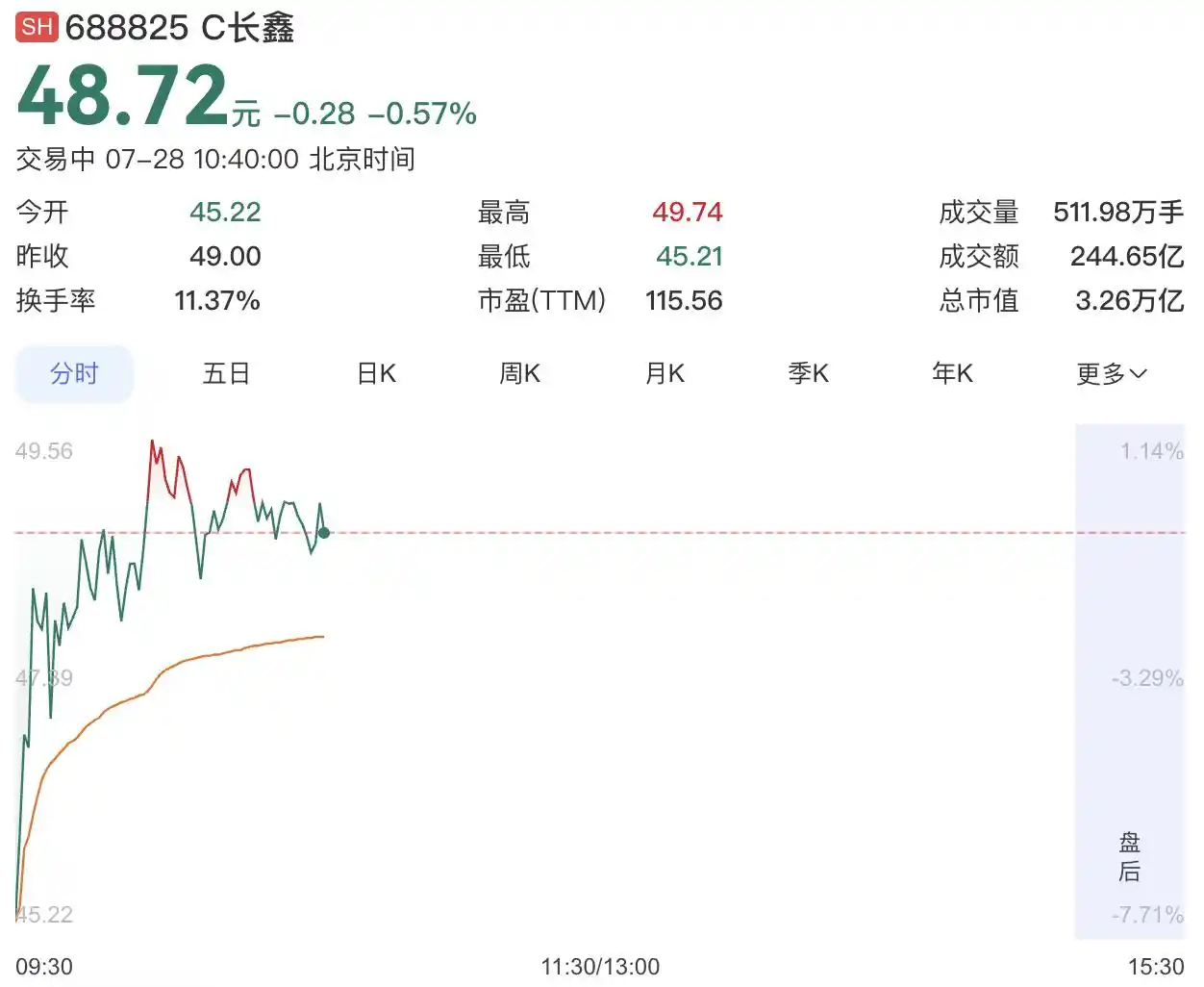
Just yesterday, this leading domestic DRAM manufacturer officially debuted on the STAR Market. Its first-day performance set several new A-share historical records, with a full-day turnover of 141.187 billion yuan, becoming the first A-share stock in history to exceed 100 billion yuan in single-day turnover. This resulted in huge paper gains for all strategic placement shareholders, including Xiaomi founder Lei Jun.

According to the preliminary offline placement results announced by CXMT on July 20, Xiaomi's wholly-owned subsidiary, Wuhan 1810 Enterprise Management Co., Ltd. (hereafter "1810"), was included in the strategic placement list, receiving an allocation of 18,244,800 shares. Based on the issue price, the total investment was approximately 158 million yuan.

Information from Tianyancha shows that 1810 was established in 2021, primarily engaged in business services, with a registered capital of 5.3 billion yuan and paid-in capital of 3.7857 billion yuan. The company's controlling shareholder is Xiaomi Technology Co., Ltd., in which Lei Jun holds a 97.48% stake. Based on this calculation, Lei Jun's paper profit through 1810 on CXMT's listing day was 717 million yuan.

However, on the morning of July 28, Xu Jieyun, Special Assistant to the Chairman of Xiaomi Group and Deputy General Manager of the Strategy and Market Department, responded by saying, "Friends should just take it as fun, don't take it seriously. Actually, it can't be calculated this way; this is a corporate investment action. The specific subsidiary entity and personal wealth cannot be conflated. Also, once again, congratulations to CXMT."

Image Source: Xu Jieyun's Personal Weibo

Alibaba and Nio also benefited from investing in CXMT. Alibaba Group holds nearly 5% of CXMT's shares through two entities, with a cumulative investment of approximately 7.6 billion yuan. Based on the latest market value on the listing day, the value of Alibaba's holdings exceeds 170 billion yuan, representing a paper gain of over 160 billion yuan and a total return multiple exceeding 20 times.

In fact, Alibaba first invested in CXMT as early as December 2021. At that time, Alibaba (China) Network Technology Co., Ltd. invested about 1.5 billion yuan to acquire approximately 1.12% of CXMT's shares. In June 2026, Alibaba invested another 6.1 billion yuan through its subsidiary Zhejiang Alibaba Cloud Computing Co., Ltd. to participate in CXMT's capital increase and share expansion, raising its total stake to nearly 5%. Alibaba Cloud Computing thus became CXMT's sixth-largest shareholder and the largest industrial investor in the final pre-IPO round.

Nio appeared on CXMT's IPO strategic placement list, committing to subscribe to shares worth 158 million yuan with an 18-month lock-up period, subscribing to approximately 18,244,800 shares. Based on CXMT's closing price of 49 yuan per share on July 27, Nio's paper gain is about 740 million yuan, with a yield exceeding 465%.

Regarding the news that "Nio became a strategic investor in CXMT," Nio Chairman Li Bin told the media that cooperation is currently progressing smoothly and that partnering with CXMT helps stabilize Nio's supply chain. Li Bin himself recently attended a thank-you banquet held by CXMT.

Headquartered in Hefei, Anhui, CXMT has three 12-inch DRAM wafer fabs in Hefei and Beijing. According to Omdia data, the company is China's number one and the world's fourth-largest DRAM manufacturer.

It is worth noting that Hefei's state-owned capital had already begun laying out the integrated circuit industry before CXMT's birth. In 2013, Hefei City issued an integrated circuit industry development plan, first proposing to build an influential "China Silicon Valley." The listing of CXMT marks a historic leap for Hefei's integrated circuit industry investments, bringing over one trillion yuan in paper gains to Hefei's state-owned capital. Hefei's total A-share market capitalization has exceeded 4 trillion yuan, making it the second-highest city in the Yangtze River Delta by A-share market capitalization.

Within CXMT, 14 directors, senior managers, core technical personnel, and their close relatives collectively indirectly hold 2.034 billion shares of the company. Based on the closing price of 49 yuan per share, the total market value of their holdings reaches 99.666 billion yuan.

Banks and insurance institutions that bet on CXMT also reaped substantial profits. Five major state-owned banks invested in CXMT through their AICs (Asset Investment Companies) and affiliated funds: Agricultural Bank Investment, CCB Investment, ICBC Financial Investment, BOC Asset, and BOCOM Financial hold approximately 574 million shares, 498 million shares, 383 million shares, 230 million shares, and 230 million shares, respectively, totaling about 1.915 billion shares. Additionally, China Merchants Bank, SPD Bank, and Huishang Bank also hold equity through participating in funds and other means. The potential appreciation for this group of banks' holdings exceeds 100 billion yuan.

Regarding insurance companies, Hexie Health holds 901 million shares, China Life Investment holds 476 million shares, PICC Capital holds 467 million shares, Sunshine Life holds 225 million shares, China Post Life holds 225 million shares, and PICC Science and Technology Innovation holds 90 million shares, totaling about 2.384 billion shares, also valued at over 100 billion yuan.

However, some companies regrettably missed out. Market information shows that Country Garden once held a small stake in CXMT during its financing stages. Due to its own debt and liquidity pressures, it completely exited before the IPO, directly missing out on nearly 50 billion yuan in potential paper gains.

It should be noted that the placement shares this time have a relatively long lock-up period. The paper gains calculated for Lei Jun and the Xiaomi-affiliated group, the banking and insurance institutions, and internet giants are merely static estimates. Subsequent stock price fluctuations will directly affect the final realized gains.

According to a report from Dawan News, in response to online discussions about CXMT, a CXMT employee said, "We should keep a calm mindset. No matter what is said online, it doesn't have much to do with us ordinary employees. We ordinary employees are more concerned about whether our future salaries and benefits will change."

This article is from "Jiemian News," reporter: Song Jianan

Trending Cryptos

Related Questions

QWhat was the core reason Xiaomi's executive clarified regarding rumors of Lei Jun's massive one-day profit from CXT?

AThe core reason was to clarify that the investment was made by a subsidiary company (Wuhan 1810 Enterprise Management Co., Ltd.), not a personal investment by Lei Jun. The executive stated that corporate investment behavior cannot be simply equated with personal wealth.

QBesides Xiaomi, which other major companies were highlighted as benefiting from CXT's IPO?

ABesides Xiaomi, Alibaba Group and Nio were highlighted as major beneficiaries. Alibaba's holdings saw a paper profit exceeding 1.6 trillion yuan, while Nio's strategic placement shares yielded a paper profit of approximately 740 million yuan.

QWhat milestone did Changxin Xinqiao achieve on its first trading day according to the article?

AOn its first trading day, Changxin Xinqiao became the first A-share stock in history to achieve a single-day trading volume exceeding 1 trillion yuan, with a total turnover of 141.187 billion yuan.

QWhich company was mentioned as having missed out on significant potential gains from CXT's IPO and why?

ACountry Garden (BGY) was mentioned as having missed out. Due to its own debt liquidity pressures, it sold off its small equity stake in CXT just before the IPO, directly missing out on nearly 50 billion yuan in potential paper profits.

QWhat is the main caution the article provides regarding the reported paper profits from CXT's IPO?

AThe main caution is that the reported paper profits are static calculations. The shares acquired through strategic placement have a long lock-up period, and subsequent stock price fluctuations will directly affect the final actual realized profits.

Related Reads

Strive Executive: Rethinking the Bitcoin Price Flywheel

In this article, the author discusses the future trajectory of Bitcoin's price, moving beyond the traditional "power law" model that has described its long-term price appreciation with diminishing returns. The core argument is that Bitcoin is maturing, evidenced by declining volatility and shallower market drawdowns. This maturation, often seen as leading to permanently lower returns, is framed as a precursor to a new, potentially explosive phase. The author draws an analogy to metal fatigue, where cracks propagate in three stages: initial irregular formation, a predictable middle phase describable by a power law (Paris' law), and a final rapid acceleration leading to fracture. Similarly, Bitcoin's monetization is seen in three phases: 1) Discovery (high volatility/returns), 2) Maturation (declining volatility/returns, improving risk-adjusted metrics), and 3) System-driven monetization. The key insight is that Phase 2 sets the stage for Phase 3. Lower volatility makes Bitcoin a more attractive asset for large-scale capital allocation (due to improved Sharpe ratios) and, crucially, a higher-quality collateral for loans. As perceived credit risk falls, the financial system can safely extend more dollar-denominated credit against Bitcoin holdings. This creates a self-reinforcing "flywheel": lower volatility → more capital allocation & cheaper credit → increased demand for fixed-supply Bitcoin → price rise → higher collateral value enabling more credit → continued price pressure. The conclusion posits that even if Bitcoin adoption eventually plateaus (reaching an S-curve saturation), the expansion of capital and credit chasing a fixed supply could cause its USD price to re-accelerate, breaking above the long-term power-law trajectory and entering the "third region" of rapid, system-driven monetization.

marsbit5h ago

Strive Executive: Rethinking the Bitcoin Price Flywheel

marsbit5h ago

OpenAI Reveals Its Own Jalapeño Chip: Accelerator 1.5–2 Times More Efficient Than Nvidia

On August 25, 2026, OpenAI unveiled initial test results for its proprietary inference accelerator, the Jalapeño. Benchmarks on SemiAnalysis's InferenceX platform showed that systems using Jalapeño delivered 1.5–1.9 times more computations per watt at peak throughput and reduced latency by 1.7–3.6 times compared to systems based on Nvidia's GB200 and GB300, tested on models like GPT-OSS-120B. Designed specifically for OpenAI's own workloads, the 700W-rated chip was developed in nine months with partners Broadcom (silicon/network) and Celestica (boards/racks). It's the first in a planned multi-year platform. Deployment is slated for late 2026, backed by an OpenAI-Broadcom agreement to deploy 10 GW of custom accelerators through 2029. This move shifts a major portion of OpenAI's daily inference, crucial for services like ChatGPT and its API, away from Nvidia's universal GPUs. By controlling this hardware architecture, OpenAI aims to directly reduce the per-query cost of its massive service traffic, converting what was previously supplier profit (noting Nvidia's high margins) into internal savings and computational capacity. While OpenAI will still rely on external suppliers for training cutting-edge models and for parts of inference, Jalapeño represents a strategic industry trend where hyperscalers design custom chips once inference volume becomes predictable. However, this specialization risks future inflexibility if AI architectures shift and creates dependency on its manufacturing partners.

cryptonews.ru6h ago

OpenAI Reveals Its Own Jalapeño Chip: Accelerator 1.5–2 Times More Efficient Than Nvidia

cryptonews.ru6h ago

Trading

Spot

Hot Articles

Discussions

Welcome to the HTX Community. Here, you can stay informed about the latest platform developments and gain access to professional market insights. Users' opinions on the price of S (S) are presented below.

活动图片