Larry Fink Says Tokenization Will Transform Markets in 2026 Investor Letter

TheNewsCryptoPublished on 2026-03-24Last updated on 2026-03-24

Abstract

In his annual investor letter, Larry Fink emphasized that tokenization will transform financial markets by 2026, addressing inefficiencies and lack of accessibility in traditional systems. He highlighted that tokenization can enable faster, more transparent transactions and broaden global participation in investment markets. Fink noted that expanding access is crucial for equitable wealth distribution and long-term economic growth. He also pointed out that tokenization could increase asset liquidity, improve market transparency, and bridge traditional finance with digital assets. This shift is expected to create new opportunities, especially in private markets, and marks a fundamental evolution in how assets are traded worldwide.

In the annual letter to investors, Larry Fink emphasized the importance of tokenization in transforming the financial markets. He explained that the traditional financial systems are based on an outdated infrastructure that lacks the required level of efficiency and accessibility for investors worldwide. He emphasized that the traditional financial systems can be transformed by the process of tokenization, which will help investors to make faster and more transparent transactions worldwide.

Fink highlighted the fact that tokenization can play a role in promoting broader participation by helping people access investment markets more easily. He noted that access to investment markets remains an important issue, considering that a majority of people still lack access to such markets. Fink noted that long-term investment remains a key aspect in helping people benefit from economic growth over a long period.
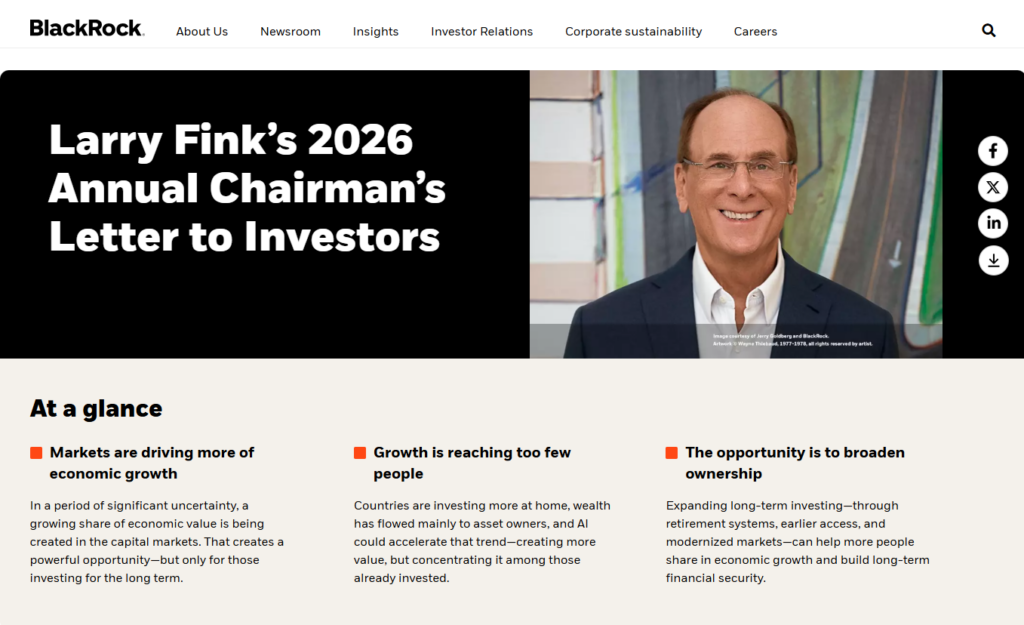
Source: Blackrock

Broader Participation and Financial System Evolution

Fink noted that financial markets need to evolve to ensure more people can access wealth creation opportunities in global markets. He noted that technology, such as tokenization, can play a role in helping people access investment markets. Fink noted that technology, such as digital wallets and blockchains, may one day enable people to invest as easily as making payments. He said that ensuring access to financial markets remains an important aspect in ensuring people benefit from economic growth.

Fink also warned that economic growth may result in asset holders benefiting disproportionately. He stressed that there is a need to expand asset ownership opportunities around the world. He explained that the expansion of asset ownership in capital markets around the world is essential to ensure the equitable distribution of economic growth in societies around the world.

Implications for Investors and Market Structure

Fink emphasized that tokenization has the potential to change the way assets are traded in financial markets around the world. He explained that assets may become more liquid and facilitate transparency in financial markets around the world. The letter explained that financial infrastructure has the potential to facilitate the interaction between traditional finance and digital asset markets.

Fink found that access to private markets may provide new investment opportunities to groups of investors who were previously unable to invest in private markets. Fink concluded that tokenization marks a fundamental shift like markets. This shift will provide long-term benefits to investors and economies. This message reflects a trend toward increased integration between traditional finance and blockchain technology.

Highlighted Crypto News:

Circle Urges Clarity in EU Market Integration Package to Strengthen Crypto Regulation

Tags#crypto investorsblackRockBlockchainBTCCryptocurrencyInvestorstokenization

Related Questions

QWhat is the main topic of Larry Fink's 2026 investor letter?

AThe main topic is the transformative potential of tokenization in financial markets.

QAccording to Fink, what problem does tokenization help solve in investment markets?

ATokenization helps solve the problem of limited accessibility and inefficiency in traditional financial systems, enabling faster and more transparent transactions.

QHow does Fink suggest tokenization can promote broader participation in financial markets?

AFink suggests that tokenization, along with technologies like digital wallets and blockchains, can make investing as easy as making payments, thereby expanding access to wealth creation opportunities.

QWhat potential impact does tokenization have on asset trading and market structure?

ATokenization can make assets more liquid, increase transparency, and facilitate integration between traditional finance and digital asset markets.

QWhy does Fink emphasize the need to expand asset ownership worldwide?

AFink emphasizes expanding asset ownership to ensure equitable distribution of economic growth benefits and prevent disproportionate gains for existing asset holders.

Related Reads

What Are Some Good Paths for Chinese Web3 Entrepreneurship? (Part 5)

This article explores pathways for Chinese Web3 teams to pivot toward AI, building on a previous discussion. It focuses on two specific team profiles: **Security & Risk Control Teams:** These teams, skilled in smart contract auditing, wallet security, and on-chain monitoring, can transition to providing **Agent behavior auditing and AI security governance**. As AI Agents automate tasks, access data, and trigger payments, enterprises will need solutions to monitor permissions, audit logs, control data access, and prevent anomalies—creating a strong B2B demand. **Application & Community-Focused Teams:** Instead of completely rebranding as AI companies, these teams should use AI to **enhance their existing products**. For example, research platforms can use AI to summarize information and identify signals; community tools can automate user support and analysis; and educational products can create personalized learning paths. The key is integrating AI to solve existing user pain points, like information overload or high operational costs. The article also advises against certain AI directions for Chinese Web3 teams, such as building general-purpose large language models (too resource-intensive), creating overly broad Agent platforms (hard to monetize), developing AI traders/automated yield products (high regulatory and risk sensitivity), or simply adding superficial AI features without genuine value. The core conclusion: Successful migration depends not on chasing AI hype, but on **identifying how a team's existing Web3 capabilities—be it in data, payments, security, or user operations—can address real needs in new AI application scenarios.**

marsbit1h ago

What Are Some Good Paths for Chinese Web3 Entrepreneurship? (Part 5)

marsbit1h ago

Trading

Spot
Futures
活动图片





