L1 Native Tokens' Final 'Monetary Premium' Is Collapsing!

比推Published on 2025-12-08Last updated on 2025-12-08

Abstract

The monetary premium on Layer 1 (L1) native tokens is rapidly fading as stablecoins increasingly dominate as the preferred medium of exchange (MoE) in on-chain economies. While L1 valuations historically incorporated a monetary premium derived from their use as a store of value (SoV) or MoE, data shows a clear shift. On Ethereum, ETH is no longer the primary MoE; stablecoins like USDC and USDT now lead in on-chain transaction volume and top Uniswap pools. A similar trend is observed on L2s like Arbitrum. On Solana, SOL remains the primary MoE due to platforms like Pumpfun and Raydium using it as a quote currency, but USDC is gaining significant traction, especially with new launchpads like MetaDAO adopting it as the default pairing asset. On BNB Chain, USDT has overtaken BNB in trading volume, which had previously been the dominant MoE. The author argues that the market has chosen stablecoins as the superior on-chain MoE. Attempts by ecosystems to enforce their native token as a quote currency add friction and costs for users with minimal price impact. Improved on-chain UX and liquidity are reducing the historical necessity of using volatile native tokens for transactions. The next wave of users will likely use stablecoins, not native tokens, for everyday exchange, further eroding this monetary premium.

Author: Silvio (@SilvioBusonero)

Original Title: The monetary premium on L1s is fading

Compiled and Edited by: BitpushNews


The valuation of L1 blockchains is a comprehensive reflection of multiple factors: including cultural narrative (Memetics), network fees, security, and the development of upper-layer applications. Among these, the most underestimated is the so-called "Monetary Premium".

The monetary premium stems from the demand of market participants to use assets as a Store of Value (SoV) or a Medium of Exchange (MoE).

  • Store of Value is directly related to the robustness (lindiness) and degree of decentralization of an asset, so it is not an easy market entry strategy.

  • In contrast, acting as a Medium of Exchange may be easier to achieve. Tokens can serve as the primary method for value exchange and measurement within the blockchain economy.

This is similar to the role of tokens in the Web2 economy:

  • Roblox's in-game token Robux, has strong exchange value.

  • When Meme coins started to grow, people bought SOL to enter and exit Meme trades. As SOL was the default currency on Pump platforms, most traders did not convert assets back to dollars but kept some SOL ready to "ape". A similar situation occurred with ETH during the 2021 NFT boom. A large number of users began using the native asset for transactions, effectively creating the utility of a Medium of Exchange (MoE).

Does the Premium Still Exist?

The answer is: No, this premium is rapidly disappearing. Users are increasingly inclined to use stablecoins for transactions.

Ethereum — Stablecoins Have Become the Medium of Exchange

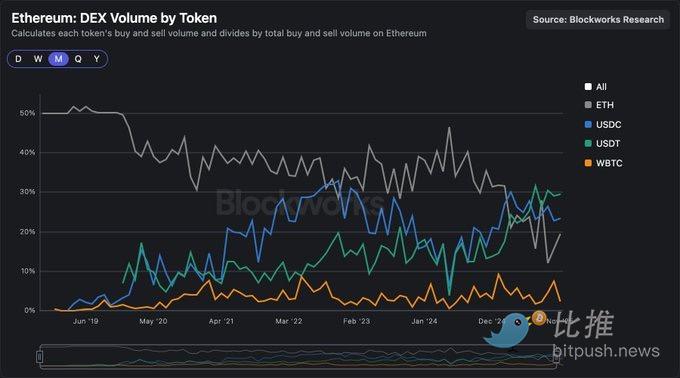
  • Judging from the on-chain transaction volume of mainstream tokens, Ethereum's native token ETH is no longer the primary medium of exchange it once was.

  • ETH's dominance as an MoE is declining, while USDC and USDT are rising in popularity on transaction volume charts and in top Uniswap liquidity pools.

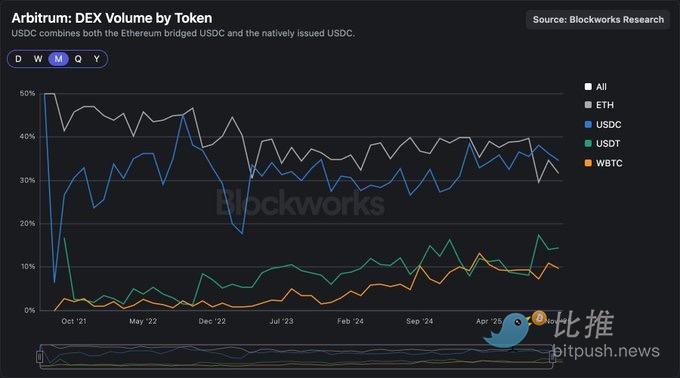
The situation is similar for L2s like Arbitrum.

Solana — SOL Maintains the Lead, but USDC is Catching Up

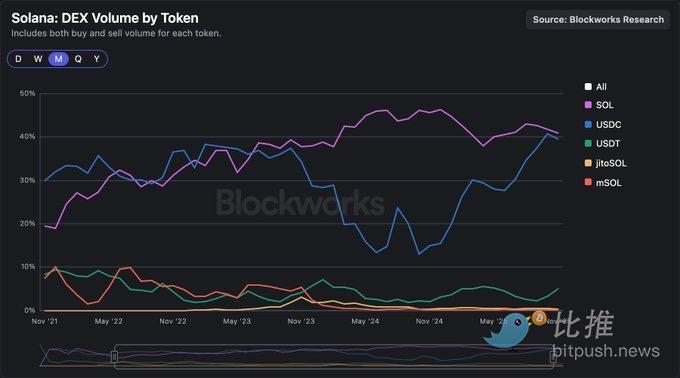
  • SOL remains the primary medium of exchange and the highest volume asset on Solana (but USDC is catching up). This is mainly because platforms like Pumpfun and Raydium tend to use SOL as the quote currency, while other platforms (like Meteora) have a mixed situation.

  • However, new launch platforms like MetaDAO are setting USDC as the default paired trading asset.

BNB and USDT Go Hand in Hand

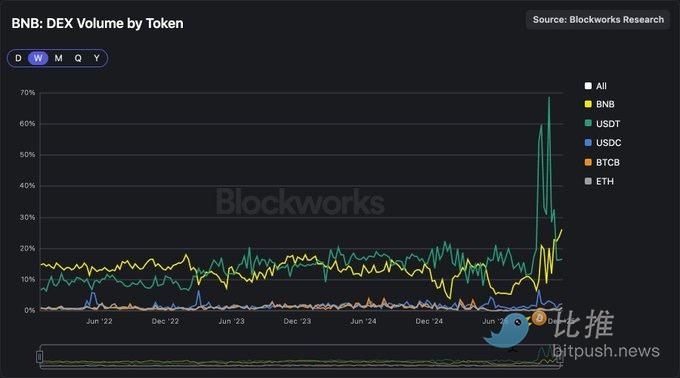
  • From 2021 to 2022, BNB absolutely dominated the role of medium of exchange, but then USDT gained market share and surpassed BNB.

The Market Has Chosen the Medium of Exchange — And It's Stablecoins

There is no such thing as "Onchain Legal Tender" in the on-chain market.

Some projects use a "quote asset" strategy, making their native token the medium of exchange, such as Zora and Virtuals. But in reality, this increases transaction costs for both users and projects, while having minimal impact on the token price itself. Ecosystem tokens can attempt a similar strategy through asset issuance platforms, i.e., requiring quotes in a specific token, but this may not be worth it.

The user experience (UX) and liquidity of the on-chain market are improving: the past monetary premium was also partly due to a lack of alternatives and lower liquidity.

The next batch of billions of users will use the same medium of exchange as in real life (USDC, Euros, etc.).


Twitter:https://twitter.com/BitpushNewsCN

Bitpush TG Discussion Group:https://t.me/BitPushCommunity

Bitpush TG Subscription: https://t.me/bitpush

Original article link:https://www.bitpush.news/articles/7594034

Related Questions

QWhat is the 'monetary premium' in the context of L1 blockchains, and what two primary needs does it stem from?

AThe 'monetary premium' refers to the portion of an L1 blockchain's valuation that comes from its use as a form of money. It stems from the market's need to use the asset as a Store of Value (SoV) and as a Medium of Exchange (MoE).

QAccording to the article, which type of asset are users increasingly preferring to use for on-chain transactions instead of native L1 tokens?

AUsers are increasingly preferring to use stablecoins, such as USDC and USDT, for on-chain transactions instead of native L1 tokens like ETH or SOL.

QOn the Solana blockchain, what is a key reason why SOL remains a primary medium of exchange, and what new trend is challenging this?

ASOL remains a primary medium of exchange on Solana largely because platforms like Pumpfun and Raydium use it as the default quote currency. However, this is being challenged by new launch platforms, such as MetaDAO, which are setting USDC as the default trading pair.

QThe article states that the monetary premium is 'fading'. What two reasons are given for the past existence of this premium?

AThe past existence of the monetary premium was partly due to a lack of other options for users and lower liquidity on-chain. The improving user experience (UX) and liquidity in on-chain markets are contributing to its decline.

QWhat does the author suggest about the next billion users entering the crypto space regarding their preferred medium of exchange?

AThe author suggests that the next billion users will use the same mediums of exchange they use in real life, such as USDC or the Euro, rather than the native tokens of L1 blockchains.

Related Reads

Farewell to Traditional Bulls and Bears: The Market Has Entered an Era of Rotating Bubbles

Farewell to traditional bull and bear markets; we have entered an era of rolling bubbles. This article uses a meteorological analogy to explain the modern market's shift from slow-moving, long-term trends to a chain of rapid, successive speculative frenzies. The old market resembled "stratiform" weather—slow, broad cycles lasting years. Today's market is like a "mesoscale convective system," where isolated storms (bubbles in sectors like AI, GLP-1 drugs, or crypto) form in sequence. Each is triggered by the outflow of capital and sentiment from the previous one, creating a self-perpetuating chain of booms and busts. This structural change is driven by eight permanent shifts: the democratization of speculation (zero-commission trading, retail options activity), perpetual buying from defined-contribution retirement plans, the dominance of passive investing (creating price-insensitive flows), the rise of multi-strategy funds and high-frequency trading (weakening price discovery), suppressed volatility that erupts violently, an index composition now dominated by long-duration, narrative-driven tech stocks, the elimination of information delays, and a permissive fiscal/monetary backdrop. These conditions ensure that rolling bubbles are the new normal. To navigate this environment, investors should either become deep-sector experts who understand the underlying technologies and business models or become adept observers of trends and capital flows. While chaotic from within each "storm," a higher-altitude view reveals a predictable pattern of serial booms. The key is to avoid being emotionally swept up in any single narrative and to recognize the market's new, permanent structure.

marsbit4m ago

Farewell to Traditional Bulls and Bears: The Market Has Entered an Era of Rotating Bubbles

marsbit4m ago

The Right Way to Use Skills: 5 Reflections After Anthropic Publicly Shared Its Internal Methodology

A deep dive into Anthropic's internal methodology for building effective AI "Skills" reveals five key insights for maximizing their value. First, Skills should focus on capturing "Gotchas" and tacit organizational knowledge—like common pitfalls and undocumented rules—rather than restating general information the AI already knows. Second, think of Skills as a form of "Context Engineering"; they are best structured as folders, not monolithic documents. A core `SKILL.md` file should act as a navigational index, progressively pulling in detailed references, examples, and assets only as needed to avoid overwhelming the model's context window. Third, whenever possible, automate repetitive tasks with scripts. This preserves the model's reasoning capacity for judgment and analysis, while scripts reliably handle the execution, saving tokens and improving accuracy. Instructions within a Skill provide the "why" and the expert judgment, while scripts provide the concrete "how." Fourth, a Skill's description is critical and often misunderstood. It should not be a list of features but a routing rule that clearly signals *when* the Skill should be triggered based on user intent and common phrasing. Finally, as Skills scale from personal tools to team-wide assets, management is crucial. Anthropic advocates for a lightweight, organic approach: let new Skills spread organically within small groups first. Those that prove genuinely useful through adoption naturally graduate to a formal marketplace, ensuring the curated library contains only high-value, battle-tested tools.

marsbit21m ago

The Right Way to Use Skills: 5 Reflections After Anthropic Publicly Shared Its Internal Methodology

marsbit21m ago

Vying for the AI Payment Track: Traditional Card Networks Face Off Against Coinbase

As AI agents increasingly conduct commercial transactions, a battle for control over the underlying payment infrastructure is unfolding. The competition centers on two divergent and incompatible technical approaches for autonomous AI payments. One camp, led by traditional card networks Visa and Mastercard, relies on tokenized card credentials within the established banking rails. Visa's "Intelligent Commerce" and Mastercard's "Agent Pay" services extend their existing tokenization technology to authorized AI agents for consumer retail transactions, leveraging decades of fraud protection and dispute resolution systems. Their partners include major AI firms like Anthropic, OpenAI, and Microsoft. The opposing camp, spearheaded by Coinbase, advocates for an open internet protocol using stablecoins. Coinbase's x402 protocol utilizes the HTTP 402 status code to enable direct, machine-to-machine micropayments with USDC on-chain. This model eliminates card fees and is designed for high-frequency, low-value transactions between AI agents, such as paying for API calls or data streams, where traditional card costs are prohibitive. Currently, application scenarios are clearly divided. Mainstream consumer-facing AI shopping services (e.g., ChatGPT's "one-click checkout," Amazon's AI-assisted shopping) predominantly use card channels due to their mature consumer protections and merchant networks. Conversely, the stablecoin channel dominates machine-to-machine payments, as seen in Amazon Bedrock's core payment service using Base blockchain. Significantly, traditional card networks are not solely defending their turf; they are also investing in the stablecoin arena. Visa has rapidly expanded its stablecoin settlement volume and partnered with Coinbase on interoperability, while Mastercard moved to acquire stablecoin platform BVNK. This dual-strategy indicates their intent to become the fee-collecting gateway for all payment flows, regardless of the underlying rail. The short-term outlook is for coexistence: cards for personal retail, stablecoins for machine transactions. The long-term outcome hinges on whether AI-driven commerce will resemble traditional retail or evolve into a vast network of machine micropayments. Visa and Mastercard's hedging strategy suggests they are prepared for either future, while companies betting on a single channel face greater risk.

Foresight News23m ago

Vying for the AI Payment Track: Traditional Card Networks Face Off Against Coinbase

Foresight News23m ago

For the First Time, Pure Human Video Pretrained VLA for Dexterous Manipulation: Deployable with Minimal Fine-Tuning Data

For the first time, a purely human-video-pretrained Vision-Language-Action (VLA) model for dexterous manipulation requires only a small amount of data for fine-tuning to achieve successful real-world deployment. Achieving human-level dexterous manipulation remains a core challenge in robotics. While multi-fingered hands offer hardware potential, Visual-Language-Action (VLA) models lag behind due to the high cost of collecting diverse, high-quality robot data. A novel framework, VITRA, developed by Microsoft Research Asia and Tsinghua University, addresses this by automatically transforming massive, unlabeled real-world human activity videos into a structured V-L-A training dataset. Key innovations include precise 3D hand motion annotation from monocular video, atomic action segmentation based on hand-speed minima, and automated instruction generation using VLMs combined with 3D trajectory visualization. This process created a massive dataset of 1 million clips. Pretrained exclusively on this human video data, the VLA model (combining a VLM backbone with a Diffusion Transformer action expert) demonstrates strong zero-shot hand motion prediction in unseen environments. Crucially, it requires minimal fine-tuning (~1.2k demonstrations) on real robot data to achieve high-success-rate dexterous manipulation tasks like grasping, placing, pouring, and sweeping on hardware like the Realman robot with the XHAND1 dexterous hand. The model shows exceptional generalization to novel objects and environments. The research also observes promising scaling behavior, where performance improves with more pretraining data, paving the way for more generalized embodied intelligence.

marsbit33m ago

For the First Time, Pure Human Video Pretrained VLA for Dexterous Manipulation: Deployable with Minimal Fine-Tuning Data

marsbit33m ago

Trading

Spot
Futures
活动图片