Is Dogecoin Dead Or Could The SpaceX IPO Lead To A Revival?

bitcoinistPublished on 2026-06-11Last updated on 2026-06-11

Abstract

Dogecoin is facing doubts about its future as its price hovers near multi-year lows and investor enthusiasm wanes. Lacking its previous narrative momentum and with modest institutional ETF inflows, it has struggled alongside the broader meme-coin downturn. However, the upcoming SpaceX IPO, seeking a massive $1.75 trillion valuation, is generating discussion as a potential catalyst. While the IPO has no direct link to Dogecoin, the event will refocus global attention on Elon Musk, whose past endorsements have significantly boosted the cryptocurrency. Some investors see this renewed spotlight as a chance for revived interest, though it remains uncertain if attention alone can drive a sustained recovery amid ongoing market challenges.

Dogecoin is once again facing questions about its future as prices hover near multi-year lows and investor enthusiasm continues to fade. Yet just as many traders are beginning to lose confidence, a massive event tied to Elon Musk’s business empire is generating fresh discussion about whether DOGE could be preparing for an unexpected second act.

Dogecoin’s Missing Spark

Dogecoin’s market position appears far weaker than in previous cycles. The cryptocurrency is trading around $0.084 and remains down nearly 57% over the past year, with losses across the weekly, monthly, and yearly timeframes. More importantly, Dogecoin is struggling with something deeper than price weakness. The narratives that once fueled demand and attracted new investors have steadily lost momentum.

For years, Elon Musk played a central role in Dogecoin’s rise. His comments and public references regularly generated excitement that pushed the cryptocurrency into headlines. However, recent developments suggest the market no longer responds with the same enthusiasm.

Meanwhile, institutional adoption has yet to fill the gap. Spot Dogecoin ETF inflows remain modest, with SoSoValue data showing total assets of about $12 million, while recent daily net inflows have largely stalled.
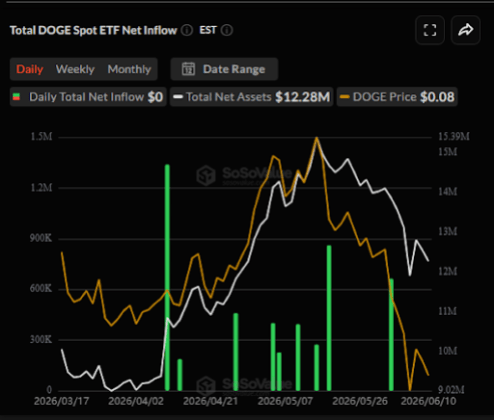
Source: SoSoValue

The broader market has also worked against the asset. Since peaking in 2024, the meme-coin sector has shed billions in value. As speculative capital exited the market, Dogecoin lost one of the strongest drivers behind its previous rallies.

Why SpaceX’s IPO Is In The Conversation

While Dogecoin’s recent performance has fueled concerns about its future, the upcoming SpaceX IPO has introduced a new element into the discussion.

According to details from SpaceX’s IPO filing, the company is seeking a valuation approaching $1.75 trillion, a figure that would make it one of the most valuable public companies in the world. The scale of the offering is significant, but what makes it relevant to Dogecoin is Elon Musk’s continued presence at the center of both stories.

The filing shows that Musk is expected to retain overwhelming voting control after the IPO, ensuring that SpaceX remains tied to his long-term vision. The public debut is also expected to place Musk and his growing network of businesses back in the global spotlight, attracting attention from global investors.

Historically, periods of heightened interest surrounding Musk have often spilled over into assets associated with him, and no cryptocurrency has benefited from that connection more than Dogecoin. Although the IPO has no direct link to the cryptocurrency, renewed attention surrounding Musk’s business empire could still influence market sentiment.

For that reason, some investors view the IPO as a potential catalyst for renewed interest in Dogecoin. Whether that translates into a lasting recovery remains uncertain, particularly as institutional participation remains limited and the broader meme-coin sector continues to recover from a downturn. However, with one of the largest IPOs in history approaching, Dogecoin may soon receive something that has repeatedly played a role in past rallies: widespread attention. Whether attention alone is enough to drive a sustainable revival is the question the market is now weighing.

DOGE begins another push upward | Source: DOGEUSDT on Tradingview.com

Related Questions

QWhat is the current price and recent performance of Dogecoin, and what is the broader sentiment among traders?

ADogecoin is currently trading around $0.084 and is down nearly 57% over the past year, with losses on weekly, monthly, and yearly timeframes. Investor enthusiasm is fading, and many traders are beginning to lose confidence in its future.

QAccording to the article, what key factors are contributing to Dogecoin's current struggle beyond its price weakness?

ADogecoin's struggle extends beyond price. The narratives that once fueled its demand have lost momentum, Elon Musk's endorsements no longer generate the same market enthusiasm, and institutional adoption remains limited, as seen in modest Spot ETF inflows of about $12 million. The broader meme-coin sector downturn has also removed a key driver of its past rallies.

QHow is the upcoming SpaceX IPO connected to the discussion about a potential Dogecoin revival?

AThe SpaceX IPO is significant because it places Elon Musk and his businesses back in the global spotlight. Historically, periods of heightened interest in Musk have spilled over to assets associated with him, with Dogecoin being the primary cryptocurrency beneficiary. The IPO could act as a catalyst for renewed attention and market sentiment toward Dogecoin.

QWhat details from the SpaceX IPO filing does the article highlight as particularly relevant?

AThe IPO filing reveals that SpaceX is seeking a valuation approaching $1.75 trillion, which would make it one of the world's most valuable public companies. Crucially, Elon Musk is expected to retain overwhelming voting control post-IPO, keeping the company tied to his vision and influence.

QWhat is the article's conclusion regarding the potential for a Dogecoin revival driven by the SpaceX IPO?

AThe article concludes that while the SpaceX IPO could bring Dogecoin the widespread attention that has fueled past rallies, it is uncertain if attention alone can drive a sustainable revival. Factors like limited institutional participation and a recovering meme-coin sector mean the market is weighing whether this catalyst will be enough.

Related Reads

Pledging ETH Earned a Steady $46 Million, So Why is BitMine Still Deep in the Red?

BitMine reported a significant surge in revenue for Q3 FY2026, driven by its Ethereum staking and validation business which generated $45.7 million. However, the company posted a net loss of $83.6 million, primarily due to a $92.1 million loss from Ethereum derivatives and options trading. This loss, stemming largely from expired contracts and exercised positions, completely offset the gains from staking. To fund its aggressive accumulation of Ethereum, BitMine has heavily relied on equity financing, significantly diluting existing shareholders. In the first nine months of the fiscal year, it issued over 340 million shares to raise approximately $11.87 billion, using most of it to purchase Ethereum. As of May 31, the company held 5.42 million ETH with an average cost of $19.05 billion, resulting in an unrealized loss of roughly $8.2 billion due to market depreciation. While staking provides a stable cash flow that covers core operational costs, the company faces rising expenses from long-term service agreements and high management fees. Additionally, BitMine remains highly dependent on continuous access to capital markets for funding its operations and expansion. The company's long-term viability hinges on its staking income consistently covering these costs and future losses, its ability to secure ongoing equity financing, and a substantial recovery in the price of Ethereum.

marsbit1h ago

Pledging ETH Earned a Steady $46 Million, So Why is BitMine Still Deep in the Red?

marsbit1h ago

Are Meme Coins a Shortcut or a Trap? Robinhood Chain Faces a Crucial Decision

Robinhood Chain, the blockchain initiative by the brokerage platform, is experiencing a strong initial surge in activity. Key metrics include over 300,000 daily active addresses, daily DEX trading volume surpassing $1 billion (ranking second among public blockchains), and a TVL exceeding $3 billion. However, the article expresses significant concern that this growth is overwhelmingly driven by memecoin trading, as observed on the Robinhood Wallet. The author argues this is a dangerous shortcut. While memecoins can rapidly boost user numbers, trading volume, and liquidity, they often result in substantial investor losses, erode trust in the ecosystem, and risk cementing Robinhood's reputation as a speculative, meme-driven platform—a perception Wall Street already holds. The piece contrasts this path with that of Coinbase's Base chain, which has emphasized fostering applications with real utility and sustainable business models. It urges Robinhood Chain to avoid becoming a "memecoin chain" and instead focus its resources on substantial use cases, particularly the tokenization of real-world assets (RWA). The proposed strategic pivot is toward facilitating global access to tokenized stocks, RWA, and other real financial instruments through its chain. This aligns with crypto's original promise of democratizing finance and represents Robinhood's largest growth opportunity: tapping into over 100 million potential new international users beyond its nearing-saturation U.S. market. Success in this direction could drive significant future revenue and redefine the company's legacy beyond the meme-stock narrative. The core message is a plea to Robinhood's leadership: choose sustainable, value-creating finance over the fleeting and damaging allure of memecoins.

Foresight News1h ago

Are Meme Coins a Shortcut or a Trap? Robinhood Chain Faces a Crucial Decision

Foresight News1h ago

Trading

Spot
活动图片





