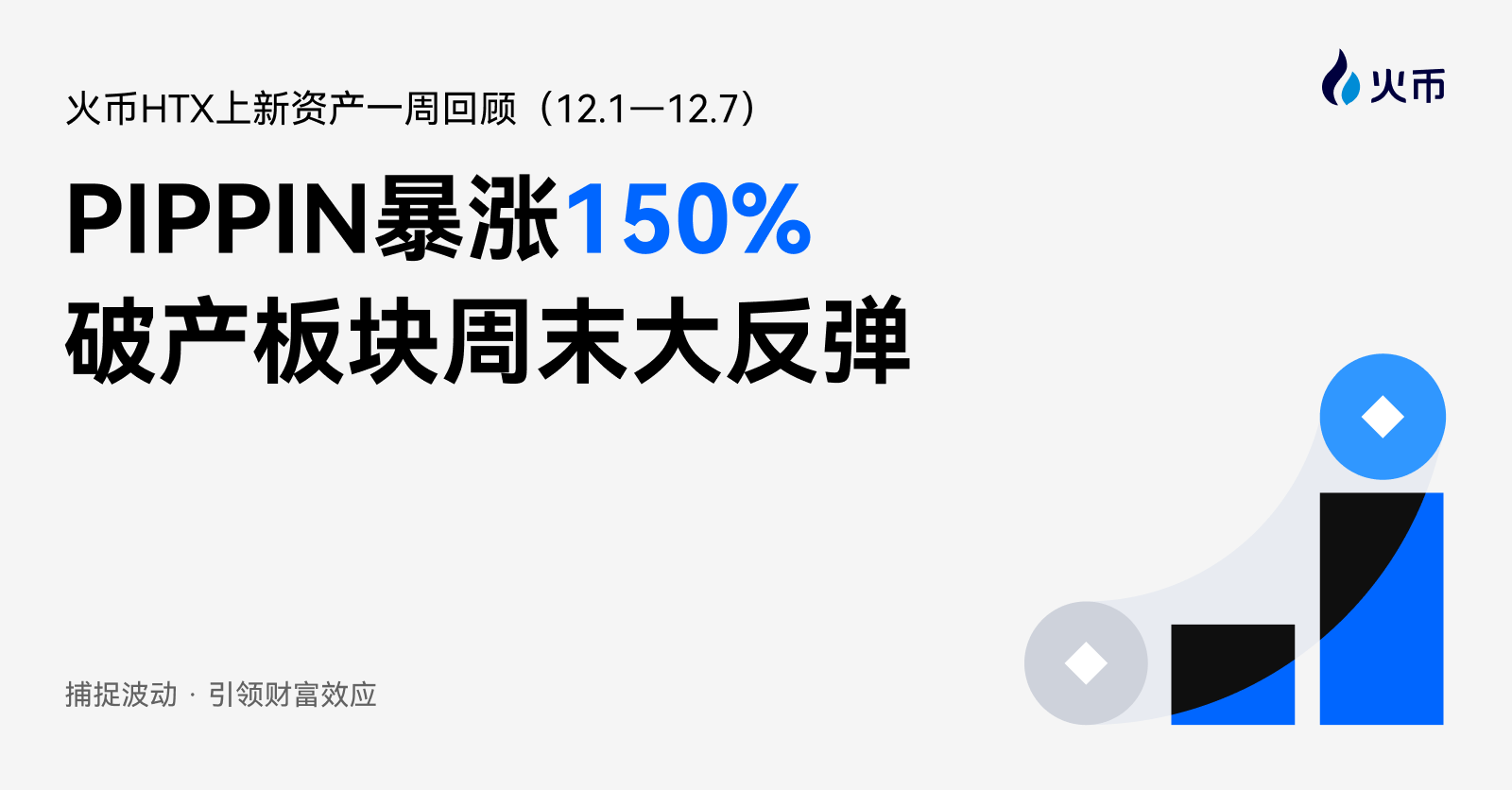
Huobi HTX New Assets Weekly Review (12.1-12.7): PIPPIN Soars 150%, Bankruptcy Sector Rebounds Strongly Over the Weekend

深潮Published on 2025-12-11Last updated on 2025-12-11

Abstract

Huobi HTX Weekly New Assets Recap (Dec 1–7): PIPPIN Surges 150%, Bankruptcy Sector Rebounds Over Weekend From December 1 to 7, multiple high-volatility assets on Huobi HTX saw strong rallies amid mixed market sentiment and improved risk appetite. SOL and BSC-based AI meme tokens like PIPPIN and FHE led the gains, showing strong recovery momentum, while the long-dormant bankruptcy sector also rebounded due to recent news around founder Do Kwon. SOL Meme tokens were among the top performers, with PIPPIN rising 150% as the top gainer. Other notable gainers included FARTCOIN (+37%) and MOODENG (+32%), reflecting continued interest in AI and meme narratives on Solana. On BSC, AI-related tokens also performed strongly. FHE (Mind Network) rose 135%, driven by discussions around homomorphic encryption and data security. SKYAI gained 65%, and B (BUILDon) increased by 46%. The bankruptcy sector, including LUNC (+104%), USTC (+56%), and LUNA (+52%), saw a significant rebound over the weekend, fueled by sentiment and speculative interest. Overall, the week was marked by a return of high-risk, high-volatility trading, with AI memes and bankruptcy tokens leading the rally. Huobi HTX continues to provide users with diverse and dynamic trading opportunities in the evolving crypto market.

Over the past week (December 1 to December 7), influenced by both fluctuating market sentiment and a renewed risk appetite among investors, several highly volatile assets on the Huobi HTX platform experienced strong rallies. AI Meme assets on the SOL and BSC chains, such as PIPPIN and FHE, led the gains, displaying a "dead cat bounce" style recovery. Meanwhile, the long-dormant bankruptcy sector saw a rotation due to recent news about founder Do Kwon. Below are the highlights of this week's top performers.
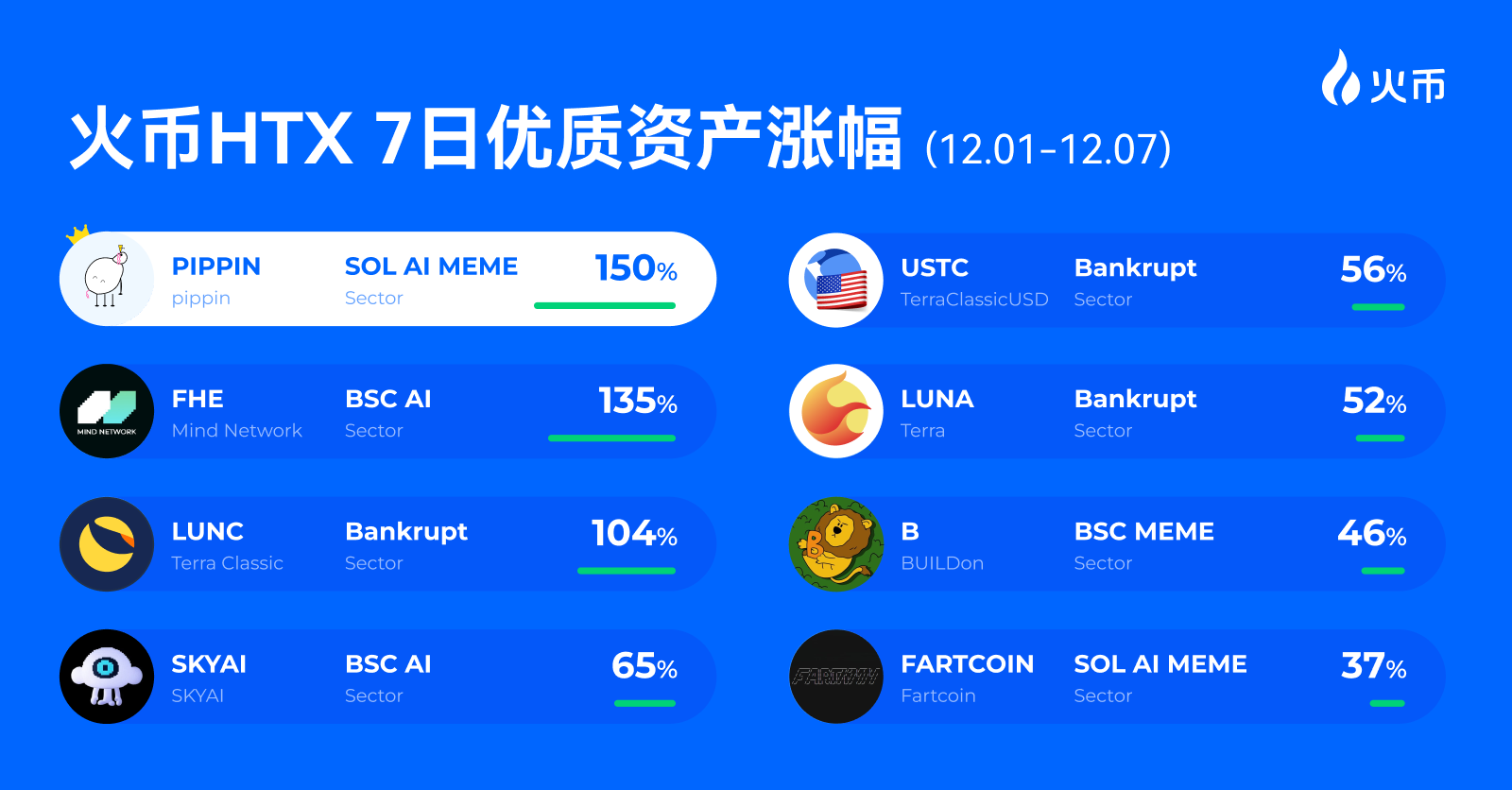
SOL Meme: Strongest Inflow of Funds, PIPPIN Leads with 150% Gain

Over the past week, the SOL ecosystem remained at the center of high-volatility narratives, with the combination of AI + Meme becoming the most chased sector. The narrative features typical short-term gaming characteristics, and SOL remains one of the most suitable public chains for incubating highly elastic assets.

  • PIPPIN (Pippin): Up 150%, the top gainer this period. Pippin is an SVG unicorn drawn using the latest LLM benchmark on ChatGPT 4o. Pippin was created by Yohei Nakajima, a recognized innovator and thought leader in the AI VC field (followed by Jeff Bezos and Marc Andreessen).

  • FARTCOIN (Fartcoin): Up 37%, continuing the "AI + MEME" fusion trend. Fartcoin is a Meme token on the SOL chain inspired by truth terminal.

  • MOODENG (Moo Deng): Up 32%, a catch-up asset boosted by the rising sentiment in the SOL ecosystem. As a hippo-themed Meme asset on the SOL chain, market participants began spreading to traditional Meme sectors after chasing AI Memes.

BSC AI: On-Chain AI Application Heat Continues

The AI sector on the BSC chain also performed prominently. From on-chain trends, BSC's AI projects generally feature "technical concepts, light asset operation, and high community participation," making them more likely to form liquidity resonance in a short time. This week's concentrated gains also indicate that funds are willing to continue seeking high-beta opportunities in "low-threshold, strong narrative" sectors.

  • FHE (Mind Network): Entered the list as the second top gainer with a 135% weekly increase, one of the most noteworthy technical assets this week. Mind Network is promoting the development of a new generation of zero-trust internet transmission protocol (HTTPZ). Ongoing discussions around homomorphic encryption and on-chain data security have driven market sentiment.

  • SKYAI: Up 65%, continuing the "rotation logic" of small-cap AI assets on BSC. SKYAI is a comprehensive AI ecosystem powered by MCP, aiming to seamlessly integrate intelligent solutions across industries. Currently, SKYAI supports aggregated datasets from BSC and Solana, totaling over 10 billion rows.

  • B (BUILDon): Up 46%. BUILDon represents a hybrid Layer-2 blockchain solution that leverages Bitcoin's security framework and Ethereum Virtual Machine (EVM) compatibility to facilitate dApp development.

Bankruptcy Sector: Weekend Sentiment Ignites "Nostalgia"

The biggest surprise this weekend came from the strong rebound in the bankruptcy sector. The long-dormant LUNA-related assets saw significant rebounds amid improved sentiment:

  • LUNC (Terra Classic): Up 104% weekly, leading the bankruptcy sector. Terra Classic (LUNC) is the original native cryptocurrency of the Terra blockchain. After the collapse of the Terra stablecoin (UST) and network fork in May 2022, the name was changed to Terra Classic to distinguish it from the new Terra blockchain (LUNA 2.0). Community-level "restructuring expectations" and "historical sentiment" once again became driving factors.

  • USTC (Terra Classic USD): Up 56%, an emotion-linked asset, strengthening in sync with LUNC. It is a decentralized algorithmic stablecoin pegged to the US dollar.

  • LUNA (Terra): Up 52%, continuing the sector rotation. It is worth emphasizing that this sector represents the market's short-term attention to "nostalgic assets," with extremely high volatility, where gains and risks coexist.

Dual Drivers of AI Meme and Bankruptcy Sector, Short-Term Risk Appetite Fully Recovers

Overall, 12/1-12/7 was a typical week of "return of speculative行情". The AI Meme赛道 on SOL and BSC saw significant gains, and the bankruptcy sector staged a strong counterattack over the weekend. Assets on the Huobi HTX platform showed strong rotation and high elasticity. As market sentiment continues to warm up, short-term traders will still have ample volatility opportunities in the coming weeks.

In this round of multi-sector共振上涨, Huobi HTX will continue to leverage the deep resources and agile response capabilities of its global platform to lead the diffusion of wealth effects in the next stage, providing users with more certain asset growth opportunities.

About Huobi HTX

Huobi HTX was established in 2013. After 12 years of development, it has evolved from a cryptocurrency exchange into a comprehensive blockchain business ecosystem covering digital asset trading, financial derivatives, research, investment, incubation, and other businesses.

Huobi HTX, as a leading global Web3 gateway, adheres to a development strategy of global expansion, ecological prosperity, wealth effect, and security compliance, providing comprehensive, secure, and reliable value and services to global virtual currency enthusiasts.

To learn more about Huobi HTX, please visit https://www.htx.com/ or HTX Square, and follow us on X, Telegram, and Discord. For further inquiries, please contact glo-media@htx-inc.com.


Related Questions

QWhich asset had the highest weekly gain on Huobi HTX from December 1 to December 7, and what was the percentage increase?

APIPPIN (Pippin) had the highest weekly gain, with a 150% increase.

QWhat was the main narrative driving the performance of SOL ecosystem assets during the week?

AThe main narrative was the combination of AI and Meme, which became the most chased sector, with SOL being one of the most suitable public chains for incubating high-elasticity assets.

QWhich BSC-based AI asset saw a 135% weekly increase and is focused on zero-trust internet transmission protocols?

AFHE (Mind Network) saw a 135% weekly increase and is advancing a new generation of zero-trust internet transmission protocol (HTTPZ).

QWhy did the bankrupt sector, including assets like LUNC and USTC, experience a significant rebound over the weekend?

AThe rebound was driven by renewed community sentiment around 'reorganization expectations' and 'historical nostalgia,' particularly influenced by recent news about founder Do Kwon.

QWhat overall market trend does the article describe for the period from December 1 to December 7 on Huobi HTX?

AThe period was characterized as a typical 'speculative行情回归期' (speculative market return period), with strong rotations and high elasticity in assets, driven by AI Meme sectors on SOL and BSC, and a rebound in the bankrupt sector, indicating a comprehensive recovery in short-term risk appetite.

Related Reads

The Value Distribution of Stablecoins

**Summary: The Value Distribution of Stablecoins** The article argues that stablecoins are evolving from mere trading tools into broader channels for dollar access. It divides the stablecoin ecosystem into four layers to analyze how value is distributed: 1. **Issuance Layer:** Mints stablecoins, holds reserve assets, and captures the spread between reserve yield and user costs (e.g., Tether, Circle). This layer currently earns the largest profit margin. 2. **Infrastructure Layer:** Connects stablecoins to the traditional financial system, handling fiat on/off-ramps, banking integration, compliance (KYC/AML), and asset management (e.g., Bridge, BVNK). This is the "unglamorous" but critical work, building the essential bridges between crypto and real-world finance. 3. **Acquiring/Distribution Layer:** Integrates stablecoins into merchant systems, manages payment flows, and provides enterprise financial software (e.g., Stripe, Coinbase). They act as the access point for businesses. 4. **Application Layer:** The end-users and businesses that ultimately use stablecoins for payments, settlements, or as a store of value. They benefit from convenience but have little pricing power. The core thesis is that while the issuance layer currently dominates profits, the often-overlooked **infrastructure layer holds significant long-term potential**. The real challenge and barrier to mass adoption is not the on-chain transfer of stablecoins (which is simple), but the complex "last mile" integration into existing business workflows, banking systems, and regulatory frameworks across different countries. Companies in this layer are currently in a "land grab" phase, investing heavily to build networks, secure bank partnerships, and establish compliance pathways. While their position is currently pressured by the profitable issuers above and distribution platforms below, the article suggests that if stablecoins become a default financial rail for businesses, the infrastructure providers who have done the hard work of integration will ultimately gain strong pricing power and become entrenched, essential players.

marsbit4h ago

The Value Distribution of Stablecoins

marsbit4h ago

The Value Distribution of Stablecoins

The Value Distribution of Stablecoins The article argues that stablecoins are evolving from a mere trading tool into a broad "dollar channel." It analyzes the industry's value chain through four layers: 1. **Issuance Layer (e.g., Tether, Circle):** The top layer that mints stablecoins, holds reserve assets, and captures the thickest interest rate spread. 2. **Infrastructure Layer (e.g., Bridge, BVNK):** Connects stablecoins to the traditional financial system, handling critical but complex "dirty work" like fiat on/off-ramps, banking integration, compliance (KYC/AML), and cross-border settlement. 3. **Acquiring/Distribution Layer (e.g., Stripe, Coinbase):** Embeds stablecoins into merchant systems, manages payment flows, and integrates with enterprise software. 4. **Application Layer:** End-users and businesses that ultimately use stablecoins for payments, settlement, or storing value. The author posits that while the issuance layer currently captures the most profit, the most overlooked and potentially critical layer is infrastructure. The core challenge for stablecoin adoption isn't the on-chain transfer (which is simple), but bridging the gap between blockchain and the real-world financial system. This involves solving practical problems for businesses: fiat conversion, reconciliation, tax handling, and user onboarding. Infrastructure companies are currently in a difficult "land-grab" phase—building networks, securing banking relationships, and achieving compliance country-by-country. They face pressure from both the profitable issuance layer above and distribution platforms below. However, the author suggests this layer is building a crucial moat. Once stablecoins become a default business rail, the infrastructure players who have done the hard work of integration may gain significant, durable value and pricing power.

链捕手4h ago

The Value Distribution of Stablecoins

链捕手4h ago

How to Do Research Well: Deliberately Practice the Real Skills That Matter

No one truly teaches you how to do research. You're often given a desk, a pre-selected problem, and vague instructions to "create something new." Consequently, many people reverse-engineer the job based on visible outputs—papers, posts, announcements—learning only how to *appear* like a researcher rather than how to *become* one. True research capability is built from stacking small, trainable skills, nearly all of which can be developed through deliberate practice. **Pick Your Own Problem:** Most researchers absorb problems from advisors or trends, lacking the underlying reasoning. Choosing a problem you genuinely care about, as John Schulman advises, leads to original work. Develop "taste" like a muscle: predict experiment outcomes, guess paper results from methods, and track which findings remain important over time. **Upgrade Your Inputs:** Relying on shared reading lists (arXiv hot lists, filtered group chats) leads to unoriginal conclusions. Undervalued old literature often holds crucial insights (e.g., MoE, LSTM, backpropagation). Richard Sutton's "The Bitter Lesson" or Claude Shannon's 1952 talk on creative thinking are more predictive than lengthy modern surveys. Breadth matters as much as depth: draw from neuroscience, mechanism design, hardware knowledge, and honest statistics. Read papers directly, especially appendices and limitations sections. **Write Everything Down:** As Paul Graham noted, writing exposes flaws in seemingly mature ideas. Writing is the cheapest defense against self-deception. Following Feynman's principle, Darwin programmatically wrote down facts contradicting his theory to combat memory bias. Maintain a detailed log of hypotheses, setups, predictions, results, and updated understandings. Reviewing past logs fosters essential humility.

marsbit6h ago

How to Do Research Well: Deliberately Practice the Real Skills That Matter

marsbit6h ago

Trading

Spot
Futures

Hot Articles

Discussions

Welcome to the HTX Community. Here, you can stay informed about the latest platform developments and gain access to professional market insights. Users' opinions on the price of S (S) are presented below.

活动图片