HashKey Falls Below IPO Price on First Day of Trading, 'The Eastern Coinbase' Not Yet Established

Odaily星球日报Published on 2025-12-17Last updated on 2025-12-17

Abstract

HashKey Holdings (stock code: 03887.HK), known as the first Hong Kong-listed cryptocurrency exchange, debuted on the Hong Kong Stock Exchange on December 17. Despite strong pre-IPO interest—with its public offering oversubscribed by nearly 394 times—the stock price fell below its initial offering price of HK$6.68 within the first hour of trading. It closed the day at HK$6.67 after hitting a low of HK$6.12. The market response contrasts sharply with earlier optimism from crypto industry participants, who had hailed HashKey as a milestone for Hong Kong’s Web3 sector and even dubbed it the "Eastern Coinbase." However, the article points out significant gaps between HashKey and Coinbase in terms of scale: HashKey has only 138,000 registered users and average daily trading volumes in the millions of dollars, far below Coinbase’s pre-IPO user base of 56 million and billions in daily trades. HashKey has reported four consecutive years of losses, which the company attributes to high investment in technology and compliance during its early development phase. The IPO raised approximately HK$1.67 billion, with 40% earmarked for technology upgrades and another 40% for market expansion. The listing is seen by some as a symbolic step toward broader acceptance of crypto in traditional finance, yet the author suggests HashKey’s successful listing may remain an isolated case in Hong Kong. This is largely due to the influential backing of its major shareholder, Lu Weiding—chairman of Wanxia...

Original | Odaily Planet Daily (@OdailyChina)

Author | Golem (@web3_golem)
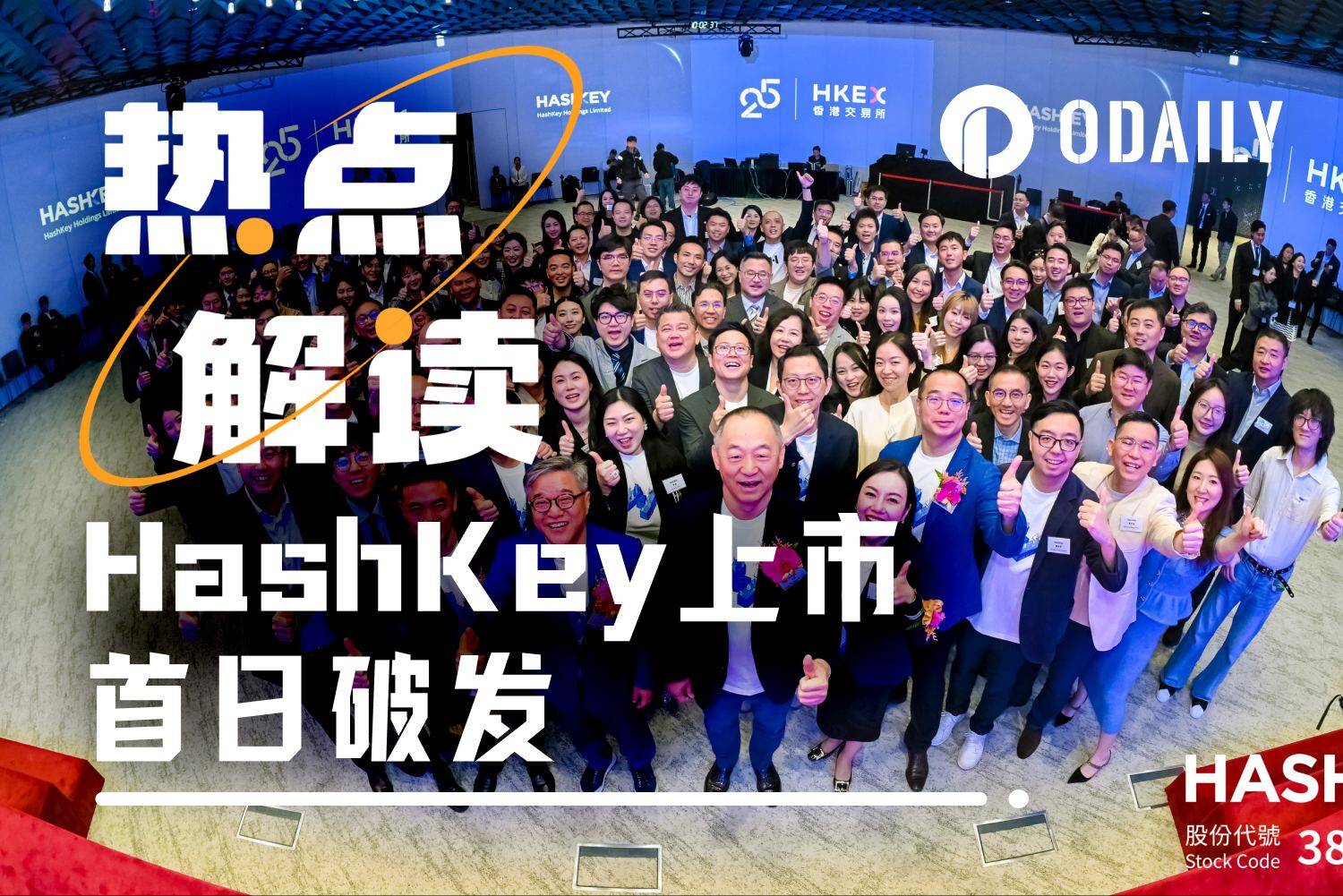
On December 17th, HashKey Holdings (03887.HK) officially listed on the stock exchange. Regrettably, the "first Hong Kong stock of a crypto exchange" fell below its IPO price of HK$6.68 within the first hour of trading.

According to Hong Kong stock market data, HASHKEY HLDGS saw its share price rise to a high of HK$7.12 during the session before declining steadily to a low of HK$6.12. It closed at HK$6.67 on its first day, close to the issue price.

This stock performance starkly contrasts with the high investor enthusiasm shown during HashKey Holdings' offering period. On December 12th, HashKey Holdings concluded its offering, selling 240.6 million shares at HK$6.68 per share, raising HK$1.67 billion (approximately US$206 million) from this Hong Kong IPO. The Hong Kong public offering portion was oversubscribed by 393.71 times, and the international placement portion was also oversubscribed.

Public opinion has become divided. On one hand, some crypto practitioners praise HashKey for pushing the crypto industry into the mainstream, calling it a significant milestone for Hong Kong's Web3 development. On the other hand, Hong Kong stock investors who scrambled to subscribe to the new shares were met with an immediate setback.

Statistics show the break-even rate for Hong Kong stocks in 2025 is between 24% and 30%; the first crypto stock hasn't escaped this range.

"The Eastern Coinbase": Wishful Thinking by Crypto Enthusiasts?

In early December, when HashKey Holdings completed its listing hearing and published its prospectus, Odaily provided an in-depth analysis of the numerous challenges facing HashKey Holdings' businesses, such as four consecutive years of financial losses, underperforming exchange operations, lack of competitiveness in its on-chain ecosystem, excessive R&D and compliance expenditures, and the decreasing scarcity of compliance licenses. We explicitly advised investors to consider the investment cautiously. (Related reading: Four consecutive years of losses, sluggish HSK, HashKey IPOs against the trend, will the capital market buy it?)

However, judging by the subsequent fervor in the HashKey IPO subscription market, expectations for the "first Hong Kong crypto stock" remained high, with the market seemingly less concerned about HashKey's loss-making status (the prospectus stated that losses were due to the trading platform still being in an early development stage and a period of high investment).

It is important to note that HashKey still allocated 40% of the funds from this offering for technology and infrastructure iteration, another 40% for market expansion and ecosystem partnerships, and the remaining 20% for operations and risk management, working capital, and general corporate purposes, respectively.

This clearly states, "I'm not profitable now, but I have growth potential. Place your bets, let's gamble on the future together."

The stock market, while valuing financial statements and corporate cash flow, has many well-known companies that are not profitable but possess high growth potential, and investors are willing to invest—for example, Amazon was unprofitable for 3 years before its IPO, but that didn't prevent it from growing into an e-commerce giant later. A more relevant example is Coinbase, which, like HashKey, took the compliance route and was also unprofitable before its IPO, yet that didn't stop it from being pursued by capital after listing.

But those comparing HashKey to the Eastern Coinbase often avoid the crucial points, emphasizing regional compliance as the commonality between HashKey and Coinbase, and highlighting HashKey's compliance premium and high growth potential.

In my view, the biggest gap between HashKey and Coinbase lies in the fact that Coinbase's massive compliance expenditures brought substantial returns to its actual business, whereas HashKey, despite obtaining a Hong Kong compliance license, shows little improvement in its business data.

Before its IPO in 2021, Coinbase's self-reported disclosures showed 56 million registered users, while HashKey Exchange currently has only 138,000 registered users; before its IPO, Coinbase's average daily trading volume had reached the billion-dollar level, while HashKey Exchange's average daily trading volume remains at the million-dollar level. As for HashKey's on-chain services and asset management business, they are even less comparable, and these two business segments contribute very limitedly to HashKey's revenue.

There were already signs that secondary market investors weren't buying the "analogy to Coinbase." In yesterday's dark pool trading on Futu, HashKey Holdings' stock price had already fallen below the issue price.

However, in this lackluster macro environment, discussing the significance of HashKey's listing抛开 its stock performance恰好 hit the collective sweet spot for the crypto industry's desire to break into the mainstream.

Exception? Or the First Case?

Judging everything based on one day's performance is indeed short-sighted. Let's take a longer view. For the Chinese crypto community, another significant meaning of HashKey's listing in Hong Kong is that it symbolizes a further "loosening" and acceptance of the crypto industry by the Hong Kong capital market. HashKey's listing fired the first shot; perhaps more high-quality crypto projects will take root and sprout in Hong Kong in the future, even triggering a bull run. The strategic significance represented by HashKey for crypto far exceeds its own value.

From this perspective, who has the chance to be the next runner?

My judgment is that HashKey's listing might be an isolated case for crypto companies in Hong Kong, and this is due to one key figure.

Xiao Feng, this often publicly visible crypto celebrity is not the largest shareholder of HashKey. The real controller of HashKey is Lu Weiding, the chairman of Wanxiang Group, who stood beside him ringing the bell this morning.

Lu Weiding (third from left) and Xiao Feng (third from right)

Lu Weiding is the major controlling shareholder of HashKey, holding 43.2% of the shares and able to exercise voting rights for 22.9% held by an employee share platform, while Xiao Feng, as the founder of Hashkey, holds 16.3%; other investors collectively hold 17.6%. The shareholding structure shows Lu Weiding's absolute authority in HashKey.

Lu Weiding took over as chairman of Wanxiang Group after his father, Lu Guanqiu, passed away. Wanxiang Group was originally a large domestic实体 enterprise, starting from automotive parts manufacturing and later engaging in real estate, tourism, agricultural products, finance, energy, metal resources, and other industries.

After taking over as chairman, Lu Weiding vigorously developed Wanxiang Group's financial industry. The group owns numerous financial enterprises including Minsheng Life Insurance, Allinpay, Zhejiang Fund, Puxing Jueneng, Wanxiang Trust, Wanxiang Leasing, Tonghui Futures, etc., building a Wanxiang financial control empire.

Why is Lu Weiding crucial to HashKey's ability to list?

Because besides being the chairman of Wanxiang Group and the major controlling shareholder of HashKey, Lu Weiding's roles also include being a deputy to the 14th National People's Congress, vice chairman of the All-China Federation of Industry and Commerce, member of the Zhejiang Provincial Committee of the Chinese People's Political Consultative Conference, and meritorious entrepreneur of Zhejiang Province. These identities and the resources they represent provide HashKey with stronger support.

One must ask, under the current regulatory environment, how can other followers replicate this advantage? Will their path to listing be as smooth? Therefore, labeling HashKey as the "model for Hong Kong crypto" would create misjudgments for entrepreneurs and investors.

For a long time to come, HashKey will not only be the "first Hong Kong crypto stock" but more likely a lone runner who squeezed onto the track at a fleeting moment of right timing, geographical convenience, and human harmony.


Related Questions

QWhat was the performance of HashKey Holdings' stock on its first day of trading on the Hong Kong Stock Exchange?

AHashKey Holdings' stock price fell below its IPO price of HK$6.68 within the first hour of trading. It reached a high of HK$7.12 and a low of HK$6.12 before closing near the issue price at HK$6.67.

QHow does the market's pre-IPO enthusiasm for HashKey contrast with its first-day trading performance?

AThere was extremely high pre-IPO enthusiasm, with the Hong Kong public offering portion receiving 393.71 times oversubscription and the international placement also being oversubscribed. This high demand sharply contrasts with the stock's first-day price drop below the offering price.

QWhat are the key reasons the article suggests that comparing HashKey to an 'Eastern Coinbase' is not accurate?

AThe comparison is inaccurate due to a significant gap in user base and trading volume. Before its IPO, Coinbase had 56 million registered users and daily trading volumes in the billions of dollars, while HashKey has only 138,000 registered users and daily volumes in the millions of dollars.

QWho is the major controlling shareholder of HashKey Holdings, and why is this significant for its ability to list?

AThe major controlling shareholder is Lu Weiding, Chairman of Wanxiang Group, who holds 43.2% of the shares and controls 22.9% of the votes through an employee持股 platform. His status as a National People's Congress representative and his extensive political and business connections provided crucial support for HashKey's successful listing.

QAccording to the article, why might HashKey's listing be an isolated case rather than a precedent for other crypto firms in Hong Kong?

AHashKey's listing may be an isolated case because its success was heavily dependent on the unique political and business resources of its major shareholder, Lu Weiding. Other crypto firms are unlikely to be able to replicate this specific advantage, making it difficult for them to achieve a similar listing.

Related Reads

The Shutdown of Claude Mythos Revealed the True Cost of Renting AI to Me

The sudden shutdown of Claude Mythos this week starkly highlights a critical, often overlooked risk for founders: when your core capability relies entirely on someone else's platform, your fate is not in your own hands. The key question becomes: who truly owns the intelligence your product depends on? For years, the debate around open-source models focused on cost. Now, the evidence is clear: fine-tuned open-source models can achieve frontier-level quality for specific, mission-critical tasks at a fraction of the cost. However, the deeper issue is control. Relying on a third-party API is like renting; it works until the landlord changes the rules, raises the rent, or asks you to leave—as Mythos experienced. The lesson is not to stop using frontier models—they are incredible infrastructure. The goal is ownership. Ownership means starting with a powerful open-source model and shaping it around what makes your company unique: your data, workflows, domain expertise, and definition of "good." Over time, the model becomes less generic and more reflective of your business, creating durable value. The optimistic conclusion is that AI's future doesn't hinge on one superior model. There is no single frontier. The frontier includes proprietary models, models fine-tuned on company-specific knowledge, specialized models for narrow problems, and intelligent routers orchestrating model ensembles. The most interesting development is not models getting smarter, but intelligence becoming increasingly customizable. The winning companies will be those that transform intelligence into a unique, owned asset. Looking ahead, the vision is not one model dominating all, but many teams owning the part of the frontier that matters most to them.

marsbit28m ago

The Shutdown of Claude Mythos Revealed the True Cost of Renting AI to Me

marsbit28m ago

Tiger Research: U.S. Strategic Bitcoin Reserve - Should the Market Be Happy or Disappointed?

Tiger Research analyzes the evolution of U.S. legislative efforts regarding a strategic Bitcoin reserve, concluding the market impact is limited in the short term but potentially positive long-term. The core event was a March 2025 executive order by former President Trump, which designated confiscated Bitcoin as a strategic reserve and promised not to sell existing holdings (approx. 190k BTC). As it contained no mandate to purchase new Bitcoin, the market reacted negatively, with prices dropping 5.7%. Legislative history shows a significant retreat from initial ambitions. The 2024 "BITCOIN Act" proposed mandatory purchases of 1 million BTC over five years. Reintroduced in 2025, it stalled due to high fiscal costs, concerns over dollar hegemony, and opposition from the Treasury Secretary. The current frontrunner, the 2026 "American Retirement and Monetary Advancement (ARMA) Act," is a compromise. It lacks any purchase requirement, instead focusing on consolidating existing government-held Bitcoin and legally prohibiting its sale for at least 20 years. While ARMA has higher passage odds due to bipartisan support and no purchase mandate, its immediate market effect is neutral. It eliminates potential government selling pressure but creates no new demand. The long-term significance is that formally establishing Bitcoin as a national reserve asset in law could later reignite debates on mandatory purchases. Therefore, the path to a government buyer is longer than initially priced by the market, but the directional narrative remains intact.

marsbit31m ago

Tiger Research: U.S. Strategic Bitcoin Reserve - Should the Market Be Happy or Disappointed?

marsbit31m ago

US Stock Market Trend (June 16): SpaceX Rises 42% in Two Days, New Fed Chairman Takes Office Today

**U.S. Stocks Trend (June 16): SpaceX Soars 42% in Two Days, New Fed Chair Takes Office Today** Markets surged on Monday following former President Trump's social media announcement of a completed U.S.-Iran deal to reopen the Strait of Hormuz, pending a June 19 signing. The news triggered a broad risk-on rally: oil prices crashed, tech stocks soared, bond yields fell, and defensive sectors lagged. **Market Performance:** The Nasdaq jumped 3.07%, led by semiconductor stocks like Micron (+9.2%). The S&P 500 gained 1.65%, and the Dow rose 0.92% to a record high. However, the Russell 2000 small-cap index underperformed (+0.72%). SpaceX continued its hot streak, rising another 5% pre-market after disclosures of large buys by an Australian billionaire and Cathie Wood's ARK. Boeing also rallied on the transportation optimism. Conversely, energy stocks like Chevron fell over 3% on the oil price plunge, with other defensive sectors also selling off. The day's action showed a clear rotation of funds from energy/defensive plays into AI and tech narratives. **Macro & Outlook:** The VIX fear index fell 8.37%. Treasury yields declined, and WTI crude dropped over 5%. Attention now shifts to a packed schedule: the Bank of Japan is widely expected to hike rates to 1.0% on Tuesday. The Fed's June meeting concludes Wednesday, marking new Chair Wash's debut. While rates are expected to hold, his tone on stubborn inflation and the "dot plot" will be crucial for gauging the 2024 rate path. The formal Iran deal signing is set for Friday. **Trend Perspective:** While the peace deal is a genuine positive, Monday's explosive rally may have gotten ahead of itself, pricing in a swift resolution to inflation concerns. The shortened trading week faces a triple test: BoJ tightening, the Fed's policy stance, and deal implementation details. Tech and semiconductors, which led the surge, remain vulnerable to any disappointment from these key events. The real price discovery begins with the central banks' communications this week.

marsbit52m ago

US Stock Market Trend (June 16): SpaceX Rises 42% in Two Days, New Fed Chairman Takes Office Today

marsbit52m ago

Trading

Spot
Futures
活动图片