HashKey crypto exchange opens Hong Kong IPO subscription, targets $215M

cointelegraphОпубліковано о 2025-12-09Востаннє оновлено о 2025-12-09

Анотація

HashKey Group, operator of one of Hong Kong’s licensed cryptocurrency exchanges, has opened subscriptions for its initial public offering (IPO), aiming to raise up to HK$1.67 billion ($214.7 million). The IPO is scheduled to debut on December 17 on the Hong Kong Stock Exchange (HKEX). The company is offering 240.6 million shares priced between $0.76 and $0.89 each, which could value HashKey at $2.46 billion at the upper end of the range. Founded in 2018, HashKey has become Hong Kong’s largest crypto exchange, capturing an estimated 75% market share. As of September 30, it had facilitated $167 billion in cumulative spot trading volume. The exchange offers a range of services including spot trading, OTC, staking, and tokenization, and also operates an Ethereum layer-2 network called HashKey Chain. The IPO is backed by prominent sponsors such as JPMorgan and Guotai Junan. Proceeds will be used to expand ecosystem infrastructure, enhance risk management, and support talent acquisition. The offering comes amid a significant increase in IPO activity in Hong Kong, with HKEX reporting a 209% year-on-year rise in funds raised in 2025.

HashKey Group, operator of one of Hong Kong’s licensed crypto exchanges, has opened subscriptions for its initial public offering (IPO) ahead of an expected listing next week.

HashKey is seeking to raise up to 1.67 billion Hong Kong dollars ($214.7 million) in an IPO that is scheduled to debut on Dec. 17, according to a prospectus filed with the Hong Kong Stock Exchange (HKEX) on Tuesday.

The company is offering 240.6 million shares at $0.76–$0.89 each, which would bring HashKey’s valuation to $2.46 billion at the top of the range.

With the subscription period beginning today, investors can apply for HashKey shares online through the HK eIPO White Form or using an electronic application via HKEX’s digital IPO settlement platform FINI until Friday.

HashKey’s rapid path to IPO after three years of operation

Founded in 2018, HashKey has grown into Hong Kong’s largest crypto exchange, reportedly capturing a 75% market share, or more than three times that of its nearest competitor.

After commencing operations and obtaining key regulatory approvals in Hong Kong in 2022, HashKey entered full-scale operations in 2023.

According to its prospectus, HashKey had facilitated $167 billion in cumulative spot trading volume as of Sept. 30.
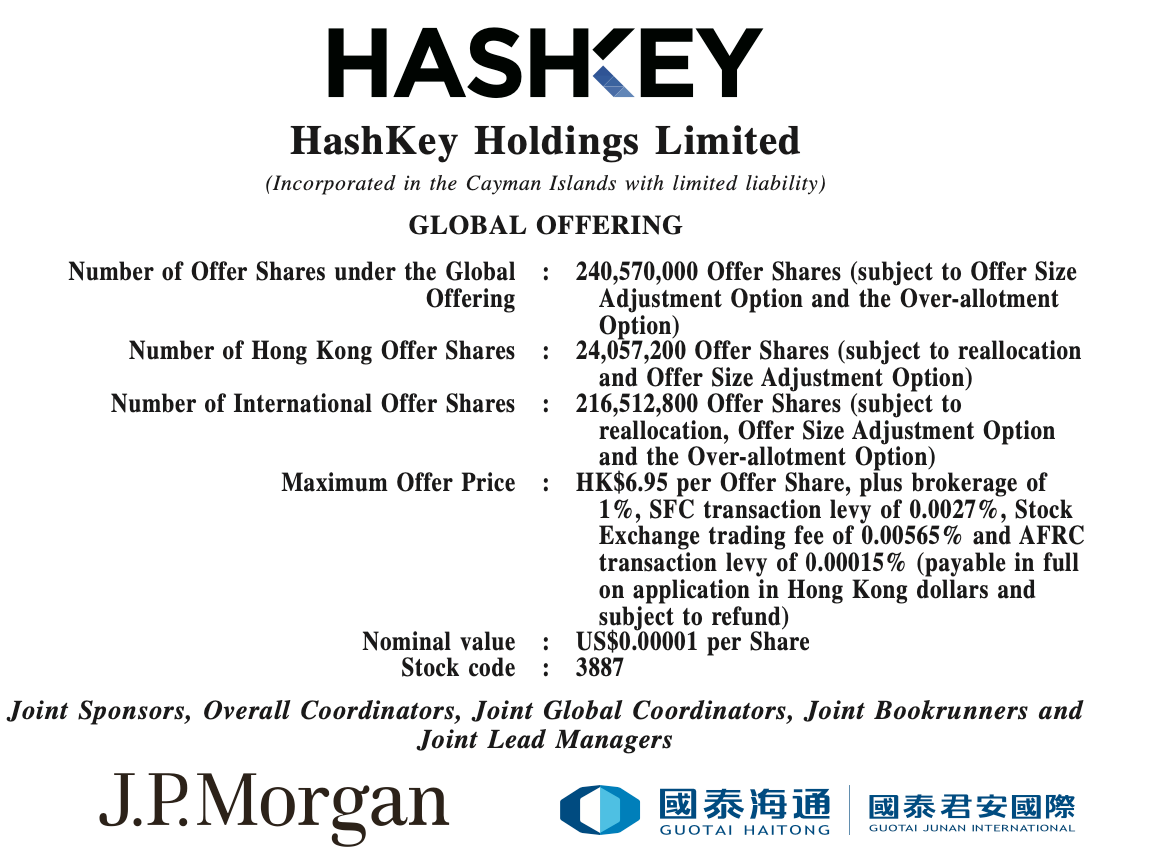
HashKey’s IPO prospectus filed with the HKEX on Tuesday. Source: HKEX

HashKey offers a wide range of digital asset services to both institutional and retail investors, including spot exchange, over-the-counter (OTC) trades, staking and tokenization. It also operates HashKey Chain, an Ethereum layer-2 network designed for real-world assets (RWAs), stablecoins and decentralized applications.

The company has also emerged as the largest Asian, Hong Kong-based asset management provider in 2024, with $1 billion in assets under management as of Sept. 30, the prospectus states.

Related: Bitkub exchange eyes Hong Kong IPO as Thai markets slump to 5-year lows: Report

HashKey’s IPO is backed by high-profile sponsors, including major US investment bank JPMorgan and local financial institutions such as Guotai Junan.

The IPO proceeds are planned to go toward scaling its ecosystem and infrastructure, bolstering risk management and hiring talent, the filing notes.

HashKey’s public offering comes amid a continued IPO boom in Hong Kong, with HKEX reporting a 209% year-on-year increase in funds raised through IPOs in 2025, totaling $27.8 billion in the first months of the year.

Magazine: Animoca’s bet on altcoin upside, analyst eyes $100K Bitcoin: Hodler’s Digest, Nov. 23 – 29


Пов'язані матеріали

Farcaster Is Not a Pivot, It's Evolution: The True Ambition from Social to Wallet

Recently, Farcaster co-founder Dan Romero announced a shift in the project’s focus from "social-first" to "wallet-first," sparking widespread discussion. While some interpreted this as Farcaster abandoning social features or even signaling the failure of Web3 social networks, the move is better understood as a strategic evolution rather than a pivot. Farcaster’s integration of a built-in wallet is not a replacement for social functionality but an upgrade to improve user experience. It enables seamless on-chain interactions, especially as Frames evolve into more powerful Mini Apps. This enhancement allows users to mint NFTs, execute trades, and engage with decentralized applications without leaving the app—reducing friction and supporting richer crypto-native experiences. The shift reflects a broader trend: social apps are integrating wallets, and wallet apps are adding social features. This convergence is becoming the natural direction for consumer crypto applications. By combining social graphs with built-in wallets and Mini Apps, Farcaster enables closed-loop scenarios for asset creation, discovery, trading, and community interaction—all within a unified experience. Other platforms like Telegram, Zapper, Base App, and Binance are also exploring similar integrations, highlighting the growing importance of blending social context with financial activity. Farcaster’s open and composable social protocol allows developers to build diverse clients and applications, further expanding its ecosystem. In summary, Farcaster is not moving away from social—it is enhancing it. The integration of wallet functionality aims to drive growth, improve utility, and solidify its unique value proposition in the crypto space.

marsbit1 год тому

Farcaster Is Not a Pivot, It's Evolution: The True Ambition from Social to Wallet

marsbit1 год тому

Торгівля

Спот
Ф'ючерси
活动图片