Goldman Sachs Research Report Analysis: Samsung Electronics' Shareholder Returns Fall Short of Expectations, FCF Expansion Supports Valuation Recovery

marsbitPublished on 2026-08-24Last updated on 2026-08-24

Abstract

Gold Sachs research report analysis indicates Samsung Electronics' announced shareholder return pool for 2026 (projected 90-110 trillion KRW) fell short of market expectations for a larger one-time payout. However, Goldman emphasizes that sustained Free Cash Flow (FCF) expansion and a stable, phased return mechanism are the true drivers for valuation repair, not a single event. The report maintains a Buy rating on Samsung ordinary shares with a 740,000 KRW target price, implying 74% upside. Samsung plans a ~30 trillion KRW dividend in Q3 2024, with the remaining returns from the 2026 pool executed post-January 2027 earnings via dividends and share buybacks/cancellations. Goldman estimates 2024-2026 cumulative FCF at ~270 trillion KRW. Assuming a 50% return ratio, total shareholder returns would be ~135 trillion KRW. After accounting for 2024-2025 payouts, the 2026 return is estimated near 106 trillion KRW, at the high end of guidance. While Samsung's short-term return scale lags peers like SK Hynix, its future return capacity is underpinned by robust FCF growth from memory and HBM businesses. Goldman forecasts FCF will significantly rise in 2027-2028, potentially boosting annual return pools to 179 trillion and 232 trillion KRW respectively under the existing policy, potentially matching or exceeding peers. Samsung's current valuation (1.7x P/B for 2027) is seen as attractive given high ROE projections (40%-50%). The core thesis is that Samsung's shareholder return story r...

By: Rita

Samsung Electronics' shareholder return plan has failed to meet the market's short-term expectations. Goldman Sachs believes that sustained FCF expansion and a stable return mechanism, rather than the size of a one-time return, are what truly support valuation recovery.

On August 23, Goldman Sachs released a report stating that Samsung announced an expected shareholder return pool for 2026 in the range of 90 trillion to 110 trillion won. Previous media reports suggested this year's return size could reach 150 trillion won; the median guidance of about 100 trillion won is below market expectations. Goldman Sachs maintains its Buy rating on Samsung Electronics common stock with a target price of 490,000 won, implying a 74% upside from the current stock price.

Samsung Electronics is one of the world's largest technology companies, holding the top global market share in several categories including memory chips, OLED panels, smartphones, and televisions. Goldman Sachs expects robust profitability from the memory business to continue, with substantial progress also being made in the HBM field.

Returns Below Expectations, Sustainable Return Mechanism is Key

Samsung did not announce a large-scale one-time return like SK Hynix but clarified a plan for phased returns. The company stated it will pay a cash dividend of approximately 30 trillion won in the third quarter, with the specific amount to be determined by the board at the end of October. The remainder will be executed after the January 2027 earnings announcement, in forms such as dividends and share buybacks/cancellations.

Goldman Sachs estimates Samsung's cumulative FCF from 2024 to 2026 will be about 270 trillion won. Calculating a 50% return ratio, total returns would be approximately 135 trillion won. Subtracting the 20.9 trillion won in dividends and 8.4 trillion won in buybacks already paid for 2024-2025, the 2026 return is about 106 trillion won, at the higher end of the guidance range.

The return composition will tilt towards dividends. Goldman Sachs expects a dividend of about 30 trillion won in Q3 2026, a year-end dividend slightly above 40 trillion won, and full-year dividends of about 76 trillion won. The remaining approximately 30 trillion won will be completed through buybacks and cancellations. The higher dividend proportion is due to Samsung approaching the threshold for separate taxation on dividend income, and regulatory limits on the proportion of shares held by financial affiliates in non-financial group affiliates.

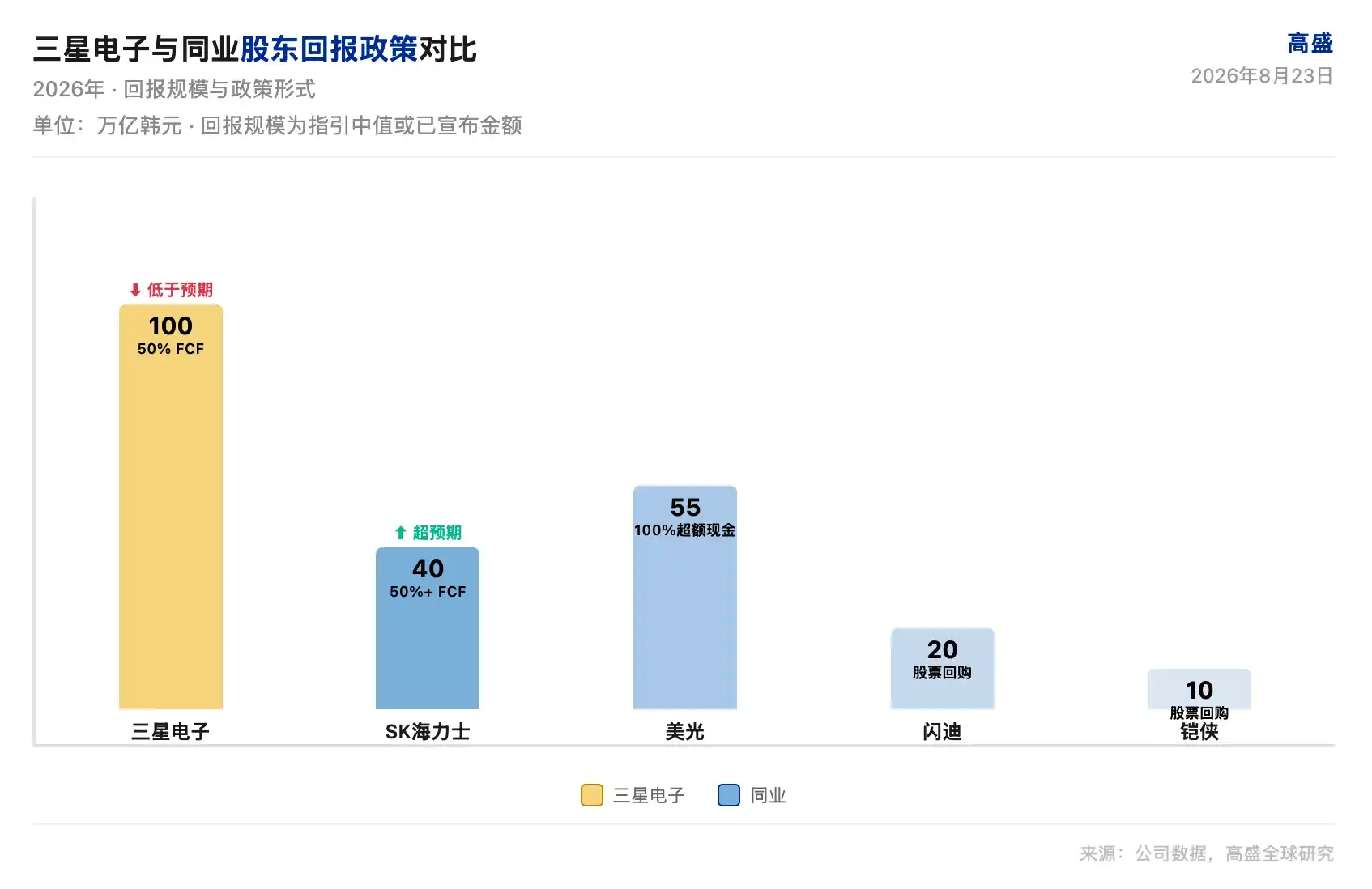
Micron has announced it will return 100% of excess cash to shareholders, SK Hynix has committed to returning over 50% of FCF and initiated a 40 trillion won buyback, and Sandisk and Kioxia are also expanding buyback scales. Samsung's return plan falls short of peers in terms of short-term size, but Goldman Sachs expects FCF to continue expanding from 2027 to 2028, allowing its return capability to gradually approach or even surpass peer levels.
FCF Growth Supports Future Returns

Samsung did not disclose return plans for 2027 and beyond. Goldman Sachs expects FCF to grow significantly, potentially increasing the stability of shareholder returns. Even under the existing 50% FCF return policy, Goldman Sachs forecasts the return pool to increase to 179 trillion won and 232 trillion won in 2027 and 2028, respectively.

Goldman Sachs assumes quarterly ordinary dividends will rise to about 10 trillion won per quarter from 2026 onwards, with an additional larger dividend paid at year-end. Based on adjustments to cash flow assumptions and buyback/dividend expectations, Goldman Sachs raised its EPS forecasts for 2026-2028 by 1%, 7%, and 11%, respectively. ROE expectations increased from 52%, 48%, 39% to 53%, 52%, 43%.

Valuation Remains Attractive

Samsung's current stock price corresponds to a forward P/B of 1.7x for 2027 and 1.2x for 2028, with an ROE of 40% to 50% for the same periods. Goldman Sachs views the risk-reward ratio as attractive, believing sustained and substantial shareholder returns will drive multiple expansion.

The 490,000 won target price is based on a SOTP valuation using 2026-2027 EV/EBITDA. The preferred stock target price is 360,000 won, based on a 27% discount to the common stock. Downside risks include deterioration in memory supply/demand, a sharp decline in smartphone margins, and loss of OLED panel market share.

While the market's short-term expectations for Samsung's return plan were disappointed, the sustained expansion of FCF and a stable return mechanism provide longer-term certainty. Samsung's shareholder return story represents a structural improvement, not a one-time event.
Disclaimer

This article is Chaoxiang Research's compilation and interpretation of a third-party brokerage research report (Goldman Sachs, August 23, 2026), combined with publicly available market information. The ratings, target prices, profit forecasts, and related judgments cited in the article are the views of the analyst of that brokerage firm, representing only the position of their institution, and do not represent the views of Chaoxiang Research, nor do they constitute any investment advice.

Markets involve risks, decisions should be made independently. This article should not be used as a basis for buying or selling any securities.


Related Questions

QAccording to Goldman Sachs' report, why did Samsung Electronics' shareholder return plan fall short of short-term market expectations, and what does the report view as the true catalyst for valuation recovery?

AGoldman Sachs noted that the median guidance of Samsung's announced KRW 90-110 trillion shareholder return pool for 2026 fell short of previous market speculation of around KRW 150 trillion for 2024. The report argues that the true support for valuation recovery is the sustained expansion of Free Cash Flow (FCF) and a stable return mechanism, rather than the scale of a one-time return event.

QHow does Goldman Sachs calculate the potential shareholder return from Samsung for 2026, and what does the analysis project regarding the composition of these returns?

AGoldman Sachs estimates Samsung's cumulative FCF for 2024-2026 to be approximately KRW 270 trillion. Applying a 50% return ratio, total returns would be about KRW 135 trillion. Subtracting dividends and buybacks already paid from 2024-2025 (KRW 29.3 trillion in total), the 2026 return is projected at around KRW 106 trillion, at the high end of the company's guidance. The return mix is expected to tilt towards dividends, with full-year 2026 dividends forecast at about KRW 76 trillion and the remaining ~KRW 30 trillion executed via share buybacks/cancellations.

QWhat is Goldman Sachs' outlook for Samsung's shareholder returns beyond 2026, and what key factor underpins this projection?

AGoldman Sachs projects significant growth in Samsung's future FCF, which will support an increase in shareholder returns. Even under the existing 50% FCF return policy, the report forecasts the return pool to rise to approximately KRW 179 trillion in 2027 and KRW 232 trillion in 2028.

QWhat is Goldman Sachs' investment rating and target price for Samsung Electronics' common stock, and how is the target price derived?

AGoldman Sachs maintains a 'Buy' rating on Samsung Electronics common stock with a target price of KRW 490,000, implying about 74% upside from the current price. The target price is derived using a Sum-of-the-Parts (SOTP) valuation method based on 2026-2027 EV/EBITDA multiples.

QAccording to the Goldman Sachs report analysis, how does Samsung's shareholder return strategy differ from that of its peers like SK Hynix and Micron in the short term and potential long term?

AIn the short term, Samsung's announced return plan is perceived as less aggressive than some peers: SK Hynix committed to returning over 50% of FCF and initiated a KRW 40 trillion buyback, while Micron announced a 100% return of excess cash. Samsung did not announce a large one-off return. However, Goldman Sachs expects that due to its projected strong FCF expansion, Samsung's return capacity is likely to gradually approach or even surpass that of its peers in the 2027-2028 timeframe.

Related Reads

Unitree Investors Jointly Heavy Bet on an Embodied Team

Unibot's early investors, including Meituan, Sequoia Capital, and Matrix Partners, have jointly invested in MiaoDong Technology, another humanoid robotics startup. Founded by former DJI employees—CEO Gao Jianrong, a 9-year DJI veteran who led multiple core business units, and CTO Yang Shuo, who previously worked in Tesla's Optimus team—MiaoDong is known for its combined expertise in hardware productization and advanced robotics cognition. Their core strategy centers on in-house motor R&D and full-stack software-hardware capabilities. The company recently made headlines with its first product, Beni, a wheel-legged "camera robot" designed for low-angle, ground-level filming and personal companionship. Successfully launched on Kickstarter, Beni set a record for the highest fundraising amount in the platform's robotics category. It received a perfect 10/10 rating from influential tech reviewer Marques Brownlee (MKBHD). Beni features capabilities like autonomous obstacle avoidance, the ability to jump 25cm, and self-righting after a fall. MiaoDong plans to leverage the technological and user data feedback from Beni's consumer launch to inform the development of future home-use humanoid robots. The company emphasizes a product-first, user-centric approach, prioritizing real-world applications and reliability over rapid, demo-focused scaling. With Beni set for global release in October and an internal target to sell millions of units, MiaoDong aims to establish itself as a significant player in the embodied AI space through steady, product-driven growth.

marsbit3m ago

Unitree Investors Jointly Heavy Bet on an Embodied Team

marsbit3m ago

Illegal Mining in Russia: Why Home Farms Are Easy to Detect

Illegal cryptocurrency mining in Russia is becoming increasingly risky, especially in regions where such activity is banned. Energy supply companies detect atypical, sustained electricity consumption in residential areas, triggering checks. They monitor anomalous usage, report data to tax authorities, and forward information to prosecutors. Home mining farms give themselves away through a characteristic load pattern: an apartment consumes electricity evenly and almost around-the-clock, making such deviations obvious in statistics. Mining remains legal only where not prohibited and when electricity is consumed under a proper contract, metered, and paid for. Income from mining is subject to taxation. To operate legally, registration or notification is required as per regulations. Current consequences for illegal mining involve applying existing rules: penalties for illegal grid connections, unmetered consumption, causing damage to energy companies, and tax evasion. Equipment may be confiscated. While specific administrative and criminal liability for mining itself is still being finalized, offenders face fines, damage claims, and potential criminal charges. Key illegal schemes include mining in prohibited regions, using illegal grid connections or unmetered power, and not paying taxes on mining income. The main damages involve losses for energy companies, grid overload, and unpaid taxes. As of now, bans on crypto mining are in effect in Moscow, the Moscow region, parts of the Kursk region, and several other territories (including parts of the North Caucasus, certain Ukrainian territories under Russian control, and areas in Southern Siberia and the Far East) until at least March 15, 2031, primarily to mitigate electricity deficit risks. The primary reason home mining is easily detectable is its non-typical power consumption pattern: equipment runs almost constantly, creating a stable load that significantly differs from normal household usage, making concealment difficult.

cryptonews.ru23m ago

Illegal Mining in Russia: Why Home Farms Are Easy to Detect

cryptonews.ru23m ago

Trading

Spot
活动图片