Gnosis announces hard fork to recover funds from Balancer exploit

cointelegraphPublished on 2025-12-23Last updated on 2025-12-23

Abstract

Gnosis Chain has executed a hard fork to recover funds stolen during a $116 million Balancer exploit that occurred in November. The hard fork, carried out on Monday, follows a prior soft fork adopted by a majority of validators. According to Gnosis, the recovered funds are now out of the hacker’s control, though specific details on how users can reclaim their assets are still under community discussion. The team aims to enable fund recovery by Christmas, after which distribution mechanisms will be finalized. The original Balancer exploit targeted V2 Composable Stable Pools and resulted in over $116 million in outflows, with white hat hackers later recovering about $28 million. Despite 11 prior audits, the vulnerability was not detected.

Gnosis chain operators executed a hard fork to recover funds tied to a $116 million Balancer exploit in November.

In a Tuesday X post following a notice for node operators, Gnosis said it executed a hard fork to recover some of the funds from a significant exploit of Balancer. The project said the funds were “out of the hacker's control,” signaling a partial or full recovery.

The hard fork, executed on Monday, followed a majority of validators adopting a soft fork in November in response to the Balancer exploit affecting “Balancer‐managed contracts on Gnosis Chain.”
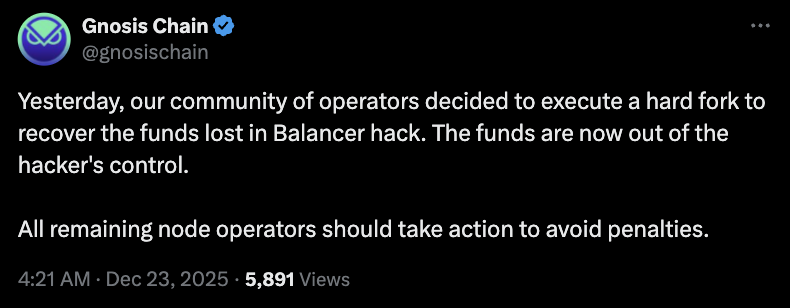
Source: Gnosis Chain

“There is still a live community discussion around how people will be able to claim back their funds, as well as how contributors involved in the rescue mission may be recognized or compensated,” said Gnosis head of infrastructure Philippe Schommers in a Dec. 12 forum post. “Right now we’re focused on enabling funds to be recovered by Christmas. Once they sit safely in a DAO controlled wallet we will figure out everything else.”

On Nov. 3, Balancer reported that the decentralized exchange and automated market maker had been exploited for more than $116 million worth of digital assets. Onchain data showed a hacker transferred millions in staked Ether (ETH) to a new wallet.

Related: Balancer exploit swells to $116M in outflows as team offers 20% bounty

Though Balancer later reported that white hat hackers had managed to recover about $28 million of the stolen funds, it did not appear to have regained access to the majority of digital assets.

11 audits didn’t prevent the Balancer exploit

According to a list of Balancer V2 audits available on GitHub, four different security companies conducted 11 audits of the platform’s smart contracts. The project reported that the exploit was “isolated to V2 Composable Stable Pools.”

Magazine: When privacy and AML laws conflict: Crypto projects’ impossible choice

Related Questions

QWhat was the purpose of the hard fork executed by Gnosis chain operators?

AThe hard fork was executed to recover funds tied to a $116 million Balancer exploit that occurred in November.

QHow much was stolen in the Balancer exploit on Gnosis Chain?

AThe Balancer exploit resulted in the theft of more than $116 million worth of digital assets.

QWhat portion of the stolen funds were recovered by white hat hackers according to the article?

AWhite hat hackers managed to recover about $28 million of the stolen funds.

QWhat specific part of the Balancer protocol was the exploit isolated to?

AThe exploit was isolated to V2 Composable Stable Pools.

QWhat was the stated goal for the recovery of the funds as mentioned by Gnosis head of infrastructure Philippe Schommers?

AThe goal was to enable the funds to be recovered by Christmas and have them sit safely in a DAO-controlled wallet.

Related Reads

$9.4 Billion: The Largest Robotics Funding This Year Has Emerged

Munich-based humanoid robotics company Neura has completed a $1.4 billion (approximately RMB 94.9 billion) Series C funding round, valuing the company at around $7 billion and positioning it among the global leaders in the sector. The investment round is notable not just for its size—reportedly the largest in robotics this year—but also for its strategic backers, which include tech giants like NVIDIA and Amazon, alongside established industrial players such as German engineering firms Bosch and Schaeffler. This mix of investors signals a significant shift in the industry's focus from technological demonstrations and general-purpose narratives toward practical, industrial deployment and commercialization. Neura's approach centers on developing humanoid robots for defined, high-value industrial tasks rather than pursuing a general-purpose model. Its early validation comes from a partnership with BMW, where its robots are being tested on actual production lines. The involvement of Bosch and Schaeffler, companies deeply embedded in global manufacturing, underscores a growing belief that humanoid robots are transitioning from labs to viable factory-floor solutions. The article highlights two converging trends driving investment: advancements in AI and large language models, which enhance robots' perception and decision-making in unstructured environments, and mounting pressure from labor shortages and rising costs in major manufacturing regions. The funding landscape is now bifurcating between companies like Figure AI, focusing on versatile general-purpose robots, and firms like Neura, targeting specific vertical industrial applications with clearer, shorter paths to ROI. While technical hurdles remain, the core challenges for widespread adoption are increasingly seen as engineering and commercial in nature: managing the high integration and customization costs for different factory environments and establishing robust, localized maintenance and service networks. The record investment in Neura, particularly from industrial capital, indicates the industry's growing confidence in moving from proving feasibility to solving the practical problems of scalability, reliability, and building sustainable business models around humanoid robots in real-world settings like automotive manufacturing and hazardous labor environments.

marsbit8h ago

$9.4 Billion: The Largest Robotics Funding This Year Has Emerged

marsbit8h ago

Trading

Spot
Futures

Hot Articles

What is USOIL

USOILUSDT Perpetual Contract is the trading symbol for West Texas Intermediate (WTI) Crude Oil priced in US dollars, representing 1 barrel of crude oil.

817 Total ViewsPublished 2026.05.25Updated 2026.05.25

What is USOIL

How to Buy USOIL

Welcome to HTX.com! We've made purchasing WTI Crude USOil/ CL (USOIL) simple and convenient. Follow our step-by-step guide to embark on your crypto journey.Step 1: Create Your HTX AccountUse your email or phone number to sign up for a free account on HTX. Experience a hassle-free registration journey and unlock all features.Get My AccountStep 2: Go to Buy Crypto and Choose Your Payment MethodCredit/Debit Card: Use your Visa or Mastercard to buy WTI Crude USOil/ CL (USOIL) instantly.Balance: Use funds from your HTX account balance to trade seamlessly.Third Parties: We've added popular payment methods such as Google Pay and Apple Pay to enhance convenience.P2P: Trade directly with other users on HTX.Over-the-Counter (OTC): We offer tailor-made services and competitive exchange rates for traders.Step 3: Store Your WTI Crude USOil/ CL (USOIL)After purchasing your WTI Crude USOil/ CL (USOIL), store it in your HTX account. Alternatively, you can send it elsewhere via blockchain transfer or use it to trade other cryptocurrencies.Step 4: Trade WTI Crude USOil/ CL (USOIL)Easily trade WTI Crude USOil/ CL (USOIL) on HTX's spot market. Simply access your account, select your trading pair, execute your trades, and monitor in real-time. We offer a user-friendly experience for both beginners and seasoned traders.

599 Total ViewsPublished 2026.05.25Updated 2026.05.25

How to Buy USOIL

Discussions

Welcome to the HTX Community. Here, you can stay informed about the latest platform developments and gain access to professional market insights. Users' opinions on the price of A (A) are presented below.

活动图片














