Gemini, Winklevoss Twins Hit With Class-Action Lawsuit Over Post-IPO Strategy Pivot, Stock Decline

bitcoinistPubblicato 2026-03-21Pubblicato ultima volta 2026-03-21

Introduzione

Shareholders have filed a class action lawsuit in New York against crypto exchange Gemini, its co-founders the Winklevoss twins, and other executives. The suit alleges the company misled investors during its September 2025 IPO by presenting a growth strategy focused on expanding its user base and international presence. The complaint claims that just months after the IPO, Gemini abruptly pivoted its business model to prioritize prediction markets, announced a 25% workforce reduction, and exited key international markets in the UK, EU, and Australia. This "Gemini 2.0" strategy, announced in February 2026, allegedly caused the company's stock price to drop over 8%. The stock fell a further 12.9% following the departure of three senior executives and has declined more than 80% from its all-time high. The plaintiffs seek damages for significant losses suffered due to these alleged misleading statements and omissions.

Shareholders filed a class action lawsuit in New York against crypto exchange Gemini, co-founders Tyler and Cameron Winklevoss, and multiple executives, alleging that the exchange misled investors during its 2025 initial public offering (IPO).

Gemini Accused Of Misleading Investors

This week, crypto exchange Gemini and several executives were hit with a class action lawsuit for allegedly misleading investors before and after the exchange’s September 2025 IPO due to its strategy pivot.

Filed on Wednesday in the US District Court for the Southern District of New York, the complaint claims that the IPO documents were “negligently prepared and, as a result, contained untrue statements of material fact or omitted to state other facts necessary to make the statements made not misleading and were not prepared in accordance with the rules and regulations governing their preparation.”
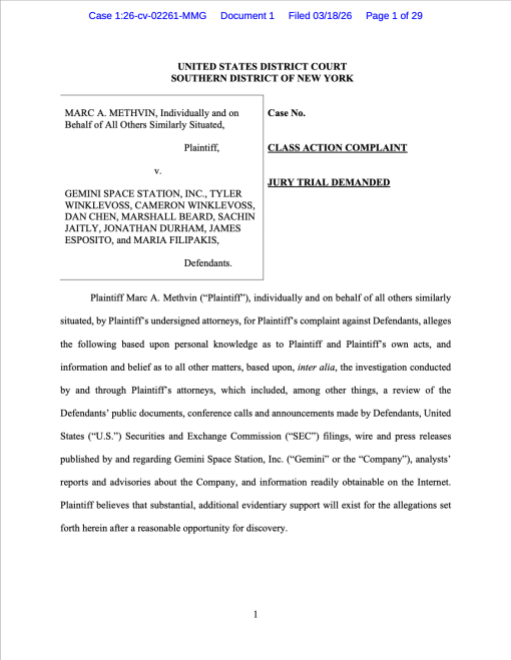
Shareholder files class action lawsuit agaisnt Gemini. Source: courtlistener

Gemini has primarily generated revenues through transactions, deposits, and fees charged to users of its crypto platform, the Plaintiff highlighted, noting that the IPO documents reportedly described the company’s revenue growth strategy as “predominantly focused on expanding [its] exchange platform via increased MTUs [monthly transacting users] (...) increased average daily trading volume, and increasing the number of assets available on [its] platform.”

The documents stated that Gemini would increase monthly transacting users through acquiring new retail and institutional users and expanding internationally.

Additionally, the lawsuit argues that throughout the Class Period, from September 12, 2025, to February 17, 2026, Gemini and its executives made statements that were “materially false” and misleading regarding the company’s business operations and prospects.

The ‘Gemini 2.0’ Strategy Pivot

The complaint emphasized the exchange “gave no indication that the Company was poised for an abrupt corporate pivot to a prediction-market-centric business model” or that it would abandon its international growth strategy just months after the IPO.

According to the lawsuit, “the truth began to emerge” in February 2026, when the crypto exchange co-founders, Tyler and Cameron Winklevoss, announced a corporate pivot to “Gemini 2.0.”

In a blog post, they described three crucial changes to the exchange’s operations: prediction market would be “more front and center in our experience”; its workforce would be reduced by 25%; and it would exit the UK, European Union (EU), and Australian markets.

The Winklevoss twins acknowledged the challenges Gemini has faced in the international market, arguing that the crypto exchange needed to simplify its structure to stay competitive.

However, the lawsuit alleges that, on this news, Gemini’s Class A common stock price fell 8.72%, to close at $6.70 per share on February 5, 2026. Similarly, it noted that the stock price fell 12.9% on February 17, 2026, on the news of the departure of three senior leaders.

Last month, the firm disclosed in a regulatory filing that Chief Operating Officer (COO) Marshall Beard, Chief Financial Officer (CFO) Dan Chen, and Chief Legal Officer (CLO) Tyler Meade were departing the company effective immediately.

In addition, the firm reported operating expenses of $520 million to $530 million, a 40% increase from the previous fiscal year, the lawsuit added. It’s worth noting that Gemini’s stock price briefly dropped to an all-time low of $5.51 on March 20, before bouncing to the $5.75 area. This represents a more than 80% drop from its September all-time high of $40.

“As a result of Defendants’ wrongful acts and omissions, and the precipitous decline in the market value of the Company’s securities, Plaintiff and other Class members have suffered significant losses and damages,” the lawsuit stated, seeking a jury trial and damages for investors who bought shares during the IPO and the Class Period.
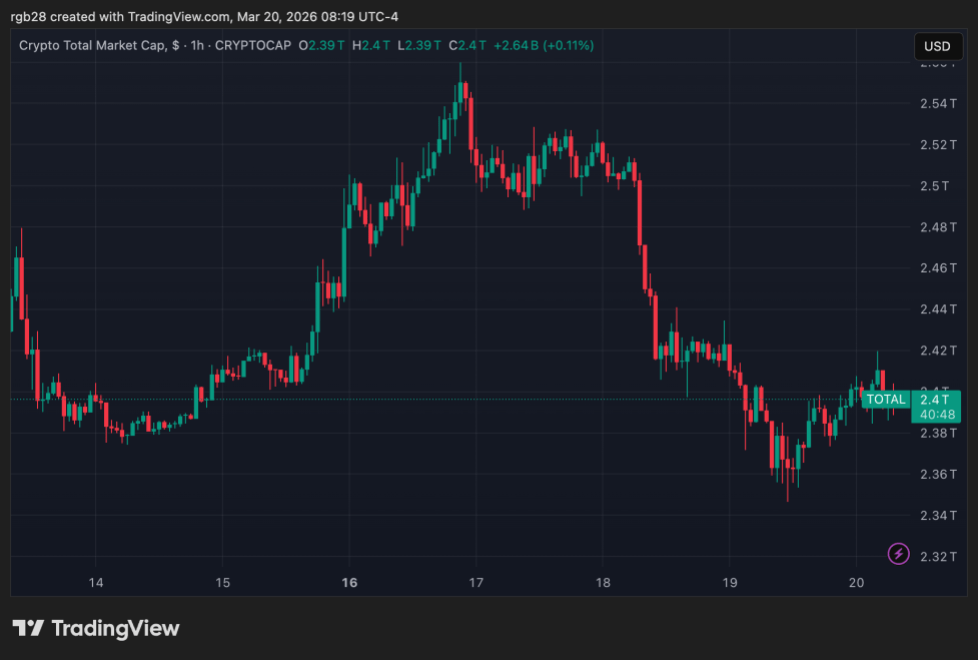
The total crypto market capitalization is at $2.4 trillion in the one-week chart. Source: TOTAL on TradingView

Domande pertinenti

QWhat is the main allegation in the class-action lawsuit filed against Gemini and the Winklevoss twins?

AThe lawsuit alleges that Gemini and its executives misled investors during its 2025 IPO by providing IPO documents that were 'negligently prepared' and contained untrue statements of material fact or omitted necessary facts, particularly concerning the company's business strategy and prospects.

QWhat was the 'Gemini 2.0' strategy pivot that triggered the lawsuit?

AThe 'Gemini 2.0' strategy pivot involved three major changes: making prediction markets more central to its platform, reducing its workforce by 25%, and exiting the UK, EU, and Australian markets, which represented an abrupt shift from the international growth strategy outlined in its IPO.

QHow did Gemini's stock price react to the announcement of the corporate pivot and the departure of senior leaders?

AGemini's Class A common stock price fell 8.72% to $6.70 per share on February 5, 2026, following the pivot announcement. It fell another 12.9% on February 17, 2026, on the news of the departure of three senior leaders, and later hit an all-time low of $5.51, representing an over 80% drop from its all-time high.

QWhich key executives were reported to have departed from Gemini, as mentioned in the lawsuit?

AThe departing executives were Chief Operating Officer (COO) Marshall Beard, Chief Financial Officer (CFO) Dan Chen, and Chief Legal Officer (CLO) Tyler Meade.

QWhat was the original revenue growth strategy for Gemini as described in its IPO documents?

AThe IPO documents described the company's revenue growth strategy as predominantly focused on expanding its exchange platform by increasing monthly transacting users (MTUs), increasing average daily trading volume, and increasing the number of assets available on its platform, primarily by acquiring new retail and institutional users and expanding internationally.

Letture associate

Goldman Sachs: July Smashes Through Crowded Trades, U.S. Stock Bull Market Not Broken but Harder to Navigate

Goldman Sachs: July Sees Crowded Trades Unwound, U.S. Bull Market Intact but Getting Tougher. The U.S. stock market in July did not see an index-level crash, but rather a significant unwinding of speculative positions. While the S&P 500 remained stable—trading within a narrow 3.5% range and staying within 2% of its high—underlying market dynamics were volatile. Heavily crowded trades, particularly in high-momentum tech, AI-linked stocks, and Asian strategies, faced severe pressure and forced deleveraging. Data indicates this was a meaningful cleanse, not a minor adjustment. Global tech exposure saw its largest sell-off in over five years, leverage in Korean equity ETFs plummeted, and Goldman's prime brokerage recorded the largest gross exposure reduction since late 2022. Leverage on momentum factors among fundamental long/short clients fell to the 28th percentile of its one-year range. The AI trade narrative shifted from pure potential to a focus on tangible returns. While Meta failed to show clear AI monetization, Microsoft and Amazon provided evidence that massive capital expenditure is translating into scalable revenue and product growth, preventing a blanket sell-off of the AI sector. The Federal Reserve's more opaque communication style and volatility in long-end Treasury yields have introduced new friction, particularly for rate-sensitive growth and tech stocks. The broader outlook for U.S. equities remains favorable, supported by a strong economy, robust earnings, and substantial AI capital expenditure. However, risk/reward is no longer cheap, and the market's upward elasticity has weakened. The Nasdaq 100's trajectory—up 12% year-to-date despite significant pullbacks—illustrates that the bull trend persists but the path is becoming more difficult. The key lesson from July is that the market no longer rewards crowded, highly leveraged trades, requiring more disciplined and liquid portfolio approaches.

marsbit2 h fa

Goldman Sachs: July Smashes Through Crowded Trades, U.S. Stock Bull Market Not Broken but Harder to Navigate

marsbit2 h fa

Interview with Robinhood Executive: Meme + Tokenized US Stocks as "Barbell" Customer Acquisition Strategy, All Business Lines Achieve Hundreds of Millions in Revenue

Interview with Robinhood executive Johann Kerbrat reveals the company's "barbell" customer acquisition strategy for its new Robinhood Chain, combining meme tokens with tokenized stocks. Three weeks after mainnet launch, the chain has seen over $3B in weekly DEX volume and 105M transactions. Kerbrat explains the logic behind the permissionless chain: meme tokens attract DeFi users, while tokenized real-world assets (RWA), currently over 90 US stocks and ETFs accessible in 120+ countries, serve global users. The goal is to bring Robinhood's 27 million funded accounts on-chain by simplifying DeFi with a user-friendly interface, exemplified by features like Robinhood Earn which offers yield without requiring wallet management. Built on Arbitrum's technology stack for its speed, low cost, and Ethereum's security, the chain focuses on financial products like Earn, spot trading, and perpetuals. Kerbrat downplays direct competition with platforms like Base, emphasizing the goal of expanding the overall market for on-chain assets. He details selective partnerships (e.g., Morpho, Lighter) based on compliance, unique UX, and differentiation. While regulatory clarity is pending for US perpetuals, the expansion continues via Bitstamp in Europe. Finally, Kerbrat positions Robinhood as a "super app" integrating stocks, options, crypto, banking, and AI trading, with all major business lines generating hundreds of millions in revenue. For the chain, current priority is driving adoption over maximizing gas fee revenue.

marsbit4 h fa

Interview with Robinhood Executive: Meme + Tokenized US Stocks as "Barbell" Customer Acquisition Strategy, All Business Lines Achieve Hundreds of Millions in Revenue

marsbit4 h fa

Trading

Spot
活动图片