When token launch platforms start building their own trading tools, the window for independent terminals may be shorter than imagined.
In February 2026, Pump.fun announced the acquisition of the on-chain trading terminal Padre, renaming it Terminal and directly embedding it into its token launch ecosystem.
This acquisition didn’t spark much discussion. Most people’s reaction was, "Oh, another acquisition." But if you’re using GMGN, Axiom, or any other independent trading terminal, this is worth thinking about for a moment.
Because it hints at a trend: on-chain trading terminals may not exist as an independent category for long.
First, Understand: Why Have Trading Terminals Suddenly Become Important?
A year ago, the standard toolchain for Meme traders was: Dexscreener for charts + Telegram Bot for orders + Twitter for Alpha. Three tools, three windows, barely functional.
By 2026, this workflow was compressed into a single interface. Trading terminals represented by GMGN integrated token discovery, smart money tracking, security checks, and one-click trading into one web application. Users no longer needed to jump between five tabs.
This isn’t a feature innovation; it’s a workflow innovation—accomplishing the same tasks with fewer steps.
The effect was immediate. GMGN quickly became the default choice for Meme traders, Axiom received investment from Y Combinator, and Photon built a loyal user base in the Solana community. In less than a year, the entire sector grew from zero to at least six or seven recognizable products.
But the Terminal Sector Has a Structural Problem
The problem lies in customer acquisition costs.
Where do trading terminal users come from? From Twitter KOL recommendations, community word-of-mouth, airdrop incentives. Every user is acquired through marketing expenses.
Platforms like Pump.fun don’t need to do this. Thousands of tokens are created on Pump.fun every day, and every token creator and early buyer is a natural trading terminal user. After Pump.fun acquired Padre, these users no longer need to leave the Pump.fun ecosystem from token creation to trading.
This is the power of vertical integration: you work hard to build a trading terminal to attract users, but the source of users is intercepted by the platform.
The same logic could also apply at the DEX level. If Jupiter or Raydium decided to add trading terminal features to their frontend—smart money tracking, new token boards, one-click buying and selling—the differentiation of independent terminals would be further eroded.
Where Is the Way Out for Independent Terminals?
This doesn’t mean independent terminals will disappear immediately. But it does mean that "building a feature-rich trading terminal" is no longer enough. You need to have some dimension that platform players are unwilling, unable, or too slow to do.
Looking back at the current sector landscape, every surviving product is essentially betting on a direction:
GMGN is betting on data network effects. More users → more wallets tracked → more accurate signals → more new users. Once this flywheel starts spinning, it’s hard for latecomers to catch up. GMGN’s biggest moat right now isn’t any single feature, but the data advantage brought by its user density.
Axiom is betting on platformization. Spot, perpetuals, farming, automated strategies, fiat on-ramps—Axiom isn’t trying to be just a Meme trading terminal, but an all-category trading center on-chain. If it can build an "on-chain Binance," then independence becomes irrelevant; it becomes the platform itself. YC’s backing gives it a longer runway to bet on this direction.
Photon is betting on extreme experience. No multi-chain, no social features, no flashy functions, only focusing on making trading execution the fastest and most stable on Solana. Photon’s bet is: there will always be a group of hardcore traders who only care about speed and latency, nothing else. This group might not be large, but its loyalty is extremely high.
1Keeper is betting on the latecomer advantage. As a newcomer to the sector, 1Keeper’s background is somewhat special—the team previously worked on MPC multi-sig wallets, serving institutional clients. In early 2026, it pivoted to building an on-chain trading terminal for Solana and BSC, with features already including mainstream modules like Discover, Trenches, Signal (smart money signals), and Trackers (wallet tracking).
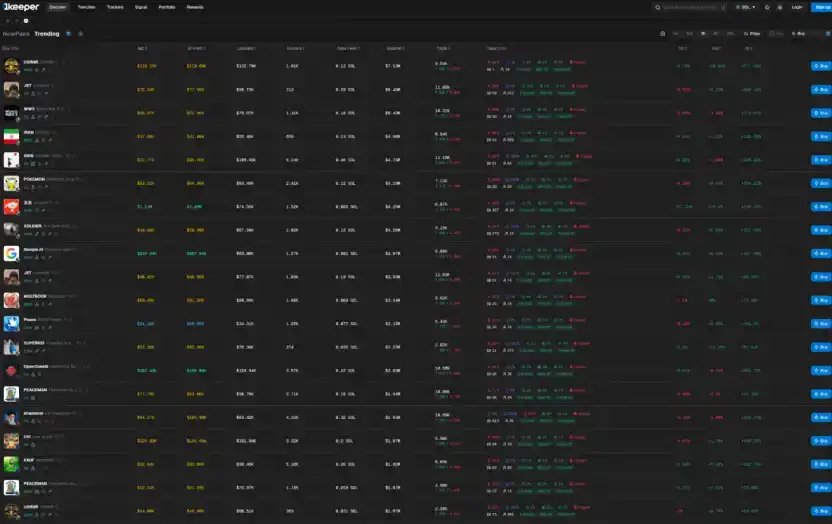
1Keeper Discover Page: Trending Token List, Covering Core Metrics Like Market Cap, Liquidity, Holders
The disadvantages for latecomers are obvious: small user base, weak brand recognition, many functional details to catch up on. But latecomers also have a subtle advantage: they can see all the pitfalls their predecessors encountered. The compromises pioneers made in product architecture (sacrificing scalability for early speed, design debt that couldn’t be changed for backward compatibility) can be bypassed directly by latecomers.
Whether this advantage can be realized depends on execution speed—the sector won’t wait.
Endgame Speculation
If we refer to Web2 experience, the endgame for tool-based products is usually one of three:
Acquired/Integrated. Platform players turn your features into a tab of their own. Corresponds to the logic of Pump.fun acquiring Padre.
Become the Platform. The tool itself expands upstream or downstream, becoming an indispensable ecosystem node. Axiom is walking this path.
Become the Niche Champion. Become the absolute number one in an extremely specific scenario. Photon is betting on this path.
For products like GMGN, 1Keeper, and Bullx, the question is: which path are you taking?
Those who move slowly might not see the end of the sector. But it’s also possible that the crypto industry simply doesn’t follow the Web2 script—user migration costs in this market are extremely low (switching terminals just requires connecting a wallet), meaning product moats are naturally weak, but it also means opportunities for a comeback always exist.
During DeFi Summer, no one predicted Uniswap would win. In the NFT frenzy, Blur replaced OpenSea in a few months.
The winner in on-chain trading terminals might not have appeared yet. Or it might already be in your bookmarks bar.