It all starts with a financing round.
This week, Kwaiwei Intelligence completed a 1 billion yuan Series B financing, becoming the latest billion-dollar unicorn in the embodied world model arena. Looking through the long list of investors, an unexpected name appears—Lens Technology.
Thus, the person behind it, Zhou Qunfei, enters the VC circle's view.
Born in 1970, she wrote a legendary story of entrepreneurial counterattack with a piece of glass, successfully transforming from an ordinary migrant worker into the "Glass Queen" presiding over a market value of 300 billion yuan. In recent years, she and Lens have begun to appear in the VC circle, investing in a batch of star companies such as BrainCo, Xinghaimap, QingskyRent, etc. Quietly, such a group of traditional tycoons is channeling money into the vast ocean of Chinese technology.
Hunan's Richest Woman Maps Out a Hidden Portfolio
Once she makes a move, it's a billion-dollar unicorn.
Kwaiwei Intelligence is an embodied intelligence company headquartered in Nanshan, Shenzhen. Its founder, Jia Kui, is a tenured professor at The Chinese University of Hong Kong, Shenzhen. In 2021, he ventured into physical AGI exploration, leading Kwaiwei Intelligence to build a fully self-developed four-layer product matrix: the underlying DexVerseTM generative simulation embodied engine, DexSense spatial intelligence sensors, DexBrain embodied intelligence brain software, and the DexForce W1 humanoid robot body, constructing a complete virtual-real synergistic technology loop.
The connection between Zhou Qunfei and Kwaiwei Intelligence can be traced back to 2022. That year, Kwaiwei's simulation models and vision sensors had already entered Lens production lines, completing tasks like disordered workpiece sorting and precision flexible assembly. Over the years, trust grew with each delivery.
One morning in April this year, Zhou Qunfei visited Kwaiwei Intelligence and decided to invest on the spot after seeing the products. Sources reveal that Zhou Qunfei's investment amounted to several hundred million yuan, made with her personal funds. "First use your product, then invest in your company, accompany you further." Such rapport is uncommon in the venture capital circle.
Through Kwaiwei Intelligence, the hidden portfolio of this manufacturing industry leader is gradually emerging.
Based on Tianyancha information, one of Zhou Qunfei's personal investment vehicles is "Changsha Qunxin Investment Consulting Co., Ltd." ("Qunxin Investment")—registered in 2011 in Changsha, Hunan, with Zhou Qunfei holding nearly 98% and her husband Zheng Junlong holding the rest. This entity has made 17 external investments.
As an LP, Qunxin Investment committed 500 million yuan to Shanghai Junhe Tonghang Private Equity Fund Partnership (Limited Partnership), whose related institution Junhe Capital has invested in companies like Changxin Technology and BOE. Additionally, Qunxin Investment has invested in Kunqiao Capital and Hengbang Capital.
In direct investments, Qunxin Investment has backed chip and semiconductor companies like Xinai Technology, Chixin Semiconductor, and Jamexin, as well as hard-tech companies like Zhongshan Precision, Jia'an Intelligence, Maiqing Technology, Laizefeng, and Damai Technology.
At the group level, Lens Technology is more active in venture capital. Especially this year, it has consecutively invested in a batch of AI star companies like BrainCo, Xinghaimap, QingskyRent, Pudu Technology, etc. At the end of April this year, Lens Technology also acted as a cornerstone investor for Cofoe Medical, which now boasts a market cap exceeding HK$10 billion. Moreover, Lens Technology is also behind the Changsha Intelligent Robotics Research Institute.
Overall, Zhou Qunfei's investment strategy involves dual tracks: personal and corporate. The former is flexible and low-key, while the latter focuses on strategic positioning and industrial synergy. Walking on two legs, they complement each other.
From Migrant Worker to Billionaire, Building a 300 Billion Yuan Empire
Earlier this year, a photo circulated online—
At a state banquet in Beijing, a woman sat between Apple CEO Tim Cook and Tesla CEO Elon Musk, with NVIDIA CEO Jensen Huang across the round table. This composed and calm female entrepreneur was none other than Lens Technology Chairman Zhou Qunfei.
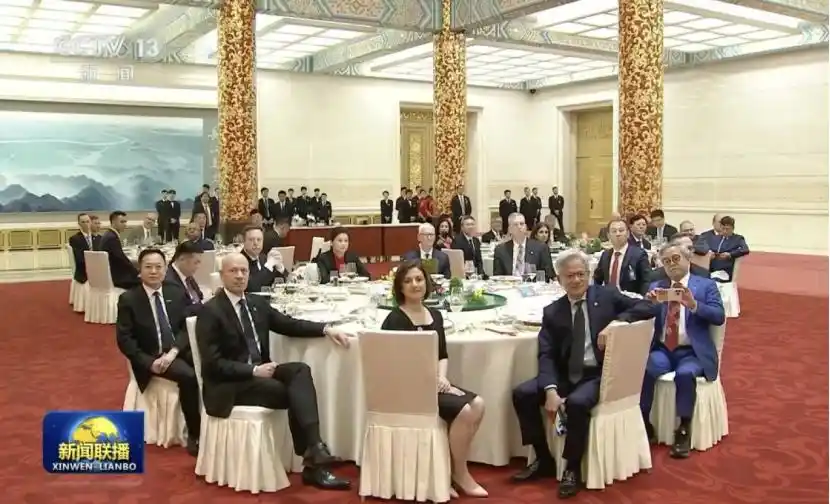
"My entrepreneurial journey is a history of hardship and tears," Zhou Qunfei once summarized.
Born in 1970 into a poor family in Xiangxiang, Hunan, she dropped out of school in her teens to make a living, heading south to Shenzhen to become a factory assembly line worker. While working, she attended training classes at Shenzhen University and even learned Cantonese.
A life-changing opportunity came in 1990. The glass factory where she worked was expanding, but the factory manager left, and the investor planned to withdraw. Zhou Qunfei proactively volunteered to take over, convincing the investor. Years later, determined to go it alone, she rented a three-bedroom farmer's house in Shenzhen with relatives and friends, establishing "Hengsheng Glass Surface Processing Factory"—the predecessor of Lens Technology.
Later, Zhou Qunfei got into the mobile phone window glass business, gradually gaining a reputation. In 2003, Lens Technology was formally established. "Lens" comes from the homophone of "lens." At that time, many foreign merchants searching for "lens" online would find Lens Technology.
What truly made Lens Technology famous was the Motorola order; Lens was the first company to meet the foreign client's drop-test requirements at the time. Soon, Apple came knocking.
In 2006, Zhou Qunfei decided to build a factory back in Hunan. She told the Liuyang city leaders one sentence: "Everyone says Hunanese are good at fighting and being officials, but not at business. Why can't we have high-tech enterprises? I just want to prove them wrong."
At that time, Apple released the first iPhone, with Lens Technology as the touchscreen glass supplier. For many years since, Lens Technology has been deeply involved in supplying multiple Apple product lines like the iPhone, Apple Watch, Mac, and Apple Vision Pro. Revenue from major customers like Apple has almost accounted for half of Lens Technology's income.
In 2015, Lens Technology listed on the Shenzhen Stock Exchange ChiNext board. Zhou Qunfei led the team to expand into new businesses. Today, Lens Technology covers smartphones, wearables, computers, smart cars, smart home devices, etc., with products including glass, sapphire, ceramics, metal, plastic materials for appearance structures and functional components. Its client list includes Huawei, OPPO, vivo, Xiaomi, as well as Porsche, BMW, NIO, Li Auto, and other renowned major enterprises.
In 2025, Lens Technology's revenue exceeded 74 billion yuan, with profits over 4 billion yuan, and it achieved A+H listing by going public in Hong Kong. This year, its stock price has climbed, once surpassing 300 billion yuan. According to the "2026 Hurun Global Rich List," Zhou Qunfei and her husband, with 135 billion yuan in wealth, rank as Hunan's richest.
Chinese Tycoons Bet on the Next Tech Future
A clear trend is emerging: Chinese tycoons who made their fortunes in traditional industries are collectively turning their gaze to the most cutting-edge tech sectors.
The latest scene is DeepSeek's first funding round, where iHealth unexpectedly appeared among the shareholders. At its helm is Liu Yi, an alumnus of Tianjin University, who built iHealth from scratch into its current 30 billion yuan market cap. After making money, Liu Yi extended his reach into venture capital.
In recent years, iHealth has acted as an LP, investing in over ten venture capital funds like Monolith Capital, Jifeng Capital, and Yaotu Capital, and has also directly invested in star projects like Moonshot AI's Kimi, StepFun, Zhiyuan Robot, and Independent Variable Robot.
Earlier this year, the family office of Zhu Xingming, chairman of the hundred-billion-yuan market cap Inovance Technology—Ming Hui Investment—invested in the billion-dollar embodied intelligence unicorn Qianxun Intelligence. Investment界 reported that Ming Hui Investment has 2.5 billion yuan in proprietary funds, 10 billion yuan in reserve industrial capital, and has invested in areas like brain-computer interfaces and AI computing.
Similarly active is the family office behind Luxshare Precision—Liling Fund, which has invested in tech companies like Winano Core, SMIC Integration, and Silan Power. Through this fund, one can see the figure of Luxshare Precision's leader, Wang Laichun. She built Luxshare Precision to a nearly 500 billion yuan market cap, and now family wealth is flowing into next-generation technology.
Quietly, these Chinese entrepreneurs, armed with industrial experience and resources, are moving away from past investment paths—real estate and traditional manufacturing are no longer the first choice. They are instead looking towards frontier directions like AI, embodied intelligence, brain-computer interfaces, nuclear fusion, etc. Behind this unanimous choice, a consensus is quietly forming:
The future's growth lies not in steel and concrete, but in the world of data and algorithms.
In a sense, they are not just seeking outlets for their wealth but are also betting with real money on China's next wave of technological future.
This article is from the WeChat public account "Investment界" (ID: pedaily2012), author: Zhou Jiali