Farewell to Buying Houses and Stocks: The Younger Generation Embraces Cryptocurrency as the Main Battlefield for Wealth

深潮Published on 2025-12-17Last updated on 2025-12-17

Abstract

A new report by Coinbase reveals a significant generational shift in wealth-building strategies in the U.S. Younger investors, including Gen Z and millennials, are increasingly moving away from traditional paths like buying real estate and investing in stocks. Instead, they are turning to alternative assets, particularly cryptocurrencies, as a core component of their financial future. The study, conducted with Ipsos, found that 73% of young investors believe it's harder for their generation to build wealth through conventional means compared to their parents' generation. In response, they are actively diversifying their portfolios, allocating 25% to non-traditional assets like crypto, derivatives, and NFTs—three times the allocation of older investors. Nearly half (45%) of young investors already hold cryptocurrency, viewing it not as a speculative side investment but as a vital tool for catching up financially. They express strong optimism about crypto’s future, with 80% believing it offers financial opportunities outside the traditional system and will play a major role in the future of finance. This shift is driving demand for more innovative, internet-native financial products—such as crypto derivatives, DeFi, and 24/7 trading platforms—and reflects a broader move toward more active, risk-tolerant investment behavior among younger generations.

Written by: Coinbase

Compiled by: Chopper, Foresight News

For decades, the path to wealth accumulation for Americans has remained almost unchanged: find a good job, buy property, invest in stocks, and wait for the power of compound interest to yield returns. However, our latest "Cryptocurrency Industry Report" shows that the younger generation of investors no longer believes in this traditional path and is adjusting their investment behavior accordingly.

To understand how different generations respond to the market and the role cryptocurrency plays in their investment portfolios, Coinbase partnered with Ipsos to conduct a specialized survey. A total of 4,350 American adults were interviewed, including 2,005 investors with investment accounts. The core findings of the survey are as follows: younger investors, such as Gen Z and Millennials, are more inclined to actively manage their investments, more open to non-traditional assets, and more likely to view cryptocurrency as a core component of their financial future than any previous generation.
A Generation Shut Out of the Traditional Wealth Ladder

Younger investors are far more optimistic about the economy than older generations, but they believe the existing financial system is not designed for them. Survey data shows that nearly seven out of ten (73%) young people believe it is more difficult for their generation to accumulate wealth through traditional means compared to their parents' generation. In contrast, only 57% of older generations share this view.

They have witnessed soaring housing costs, overwhelming student debt, and sluggish wage growth. In this context, more and more young people are seeking alternative ways to accumulate wealth beyond the traditional model of "home equity + stock portfolio."

Non-Traditional Asset Allocation Three Times Higher Than Older Generations

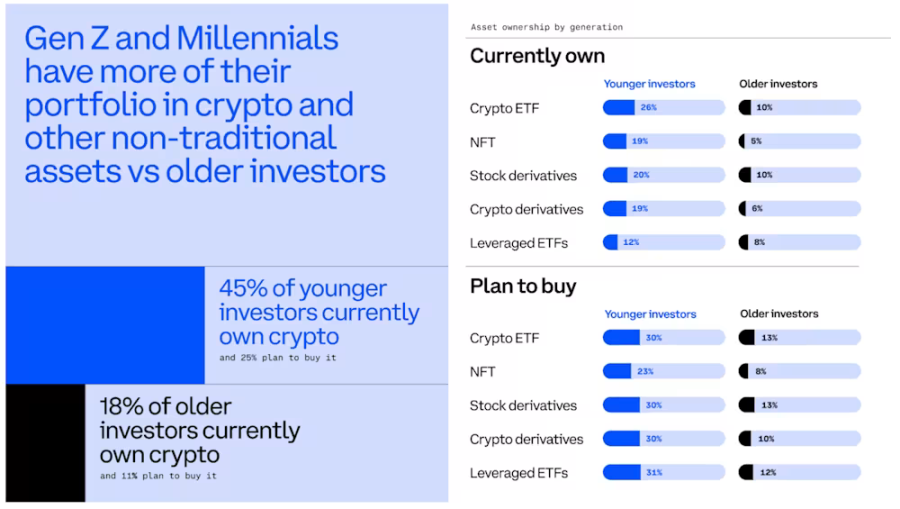
This anxiety is directly reflected in their asset allocation strategies. The survey shows that younger investors allocate 25% of their portfolios to non-traditional asset classes such as cryptocurrencies, financial derivatives, non-fungible tokens (NFTs), and other emerging products. This is three times the proportion allocated by older investors, who only allocate 8% to non-traditional assets.

The proportion of stock holdings is roughly similar across generations, but the key difference lies in the fact that younger investors diversify their portfolios beyond stocks. They are more actively seeking opportunities for returns beyond traditional stock dividends and are more willing to experiment with new investment tools and emerging markets to narrow the wealth gap.

Cryptocurrency Is Not a Side Investment but a Core Allocation

This generational shift in investment philosophy is most evident in the acceptance of cryptocurrency. The report shows that 45% of younger investors already hold cryptocurrency, compared to only 18% of older investors. Additionally, nearly half (47%) of younger investors want to gain exposure to new crypto assets before the general market, while only 16% of older investors share this desire.

In the eyes of the younger generation, cryptocurrency is not merely a form of speculative trading but an important tool to help them catch up in wealth accumulation. Eighty percent of young people believe that cryptocurrency provides their generation with more financial opportunities outside the traditional financial system. At the same time, another 80% are convinced that cryptocurrency will play a significantly larger role in the future financial system. Among older investors, only about 60% share this view.

The younger generation's enthusiasm for exploring emerging markets extends beyond spot cryptocurrencies; they are also eager to engage with more non-traditional assets. Data shows that 80% of younger investors are willing to try new investment opportunities ahead of others, while less than half of older generations share this attitude. Younger investors consistently show strong interest in emerging non-traditional products such as cryptocurrency derivatives, prediction markets, 24/7 stock trading, early token offerings, altcoins, and decentralized finance lending.

The Impact of This Trend on Future Markets

The younger generation of investors has already demonstrated distinct characteristics: they trade more frequently, are willing to take greater risks for higher returns, and are shifting a significant portion of their portfolios to non-traditional assets, with cryptocurrency at the core. At the same time, they are driving the entire financial industry toward a transformation that better meets the needs of the internet-native generation, creating platforms that operate around the clock and support diverse asset trading.


Related Questions

QAccording to the Coinbase report, what percentage of young investors have allocated their portfolios to non-traditional assets?

AYoung investors have allocated 25% of their portfolios to non-traditional assets like cryptocurrency, derivatives, and NFTs.

QHow does the view on the difficulty of building wealth through traditional pathways differ between younger and older generations?

A73% of young investors believe it is harder for their generation to build wealth through traditional pathways, compared to only 57% of older investors who share this view.

QWhat proportion of young investors already hold cryptocurrency, and how does this compare to older investors?

A45% of young investors hold cryptocurrency, whereas only 18% of older investors do.

QWhat is the prevailing belief among young investors regarding the future role of cryptocurrency in the financial system?

A80% of young investors believe that cryptocurrency will play a significantly larger role in the future financial system.

QBeyond spot crypto, what types of emerging, non-traditional products are young investors interested in?

AYoung investors are highly interested in emerging products like crypto derivatives, prediction markets, 24/7 stock trading, early token sales, altcoins, and DeFi lending.

Related Reads

The Value Distribution of Stablecoins

**Summary: The Value Distribution of Stablecoins** The article argues that stablecoins are evolving from mere trading tools into broader channels for dollar access. It divides the stablecoin ecosystem into four layers to analyze how value is distributed: 1. **Issuance Layer:** Mints stablecoins, holds reserve assets, and captures the spread between reserve yield and user costs (e.g., Tether, Circle). This layer currently earns the largest profit margin. 2. **Infrastructure Layer:** Connects stablecoins to the traditional financial system, handling fiat on/off-ramps, banking integration, compliance (KYC/AML), and asset management (e.g., Bridge, BVNK). This is the "unglamorous" but critical work, building the essential bridges between crypto and real-world finance. 3. **Acquiring/Distribution Layer:** Integrates stablecoins into merchant systems, manages payment flows, and provides enterprise financial software (e.g., Stripe, Coinbase). They act as the access point for businesses. 4. **Application Layer:** The end-users and businesses that ultimately use stablecoins for payments, settlements, or as a store of value. They benefit from convenience but have little pricing power. The core thesis is that while the issuance layer currently dominates profits, the often-overlooked **infrastructure layer holds significant long-term potential**. The real challenge and barrier to mass adoption is not the on-chain transfer of stablecoins (which is simple), but the complex "last mile" integration into existing business workflows, banking systems, and regulatory frameworks across different countries. Companies in this layer are currently in a "land grab" phase, investing heavily to build networks, secure bank partnerships, and establish compliance pathways. While their position is currently pressured by the profitable issuers above and distribution platforms below, the article suggests that if stablecoins become a default financial rail for businesses, the infrastructure providers who have done the hard work of integration will ultimately gain strong pricing power and become entrenched, essential players.

marsbit4h ago

The Value Distribution of Stablecoins

marsbit4h ago

The Value Distribution of Stablecoins

The Value Distribution of Stablecoins The article argues that stablecoins are evolving from a mere trading tool into a broad "dollar channel." It analyzes the industry's value chain through four layers: 1. **Issuance Layer (e.g., Tether, Circle):** The top layer that mints stablecoins, holds reserve assets, and captures the thickest interest rate spread. 2. **Infrastructure Layer (e.g., Bridge, BVNK):** Connects stablecoins to the traditional financial system, handling critical but complex "dirty work" like fiat on/off-ramps, banking integration, compliance (KYC/AML), and cross-border settlement. 3. **Acquiring/Distribution Layer (e.g., Stripe, Coinbase):** Embeds stablecoins into merchant systems, manages payment flows, and integrates with enterprise software. 4. **Application Layer:** End-users and businesses that ultimately use stablecoins for payments, settlement, or storing value. The author posits that while the issuance layer currently captures the most profit, the most overlooked and potentially critical layer is infrastructure. The core challenge for stablecoin adoption isn't the on-chain transfer (which is simple), but bridging the gap between blockchain and the real-world financial system. This involves solving practical problems for businesses: fiat conversion, reconciliation, tax handling, and user onboarding. Infrastructure companies are currently in a difficult "land-grab" phase—building networks, securing banking relationships, and achieving compliance country-by-country. They face pressure from both the profitable issuance layer above and distribution platforms below. However, the author suggests this layer is building a crucial moat. Once stablecoins become a default business rail, the infrastructure players who have done the hard work of integration may gain significant, durable value and pricing power.

链捕手4h ago

The Value Distribution of Stablecoins

链捕手4h ago

How to Do Research Well: Deliberately Practice the Real Skills That Matter

No one truly teaches you how to do research. You're often given a desk, a pre-selected problem, and vague instructions to "create something new." Consequently, many people reverse-engineer the job based on visible outputs—papers, posts, announcements—learning only how to *appear* like a researcher rather than how to *become* one. True research capability is built from stacking small, trainable skills, nearly all of which can be developed through deliberate practice. **Pick Your Own Problem:** Most researchers absorb problems from advisors or trends, lacking the underlying reasoning. Choosing a problem you genuinely care about, as John Schulman advises, leads to original work. Develop "taste" like a muscle: predict experiment outcomes, guess paper results from methods, and track which findings remain important over time. **Upgrade Your Inputs:** Relying on shared reading lists (arXiv hot lists, filtered group chats) leads to unoriginal conclusions. Undervalued old literature often holds crucial insights (e.g., MoE, LSTM, backpropagation). Richard Sutton's "The Bitter Lesson" or Claude Shannon's 1952 talk on creative thinking are more predictive than lengthy modern surveys. Breadth matters as much as depth: draw from neuroscience, mechanism design, hardware knowledge, and honest statistics. Read papers directly, especially appendices and limitations sections. **Write Everything Down:** As Paul Graham noted, writing exposes flaws in seemingly mature ideas. Writing is the cheapest defense against self-deception. Following Feynman's principle, Darwin programmatically wrote down facts contradicting his theory to combat memory bias. Maintain a detailed log of hypotheses, setups, predictions, results, and updated understandings. Reviewing past logs fosters essential humility.

marsbit6h ago

How to Do Research Well: Deliberately Practice the Real Skills That Matter

marsbit6h ago

Trading

Spot
Futures
活动图片