ETHZilla moves into onchain housing finance with 15% Zippy acquisition

cointelegraphPublished on 2025-12-10Last updated on 2025-12-10

Abstract

ETHZilla (ETHZ) has acquired a 15% stake in digital housing lender Zippy for $5 million in cash and $16.1 million in stock, marking its second acquisition in a week as part of a broader move into real-world asset (RWA) markets. The partnership aims to integrate Zippy’s loan-origination and AI-powered systems with ETHZilla’s tokenization platform to bring manufactured-home loans onchain. As part of the deal, ETHZilla gains a board seat and a 36-month exclusivity agreement with Zippy. Despite this expansion, ETHZilla’s stock has declined roughly 10% following the announcement, continuing a downward trend seen across several Ether treasury companies amid falling ETH prices.

Former biotech company ETHZilla (ETHZ) is doubling down on its push into real-world asset markets, taking a 15% stake in digital housing lender Zippy to bring manufactured-home loans onchain. The deal marks the company’s second acquisition in a week.

According to Wednesday’s announcement, ETHZilla will pay $5 million in cash and $16.1 million in stock for a 15% stake in Zippy, a US-based lender founded in 2021 that originates manufactured-home loans through a digital platform.

The companies plan to link Zippy’s loan-origination and AI-powered systems with ETHZilla’s tokenization stack for onchain distribution of manufactured-home chattel loans, including potential forward-flow sales to institutional investors.

As part of the transaction, ETHZilla will gain a board seat at Zippy and secure a 36-month exclusivity period requiring Zippy to conduct all blockchain infrastructure, digital asset issuance and tokenization through ETHZilla’s platforms.

ETHZilla, the sixth-largest Ether (ETH) treasury company according to CoinGecko data, said the investment builds on its broader push into real-world asset (RWA) markets.
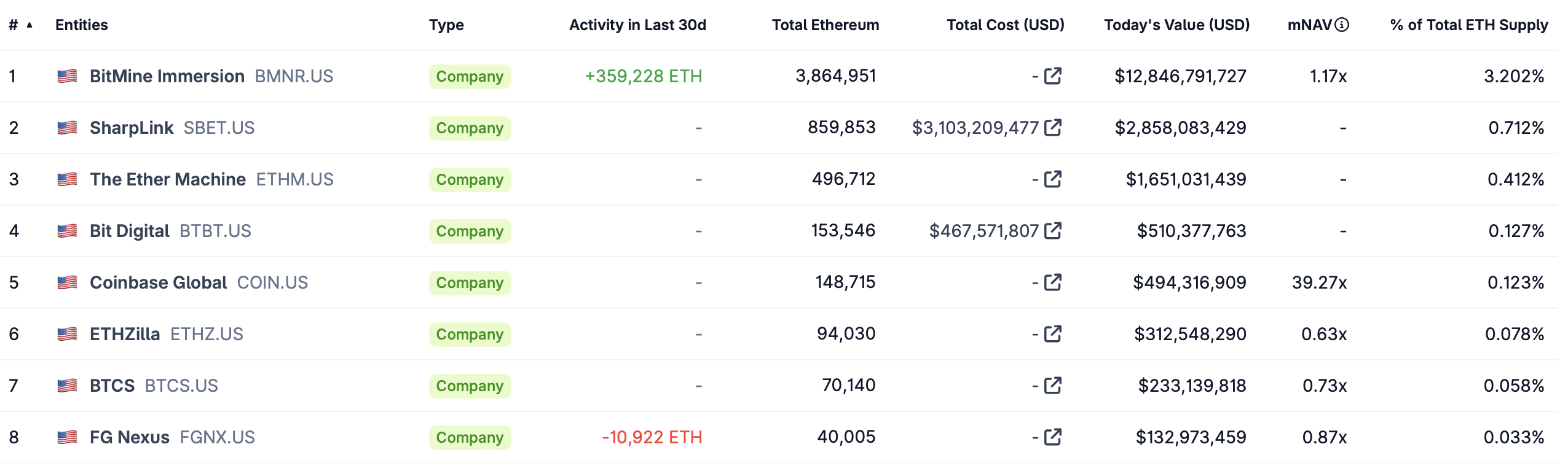
Top Ethereum treasury companies. Source: CoinGecko

The announcement comes one week after ETHZilla acquired a 20% fully diluted stake in auto-finance startup Karus for $10 million in cash and stock.

ETHZilla’s stock price was down around 10% at the time of writing, according to Yahoo Finance data.
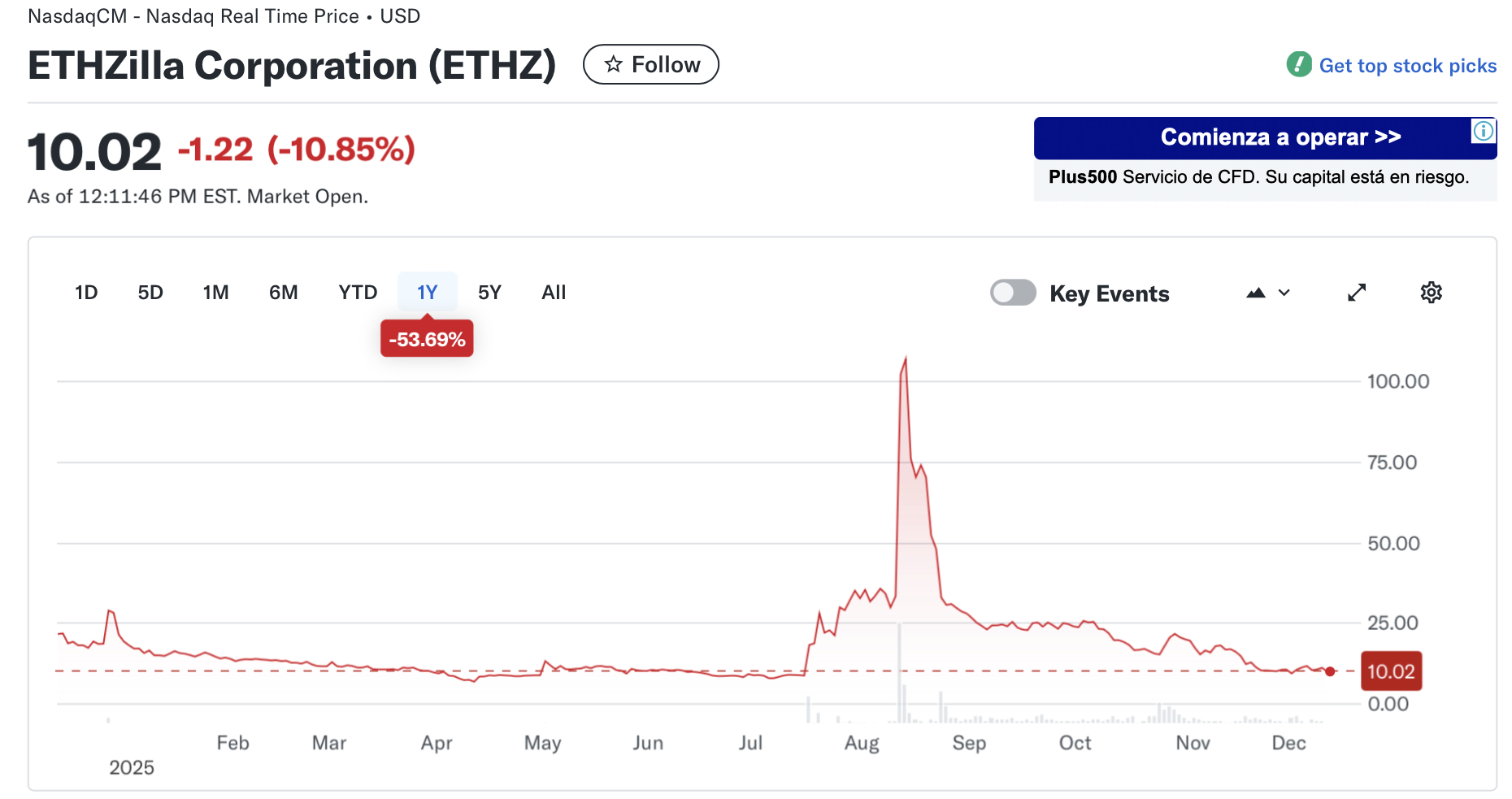
Source: Yahoo Finance

Related: Ethereum rising to $3.3K proves bottom is in: Is 100% ETH rally next?

Ether treasury stocks face steep declines

Several public companies that adopted Ether as a balance-sheet asset this year have seen sharp share-price reversals as the token price has fallen from its peak, ETHZilla among them.

ETHZilla, formerly 180 Life Sciences Corp, announced its pivot to an Ether treasury company on July 29. Its stock climbed from a $45 open that day to a $107 close by Aug. 13. However, the stock has declined roughly 91% since then, trading around $10 at this writing.

SharpLink Gaming launched an Ethereum treasury strategy in May, alongside a $425 million private placement that included Consensys as an investor and coincided with the nomination of Ethereum co-founder Joseph Lubin as chairman.

The company’s stock climbed more than 130% on the news to $79.21 on May 29, but has since dropped sharply to trade around $11.77 on Wednesday, according to Yahoo Finance data.
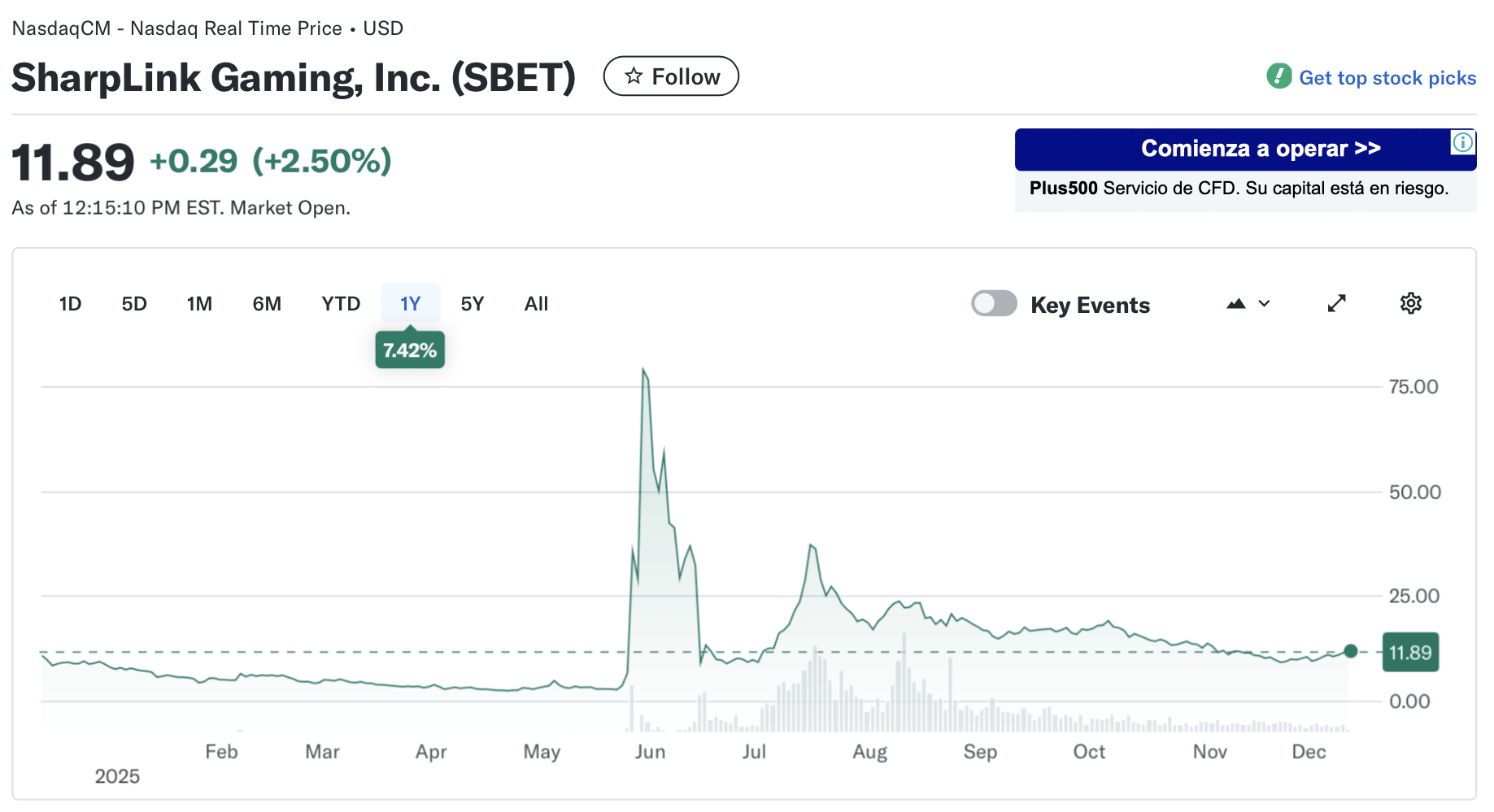
Source: Yahoo Finance

Bitmine Immersion, an Ether treasury company led by Fundstrat’s co-founder Tom Lee, has also struggled in recent months. Its stock hit an all-time high of $135 in July, but has since fallen to around $40 at this writing.
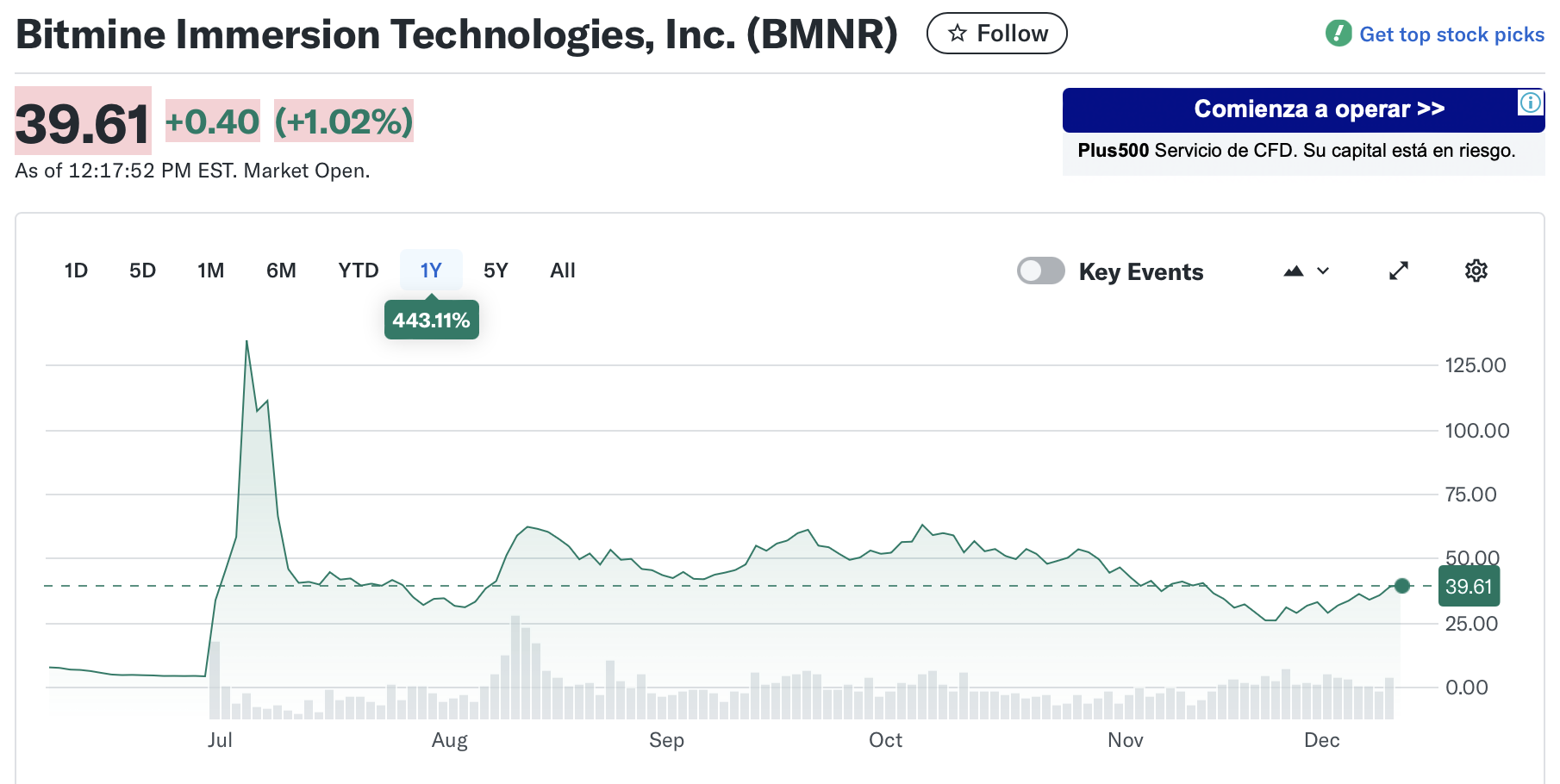
Source: Yahoo Finance

In August, Komodo Platform chief technology officer Kadan Stadelmann told Cointelegraph that companies adopting ETH treasury strategies face structural risks, and warned that a downturn in the market could force liquidations and amplify selling pressure on the token.

Ether has fallen since its all-time high of $4,946.05 on Aug. 24 and now trades at $3,365, according to CoinGecko data.

Magazine: Meet the onchain crypto detectives fighting crime better than the cops


Related Reads

Altcoin Hacked, Leading to Sharp Price Drop! Also Listed on Major Exchanges!

The price of the NES token plummeted significantly following suspicious activity and large sell-offs detected on the network. Blockchain observers suggested that one wallet minted approximately $55 million worth of NES tokens and began selling them on decentralized exchanges. This selling pressure caused the price of NES to drop by up to 40%. According to the data, the address in question still holds around $18 million worth of NES, indicating that market sell-off pressure may continue. Prior to the incident, it was reported that about $12.35 million worth (62.9 million NES tokens) were transferred to the Ethereum mainnet in the morning (Turkish time), with claims that liquidity was withdrawn and tokens were sold on the market later that evening. However, data regarding the $55 million token mint and the transfer of 62.9 million NES tokens has not been independently confirmed. The NESA team confirmed in a statement that they detected malicious activity exploiting a vulnerability in their Layer 1 network originating from Cosmos EVM. They stated they are working to contain the impact, responded promptly, and will restore services after implementing a software patch and additional measures to ensure secure network operation. Nesa also notified all cryptocurrency exchanges and stated deposit operations will resume after necessary work is completed. The article includes a chart showing the NES price decline following the exploit and concludes with a standard disclaimer that this is not investment advice.

cryptonews.ru1h ago

Altcoin Hacked, Leading to Sharp Price Drop! Also Listed on Major Exchanges!

cryptonews.ru1h ago

PeaqOS and World ID Integrate ZK Proofs into Autonomous Robots

The integration of PeaqOS and World ID now allows autonomous machines to verify they are interacting with real, unique individuals without collecting names, photos, or other personal data. This update, available via robotic.sh, enables connected devices to directly request and verify World ID proofs. The system leverages zero-knowledge technology, letting a person prove they are human while maintaining the privacy of their identity. This addresses a key challenge for operators of delivery robots, shared machines, and autonomous systems: how to authenticate a user as genuine without relying on insecure PINs, pickup codes, or traditional identity checks that require personal data collection. Instead of obtaining identifying information, a device receives a cryptographic proof that the user is a real person. PeaqOS acts as a coordination layer, allowing devices to utilize World ID via decentralized identifiers and a device marketplace. A robot can request verification, receive a zero-knowledge proof, and register an auditable record of the interaction—all without exposing underlying personal data. The system also supports uniqueness verification, enabling machines to enforce rules like "one item per person" without maintaining user identity databases. A demonstrated use case involves autonomous medicine delivery: a patient verifies via the World App when placing an order, a pharmacist verifies before loading the medication, and the patient verifies again upon delivery so the robot can confirm the recipient is linked to the order before unlocking the compartment. Similarly, promotional robots could ensure one item per person, and shared vending machines could grant access to verified individuals without requiring accounts or personal data. This integration for PeaqOS-powered robots and devices minimizes the identity information collected or stored while allowing autonomous systems to confirm they are interacting with real humans.

cryptonews.ru2h ago

PeaqOS and World ID Integrate ZK Proofs into Autonomous Robots

cryptonews.ru2h ago

Trading

Spot
活动图片