Ethereum Supply Becomes More Concentrated In Large Wallets, Here Are The Numbers

bitcoinistPublished on 2026-06-01Last updated on 2026-06-01

Abstract

Recent on-chain data indicates a significant increase in Ethereum concentration among large wallet holders. Whale addresses holding at least 100,000 ETH now control 22.03% of the total supply, the highest level in ten weeks, representing approximately $35 billion in value. This trend points to aggressive accumulation by institutional players and whales, continuing despite recent market volatility and price declines. Supporting this shift, exchange reserves have been consistently declining, suggesting assets are being moved to cold storage for long-term holding. Market activity shows a surge in buy orders from these large holders, effectively absorbing selling pressure from retail investors. Notably, one whale recently opened a highly leveraged $25.6 million long position, signaling strong confidence albeit with substantial risk.

The concentration of Ethereum (ETH) among large wallet holders is increasing as whales and institutional players continue to buy the second-largest cryptocurrency at an aggressive pace. Fresh on-chain data has also revealed a striking shift in the asset’s supply distribution. Currently, almost a quarter of Ethereum’s supply is now controlled by these large players, suggesting that accumulation by whales has continued despite recent price declines and market volatility.

Over 22% Of Ethereum Supply Now Controlled By Whales

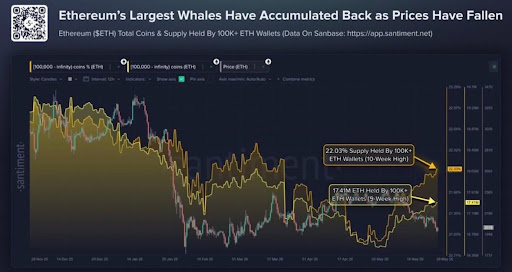
On May 28, on-chain analytics platform Santiment posted fresh data on Ethereum’s supply distribution and whale concentration on X. According to the report, whale wallets with at least 100,000 ETH now collectively hold a staggering 17.4 million tokens, indicating a renewed accumulation trend among major investors.

Santiment noted that this represents the highest number of ETH held by this group of whales in the past nine weeks, suggesting that large players and institutions are aggressively increasing their buying activity as prices continue to decline. Notably, the total value of each ETH whale wallet has surged to approximately $35 billion based on recent market prices.
Source: Santiment

Moreover, the share of Ethereum’s supply held by these whales has reached a whopping 22.03%, marking a supply distribution high not seen in as long as 10 weeks. This data highlights a growing dominance of a small group of large holders over Ethereum’s circulating supply, in contrast to the smaller holdings of retail investors.

Interestingly, Ethereum whale activity has been increasing since 2025, with investors taking advantage of lower prices and market swings to bolster their positions. However, sometime in 2026, Ethereum experienced a major distribution phase, as these same whales began selling off their cryptocurrencies. However, recent reports indicate this trend has since changed.

Not only are whales accumulating Ethereum directly, but according to CryptoQuant, exchange reserves have continued to decline into Q2 2026. This consistent outflow has contributed significantly to ETH’s reduced circulating supply, suggesting that whales are buying ETH and moving it to cold wallets for long-term holding.

ETH Buy Orders Surge As Whales Go Long

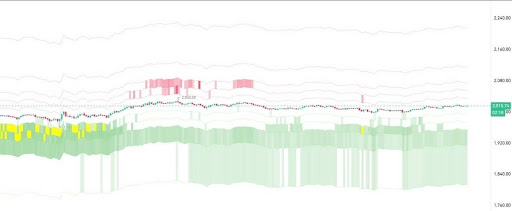
Currently, buy orders for Ethereum are still rising, as on-chain data shows strong confidence and renewed interest among large holders. Crypto analyst CW shared this latest development on X, noting that there have been virtually no sell orders from whales in recent days. He also said that the buy orders are effectively absorbing the selling volume from retail investors in the ETH market.
Source: Santiment

As this unfolds, whales appear to be going long on Ethereum, betting that it could increase soon. A recent market report by Crypto Rover shows that a large holder opened a staggering $25.6 million ETH long position with 25x leverage. Crypto Rover described this as an “insane gamble,” highlighting both massive confidence and extreme risk involved. The analyst noted that if Ethereum’s price drops by just $20, the whale’s entire position could be wiped out.

ETH bull push for recovery | Source: ETHUSDT on Tradingview.com

Related Questions

QAccording to the article, what percentage of Ethereum's supply is now controlled by large wallet holders (whales)?

AAccording to the on-chain data from Santiment, large wallet holders (whales) now control 22.03% of Ethereum's supply.

QWhat is the minimum amount of ETH that defines a 'whale wallet' in the data presented by Santiment?

AIn the Santiment data, a 'whale wallet' is defined as a wallet holding at least 100,000 ETH.

QWhat recent trend does the decline in exchange reserves into Q2 2026 suggest about whale behavior?

AThe consistent decline in exchange reserves into Q2 2026 suggests that whales are buying ETH and moving it to cold wallets for long-term holding, rather than keeping it on exchanges for trading.

QWhat did analyst CW note about sell orders from whales in recent days?

AAnalyst CW noted that there have been virtually no sell orders from whales in recent days, with buy orders effectively absorbing the selling volume from retail investors.

QWhat significant risk did Crypto Rover highlight about the large $25.6 million ETH long position with 25x leverage?

ACrypto Rover highlighted that if Ethereum's price drops by just $20, the whale's entire $25.6 million leveraged long position could be wiped out.

Related Reads

For Hedging, Buy Gold and Oil; For Explosive Growth, Buy AI; Bitcoin, the 'Outdated' Asset, Enters a Bear Market

Bitcoin’s price has recently fallen sharply, hitting a two-month low near $66,000, with Ethereum also dropping to a three-month low. While surface explanations point to ETF outflows, geopolitical tensions, and corporate selling, a deeper issue is emerging: Bitcoin is losing a crucial asset competition. For years, Bitcoin thrived in a low-rate environment where investors sought alternatives amid inflation fears and dissatisfaction with traditional options. Now, the market landscape has shifted, leaving Bitcoin stuck in an "awkward middle ground," facing challenges on three fronts: 1. **As an inflation hedge, gold is winning.** Investors worried about persistent inflation are turning to tangible assets like gold, energy stocks, and commodity producers, which offer more direct pricing power and physical backing. 2. **For growth exposure, AI is winning.** Those seeking high growth now favor AI-related companies with actual revenues and profits, an area where Bitcoin's lack of cash flow puts it at a disadvantage. 3. **Within crypto, infrastructure and stablecoins are winning.** Even investors wanting crypto exposure have alternatives like exchanges, stablecoin issuers, and tokenization firms, whose performance is directly tied to real-world adoption and offers clearer operational leverage. The recent market reaction to inflation warnings highlights this shift. Instead of boosting Bitcoin as "digital gold," such news now drives flows toward traditional inflation-sensitive assets. Therefore, recent events like ETF outflows and corporate selling are seen not as causes, but as symptoms of this new reality. Capital has more compelling options, and investors are becoming more selective. The emerging bear case for Bitcoin is no longer about it being a fraud or failed technology, but rather that **scarcity alone is no longer enough**. It is no longer seen as the best hedge, the best growth asset, or the only crypto play.

marsbit3m ago

For Hedging, Buy Gold and Oil; For Explosive Growth, Buy AI; Bitcoin, the 'Outdated' Asset, Enters a Bear Market

marsbit3m ago

SaaS Battle Royale: The Survivors Who Win All Share One Common Trait

**Summary** The AI revolution has triggered a "SaaS apocalypse," forcing a brutal market shakeout. The key dividing line is the pricing model. Companies like Snowflake and Datadog, which charge based on consumption (e.g., data processed or compute used), are thriving. AI workloads actively *generate* more demand for their services, fueling growth. Datadog's accelerating revenue is a prime example. Microsoft and Palantir, as platform/ecosystem players, also benefit by acting as essential channels for AI deployment. In contrast, traditional SaaS firms built on per-seat or per-task licensing (e.g., Intuit, Adobe) face direct pressure, as AI threatens to automate the very human tasks their software supports. Companies like Salesforce, a per-seat giant, are caught in the middle. While showing strong AI monetization (e.g., its Agentforce platform) and experimenting with consumption-based "Flex Credits," its stock remains under pressure, illustrating that the market rewards *completed* transitions, not just the intent. The recent Microsoft Build conference underscored key trends: AI is evolving from an assistant to an autonomous "agent," and platform providers like Microsoft are consolidating their control. The market's recovery is highly selective, focused on identifying which companies are "fed by AI" versus "eaten by AI." Future focus will be on the diffusion of this recovery to transforming companies and the real-world adoption data of AI agents like Microsoft Copilot.

marsbit20m ago

SaaS Battle Royale: The Survivors Who Win All Share One Common Trait

marsbit20m ago

Trading

Spot
Futures

Hot Articles

Discussions

Welcome to the HTX Community. Here, you can stay informed about the latest platform developments and gain access to professional market insights. Users' opinions on the price of ETH (ETH) are presented below.

活动图片









