Ethereum network sees 62% drop in fees: Is ETH price at risk?

cointelegraphPublished on 2025-12-09Last updated on 2025-12-09

Abstract

Ethereum's network fees have dropped 62% over 30 days, significantly more than other major blockchains, indicating cooling base layer activity despite ETH's price rally to a three-week high near $3,400. While decentralized exchange volumes and DApp revenues on Ethereum have declined, layer-2 networks like Base and Polygon show substantial growth in transactions. The Fusaka upgrade may have contributed to lower fees. Derivatives data showing neutral funding rates and Ethereum's maintained dominance in Total Value Locked (TVL) suggest no immediate bearish pressure, with the ecosystem's shift to layer-2 scaling viewed as a sustainable growth model.

Key takeaways:

  • Ethereum’s base layer activity has cooled, with fees and TVL dropping, showing slower demand despite the recent price recovery.

  • Layer-2 networks are growing rapidly, helping to support Ethereum even as base layer usage weakens and traders remain cautious.

Ether (ETH) rallied to a three-week high near $3,400 on Tuesday after weak United States job market data reinforced expectations that US monetary policy could become less restrictive sooner than previously thought.

Even with the 11.2% weekly gains, traders still worry that sluggish Ethereum network activity and limited demand for bullish leverage may curb the short-term upside.
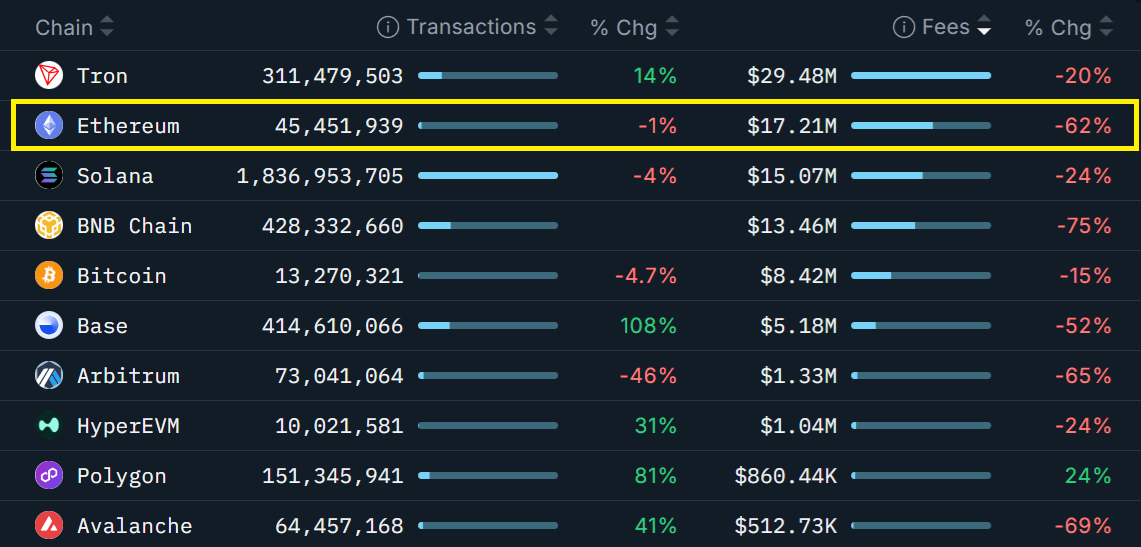
Blockchains ranked by 7-day network fees, USD. Source: Nansen

Nansen data shows that Ethereum’s 30-day network fees dropped by 62%, a far deeper pullback than the roughly 22% decline observed on Tron, Solana and HyperEVM during the same window.

Some activity, however, stood out: transactions on Base rose 108%, while Polygon recorded an 81% increase, suggesting continued momentum across Ethereum’s expanding layer-2 ecosystem.

The Ethereum Fusaka upgrade on Dec. 3 introduced changes designed to improve rollup efficiency, which may have contributed to the lower network fees noted throughout the month.
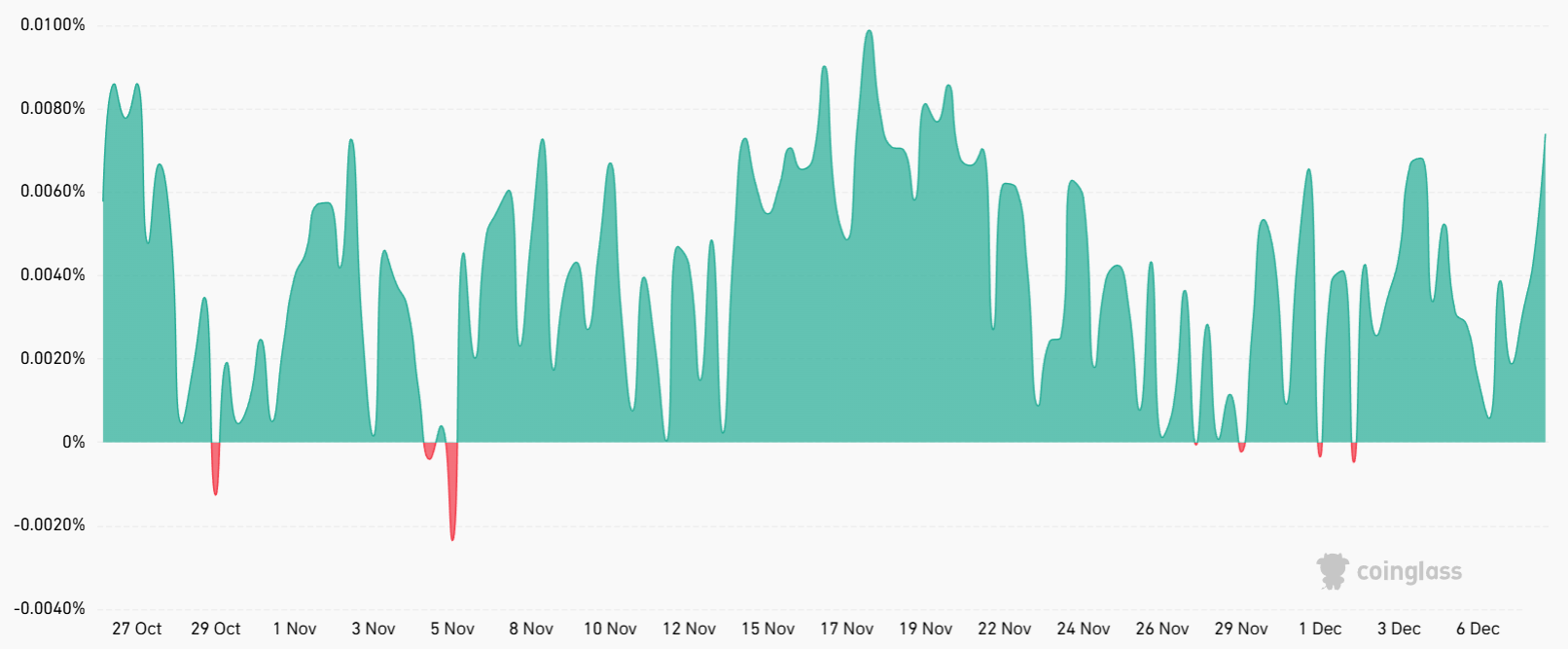
ETH perpetual futures 8-hour funding rate. Source: CoinGlass

On Tuesday, the annualized funding rate for ETH perpetual futures held near 9%, reflecting a fairly even distribution of leveraged positions between buyers (longs) and sellers (shorts). Under normal market conditions, this indicator tends to oscillate between 6% and 12% to account for capital costs; levels above that range usually signal stronger bullish positioning.

Traders turned more defensive after the US Bureau of Labor Statistics reported 1.85 million layoffs in October, the highest figure since 2023. Markets are now pricing in a 0.25% interest rate cut by the US Federal Reserve on Wednesday, while attention shifts to Fed Chair Jerome Powell’s comments following the Committee meeting.

Ethereum’s layer-2 growth offsets base layer fee declines

Despite the recent bullish momentum, Ether still trades 32% below its all-time high of $4,597 from August. To gauge whether demand for the Ethereum network is genuinely declining, it’s useful to look at the impact on decentralized applications (DApps).
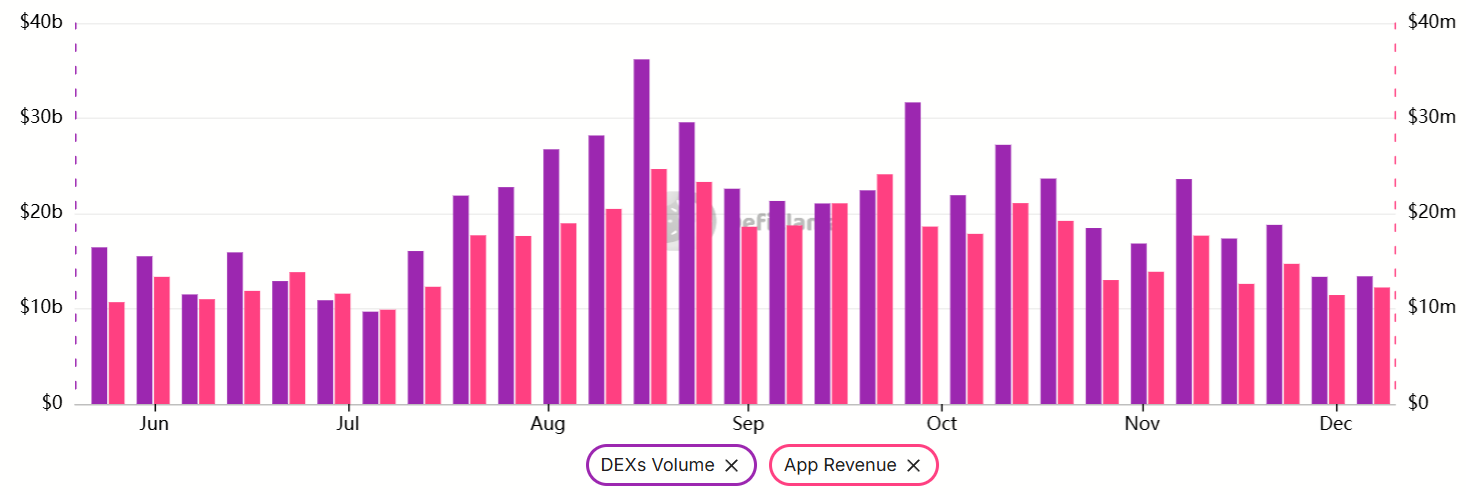
Ethereum network 7-day DEX volumes (left) vs. DApps revenue (right). Source: DefiLlama

Volumes on Ethereum-based decentralized exchanges fell to $13.4 billion over seven days, down from $23.6 billion four weeks earlier. Likewise, decentralized application revenues reached a five-month low of $12.3 million during the same period. Overall, demand for Ethereum’s base layer processing has been slipping since it peaked in late August.
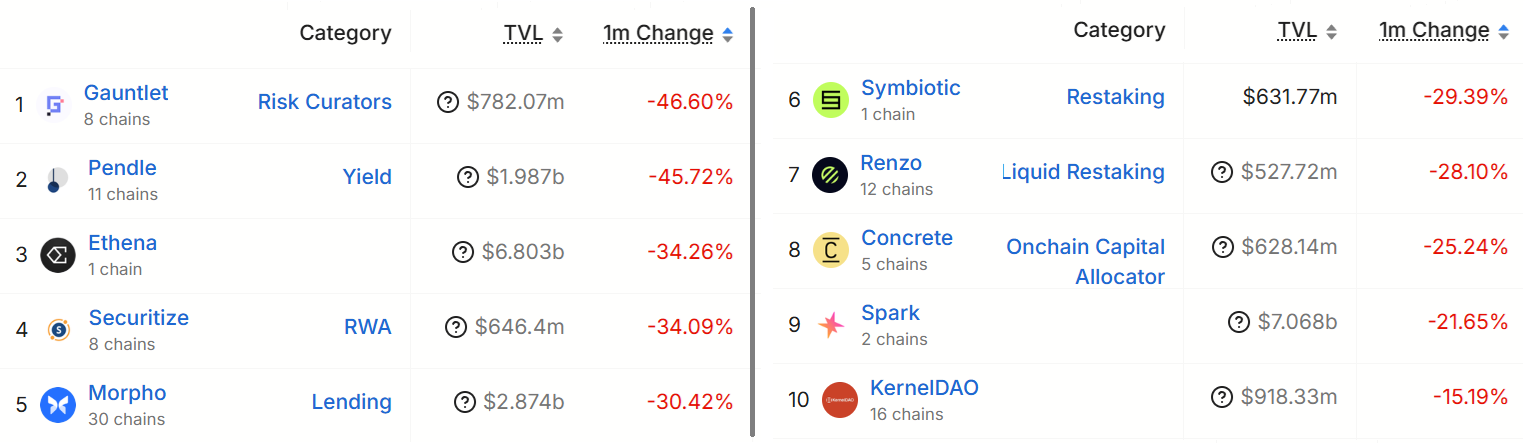
Ethereum DApps with $500 million or higher in TVL. Source: DefiLlama

Some of Ethereum’s leading DApps saw a sharp drop in total value locked (TVL), including Pendle, Athena, Morpho and Spark. Aggregate TVL on the Ethereum base layer fell to $76 billion from $100 billion two months earlier. Even so, Ethereum’s dominance remains intact with a 68% market share, while runner-up Solana holds under 10%.

Ether bulls argue that the network’s strong incentives for layer-2 scalability offer a more sustainable model compared with the heavier load and centralized coordination required by competing blockchains. Ethereum is positioned to capture a significant share of future growth in decentralized finance (DeFi).

Related: US Treasurys lead tokenization wave as CoinShares predicts 2026 growth

US Securities and Exchange Commission Paul Atkins reportedly said in a FOX Business interview that tokenization of the US market could occur in “a couple of years,” adding that blockchain offers “huge benefits” such as predictability and transparency. Atkins said the US should “embrace this new technology, bring it onshore where it can work under American rules.”

While Ethereum’s base layer fees have seen a sharp decline, along with the drop in TVL, activity across the layer-2 ecosystem continues to expand. Currently, neither onchain nor derivatives data indicate a meaningful weakness in ETH price dynamics.

This article is for general information purposes and is not intended to be and should not be taken as legal or investment advice. The views, thoughts, and opinions expressed here are the author’s alone and do not necessarily reflect or represent the views and opinions of Cointelegraph.


Related Reads

Just Now, Chinese AI Enters Top 2 in Global Programming, Only Claude Remains Ahead

**China's AI Ranks Second Globally in Programming, Trailing Only Claude** Today, Alibaba's Qwen3.7-Max achieved a score of 1541 on the Code Arena benchmark, securing fourth place globally and surpassing top models like GPT-5.5 and Gemini 3.5 Flash. Among the top positions, it is now the only non-Claude model, placing second overall after Anthropic's Opus models. Before this official ranking, Qwen3.7-Max had already gained recognition overseas. In practical tests, it outperformed rivals on tasks like creating a self-training Tetris AI and generating complex 3D models, often at a significantly lower cost. Developers praised its ability, especially when integrated with tools like Hermes Agent and OpenCode, to effectively replace models such as GPT-5.5. In a hands-on challenge to create a 3D racing game from a detailed prompt, Qwen3.7-Max delivered a fully playable HTML file in the first attempt, requiring only minor bug fixes. It uniquely included a start menu and sound effects—details missed by other models. While competitors like Gemini 3.5 Flash and Claude Opus 4.6 produced less polished or functional versions, and GPT-5.5 had its own quirks, Qwen3.7-Max stood out for its initial completeness and playability. This performance stems from its design as an "Agent Base Model," built for long-duration, autonomous task execution. Internal tests show it can run continuously for 35 hours, making over 1158 tool calls without context degradation or instruction drift. Key technical advancements include "environment expansion" training, which improves adaptability across different frameworks, and "long-horizon autonomous execution" training, enabling sustained strategic decision-making. By entering the top tier of the programming arena, Qwen3.7-Max demonstrates that Chinese AI models are not just catching up but are becoming defining competitors, challenging the long-standing dominance of Silicon Valley in this field.

marsbit21m ago

Just Now, Chinese AI Enters Top 2 in Global Programming, Only Claude Remains Ahead

marsbit21m ago

From a Lunch Table to an Infinite Universe: Fei-Fei Li Bets on AI's Next Dimension

From a Lunch Table Conversation to an Infinite Universe: Fei-Fei Li Bets on AI's Next Frontier - Spatial Intelligence In an era dominated by large language models, AI pioneer Fei-Fei Li argues that true understanding requires spatial intelligence — the ability to perceive, reason, and interact within the physical 3D/4D world. She points to evolutionary history: spatial perception drove the Cambrian explosion 540 million years ago, while language is a far more recent, inherently "lossy" way to encode reality. Current models struggle with basic spatial tasks a child can do, like counting chairs in a video. Her company, World Labs, is pioneering this shift with "Marble," a model that generates navigable, consistent 3D worlds from text, images, or simple 3D inputs—distinct from video generators like Sora. Though smaller than models like GPT-5, due to scarce 3D data and early-stage scaling laws, Marble is already used in gaming, robot training (by NVIDIA), architectural design, and personalized therapy for conditions like OCD and acrophobia. Li envisions this technology enabling "infinite universes" for creativity, social interaction, and more. However, she cautions against utopian or dystopian extremes, advocating for a measured vision where AI enhances human dignity and prosperity, akin to how electricity transformed civilization. The journey is long — as evidenced by the 20-year path to viable autonomous vehicles — but the direction is clear: for AI to move from merely talking about the world to truly understanding and acting within it.

marsbit24m ago

From a Lunch Table to an Infinite Universe: Fei-Fei Li Bets on AI's Next Dimension

marsbit24m ago

X Stock Market Investment & Trading: A 'Noise-Free' List of 50 Key Accounts

Titled "A 'Noise-Reduction' List of 50 Top US Stock Market Influencers on X," this article curates a selection of accounts for investors seeking quality information beyond follower counts. The list prioritizes accounts that have consistently discussed US stocks, ETFs, earnings, macroeconomics, options, and tech/AI/semiconductor topics over the past 90 days. Selection criteria focused on genuine informational value, stable analytical frameworks over mere news aggregation, and a clear relevance to US equity markets, with tighter filtering for crypto-heavy accounts. The final 50 accounts are categorized into three groups: - **Core US Stocks/Trading (31 accounts)**: Covering market trends, individual stocks, earnings, valuation, options, macroeconomics, and trading strategies. - **Tech/AI/Semiconductors (18 accounts)**: Focused on tech stocks, AI supply chains, semiconductor cycles, data centers, and cloud capital expenditure. - **News Source (1 account)**: Useful as a news radar, not for standalone decision-making. Presented alphabetically by handle, the list includes analysts, traders, and researchers such as @amy6tina (options/CFA), @dylan522p (semiconductors/AI infrastructure), @gerberkawasaki (tech stocks), @jimcramer (market commentary), and @tengyanai (semiconductors/AI trends). The article suggests using the list to: 1) complete one's information sources on US markets and specific sectors, 2) observe narrative linkages between AI, semiconductors, earnings, macro liquidity, and stock prices, and 3) "de-noise" and enhance the quality of one's X feed. It clarifies this is not investment advice or an endorsement, but a snapshot of content relevance and informational value for US equity investors.

marsbit30m ago

X Stock Market Investment & Trading: A 'Noise-Free' List of 50 Key Accounts

marsbit30m ago

Trading

Spot
Futures

Hot Articles

Discussions

Welcome to the HTX Community. Here, you can stay informed about the latest platform developments and gain access to professional market insights. Users' opinions on the price of ETH (ETH) are presented below.

活动图片