Ethereum Nearing A Turning Point? Supply-Demand Structure Suggest A Shift Is Coming In 2026

bitcoinistPublished on 2025-12-31Last updated on 2025-12-31

Abstract

Ethereum is struggling to reclaim the $3,000 level amid persistent selling pressure and weak market sentiment. According to a CryptoQuant report, ETH is in a late-stage bearish phase, transitioning toward range-bound trading with slower, more methodical distribution rather than panic selling. Despite price weakness, on-chain data shows improvement: ETH is leaving exchanges at the fastest pace this cycle, likely due to increased staking and long-term holding. The validator queue now has more ETH waiting to enter staking than to exit, indicating tightening medium-to-long-term supply. While ETF flows remain negative, network activity is resilient, with record smart contract deployments and growing real-world asset value on-chain. The data suggests ongoing price pressure but gradual structural improvement, with a potential shift expected by 2026.

Ethereum is once again struggling to regain the $3,000 level, highlighting the fragile state of the market as selling pressure continues to weigh on price action. After multiple failed attempts to push higher, ETH remains locked below key resistance, reflecting broad uncertainty and a lack of conviction among both traders and long-term investors.

Market sentiment has deteriorated sharply, with apathy and fear dominating positioning as participants remain hesitant to deploy fresh capital. Rather than aggressive capitulation, the current environment points to exhaustion and indecision, a common feature of late-cycle corrective phases.

According to a recent report by XWIN Research Japan on CryptoQuant, Ethereum is now in a late-stage bearish phase that appears to be transitioning into a more range-bound structure. While bearish pressure still dominates the broader trend, the nature of selling activity is changing.

Instead of sharp, panic-driven sell-offs, the market is experiencing slower, more methodical distribution, suggesting that many weak hands may have already exited. This shift often marks a critical inflection point, where volatility compresses, and price stabilizes within a defined range.

Ethereum’s On-Chain Structure Improves As Price Weakness Persists

While Ethereum continues to struggle below key resistance levels, on-chain indicators suggest that the underlying market structure may be gradually improving. Data shows ETH leaving exchanges at the fastest pace of this cycle, a move increasingly associated with self-custody, staking, and long-term holding rather than short-term trading activity.

This shift is reinforced by validator queue dynamics: for the first time in six months, the entry queue has surpassed the exit queue, with roughly 745,000 ETH waiting to be staked versus around 360,000 ETH queued for withdrawal. The imbalance points to renewed staking participation and a tightening medium- to long-term supply profile.

Additional context comes from the 90-day Spot Taker CVD, which indicates a transition away from strongly sell-dominant conditions toward neutral to mildly positive pressure. Although this does not imply an immediate price rebound, it suggests that aggressive selling is beginning to lose intensity.
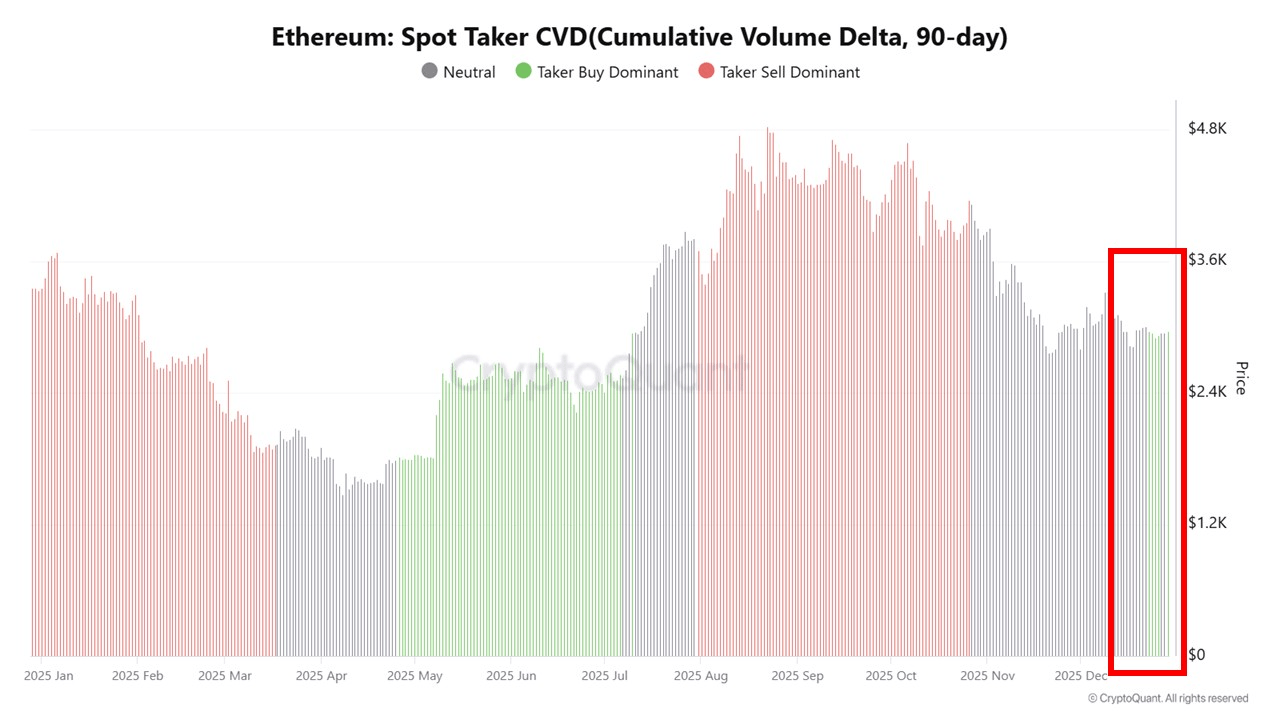
Ethereum Spot Taker CVD | Source: CryptoQuant

That said, Ethereum ETF flows remain negative on both daily and weekly timeframes, signaling that institutional demand via financial products continues to weigh on price action.

Beyond market flows, Ethereum’s network activity remains resilient. Deployed smart contracts reached a record 8.7 million in Q4 2025, while on-chain real-world asset value expanded to approximately $19 billion, led by Ethereum. These trends indicate that usage-driven demand remains intact despite weak sentiment.

The data support a scenario of ongoing price pressure alongside gradual structural improvement. This assessment would weaken if exchange balances rise again or sell-side flows regain dominance.


Related Questions

QWhat is the current market sentiment for Ethereum according to the article?

AMarket sentiment has deteriorated sharply, with apathy and fear dominating positioning as participants remain hesitant to deploy fresh capital.

QWhich research firm's report is cited in the article, and what phase does it say Ethereum is in?

AThe report is by XWIN Research Japan on CryptoQuant, and it states that Ethereum is in a late-stage bearish phase that appears to be transitioning into a more range-bound structure.

QWhat on-chain data suggests an improvement in Ethereum's underlying market structure despite price weakness?

AData shows ETH leaving exchanges at the fastest pace of this cycle, and the validator entry queue has surpassed the exit queue for the first time in six months, indicating a shift toward self-custody, staking, and long-term holding.

QWhat does the 90-day Spot Taker CVD indicate about the current selling pressure?

AThe 90-day Spot Taker CVD indicates a transition away from strongly sell-dominant conditions toward neutral to mildly positive pressure, suggesting that aggressive selling is beginning to lose intensity.

QWhat two metrics are provided as evidence that Ethereum's network activity remains resilient?

ADeployed smart contracts reached a record 8.7 million in Q4 2025, and on-chain real-world asset value expanded to approximately $19 billion, led by Ethereum.

Related Reads

TechFlow Intelligence Bureau: Chip Stocks Lose Trillions in a Single Day, Bitcoin Falls Below $60,000, US-Iran Conflict Escalates

**Daily Tech & Markets Roundup: AI Advances, Market Turmoil, and Geopolitical Tensions** **AI / LLMs**: Anthropic's internal report on AI self-improvement sparked serious discussions about Recursive Self-Improvement (RSI). Meanwhile, debate continues on AI coding tools after Claude was accused of introducing bugs into the rsync codebase. In positive news, DeepSeek V4 Flash impressed in local deployment tests, and GitHub Copilot now supports custom endpoints for local models. A surprising research turn suggests removing chain-of-thought prompting can sometimes improve LLM performance. **Crypto / Web3**: Bitcoin plunged below $60,000, with its RSI hitting levels last seen during the COVID-19 crash, driven by strong U.S. jobs data reviving interest rate hike fears. Discussions highlight Ethereum DeFi's continued lack of a smooth consumer payment layer. **Chips / Hardware**: Chip stocks suffered a massive sell-off, with the Philadelphia Semiconductor Index posting its worst single-day drop in six years, erasing over a trillion dollars in value. Marvell, Micron, AMD, and Intel were among the biggest losers. **Tech Companies**: A leaked Microsoft document revealing goals to make Copilot "addictive" drew criticism. LinkedIn founder Reid Hoffman left Microsoft's board to focus full-time on his AI agent startup, Manus. Google was revealed to be paying SpaceX $920 million monthly for AI training compute. **Markets & Macro**: A blowout U.S. jobs report (172k vs. 80k expected) crushed hopes for near-term rate cuts, sending Treasury yields soaring and triggering a broad market sell-off. CEOs from Kraft, McDonald's, and Whirlpool simultaneously warned U.S. consumers are exhausting their savings. **Geopolitics**: U.S.-Iran tensions escalated with missile/drone interceptions and U.S. strikes on Iranian radar sites, keeping the critical Strait of Hormuz largely closed since late February and posing ongoing oil supply risks. **The Bottom Line**: The strong jobs data acted as a single trigger for correlated sell-offs across equities, crypto, and chips. Underlying the volatility is a stark contradiction between robust employment data and warnings of consumer weakness, alongside geopolitical risks that could reignite inflation, leaving markets to price in a fraught macro outlook with no clear "soft landing" path.

marsbit4h ago

TechFlow Intelligence Bureau: Chip Stocks Lose Trillions in a Single Day, Bitcoin Falls Below $60,000, US-Iran Conflict Escalates

marsbit4h ago

Trading

Spot
Futures

Hot Articles

How to Buy SFP

Welcome to HTX.com! We've made purchasing SafePal (SFP) simple and convenient. Follow our step-by-step guide to embark on your crypto journey.Step 1: Create Your HTX AccountUse your email or phone number to sign up for a free account on HTX. Experience a hassle-free registration journey and unlock all features.Get My AccountStep 2: Go to Buy Crypto and Choose Your Payment MethodCredit/Debit Card: Use your Visa or Mastercard to buy SafePal (SFP) instantly.Balance: Use funds from your HTX account balance to trade seamlessly.Third Parties: We've added popular payment methods such as Google Pay and Apple Pay to enhance convenience.P2P: Trade directly with other users on HTX.Over-the-Counter (OTC): We offer tailor-made services and competitive exchange rates for traders.Step 3: Store Your SafePal (SFP)After purchasing your SafePal (SFP), store it in your HTX account. Alternatively, you can send it elsewhere via blockchain transfer or use it to trade other cryptocurrencies.Step 4: Trade SafePal (SFP)Easily trade SafePal (SFP) on HTX's spot market. Simply access your account, select your trading pair, execute your trades, and monitor in real-time. We offer a user-friendly experience for both beginners and seasoned traders.

670 Total ViewsPublished 2026.05.22Updated 2026.06.02

How to Buy SFP

How to Buy CTR

Welcome to HTX.com! We've made purchasing Citrea (CTR) simple and convenient. Follow our step-by-step guide to embark on your crypto journey.Step 1: Create Your HTX AccountUse your email or phone number to sign up for a free account on HTX. Experience a hassle-free registration journey and unlock all features.Get My AccountStep 2: Go to Buy Crypto and Choose Your Payment MethodCredit/Debit Card: Use your Visa or Mastercard to buy Citrea (CTR) instantly.Balance: Use funds from your HTX account balance to trade seamlessly.Third Parties: We've added popular payment methods such as Google Pay and Apple Pay to enhance convenience.P2P: Trade directly with other users on HTX.Over-the-Counter (OTC): We offer tailor-made services and competitive exchange rates for traders.Step 3: Store Your Citrea (CTR)After purchasing your Citrea (CTR), store it in your HTX account. Alternatively, you can send it elsewhere via blockchain transfer or use it to trade other cryptocurrencies.Step 4: Trade Citrea (CTR)Easily trade Citrea (CTR) on HTX's spot market. Simply access your account, select your trading pair, execute your trades, and monitor in real-time. We offer a user-friendly experience for both beginners and seasoned traders.

541 Total ViewsPublished 2026.05.25Updated 2026.06.02

How to Buy CTR

What is USOIL

USOILUSDT Perpetual Contract is the trading symbol for West Texas Intermediate (WTI) Crude Oil priced in US dollars, representing 1 barrel of crude oil.

540 Total ViewsPublished 2026.05.25Updated 2026.05.25

What is USOIL

Discussions

Welcome to the HTX Community. Here, you can stay informed about the latest platform developments and gain access to professional market insights. Users' opinions on the price of A (A) are presented below.

活动图片