Ethereum Holds Strong Above $2K, While $LIQUID Starts Turning Heads: Price Analysis & Outlook

bitcoinistPublished on 2026-02-10Last updated on 2026-02-10

Abstract

Ethereum (ETH) has demonstrated strong resilience, maintaining a key support level above $2,000, with $2,150 acting as a critical invalidation point for the bullish outlook. A confirmed breakout above $2,850 could propel ETH toward the $3,500 target. Despite subdued short-term price action compared to competitors like Solana, long-term holders continue to accumulate ETH, providing stability. The primary catalyst for momentum remains institutional inflows into ETH ETFs. Meanwhile, LiquidChain ($LIQUID) is gaining attention as an emerging Layer 3 interoperability solution aimed at unifying fragmented liquidity across major blockchains like Bitcoin, Ethereum, and Solana. Its "Deploy-Once" architecture allows developers to build cross-chain applications without complex bridging mechanisms. Having raised over $533K in its presale, $LIQUID represents a high-risk, high-reward bet on cross-chain infrastructure, appealing to speculative capital seeking alpha beyond established assets like ETH. The market is currently bifurcated: one segment favors ETH for its stability and institutional role, while another pursues higher volatility in emerging protocols like LiquidChain. Traders should monitor ETH’s volume at key levels and institutional ETF flows for directional cues.

Trusted Editorial content, reviewed by leading industry experts and seasoned editors. Ad Disclosure

Quick Facts:

  • ➡️ Ethereum has established strong support above $2,000, with $2,150 serving as the critical invalidation level for the bullish thesis.
  • ➡️ A confirmed breakout above $2,850 is required to trigger a run toward the $3,500 analyst target.
  • ➡️ Institutional flows into ETH ETFs remain the primary catalyst to watch for a shift in short-term momentum.
  • ➡️ LiquidChain solves liquidity fragmentation across major chains, attracting speculative capital betting on a unified cross-chain future.

Ethereum’s price action over the last quarter hasn’t been about explosive growth, it’s been a masterclass in resilience.

While Bitcoin flirts with range highs and Solana captures retail attention, Ether ($ETH) has quietly established a formidable defensive line above the psychological $2,000 mark. It’s coiling.

As macro liquidity conditions ease, the asset looks ready for a decisive move.

Why the defense? A massive shift in holder behavior. On-chain data shows that despite lackluster price performance compared to competitors, long-term holders aren’t selling at these valuations.

This accumulation phase has kept $ETH firmly anchored, even as heavy outflows from legacy institutional products initially dampened post-ETF sentiment.

But stability is a double-edged sword. While $2,000 is a rock-solid floor, the lack of fireworks is pushing capital elsewhere. Traders seeking high-beta exposure are increasingly rotating into infrastructure plays and presales that promise the erratic, high-multiple returns $ETH currently lacks.

Frankly, the market looks bifurcated: one side playing the safe, long-term accumulation game with $ETH, and the other aggressively targeting emerging layer-3 protocols like LiquidChain ($LIQUID) to capture early-cycle alpha.

Read more about $LIQUID here.

Technical Resilience: Can Ethereum Reclaim $3,000 Before Q3?

Technically, Ethereum is trapped. The asset is painting a classic consolidation pattern on the daily chart, having successfully tested the $2,200–$2,300 zone multiple times. That confirms this area as a region of significant demand.

However, the 50-day Exponential Moving Average (EMA) and the $2,700 horizontal level are currently acting as stiff resistance. With the Relative Strength Index (RSI) hovering near 48, momentum is neutral, leaving room for a breakout in either direction without immediate concern for overbought conditions.

The ‘slow bleed’ narrative? It largely ignores the massive institutional adoption of Ethereum’s Layer 2 ecosystem. While critics point to L2s cannibalizing mainnet revenue, the aggregate Total Value Locked (TVL) across the Ethereum ecosystem remains dominant.

The key metric to watch in the coming weeks is the net flow into Spot ETH ETFs. After months of stagnation, a reversal to consistent positive inflows would likely provide the necessary buy pressure to chew through the sell walls at $2,850.

Price Scenarios and Outlook:

  • The Bull Case: If ETH can close a daily candle above $2,850 on sustained volume, it invalidates the lower-high structure. We could see a swift move to test liquidity at $3,500, driven by short liquidations and renewed institutional interest.
  • The Base Case: The asset continues to chop between $2,300 support and $2,700 resistance. This accumulation range could persist for several weeks as the market waits for clearer macro signals from the Federal Reserve.
  • The Bear Case: A breakdown below $2,150 would be technically catastrophic. It would likely trigger a cascade toward the $1,800 region as leveraged longs get flushed out.

Traders watching this setup should monitor the volume on the next retest of $2,500; low-volume bounces suggest weakness, while a high-volume rejection of lower prices would confirm the bullish accumulation thesis.

Get your $LIQUID here.

Smart Money Rotates: LiquidChain Targets the Cross-Chain Liquidity Gap

While Ethereum battles for momentum, sophisticated capital is hunting for infrastructure plays that connect these fragmented ecosystems. The rotation is moving toward solutions that solve ‘bridging fatigue.’

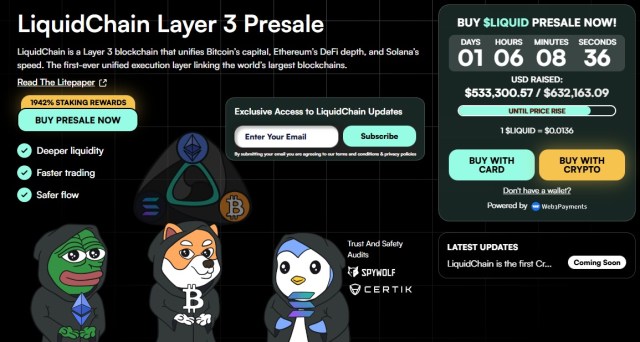
LiquidChain ($LIQUID) has emerged as a focal point here, positioning itself as a Layer 3 infrastructure play designed to unify liquidity across Bitcoin, Ethereum, and Solana.

The project differentiates itself with a ‘Deploy-Once’ architecture. This allows developers to build applications that access liquidity from multiple chains without complex wrapping mechanisms or vulnerable bridges.

That utility-first approach is clicking with early-stage investors. The numbers back this up: LiquidChain has raised over $533K to date, with tokens priced at $0.0136. The steady influx of capital during a choppy market suggests investors are betting on interoperability as the dominant theme of the next cycle.
The thesis for LiquidChain relies on its ability to serve as a high-beta correlation to the broader L1 market. If ETH and SOL rally, the demand for cross-chain execution generally expands, theoretically benefiting the protocols that facilitate that traffic. However, this sector carries risks.

As a presale asset, $LIQUID faces the dual challenges of delivering on its technical roadmap and navigating the volatility typical of unlisted tokens. It represents a speculative allocation for those betting that the future of DeFi is chain-agnostic rather than chain-maximalist.

For investors monitoring the space, the divergence is clear: ETH offers the stability of an established settlement layer, while projects like LiquidChain offer the speculative upside of solving the settlement layer’s connectivity problems.

Buy $LIQUID here.

This article is for informational purposes only and does not constitute financial advice. Crypto assets, including presales, are high-risk investments. Always conduct independent research.

Editorial Process for bitcoinist is centered on delivering thoroughly researched, accurate, and unbiased content. We uphold strict sourcing standards, and each page undergoes diligent review by our team of top technology experts and seasoned editors. This process ensures the integrity, relevance, and value of our content for our readers.

patrubogdan

Follow

Full Profile

Related Posts

Bitcoin Hyper Could Conquer 2026 if Bitcoin Regains Lost Ground

Tether Pushes for $1 Despite Market Crash, While Maxi Doge Reaches New Heights

Convicted FTX CEO SBF Cries ‘Biden Lawfare’ In Trump Pardon Pitch

Bitcoin Hovers Below $70K – Breakout Soon or is $HYPER a Safer Bet?

Crypto And Banks Clash Again Over ‘Skinny’ Fed Accounts Ahead Of Tuesday’s Meeting

South Korea To Probe Crypto Exchanges, Tighten Regulations After Bithumb $40B Bitcoin Error

Related Reads

Why Do You Always Lose Money on Polymarket? Because You're Betting on News, While the Pros Read the Rules

Why do you always lose money on Polymarket? Because you bet on news, while the pros study the rules. This article explains how top traders ("che tou") profit by meticulously analyzing market rules, not just predicting events. Polymarket, a prediction market platform, often sees disputes over event outcomes due to ambiguous rule wording. For instance, a market asking "Who will be the leader of Venezuela by the end of 2026?" was misinterpreted by many who bet on Delcy Rodríguez, assuming she held power. However, the rules specified "officially holds" as the formally appointed, sworn-in individual. Since Nicolás Maduro was still recognized as president officially, he won the market—even being in prison. To resolve such disputes, Polymarket uses a decentralized arbitration system via UMA protocol. The process involves: 1. Proposal: Anyone can propose a market outcome by staking 750 USDC, earning 5 USDC if unchallenged. 2. Dispute: A 2-hour window allows challenges with a 750 USDC stake; successful challengers earn 250 USDC. 3. Discussion: A 48-hour period on UMA Discord for evidence and debate. 4. Voting: UMA token holders vote in two 24-hour phases (blind then public). Outcomes require >65% consensus and 5M tokens voted; otherwise, four re-votes occur before Polymarket intervention. 5. Settlement: Results are final and automatic. Unlike traditional courts, Polymarket’s system lacks separation between arbitrators and stakeholders—voters often hold market positions, creating conflicts of interest. This leads to herd mentality in discussions and non-transparent outcomes without explanatory rulings, preventing precedent formation. Thus, success on Polymarket hinges on deep rule interpretation, not just event prediction, exploiting gaps between reality and contractual wording.

marsbit37m ago

Why Do You Always Lose Money on Polymarket? Because You're Betting on News, While the Pros Read the Rules

marsbit37m ago

DeepSeek Funding: Liang Wenfeng's 'Realist' Pivot

DeepSeek, a leading Chinese AI company, has initiated its first external funding round, aiming to raise at least $300 million at a valuation of no less than $10 billion. This move marks a significant shift from its founder Liang Wenfeng’s previous idealistic stance of rejecting external capital to maintain independence. Despite strong financial backing from its parent company, quantitative trading firm幻方量化 (Huanfang Quant), which provided an estimated $700 million in revenue in 2025 alone, DeepSeek faces mounting challenges. Key issues include a 15-month gap in major model updates, delays in its flagship V4 release, and the loss of several core researchers to competitors offering significantly higher compensation. The company is also undergoing a strategic pivot by migrating its infrastructure from NVIDIA’s CUDA to Huawei’s Ascend platform, a move aligned with China’s push for technological self-reliance amid U.S. export controls. However, DeepSeek lags behind rivals like智谱AI and MiniMax—both now publicly listed—in areas such as product ecosystem, multimodal capabilities, and commercialization. The funding round, though relatively small in scale, is seen as a way to establish a market-validated valuation anchor, making employee stock options more competitive and facilitating talent retention. It also signals DeepSeek’s transition from a pure research-oriented organization to a commercially-driven player in the global AI ecosystem.

marsbit1h ago

DeepSeek Funding: Liang Wenfeng's 'Realist' Pivot

marsbit1h ago

Trading

Spot
Futures

Hot Articles

Discussions

Welcome to the HTX Community. Here, you can stay informed about the latest platform developments and gain access to professional market insights. Users' opinions on the price of ETH (ETH) are presented below.

活动图片