Ethereum Gains Institutional Support, Though ETH Price Outlook Remains Contested

bitcoinistPublished on 2026-01-16Last updated on 2026-01-16

Abstract

Ethereum is attracting significant institutional and retail interest, with record levels of staking, treasury accumulation, and new wallet creation. Over 35.8 million ETH is staked, representing nearly 30% of supply, indicating long-term holder commitment. Institutions like Standard Chartered have raised their 2026 price target to $7,500, citing strong demand from corporate treasuries and ETFs. Despite positive fundamentals, ETH faces technical resistance near $3,400, with key support at $3,000. While user growth remains strong, macro conditions and ETF flows may limit near-term gains.

Ethereum (ETH) is significantly drawing attention from both institutional investors and everyday users, as on-chain data shows rising participation across staking, treasury accumulation, and wallet creation.

Related Reading: Ethereum New Addresses Hit Record Levels: What’s Driving The Growth?

Similarly, price forecasts remain mixed. While major banks and market analysts see room for further upside, others caution that macro conditions, ETF flows, and technical resistance levels could limit near-term gains.

With ETH trading near the $3,300–$3,400 range in mid-January, the network’s foundation appears stronger than in previous quarters. Yet the question remains whether these developments will translate into a sustained price rally.
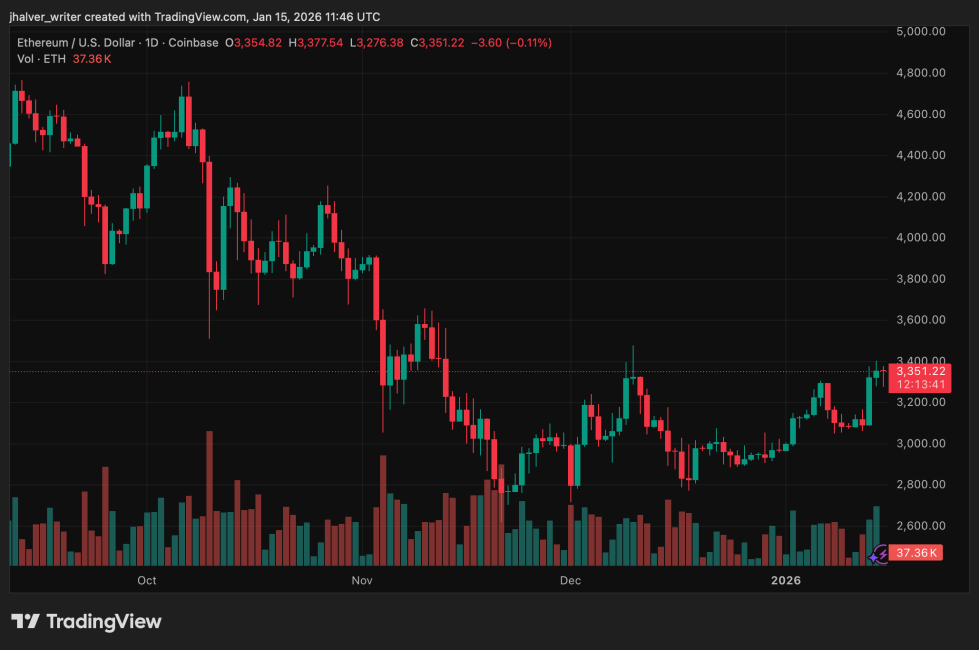
ETH's price trends upwards on the daily chart. Source: ETHUSD on Tradingview

Ethereum Staking and Treasury Demand Signal Long-Term Commitment

Ethereum staking has reached a record value of about $118 billion, with roughly 35.8 million ETH locked on the Beacon Chain. This represents close to 30% of the circulating supply, suggesting a growing preference among holders to earn yield rather than sell.

Network participation is also increasing. Active validators now exceed 976,000, while around 2.3 million ETH is queued for future staking. Lido Finance remains the largest staking provider, holding roughly a quarter of all staked ETH.

Corporate treasury activity has added to this trend. BitMine Immersion, one of the largest Ethereum treasury firms, recently staked an additional 154,304 ETH, worth roughly $514 million at current prices. The company’s total ETH holdings now exceed 4 million tokens.

Institutional Forecasts Point to Higher Targets

Several financial institutions have revised their outlook for Ethereum in 2026. Standard Chartered has recently raised its year-end ETH price target to $7,500, up from a previous estimate of $4,000. The bank cited growing demand from corporate treasuries, spot ETH investment products, and expectations for network fee growth.

According to analysts, treasury firms and ETF-related flows have absorbed close to 4% of Ethereum’s circulating supply since mid-2025. Treasury buyers alone reportedly acquired around 2.3 million ETH in just over two months, a pace the bank compares favorably with past Bitcoin accumulation phases.

Standard Chartered also suggested Ethereum could outperform Bitcoin if real-world usage, stablecoin activity, and tokenized asset adoption continue to expand on its network. Longer-term scenarios project costs of up to $25,000 by 2028 and $40,000 by 2030, although these projections rely on optimistic assumptions.

User Growth Rises, But ETH Price Faces Technical Limits

Ethereum’s user base is also expanding. In early January, the network recorded nearly 393,600 new wallet addresses in a single day, with a weekly average of over 327,000 new addresses.

Analysts link this surge to the Fusaka protocol upgrade, which reduced data costs for Layer-2 networks, as well as record stablecoin transfer volumes of roughly $8 trillion in late 2025.

Related Reading: Boycott Urged For CLARITY Act Draft: Expert Raises Concerns Over Banks Manipulation

Despite stronger fundamentals, price action remains cautious. ETH recently tested the $3,400 resistance level, with key hurdles near $3,550 and $3,650 based on long-term moving averages. Support is forming around $3,000, and a failure to hold that level could expose ETH to further downside.

Cover image from ChatGPT, ETHUSD chart from Tradingview

Related Reads

Farewell to Traditional Bull and Bear Markets, Deciphering the Logic of Today's Bubble Rotation

"Farewell to Traditional Bulls and Bears: Understanding Today's Market Logic of Bubble Rotation" The article draws a parallel between modern financial markets and a meteorological chain of thunderstorms, contrasting it with the past's slower-moving, more predictable 'layered cloud' systems of long bull/bear cycles and gradual sector rotations. The author argues that today's market has undergone a permanent structural shift, creating an environment where discrete, intense thematic bubbles (e.g., AI, GLP-1 drugs, crypto, robotics, quantum tech) sequentially form, swell, and burst. These 'storm cells' are triggered when capital fleeing a dying bubble acts like a meteorological 'cold air wedge,' forcing the warm, moist capital of latent interest in a new sector to rapidly rise and condense into the next speculative frenzy. This new 'convective' market regime is driven by eight fundamental changes: 1. Democratization of speculation via zero-commission trading, gamified apps, and heavy retail participation in instruments like 0DTE options. 2. Permanent, price-insensitive buying pressure from defined-contribution retirement plans (e.g., 401(k)s). 3. Passive investing creating inelastic market participants that amplify momentum, especially into mega-cap stocks. 4. The dominance of multi-strategy funds and high-frequency trading (HFT), weakening price discovery and creating fragile microstructure prone to synchronized sell-offs. 5. Artificially suppressed volatility that eventually erupts in violent spikes. 6. A transformed market index heavily weighted toward long-duration, narrative-driven tech companies instead of stable, cyclical industrials. 7. The total elimination of information delay, accelerating fear-of-missing-out (FOMO) and herd behavior. 8. A persistently loose fiscal and monetary policy environment. These structural shifts are deemed irreversible. The article outlines the common lifecycle of these thematic bubbles: latency, catalyzing event, narrative formation, peak divergence, and rupture—with outflowing capital seeding the next bubble. In this environment, two investor archetypes can thrive: deep domain experts who understand underlying technologies and business models, and disciplined trend-followers. The author concludes that while emotionally challenging, recognizing this new "climate" is crucial. The key is to elevate one's perspective above the immediate storm to see the cyclical chain of bubbles, avoiding being swept away by the emotions of any single thematic frenzy.

Foresight News3m ago

Farewell to Traditional Bull and Bear Markets, Deciphering the Logic of Today's Bubble Rotation

Foresight News3m ago

Michael Saylor's Latest Article: Bitcoin Must Find Balance Between Uniqueness and Universal Value

Michael Saylor outlines four key Bitcoin ideologies shaping its future: * **Bitcoin Maximalists** see Bitcoin as the dominant digital monetary network and a breakthrough in economic empowerment, emphasizing its superior property rights and role as a sound money solution. * **Bitcoin Capitalists** focus on integration, believing Bitcoin must embed into the global economy—through institutions, capital markets, and financial products—to reach its full potential as digital capital. * **Bitcoin Technologists** advocate for continuous protocol improvements in scalability, privacy, and security to adapt to evolving needs and threats, while acknowledging the high bar for change. * **Bitcoin Fundamentalists** guard Bitcoin's core principles of self-custody, decentralization, and censorship resistance, warning against dilution from institutions or risky modifications. Saylor argues that a healthy Bitcoin ecosystem requires a balance of these perspectives. Bitcoin's path forward involves disciplined expansion: preserving its immutable core (Fundamentalist insight), recognizing its dominant status (Maximalist view), integrating with the global economy (Capitalist drive), and enabling careful innovation, primarily in higher layers (Technologist role). The challenge is to maintain Bitcoin's unique properties while making it useful for the world, ensuring it remains Bitcoin as it grows.

Foresight News35m ago

Michael Saylor's Latest Article: Bitcoin Must Find Balance Between Uniqueness and Universal Value

Foresight News35m ago

Reddit Weekly Hot Stock Watch: RKLB/LUNR/ASTS Plunge Collectively, Is the Space Sector Still Worth Considering?

Reddit's stock communities witnessed a concentrated surge in discussion around space stocks last week, with SPCE, RKLB, LUNR, and ASTS leading the chatter. This often signals an underlying catalyst for investor attention. However, despite being grouped as "space plays," these companies have vastly different fundamentals and recent performances. While SPCE (Virgin Galactic) saw a 22% single-day surge—potentially fueled by short covering and fallout from Blue Origin's rocket test anomaly—the other three stocks declined sharply. RKLB dropped 15%, LUNR fell 13%, and ASTS was down 7%. This divergence highlights they are not a monolithic sector. The downturn for RKLB, LUNR, and ASTS stemmed from multiple headwinds converging: Blue Origin's New Glenn rocket explosion (directly impacting ASTS's launch plans), anticipation of SpaceX's massive IPO drawing funds away from these "alternative" public space stocks, and insider selling at RKLB after significant rallies. A closer look reveals key differences: RKLB stands out with substantial, growing revenue ($113.9M in Q1) and a $2.2B backlog, though its high valuation (~80x Forward P/S) prices in success for its upcoming Neutron rocket. LUNR's reported revenue growth is largely acquisition-driven, with its core moon landing business facing a crucial test with the upcoming IM-3 mission. ASTS has a large potential market in space-based cellular connectivity but faces significant execution risk, especially after the Blue Origin launch setback. SPCE, despite high discussion volume, has minimal revenue and its recent spike appears driven more by sentiment than fundamentals. The analysis suggests it's premature to call a "buying opportunity" for the sector broadly. RKLB is considered the most fundamentally sound but may be more attractive at a lower price point ($96-$102). For the others, investors are advised to wait for specific catalysts: LUNR's IM-3 mission outcome, clarity on ASTS's revised launch timeline, and for SPCE, to avoid the speculative frenzy. The long-term space thesis remains, but short-term valuations have run ahead of fundamentals for most names.

marsbit49m ago

Reddit Weekly Hot Stock Watch: RKLB/LUNR/ASTS Plunge Collectively, Is the Space Sector Still Worth Considering?

marsbit49m ago

Why Does Crypto Always Build 'Casinos', But Rarely Creates 'Indispensable Products'?

The article explores why cryptocurrency has primarily fostered speculation rather than essential, "sticky" consumer products. It introduces the concept of "sofalarity"—the point where a platform's convenience becomes so ingrained that leaving feels unthinkable. While Big Tech creates this lock-in through ecosystem control and data harvesting, crypto lacks equivalent everyday utility. Its appeal hinges on the variable rewards of price volatility, akin to gambling, which drives engagement but not dependency. The author argues crypto's core promise—fixing opaque backend systems like correspondent banking—solves problems most people never see or feel, failing to deliver a tangible "aha moment" of improved daily life. This need for explanation hinders mass adoption. Meanwhile, platforms like Google and Meta monetize vast behavioral data, a treasure trove crypto's transparent ledgers (recording only financial transactions) cannot match for predictive insight. The piece further questions whether crypto's potential lies in consumer super-apps or, more plausibly, in becoming enterprise-grade infrastructure—modern settlement rails. It concludes with a critical look at Real-World Asset (RWA) tokenization, suggesting it may merely digitize and accelerate corporate extraction (e.g., in housing or healthcare) rather than democratize access, as the technology itself is a neutral tool. True disruption, the author implies, requires building sovereign systems outside exploitative platforms.

marsbit50m ago

Why Does Crypto Always Build 'Casinos', But Rarely Creates 'Indispensable Products'?

marsbit50m ago

Trading

Spot
Futures

Hot Articles

Discussions

Welcome to the HTX Community. Here, you can stay informed about the latest platform developments and gain access to professional market insights. Users' opinions on the price of ETH (ETH) are presented below.

活动图片















