Ethereum Foundation Backs SEAL Initiative as LiquidChain L3 Protocol Gains Traction

bitcoinistPublished on 2026-02-10Last updated on 2026-02-10

Abstract

The Ethereum Foundation has officially backed the Security Alliance (SEAL), a coalition of white-hat hackers and researchers, to strengthen the crypto industry’s coordinated defense against drainer attacks. SEAL’s "SEAL 911" initiative enables real-time reporting of exploits, helping intercept stolen funds before they are laundered. This move signals a shift from reactive security measures to more structural solutions that reduce complexity and risk. LiquidChain ($LIQUID), a Layer 3 protocol, is gaining traction as a architectural solution to cross-chain vulnerabilities. By unifying liquidity across Bitcoin, Ethereum, and Solana into a single execution layer, it eliminates the need for risky bridging operations—a common attack vector. The project has raised over $533K in its presale, reflecting growing institutional interest in infrastructure that abstracts away cross-chain complexity and enhances security through design rather than intervention.

Trusted Editorial content, reviewed by leading industry experts and seasoned editors. Ad Disclosure

Quick Facts:

  • ➡️ The Ethereum Foundation has officially backed the Security Alliance (SEAL), strengthening the industry’s coordinated response against crypto drainers.
  • ➡️ Market focus is shifting from reactive security measures to architectural solutions that reduce complexity.
  • ➡️ LiquidChain is capitalizing on this trend by unifying Bitcoin, Ethereum, and Solana liquidity into a single, secure L3 execution layer.
  • ➡️ Institutional support for white-hat initiatives signals a maturing market where security is treated as a public good rather than a luxury.

The decentralized finance security landscape just shifted.

By formally backing the Security Alliance (SEAL), the Ethereum Foundation is acknowledging a hard truth: code audits alone aren’t enough to stop the rising tide of sophisticated crypto drainers.

SEAL, a coalition of white-hat hackers and researchers, has quietly become the industry’s emergency response team. Their ‘SEAL 911’ initiative lets victims and protocols report active exploits in real-time, often intercepting funds before they hit mixers.

The Foundation’s backing isn’t just financial; it’s an institutional nod to coordinated defense. Previously, protocols fought threats in silos. Now, the centralization of threat intelligence creates a “herd immunity” effect that makes drainer-as-a-service operations significantly harder to scale.

But let’s be honest: while SEAL treats the symptoms (exploits), the market is hunting for a cure to the root cause: complexity. Most losses happen during the intricate dance of bridging assets and signing obscure permissions.

Ironically, for an industry built on trustless code, our security still relies heavily on human intervention. Recognizing this, investors are rotating toward architectural solutions that remove the need for risky bridging entirely.

This thesis is driving capital into LiquidChain ($LIQUID), a Layer 3 infrastructure project designed to unify liquidity across Bitcoin, Ethereum, and Solana.

Learn more about LiquidChain here.

LiquidChain Unifies Liquidity To Remove Bridge Risk

Fragmentation is the enemy of security. Every time you wrap an asset or use a third-party bridge, you introduce a new point of failure, a vector that drainers exploit with ruthless efficiency. LiquidChain ($LIQUID) positions itself as the structural antidote, fusing the liquidity of the three largest ecosystems into a single execution environment.

By operating as a Layer 3 (L3) protocol, LiquidChain allows developers to deploy applications once that access Bitcoin, Ethereum, and Solana simultaneously.

For the end-user, this means ‘single-step execution.’ Instead of the perilous multi-step process of bridging $ETH to $SOL, swapping, and then staking, actions that often require signing multiple blind approvals, LiquidChain handles the cross-chain complexity at the protocol level.

This creates a verifiable settlement layer where the friction (and risk) of interoperability is abstracted away. The project’s unique proposition isn’t building a better bridge; it’s creating an environment where bridges are rendered invisible. Developers gain access to a Cross-Chain VM, allowing them to tap into Bitcoin’s capital base while using Solana’s speed.

No more navigating the dark forest of cross-chain transfers.

$LIQUID is available here.

Smart Money Rotates Into L3 Infrastructure As Presale Crosses $533K

While the broader market reacts to security headlines, astute capital is quietly positioning itself in infrastructure plays that streamline the user experience. The data tells the story: LiquidChain ($LIQUID) has raised over $533K to date.

Currently priced at $0.0136, the token represents a bet on the ‘abstraction narrative’, the idea that the next billion users won’t care (or know) which chain they’re using.
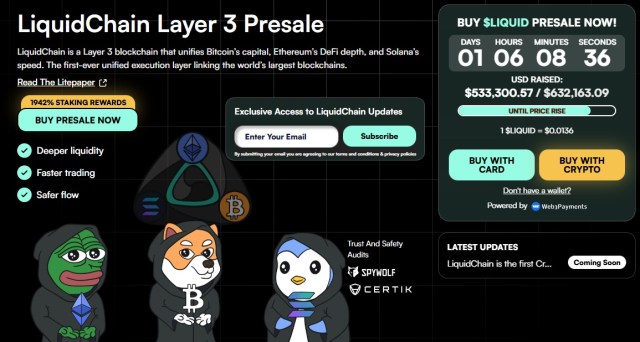
The capital inflow suggests investors are looking beyond commoditized Layer 2 scaling solutions toward Layer 3 protocols with specific interoperability use cases.

The utility of the $LIQUID token extends beyond simple governance. It functions as the transaction fuel for this cross-chain environment and facilitates liquidity staking. In a market where yield is often chased at the expense of safety, LiquidChain’s model offers a compelling alternative: rewards derived from the friction of unifying the world’s disparate blockchains.

With the presale gaining momentum, the window for early entry at these valuations is narrowing as the project approaches mainnet deployment.

Buy $LIQUID here.

Disclaimer: The content provided in this article is for informational purposes only and does not constitute financial advice. Cryptocurrency investments carry inherent risks, including high volatility and potential loss of principal. Always conduct your own research.

Editorial Process for bitcoinist is centered on delivering thoroughly researched, accurate, and unbiased content. We uphold strict sourcing standards, and each page undergoes diligent review by our team of top technology experts and seasoned editors. This process ensures the integrity, relevance, and value of our content for our readers.

patrubogdan

Follow

Full Profile

Related Posts

Crypto Exchange Backpack Targets Token Launch Soon, as BMIC Fires Up Quantum Defense

Vitalik Buterin Outlines Ethereum’s AI Future, While SUBBD Token Targets the Creator Economy

Binance Dominates Trump’s USD1 Supply as Bitcoin Hyper Breaks Records

Cathie Wood’s Ark Invest Buys More Bullish Assets Just Days After Last Purchase, While LiquidChain Turns Heads

Polymarket Sues Massachusetts Over Prediction Market Regulation – SUBBD Token Takes Advantage

Bitcoin Hyper Could Conquer 2026 if Bitcoin Regains Lost Ground

Related Questions

QWhat is the SEAL initiative and why is the Ethereum Foundation backing it?

AThe SEAL (Security Alliance) initiative is a coalition of white-hat hackers and researchers that serves as the industry's emergency response team against crypto drainers. The Ethereum Foundation is backing it to strengthen the coordinated defense against exploits, providing both financial support and institutional validation for centralized threat intelligence to create a 'herd immunity' effect.

QHow does LiquidChain's L3 protocol address security concerns in DeFi?

ALiquidChain's Layer 3 protocol unifies liquidity from Bitcoin, Ethereum, and Solana into a single execution layer, eliminating the need for risky cross-chain bridges. It reduces complexity by allowing 'single-step execution' and abstracting away interoperability friction, thereby removing common attack vectors used by drainers.

QWhat is the current presale status and token price of LiquidChain ($LIQUID)?

ALiquidChain's presale has raised over $533,000 to date, with the $LIQUID token currently priced at $0.0136.

QHow does SEAL's 'SEAL 911' initiative work?

ASEAL's 'SEAL 911' initiative allows victims and protocols to report active exploits in real-time, enabling white-hat hackers to intercept funds before they reach mixers or are laundered.

QWhat is the core investment thesis behind capital flowing into L3 infrastructure like LiquidChain?

AThe investment thesis centers on the 'abstraction narrative' - that next-generation users won't care about underlying blockchain complexity. Investors are betting on infrastructure that streamlines user experience by unifying liquidity across chains and eliminating bridging risks, treating security as a fundamental architectural feature rather than an add-on.

Related Reads

The Right Way to Use Skills: 5 Reflections After Anthropic Publicly Shared Its Internal Methodology

A deep dive into Anthropic's internal methodology for building effective AI "Skills" reveals five key insights for maximizing their value. First, Skills should focus on capturing "Gotchas" and tacit organizational knowledge—like common pitfalls and undocumented rules—rather than restating general information the AI already knows. Second, think of Skills as a form of "Context Engineering"; they are best structured as folders, not monolithic documents. A core `SKILL.md` file should act as a navigational index, progressively pulling in detailed references, examples, and assets only as needed to avoid overwhelming the model's context window. Third, whenever possible, automate repetitive tasks with scripts. This preserves the model's reasoning capacity for judgment and analysis, while scripts reliably handle the execution, saving tokens and improving accuracy. Instructions within a Skill provide the "why" and the expert judgment, while scripts provide the concrete "how." Fourth, a Skill's description is critical and often misunderstood. It should not be a list of features but a routing rule that clearly signals *when* the Skill should be triggered based on user intent and common phrasing. Finally, as Skills scale from personal tools to team-wide assets, management is crucial. Anthropic advocates for a lightweight, organic approach: let new Skills spread organically within small groups first. Those that prove genuinely useful through adoption naturally graduate to a formal marketplace, ensuring the curated library contains only high-value, battle-tested tools.

marsbit2m ago

The Right Way to Use Skills: 5 Reflections After Anthropic Publicly Shared Its Internal Methodology

marsbit2m ago

Vying for the AI Payment Track: Traditional Card Networks Face Off Against Coinbase

As AI agents increasingly conduct commercial transactions, a battle for control over the underlying payment infrastructure is unfolding. The competition centers on two divergent and incompatible technical approaches for autonomous AI payments. One camp, led by traditional card networks Visa and Mastercard, relies on tokenized card credentials within the established banking rails. Visa's "Intelligent Commerce" and Mastercard's "Agent Pay" services extend their existing tokenization technology to authorized AI agents for consumer retail transactions, leveraging decades of fraud protection and dispute resolution systems. Their partners include major AI firms like Anthropic, OpenAI, and Microsoft. The opposing camp, spearheaded by Coinbase, advocates for an open internet protocol using stablecoins. Coinbase's x402 protocol utilizes the HTTP 402 status code to enable direct, machine-to-machine micropayments with USDC on-chain. This model eliminates card fees and is designed for high-frequency, low-value transactions between AI agents, such as paying for API calls or data streams, where traditional card costs are prohibitive. Currently, application scenarios are clearly divided. Mainstream consumer-facing AI shopping services (e.g., ChatGPT's "one-click checkout," Amazon's AI-assisted shopping) predominantly use card channels due to their mature consumer protections and merchant networks. Conversely, the stablecoin channel dominates machine-to-machine payments, as seen in Amazon Bedrock's core payment service using Base blockchain. Significantly, traditional card networks are not solely defending their turf; they are also investing in the stablecoin arena. Visa has rapidly expanded its stablecoin settlement volume and partnered with Coinbase on interoperability, while Mastercard moved to acquire stablecoin platform BVNK. This dual-strategy indicates their intent to become the fee-collecting gateway for all payment flows, regardless of the underlying rail. The short-term outlook is for coexistence: cards for personal retail, stablecoins for machine transactions. The long-term outcome hinges on whether AI-driven commerce will resemble traditional retail or evolve into a vast network of machine micropayments. Visa and Mastercard's hedging strategy suggests they are prepared for either future, while companies betting on a single channel face greater risk.

Foresight News4m ago

Vying for the AI Payment Track: Traditional Card Networks Face Off Against Coinbase

Foresight News4m ago

For the First Time, Pure Human Video Pretrained VLA for Dexterous Manipulation: Deployable with Minimal Fine-Tuning Data

For the first time, a purely human-video-pretrained Vision-Language-Action (VLA) model for dexterous manipulation requires only a small amount of data for fine-tuning to achieve successful real-world deployment. Achieving human-level dexterous manipulation remains a core challenge in robotics. While multi-fingered hands offer hardware potential, Visual-Language-Action (VLA) models lag behind due to the high cost of collecting diverse, high-quality robot data. A novel framework, VITRA, developed by Microsoft Research Asia and Tsinghua University, addresses this by automatically transforming massive, unlabeled real-world human activity videos into a structured V-L-A training dataset. Key innovations include precise 3D hand motion annotation from monocular video, atomic action segmentation based on hand-speed minima, and automated instruction generation using VLMs combined with 3D trajectory visualization. This process created a massive dataset of 1 million clips. Pretrained exclusively on this human video data, the VLA model (combining a VLM backbone with a Diffusion Transformer action expert) demonstrates strong zero-shot hand motion prediction in unseen environments. Crucially, it requires minimal fine-tuning (~1.2k demonstrations) on real robot data to achieve high-success-rate dexterous manipulation tasks like grasping, placing, pouring, and sweeping on hardware like the Realman robot with the XHAND1 dexterous hand. The model shows exceptional generalization to novel objects and environments. The research also observes promising scaling behavior, where performance improves with more pretraining data, paving the way for more generalized embodied intelligence.

marsbit14m ago

For the First Time, Pure Human Video Pretrained VLA for Dexterous Manipulation: Deployable with Minimal Fine-Tuning Data

marsbit14m ago

Trading

Spot
Futures

Hot Articles

How to Buy L3

Welcome to HTX.com! We've made purchasing Layer3 (L3) simple and convenient. Follow our step-by-step guide to embark on your crypto journey.Step 1: Create Your HTX AccountUse your email or phone number to sign up for a free account on HTX. Experience a hassle-free registration journey and unlock all features.Get My AccountStep 2: Go to Buy Crypto and Choose Your Payment MethodCredit/Debit Card: Use your Visa or Mastercard to buy Layer3 (L3) instantly.Balance: Use funds from your HTX account balance to trade seamlessly.Third Parties: We've added popular payment methods such as Google Pay and Apple Pay to enhance convenience.P2P: Trade directly with other users on HTX.Over-the-Counter (OTC): We offer tailor-made services and competitive exchange rates for traders.Step 3: Store Your Layer3 (L3)After purchasing your Layer3 (L3), store it in your HTX account. Alternatively, you can send it elsewhere via blockchain transfer or use it to trade other cryptocurrencies.Step 4: Trade Layer3 (L3)Easily trade Layer3 (L3) on HTX's spot market. Simply access your account, select your trading pair, execute your trades, and monitor in real-time. We offer a user-friendly experience for both beginners and seasoned traders.

4.1k Total ViewsPublished 2024.11.27Updated 2026.06.02

How to Buy L3

Discussions

Welcome to the HTX Community. Here, you can stay informed about the latest platform developments and gain access to professional market insights. Users' opinions on the price of L3 (L3) are presented below.

活动图片