Either Go Full-Stack or Get Out: The Calculations Behind xAI's $60 Billion Acquisition of Cursor

marsbitPublished on 2026-06-18Last updated on 2026-06-18

Abstract

The article discusses xAI's $60 billion stock acquisition of Anysphere, the parent company of the AI coding tool Cursor, arguing that the core motivation is not market share but access to high-quality training data from its 7 million daily developers. It posits that to become a major AI player, a company must build a full-stack encompassing compute, model, and application layers. This thesis is illustrated by Anthropic's 540x revenue growth in 28 months, largely driven by its coding product, Claude Code, which captured 54% of the enterprise AI programming market. The author, a VC, contends that full-stack integration creates sustainable unit economics for model training and provides proprietary data for defensible competitive advantages, predicting a wave of model companies aggressively building or acquiring application-layer products. The central takeaway is that in an era where building products is 10x easier, ambition must be 10x greater to succeed.

Author: Tara Tan

Translation: Deep Tide TechFlow

Source: The Strange Review

Deep Tide Introduction: xAI, under SpaceX, acquired Anysphere, Cursor's parent company, for $60 billion in stock—not for market share, but for the high-quality training data generated by 7 million developers writing code every day. Strange Ventures partner Tara Tan uses this deal to put forward a judgment: to be a major AI player, you must integrate the entire stack of compute, models, and applications. This short review breaks down Anthropic's path to a 540-fold revenue increase in 28 months and explains why model companies will aggressively acquire into the application layer next. Note the author's identity as a VC, and full-stack is precisely her own investment thesis.

Code generation is by far the strongest killer application for large language models, bar none.
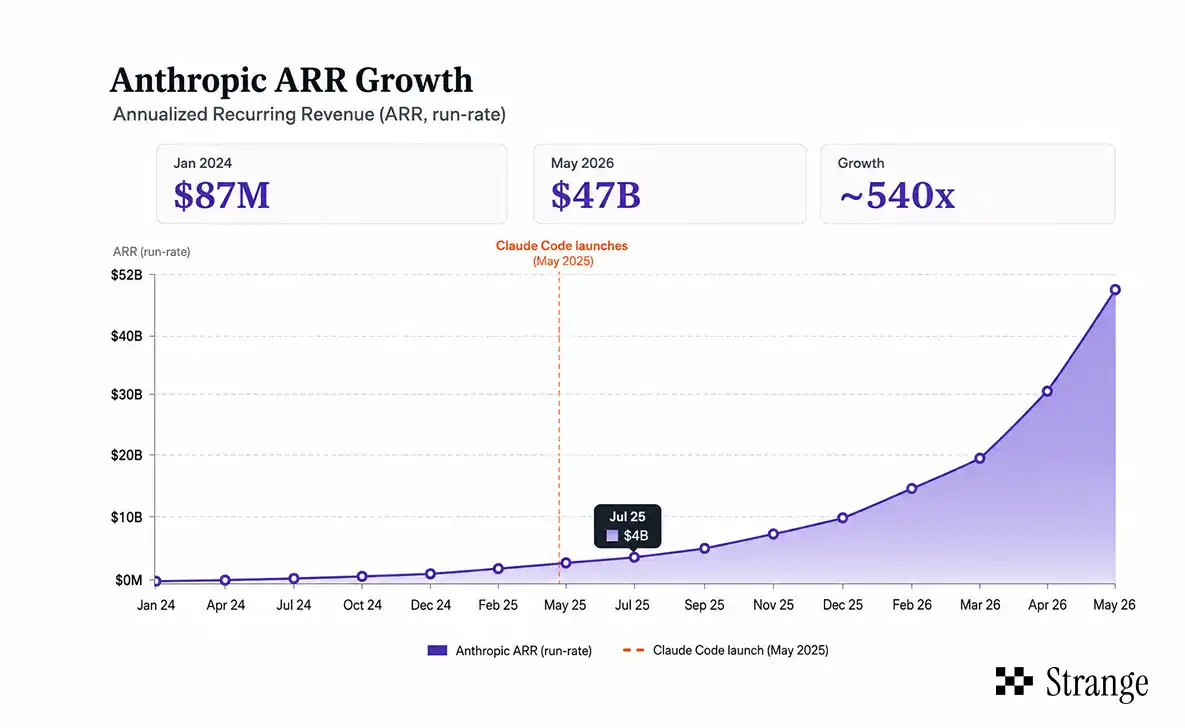
Anthropic's revenue grew from an annualized rate of $87 million in January 2024 to $47 billion in May 2026, an approximately 540-fold increase in 28 months. This growth was driven by two engines firing simultaneously: top-down enterprise partnerships (Claude is the only frontier model available on all three major cloud platforms) and bottom-up developer penetration, powered by Claude Code. This product is the fastest-growing in the company's history, going from zero to $2.5 billion in annualized revenue in 9 months. Anthropic now holds 54% of the enterprise AI programming market.

Cursor is the same bet SpaceX is making.

Yesterday, SpaceX announced the acquisition of Anysphere, the company behind Cursor, for $60 billion in stock. This AI programming tool is used daily by 7 million developers. Incubated at MIT four years ago, its annualized revenue has surged to $2 billion, making it the highest-revenue AI programming tool in its category. Over the past year, its market share has been declining, from 41% to 26%, as Claude Code gained ground. But xAI isn't buying market share.

xAI already has the full stack: Colossus for compute, Grok for the model, and X for the application. The problem is that X is for browsing, while Cursor is for writing code. The data generated by developers writing code is arguably the highest-signal training data in the AI field, and that's precisely what Grok lacks to complete its competitive edge.

This confirms a thought I've been pondering since the OpenAI-NVIDIA deal last September:

To be a major AI player, you must go full-stack.
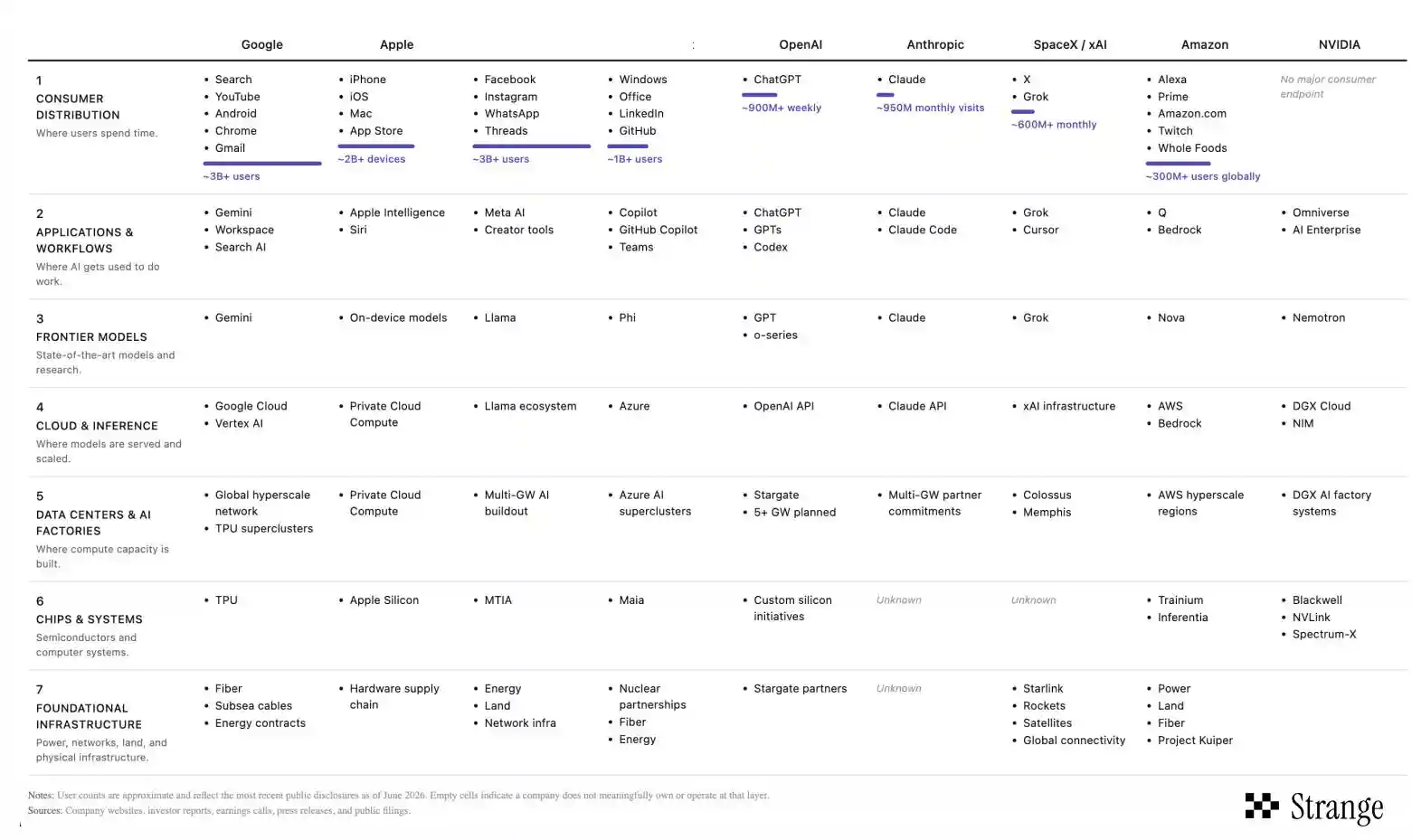
The logic is becoming increasingly clear. Better products lead to better infrastructure (more data), and better infrastructure, in turn, leads to a better experience. This has always been the core investment logic at Strange.
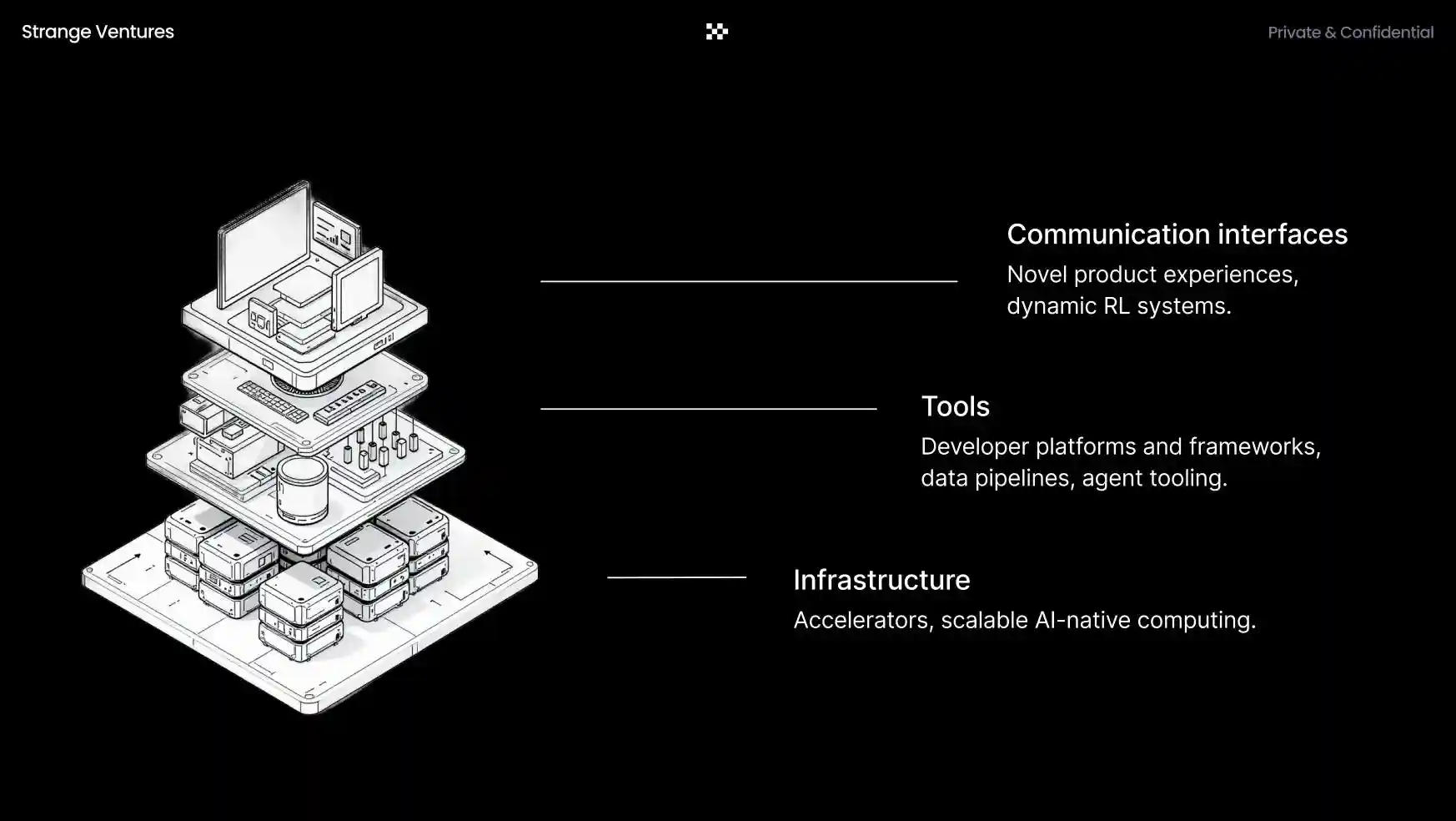
Caption: The author's team's investment logic diagram on "Full-Stack Flywheel"

Going full-stack achieves two things:

First, the unit economics of building and training models become sustainable.

Second, you gain proprietary training data from the application layer, differentiating yourself from other model vendors. User data and workflow lock-in then form a solid moat.

The next few years will likely see actions like these: model companies either internally develop applications or aggressively acquire upward, directly swallowing the application layer.

A popular saying among entrepreneurs now is: Because building products is 10 times easier than before, companies need to be 10 times more ambitious to succeed. Currently, this seems to be holding true across various sectors.

——Tara

Related Questions

QAccording to the article, what is the primary reason behind xAI's acquisition of Anysphere (Cursor's parent company)?

AThe primary reason is to gain access to the high-quality training data generated by Cursor's 7 million daily developers writing code, which is considered some of the strongest signal data in AI for enhancing xAI's model, Grok. It is not about acquiring market share.

QWhat key concept does the author propose is essential for a company to become a major AI player?

AThe author proposes that to become a major AI player, a company must achieve a 'full-stack' approach, integrating and controlling the entire pipeline from computing power (infrastructure) and models to the end-user applications.

QWhat two main benefits does building a full-stack AI company provide, as outlined in the article?

AFirst, it makes the unit economics of building and training models sustainable. Second, it provides access to proprietary training data from the application layer, creating differentiation from other model companies and forming a strong competitive moat through user data and workflow lock-in.

QHow did Anthropic's revenue change from January 2024 to May 2026, and what were the two key drivers of this growth?

AAnthropic's revenue grew approximately 540 times in 28 months, from an annualized $87 million in January 2024 to $47 billion in May 2026. The two key drivers were top-down enterprise partnerships (Claude being available on all three major cloud platforms) and bottom-up developer adoption fueled by its product, Claude Code.

QWhat trend does the author predict for AI model companies in the coming years based on the full-stack thesis?

AThe author predicts that in the coming years, model companies will increasingly either build applications internally or aggressively acquire and integrate companies at the application layer through M&A (mergers and acquisitions).

Related Reads

Supporters of Bitcoin BIP-110 Update Have Prepared a 'Last Resort' Plan If the Proposal Is Not Adopted: It Could Radically Change BTC's Value

Supporters of the BIP-110 update for Bitcoin have prepared a contingency plan in case the proposal is not adopted, a move that could radically alter BTC's value. Developer Chris Guida has adapted a proof-of-work code originally created by Luke Dashjr in 2017 for the current version of Bitcoin Knots. This adaptation is described as a last-resort measure to be activated if miners do not signal readiness for BIP-110. The proposal itself is a soft fork aimed at temporarily limiting the storage of arbitrary data in Bitcoin transactions. It introduces stricter limits on new transaction outputs, OP_RETURN fields, and witness data, with rules designed to expire after approximately one year. Guida stated this option needs to remain open if miners were to "conspire to betray Bitcoin." Should the contingency code be used, it could change Bitcoin's current mining algorithm. This change would likely prevent existing ASIC miners from generating blocks on the new chain, leading to a large-scale reorganization of the Bitcoin mining network. Luke Dashjr, another Bitcoin Knots developer, contributed to the code and expressed hope it would not be needed, but sees its existence as useful for a potential crisis. A supporter known as Mechanic argued that the mere possibility of a proof-of-work change could act as a deterrent, emphasizing that Bitcoin's rules should be set by participants and node operators, not miners. While miner signals are tracked for BIP-110 activation, data from the proposal's official tracking page indicates support remains limited.

cryptonews.ru1h ago

Supporters of Bitcoin BIP-110 Update Have Prepared a 'Last Resort' Plan If the Proposal Is Not Adopted: It Could Radically Change BTC's Value

cryptonews.ru1h ago

Why Did Bitcoin's Price Remain Stable and Not Fall Despite the Recent Major Hack? Here's the Secret

The article discusses why Bitcoin's price remained stable despite a recent $100 million hack targeting individual cold wallets, citing insights from experts on "The Wolf of All Streets" channel. Analysts attribute this resilience to significant institutional shifts in the crypto market. Key points include: 1. **Market Maturation:** The crypto market has transitioned from being dominated by individual retail holders to institutional investors. Most new capital now enters via regulated channels like spot ETFs and custodial services (e.g., Coinbase, Anchorage), making vulnerabilities in individual cold wallets less impactful. 2. **Institutional Dominance:** Control over price dynamics has shifted from miners and crypto exchanges to Wall Street and institutional capital. These large players operate with long-term strategies, viewing price corrections as buying opportunities rather than reasons for panic. 3. **Increased Resilience:** Institutional involvement has reduced market sensitivity to negative news. Sellers are largely exhausted, and remaining holders are steadfast. Major financial institutions (e.g., Morgan Stanley, Wells Fargo) are incorporating crypto assets into portfolios, with research teams recommending allocations of 1–6% to Bitcoin. 4. **Risk Perception:** Bitcoin's integration into traditional financial indices has lowered perceived risk among professionals and institutions, further stabilizing its price against isolated security breaches.

cryptonews.ru2h ago

Why Did Bitcoin's Price Remain Stable and Not Fall Despite the Recent Major Hack? Here's the Secret

cryptonews.ru2h ago

Trading

Spot
活动图片