Dragonfly’s Haseeb Qureshi Unveils His Crypto Predictions For 2026

bitcoinistPublished on 2025-12-30Last updated on 2025-12-30

Abstract

Dragonfly partner Haseeb Qureshi shared his 2026 crypto predictions, expecting surprises both positive and negative. He forecasts Bitcoin exceeding $150K by year-end, but with decreasing dominance, and a moderate altcoin rebound without a true "alt season." He anticipates underperformance from newer fintech chains like Tempo and Robinhood Chain, while Ethereum and Solana overdeliver. More Fortune 100 companies, especially in banking, will launch blockchains, with Avalanche and modular stacks like OP and ZK standing out. A major tech firm may launch or acquire a crypto wallet. In DeFi, perp DEXs will consolidate around three major venues, and equity perps will grow significantly. Stablecoin supply will expand by ~60%, with USD remaining dominant, though USDT's share may drop to ~55%. Stablecoin-backed cards will see explosive growth, especially in emerging markets. US crypto legislation may pass after negotiations, but with industry buyer’s remorse. Prediction markets will grow rapidly, led by Polymarket, while most competitors fail. AI use in crypto will remain limited to engineering and security, with no meaningful agent-to-agent payments. Privacy solutions like Zcash may see some adoption, but overall, 2026 will largely continue existing trends.

Dragonfly partner Haseeb Qureshi published a category-by-category set of 2026 crypto predictions on X late Monday, arguing next year will “surprise, both to the upside and to the downside” even if “the trend lines mostly continue.”

Bitcoin And Crypto Predictions For 2026

His headline macro call pairs a bullish bitcoin target with a broader market rebound. “BTC is > $150K by year-end, but BTC dominance decreases in 2026,” Qureshi wrote. But he rejected the idea that this automatically implies a blow-off alt cycle: “I don’t think it will be wild enough to call it alt season. I think alts will rebound nevertheless, just not to crazy highs.”

Moreover, Qureshi said “the recent crop of fintech chains” will not meet expectations on usage and value flow. “Despite the excitement around the recent crop of fintech chains, their metrics will underwhelm,” he wrote, pointing to “daily active addresses, stablecoin flows, and RWAs.” He named Tempo, Arc, and Robinhood Chain as likely laggards, while adding that “Ethereum and Solana will overdeliver” and that “best developers will continue to build on neutral infra chains.”

On enterprise rails, he expects more large companies to launch networks, skewing toward regulated incumbents. “Many more Fortune 100s launch blockchains, although increasingly concentrated among banking and fintech players,” he wrote, adding: “Expect Avalanche to be a standout here, alongside OP stack, Orbit, and ZK Stack.”

Qureshi also predicted a major distribution move from consumer tech: “A big tech company (Google, Facebook, Apple, etc.) launches or acquires a crypto wallet in 2026.” And he offered a contrarian timing call on Monad: “Monad gets written off as dead by CT, but metrics take off in the latter part of the year after analysts have already forgotten about it.”

On infrastructure, he said DoubleZero adoption broadens: “At least 3 other chains connect to DoubleZero to improve their latency & throughput metrics. DoubleZero hits 80%+ stake on Solana.”

DeFi And Stablecoins

Qureshi forecass a more concentrated perpetuals market structure. “Perp DEX market share consolidates to something like 3 big venues a la HBO (market share something like 40 / 30 / 20), followed by a long tail of smaller players who compete over the leftovers (last 10%),” he wrote.

He also expects product expansion into equities. “Equity perps take off, becoming >20% of total DeFi perp volume by EOY,” he wrote, alongside “significant growth in RFQ compared to CLOBs/AMMs, both on spot and perps.” He added a reputational tail risk: “Some DeFi-related insider trading scandal hits mainstream media.”

Qureshi predicts a large expansion in stablecoin supply while remaining overwhelmingly dollar-based. “Stablecoin supply expands by ~60% in 2026, and USD remains 99%+,” he wrote. He expects Tether to cede some share: “USDT dominance declines moderately to ~55%.”

His strongest distribution claim centered on payments. “Stablecoin-backed cards grow 1,000% in 2026—insanely fast growth,” Qureshi wrote. “Becomes the dominant way that stablecoins land and expand in emerging markets. Rain is the biggest winner here.”

Regulation And Prediction Markets

Qureshi predicted a US legislative deal next year, but with caveats on what the industry gets. “Clarity Act gets signed into law in 2026 after some significant markups and horse trading,” he wrote. “A bit of buyer’s remorse from crypto insiders.”

He also forecast political scrutiny if Democrats take the House. “Dems win the house, and there is a parade of hearings about anything in crypto that touched TRUMP / WLFI,” Qureshi wrote.

“The underlying deals get subpoenaed.” In his scenario, Trump distances himself: “Trump insists he was never involved and didn’t know anything about it (and thus these deals are not protected by executive privilege). Anyone who signed a stupid deal gets publicly embarrassed.”

Qureshi expects prediction markets to expand rapidly amid unresolved US legal fights. “Prediction markets grow like crazy,” he wrote, citing “big legal fights over sportsbetting regulation and federal pre-emption,” but adding that “nothing major gets resolved next year, so status quo continues through 2026.”

He argued Polymarket extends its cultural edge and distribution. “Meanwhile Polymarket continues to steamroll the culture,” Qureshi wrote. “Prediction markets are perceived as cool and smart, and so are allowed to throw up odds everywhere.” He added that as domestic expansion ramps, “it starts winning more and more domestic market share from Robinhood and sportsbooks.”

Most competitors, in his view, will not matter. “The explosion of other platforms tacking on prediction markets mostly flop,” he wrote. “90% of prediction market offerings are totally ignored and then wind down by EOY.”

Qureshi said “B2B partnership-driven distribution underperforms, direct-to-consumer outperforms,” with demand concentrated in “Polymarket, Robinhood, and Kalshi frontends (plus traditional sportsbooks).”

AI And Privacy

Qureshi argued crypto’s practical AI use remains narrow. “Primary AI use cases in crypto remain within software engineering and security. Everything else remains a prototype,” he wrote. “Wallet automation remains minimal.” He added: “AI agents will still not be ‘paying each other’ or spending any meaningful money in 2026.”

On spam and identity, he dismissed the near-term feasibility of a Worldcoin-style gate despite theoretical promise. “Worldcoin has verified 17 million identities—that’s 1 in 500 people,” Qureshi wrote. “Being at 1/500 distribution is way too small of an identity base for any service to transition to using Worldcoin as an identity gate.” He suggested an alternative path: “ZK Passports are probably more likely in the short-medium term, because much more of the world’s population as an NFC-enabled passport and can scan it with their phones.”

Asked about privacy as a major theme, Qureshi demurred. “I think privacy is going to be a laggard,” he wrote. “Zcash will likely do well because people want to believe, and there will be some adoption of private transactions on Arc, Tempo, etc.” Still, he returned to his overarching frame: “I predict mostly people will keep doing things in 2026 the way they’ve already been doing them.”

At press time, the total crypto market cap stood at $2.93 trillion.
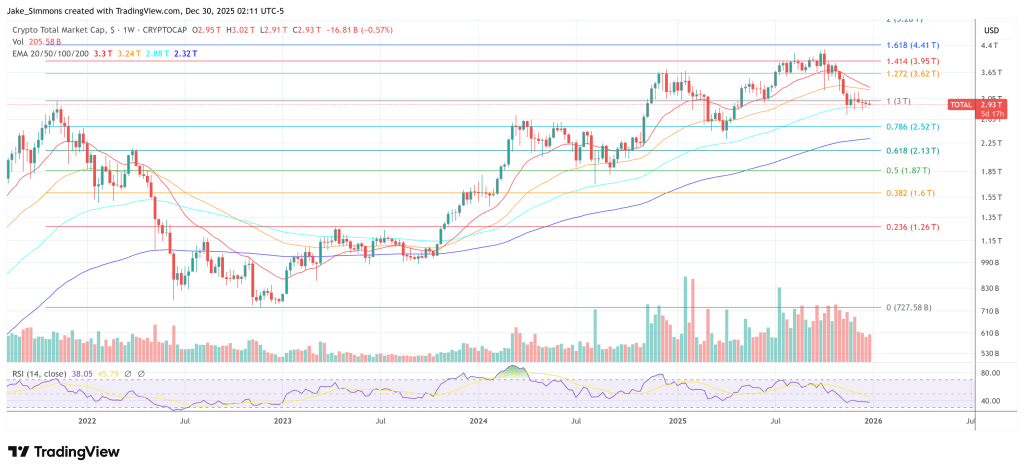
Total crypto market cap holds above the 2021 high, 1-week chart | Source: TOTAL on TradingView.com

Trending Cryptos

Related Questions

QWhat is Haseeb Qureshi's price prediction for Bitcoin by the end of 2026?

AHaseeb Qureshi predicts that Bitcoin (BTC) will be greater than $150,000 by the end of 2026.

QWhich two blockchain platforms does Qureshi expect to 'overdeliver' in 2026?

AQureshi expects Ethereum and Solana to overdeliver in 2026.

QWhat does Qureshi predict will happen to the stablecoin supply in 2026?

AHe predicts the stablecoin supply will expand by approximately 60% in 2026, with the USD remaining over 99% dominant.

QAccording to Qureshi, what is the primary use case for AI in the crypto space in 2026?

AThe primary AI use cases in crypto will remain within software engineering and security, with everything else being a prototype.

QWhat major legislative action does Qureshi forecast for the US crypto industry in 2026?

AHe predicts the 'Clarity Act' will be signed into law in 2026 after significant markups and horse trading.

Related Reads

CPU Makes a Comeback to the Table, A $170 Billion "Power Seizure" Drama Begins

A new era is dawning for the server CPU (Central Processing Unit), driven by the shift from AI model training to large-scale reasoning and the rise of Agentic AI. This article explores how the CPU is reclaiming a central role in the AI data center. For years, the focus has been on the GPU (Graphics Processing Unit) for AI training. However, as AI moves to the inference and Agent phase—where tasks involve complex, multi-step reasoning, tool calls, and data management—the workload balance is flipping. Studies show CPUs now handle over 70% of the workload in Agentic AI, up from 10-30% in training. This is because Agent tasks generate massive intermediate data (KV Cache) that exceeds GPU memory, forcing it to be offloaded to the CPU's larger, more scalable memory pools. This increased importance is translating into market changes. Major players are taking note: NVIDIA launched its first standalone CPU line, Vera, based on ARM architecture and optimized for Agent performance. AMD doubled its server CPU market forecast to over $1200 billion by 2030. Analyst reports project the total server CPU market could reach $1700 billion by 2030, with AI-driven demand being a primary driver. Furthermore, the classic ratio of CPUs to GPUs in AI servers is rapidly changing, converging from 1:8 toward 1:1 for Agent deployments. This surge in demand has led to a rare industry-wide price increase of 10-15% for server CPUs from Intel and AMD, breaking a decade-long trend of "more performance for the same price." Demand is bifurcating into high-core-count CPUs for in-rack GPU support and moderate-core CPUs for standalone Agent task orchestration. In China, this global trend presents an opportunity for domestic CPU manufacturers like Hygon (海光信息) and Huawei Kunpeng, who are bolstered by both growing AI infrastructure needs and national policies promoting technological self-reliance ("xin chuang"). The maturity of their software ecosystems is also accelerating, evidenced by faster adaptation to new AI models. In conclusion, the narrative is shifting from a GPU-centric view to one where CPU-GPU synergy is critical. The CPU is no longer a peripheral component but a performance-defining bottleneck and a key growth driver in the AI hardware stack, opening a massive new market estimated in the hundreds of billions of dollars.

marsbit11h ago

CPU Makes a Comeback to the Table, A $170 Billion "Power Seizure" Drama Begins

marsbit11h ago

TechFlow Intelligence: AMD AI Director Publicly Criticizes Claude Code for "Becoming Dumber and Lazier", Trump Claims Full Ceasefire in Hormuz But Strait Still Has 80 Unexploded Mines

TechFlow Intelligence Report: This daily digest covers key developments in AI, crypto, hardware, and geopolitics. In AI, SK Telecom faces US export control scrutiny over its partnership with Anthropic, while a Gemini user reports being misled in a scam scenario, sparking safety debates. China's Z.AI launches the GLM-5.2 model, rivaling Claude Opus without NVIDIA chips. In crypto, Bithumb lists ReProtocol, and Upbit delists KernelDAO. On the hardware front, MIT researchers build a custom OS to study chips, ASML denies US claims its advanced lithography machines are in China, and Amazon considers selling its in-house AI chips. Apple's future A21 Pro chip may use TSMC's latest N2P process. Major tech issues include 10,000 GitHub repositories distributing malware and Apple patching a critical eavesdropping flaw in Beats earbuds. US stocks rise, led by semiconductors, with Intel surging 10.6%, while SpaceX falls 3.5%. Geopolitically, despite a US-Iran deal, the Strait of Hormuz remains risky with ~80 uncleared mines, stalling 80M barrels of oil on standby tankers. Iran postpones Switzerland talks, and Trump calls the agreement an "unconditional surrender." The report highlights a contrast: temporary geopolitical calm versus the ongoing, fundamental restructuring of tech supply chains and chip independence.

marsbit11h ago

TechFlow Intelligence: AMD AI Director Publicly Criticizes Claude Code for "Becoming Dumber and Lazier", Trump Claims Full Ceasefire in Hormuz But Strait Still Has 80 Unexploded Mines

marsbit11h ago

Trading

Spot
Futures

Hot Articles

Discussions

Welcome to the HTX Community. Here, you can stay informed about the latest platform developments and gain access to professional market insights. Users' opinions on the price of S (S) are presented below.

活动图片