Original | Odaily Planet Daily (@OdailyChina)
Author | Asher (@Asher_ 0210)
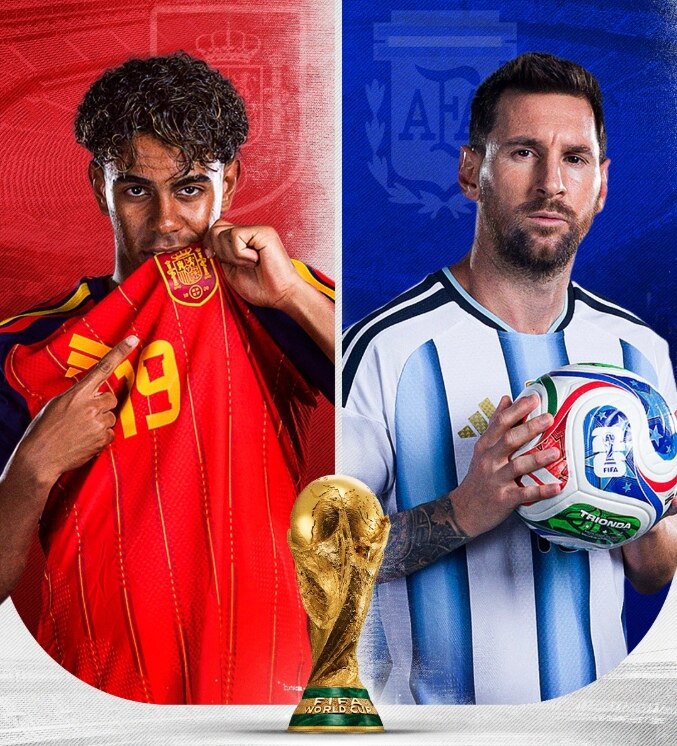
At 3 a.m. Beijing Time on July 20, the 2026 FIFA World Cup will crown its champion between Argentina and Spain. On one side is Argentina, attempting to defend their title and achieve a historic back-to-back World Cup win; on the other is Spain, who have marched steadily to the final with an almost unbreakable defense.
Spain's path to the final has demonstrated remarkable stability. In the knockout stages, they successively defeated Austria, Portugal, Belgium, and France, maintaining tight control of the game rhythm against multiple strong opponents. Particularly in the semi-final against France, Spain allowed little space for counterattacks from the Mbappé-led frontline, ultimately advancing with a 2-0 victory. With only 1 goal conceded and 6 clean sheets in 7 matches, their solid defense and formidable midfield control have been the bedrock of their journey.
Argentina's road, in contrast, has been fraught with danger and comebacks. Since entering the knockout rounds, they have hardly secured a comfortable win. They narrowly defeated Cape Verde and Egypt 3-2 each; in the quarter-final against Switzerland, they only scored consecutive goals deep into extra time; facing England in the semi-final, they were still trailing in the 85th minute before relying on Messi's assists for Enzo and Lautaro to complete a dramatic turnaround.
Furthermore, this final carries a storyline almost worthy of a movie script.
During a charity photoshoot in 2007, a young Lionel Messi was photographed bathing an infant Lamine Yamal. No one could have imagined that nearly two decades later, the two would meet for the first time in their careers on the World Cup final stage.
Now, Messi is 39 years old, while Yamal is just 19. One is potentially playing his final World Cup match; the other stands at the threshold of his own era. This nearly 20-year-old photo adds a layer of symbolic generational transition to this final.

Before delving into which side the AIs predict will lift the trophy, let's review their performance in the two semi-finals (related content can be read here: Semi-final AI Prediction Battle: Is France a Lock? England vs Argentina Hangs in the Balance).
Most Stumbled in Semis, Gemini Nailed Both
In the quarter-finals, all 6 AIs correctly predicted France, Spain, England, and Argentina to advance. However, by the semi-finals, the overall prediction performance of the AIs became somewhat "lackluster."
For France vs. Spain, ChatGPT, Claude, Grok, DeepSeek, and Qwen not only unanimously favored France to advance but also all predicted a 2-1 win for France. These five models reasoned that France could exploit the spaces left by Spain's advancing full-backs to decide the match with swift counterattacks. In reality, France failed to execute the expected counters, were instead controlled by Spain's rhythm, and ultimately exited with a 0-2 loss. Gemini, the sole model to pick Spain, got the advancing team right, but it predicted the match would go to a penalty shootout, thus also missing the exact process.
For England vs. Argentina, the 6 AIs were split down the middle. Grok, DeepSeek, and Qwen supported England, while ChatGPT, Gemini, and Claude backed Argentina. In the end, Argentina completed a 2-1 comeback. The three models supporting Argentina correctly predicted the advancing side, with only Gemini also accurately predicting the final score.
After the two semi-finals, Gemini emerged as the only model to correctly pick both finalists, delivering the most accurate predictions of this round. Yet, as we approach the ultimate championship match, all 6 AIs have once again aligned on the same side.
Consensus Returns for Final, All 6 AIs Favor Spain
Monitoring by prediction market tools shows that in the "World Cup Final Argentina vs Spain" event on predict.fun, the implied probability for an Argentina win is temporarily reported at 27%; a draw at 32%; and a Spain win at 43%. Furthermore, including extra time and penalties, Spain's implied championship probability stands at 59%, compared to Argentina's 41%.
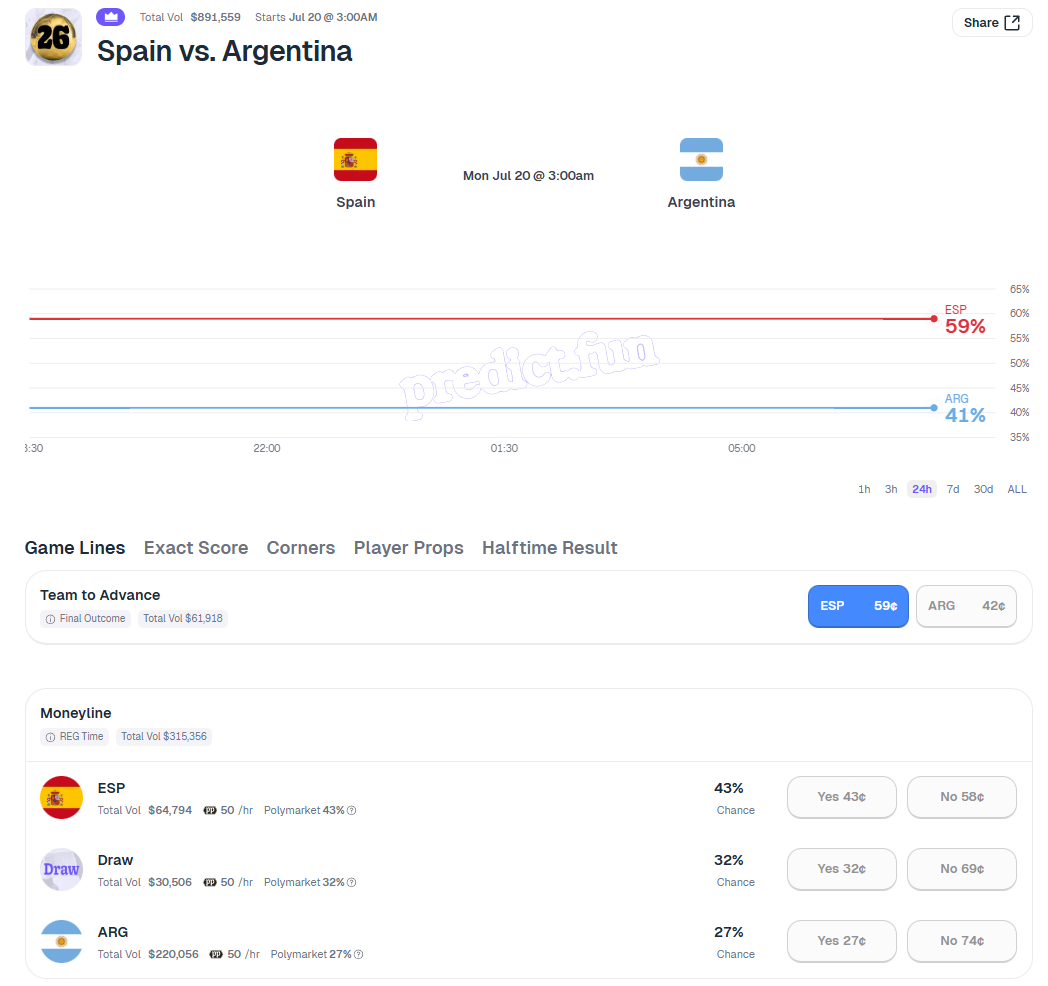
While the prediction market shows a close championship probability, the stance of the 6 AIs is highly unanimous: ChatGPT, Claude, Gemini, Grok, DeepSeek, and Qwen all favor Spain to win the title.
Why Do All AIs Predict a Spanish Victory?
The reasons cited by the AIs for favoring Spain are highly consistent: defense, midfield control, and physical preparedness.
Spain's most compelling advantage is their near-impenetrable defense this tournament. Conceding only 1 goal in the first 7 matches and successively containing Portugal, Belgium, and France in the knockouts. While Argentina possesses greater offensive firepower, facing Spain's compact formation, they are unlikely to find the same open spaces for counterattacks as before.
Midfield control will dictate the pace of the match. Rodri orchestrates the attack, Olmo consistently infiltrates the attacking channels between defenders, and Yamal can continuously stretch Argentina's defense from the wings. Argentina excels at compressing the center and launching rapid attacks through Messi, Álvarez, and Lautaro, but Spain has the ability to reduce transitional play through prolonged possession, making it difficult for Argentina to settle into their preferred rhythm.
Physical preparedness is also a variable widely mentioned by the AIs. Spain finished their semi-final a day earlier than Argentina and had a relatively smoother path; Argentina, meanwhile, played 120 minutes against Switzerland and battled until stoppage time against England. If the match goes into extra time, Spain's younger squad and deeper bench could become decisive advantages.
5 AIs Don't Favor a Spanish Win Within 90 Minutes
Although unanimous on the champion, the 6 models still have different judgments on how Spain might win the match.
Gemini, the top performer in the semis, predicts a 1-1 draw in regulation time, a continued stalemate in extra time, and ultimately a penalty shootout to decide the champion, picking Spain to emerge victorious.
ChatGPT, Grok, and Qwen offer similar predictions, all leaning towards a 1-1 scoreline after 90 minutes. They believe Argentina has the ability to equalize through Messi's playmaking and attacking efficiency, but in extra time, Spain's superior physical conditioning and squad depth will gradually tell, leading to a winning goal in the additional 30 minutes.
Claude does not predict a specific score but believes the match will be locked in a low-scoring range (1-1, 1-0, or 0-0). It emphasizes the cautious atmosphere typical of finals, suggesting the sides may remain evenly matched for long periods until a set piece, counterattack, or individual moment of brilliance breaks the deadlock.
DeepSeek is the only model leaning more towards Spain resolving the match within the 90 minutes. It expects Spain to continue their defensive solidity, limit Argentina's attack, and secure a direct 2-0 or 2-1 victory.
Before the semi-finals, 5 AIs unanimously backed France to advance, only for Spain to deliver a 2-0 masterclass, collectively proving the AIs wrong. This time, will Spain fulfill the promise of their overall strength, or will Argentina once again drag the match into familiar desperate straits and find a path to another miraculous turnaround?