DAT: The Evolution of Digital Asset Treasuries as Strategic Assets for Crypto Enterprises

marsbitPublished on 2025-12-22Last updated on 2025-12-22

Abstract

By the end of 2025, the Digital Asset Treasury (DAT) remains a significant corporate trend in the crypto industry, evolving from passive market participation to a strategic resource integrated into long-term enterprise planning. Companies are increasingly incorporating digital assets like Bitcoin and Ethereum into their balance sheets, shifting focus from mere accumulation to rational asset allocation, risk management, and strategic engagement with blockchain ecosystems. DAT strategies now emphasize diversification, cash flow stability, and participation in on-chain governance, staking, and lending, transforming digital assets into tools for operational resilience and ecosystem influence. Market structure is maturing, with indices like MSCI raising standards for transparency and governance, moving from asset-driven to capability-driven evaluations. Enterprises demonstrating robust risk controls, diversified portfolios, and synergistic business-ecosystem integration show greater resilience. The industry is experiencing differentiation: firms with clear strategic frameworks and sustainable practices are gaining competitive edges, while those reliant on single assets or market sentiment face constraints. Ultimately, DAT's value lies not in the volume of assets held but in the ability to embed them within a coherent strategy, sound governance, and active ecological participation, marking a shift from financial instruments to key strategic resources in corporate growth.

By the end of 2025, Digital Asset Treasuries (DAT) remain one of the most noteworthy corporate behaviors in the crypto industry. An increasing number of enterprises are choosing to incorporate digital assets into their balance sheets. This move is no longer merely a passive participation in market trends but an attempt to transform digital assets into long-term strategic resources. As market conditions and regulatory expectations gradually evolve, the DAT industry is undergoing structural optimization and capability screening. Its core value has shifted from单纯的 asset holding to a test of corporate strategic execution.

Typical DAT enterprises typically raise funds through stock financing, bond issuance, or private placements and allocate them to mainstream digital assets like Bitcoin and Ethereum. Compared to the early strategy of primarily "hoarding coins," companies now place greater emphasis on the rationality of asset allocation, risk control systems, and strategic linkages with the blockchain ecosystem. On one hand, digital assets provide enterprises with asset diversification and long-term value potential; on the other hand, companies must simultaneously establish cash flow management and risk constraint mechanisms to ensure operational sustainability. Furthermore, holding digital assets means enterprises can participate in on-chain governance, staking, and lending, thereby gaining deeper participation rights and influence at the ecosystem level. This change indicates that DAT has gradually become part of the corporate strategic management system, rather than just a book asset.
Market Structure and Corporate Performance

From recent industry performance, DAT enterprises are entering a clear phase of structural adjustment. Some companies are stabilizing market expectations and improving shareholder structure through share buybacks and asset portfolio optimization; others are gradually returning to more稳健 operational paths through strategic contraction or asset adjustments. At the same time, index agencies like MSCI are beginning to重新审视 the inclusion criteria for DAT-related companies, with significantly increased attention to corporate information disclosure, governance structure, and operational stability. This means the market is weakening its reliance on asset size and short-term price performance,转而 assessing enterprises' operational capabilities and risk management levels in complex environments.

It is worth noting that some companies with Ethereum-related assets as core allocations have shown relative resilience in recent market adjustments. This is not a reflection of a single asset's advantage but rather更多地反映了 the important role of asset diversification, business synergy, and governance capabilities in long-term corporate performance. Overall, changes in market structure are driving the DAT industry from "asset-driven" to "capability-driven."

Corporate Behavior and Strategic Choices

Starting from specific corporate behaviors, the strategic logic behind DAT can be understood more clearly.

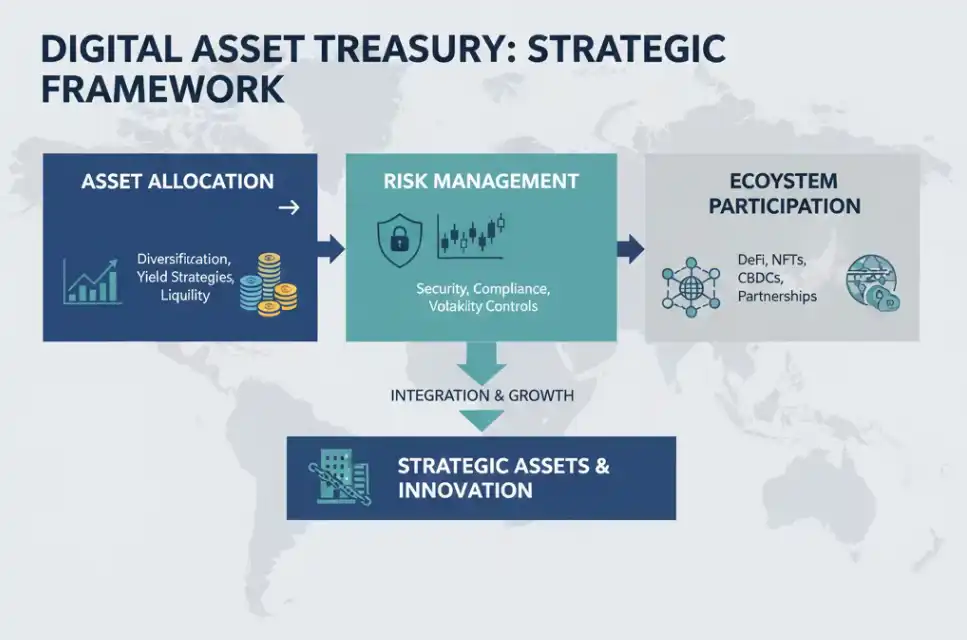
At the asset level, enterprises no longer view digital assets as isolated investment targets but incorporate them into a long-term capital allocation framework to support future business expansion and ecosystem布局.

At the risk and stability level, companies balance market expectations and internal robustness through asset diversification, share buybacks, and operational structure improvements. The significance of such operations lies not in short-term market feedback but in securing greater strategic maneuvering space for the enterprise.

At the ecosystem level, holding digital assets enables enterprises to participate in on-chain governance and ecosystem building, transforming financial behavior into actual influence and voice. This shift from "asset management" to "ecosystem participation" is becoming an important path for DAT enterprises to build long-term competitiveness.

Overall, DAT has evolved from simple coin-holding behavior to a comprehensive practice integrating asset strategy, risk control, and ecosystem participation.

Industry Trends and Corporate Divergence

Observing from a longer cycle, the evaluation criteria of the DAT industry are undergoing substantive changes. Market focus is gradually shifting from asset size and short-term price fluctuations to corporate operational capabilities, cash flow stability, and governance transparency. This change directly promotes divergence among enterprises: those with clear asset strategies, diversified allocations, and robust governance structures are more likely to establish advantages in long-term competition; while those highly reliant on single assets or market sentiment see their strategic flexibility and sustainability significantly limited.

More importantly, some enterprises have already begun to transform digital assets into sustainable strategic resources through the combination of business synergy, ecosystem participation, and asset management. This path does not rely on a single market phase but is built on long-term capability building, constituting the core direction for the future development of the DAT industry.

Conclusion

The true value of DAT enterprises is not reflected in how many digital assets they hold, but in whether the enterprise can incorporate these assets into a clear strategic framework, establish a robust operational system and governance structure, and form sustained participation capabilities at the ecosystem level. By observing corporate behavior and industry structural changes, it can be seen that the DAT industry is moving towards a competitive stage centered on strategic capability and long-term execution.

Understanding DAT essentially means understanding how digital assets are transforming from a financial tool into a key resource within the corporate strategic system. This transformation not only reshapes how enterprises manage assets but also provides new judgment coordinates for investors and industry participants. In the future, enterprises that can form良性 synergy between asset strategy, risk management, and ecosystem participation are more likely to establish long-term, stable competitive advantages within the DAT system.

Related Reads

WEEX TradFi Trading Competition Kicks Off, 50,000 USDT Prize Pool First-Come, First-Served, Open a Position and Get 5 U

WEEX Exchange Launches "TradFi Trading Competition" with a 50,000 USDT Prize Pool Amidst a crypto market downturn, WEEX Exchange highlights the growth of tokenized traditional finance (TradFi) assets as a key trend, allowing users to trade stocks, ETFs, and commodities using crypto. The platform has launched a "TradFi Trading Competition" from July 9th to 23rd, featuring a 50,000 USDT prize pool. The campaign offers three reward tiers: 1. **New User Bonus (25,000 USDT pool):** New users depositing ≥100 USDT, completing a specified spot trade, and one TradFi contract trade (margin ≥10 USDT) receive 200 USDT. 2. **Volume-Based Rewards (20,000 USDT pool):** All users can earn tiered bonuses for achieving TradFi contract trading volumes of 5,000 USDT (3 USDT), 20,000 USDT (10 USDT), and 100,000 USDT (50 USDT). Rewards are stackable. 3. **Participation Reward:** Any user opening a TradFi contract trade during the event receives 5 USDT instantly. The article promotes WEEX's TradFi features, which include trading tokenized shares of companies like NVIDIA and Tesla using USDT, 24/7 trading, fractional share investing starting from $5, and high leverage up to 100x for hedging. It positions these features as solutions to traditional investing barriers like high fees, strict trading hours, and high share prices. The summary concludes by encouraging users to join the competition and leverage WEEX's platform to access global TradFi markets.

marsbit46m ago

WEEX TradFi Trading Competition Kicks Off, 50,000 USDT Prize Pool First-Come, First-Served, Open a Position and Get 5 U

marsbit46m ago

Switching Chains for Another Shot at Success: Can It Really 'Change One's Destiny'?

Recent months have witnessed a wave of established blockchain projects migrating to new public chains, notably Base and Arbitrum, coupled with strategic pivots in their business models—essentially "re-starting" elsewhere. Examples include Sophon (moving from ZKsync to Base to cut $3M+ annual costs and focus on consumer apps), Moonbeam (shifting from Polkadot to Base to pursue decentralized AI), and Secret Network (planning a move from Cosmos to Arbitrum to explore privacy-AI integrations, though its token price plunged 30% post-announcement). A common thread is that these migrating projects are primarily layer-1 or layer-2 chains now seeking relevance in AI and real-world consumer applications. This trend highlights the relative stagnation of ecosystems like Polkadot and Cosmos, which are seeing significant outflows. However, the community remains skeptical about whether such chain-hopping truly enables a turnaround. Historical cases like y00ts NFTs (which moved from Solana to Polygon and back to Ethereum) and Synthetix (which retreated from a multi-chain strategy) show that migration often fails to deliver expected benefits and can add complexity. In today's more rational market, devoid of easy narrative or airdrop红利, simply changing chains is unlikely to be a silver bullet. For both migrating projects and destination chains, the real challenge lies not in attracting projects but in developing actual use cases that retain users.

marsbit50m ago

Switching Chains for Another Shot at Success: Can It Really 'Change One's Destiny'?

marsbit50m ago

Does Switching Chains to Re-entrepreneur Really "Change One's Destiny"?

Amid a recent wave of blockchain migrations, several established projects, including Sophon, Moonbeam, and Secret Network, are moving to new ecosystems like Base and Arbitrum. Unlike past migrations driven by hype or security, these moves are often accompanied by strategic pivots, such as shifting focus to consumer applications, AI, or privacy-AI integration, effectively representing a "re-startup" attempt. However, the crypto community has reacted cautiously. Following Secret Network's announcement of its planned migration to Arbitrum, its token price plummeted over 30% in 24 hours. While migrating to more cost-efficient, higher-traffic, or technologically suitable chains can be a pragmatic choice, history shows that such moves rarely guarantee success. Examples like the y00ts NFT project, which moved from Solana to Polygon and then to Ethereum, or Synthetix’s retreat from a multi-chain strategy, illustrate the challenges and often underwhelming results. The current market environment, characterized by greater user rationality and the partial validation of past narratives, makes a successful "pivot via migration" even more difficult. Simultaneously, destination chains themselves face challenges in demonstrating sustainable user adoption beyond merely attracting migrating projects. Ultimately, the competition is shifting from which chain can onboard the most projects to which can genuinely foster real-world application and retain users.

链捕手54m ago

Does Switching Chains to Re-entrepreneur Really "Change One's Destiny"?

链捕手54m ago

June Transaction Volume Doubles: x402 Ecosystem Continues to Expand, Content Monetization Narrative Faces Crucial Test

X402, a protocol for AI and data services, experienced significant growth in June. Its transaction volume doubled compared to May, primarily driven by the AI inference routing service BlockRun. The ecosystem expanded with new integrations: Apify enabled data scraping services, Exa extended its AI search to Solana, and Seal launched 'Hacks', a marketplace for automated AI agents. The protocol itself received crucial upgrades, including 'Builder Codes' for tracking and affiliate systems and 'Batch Settlement' to enable practical micropayments for high-frequency AI tasks. Major external validation came from tech giants. Amazon Web Services (AWS) launched a solution for AI traffic metering at its edge nodes. More significantly, Cloudflare opened its waitlist for a Content Monetization Gateway. This gateway allows websites to charge AI bots and other automated agents for accessing content, using x402 for stablecoin payments. This addresses a core internet monetization problem and represents x402's most promising path to mass adoption, though Cloudflare's CEO noted current blockchain scalability remains a critical hurdle. Current leading use cases are AI inference routing and paid data feeds. However, the large-scale real-world test with Cloudflare's gateway will be decisive in determining if x402 can transition from a useful tool to a fundamental infrastructure component for a new web economy where AI agents pay for the content they consume.

Foresight News1h ago

June Transaction Volume Doubles: x402 Ecosystem Continues to Expand, Content Monetization Narrative Faces Crucial Test

Foresight News1h ago

Trading

Spot
活动图片