Crypto today – Market sees a relief rally, Bitcoin bumps up, but traders are cautious

ambcryptoPublished on 2026-03-30Last updated on 2026-03-30

Abstract

The crypto market experienced a period of high volatility driven by geopolitical tensions and risk-off sentiment, with Bitcoin struggling to maintain direction. Derivative positioning, particularly around the $75,000 options expiry on March 27th, suppressed price movement despite underlying demand. After $14 billion in options expired, the market stabilized as forced hedging diminished and real demand emerged. This led to a relief rally, fueled by extreme fear exhaustion—the Fear & Greed Index dropped as low as 10 before slightly recovering. With most sellers exhausted, even modest demand triggered a rebound. Institutional inflows, including $1.2 billion in ETF inflows over four weeks, provided support. However, the sustainability of the recovery depends on whether spot demand continues beyond short-term factors.

The broader crypto market has moved through a volatile stretch, as tensions around the Strait of Hormuz disrupted sentiment and triggered sharp, reactive swings. Bitcoin [BTC] led this instability, repeatedly failing to hold direction as macro uncertainty drove risk-off behavior.

At the same time, derivative positioning quietly added pressure. Traders clustered around the $75,000 max-pain level into the expiry on the 27th of March, which kept prices pinned despite underlying demand.

This created a market that looked weak, not because demand disappeared, but because positioning suppressed movement.
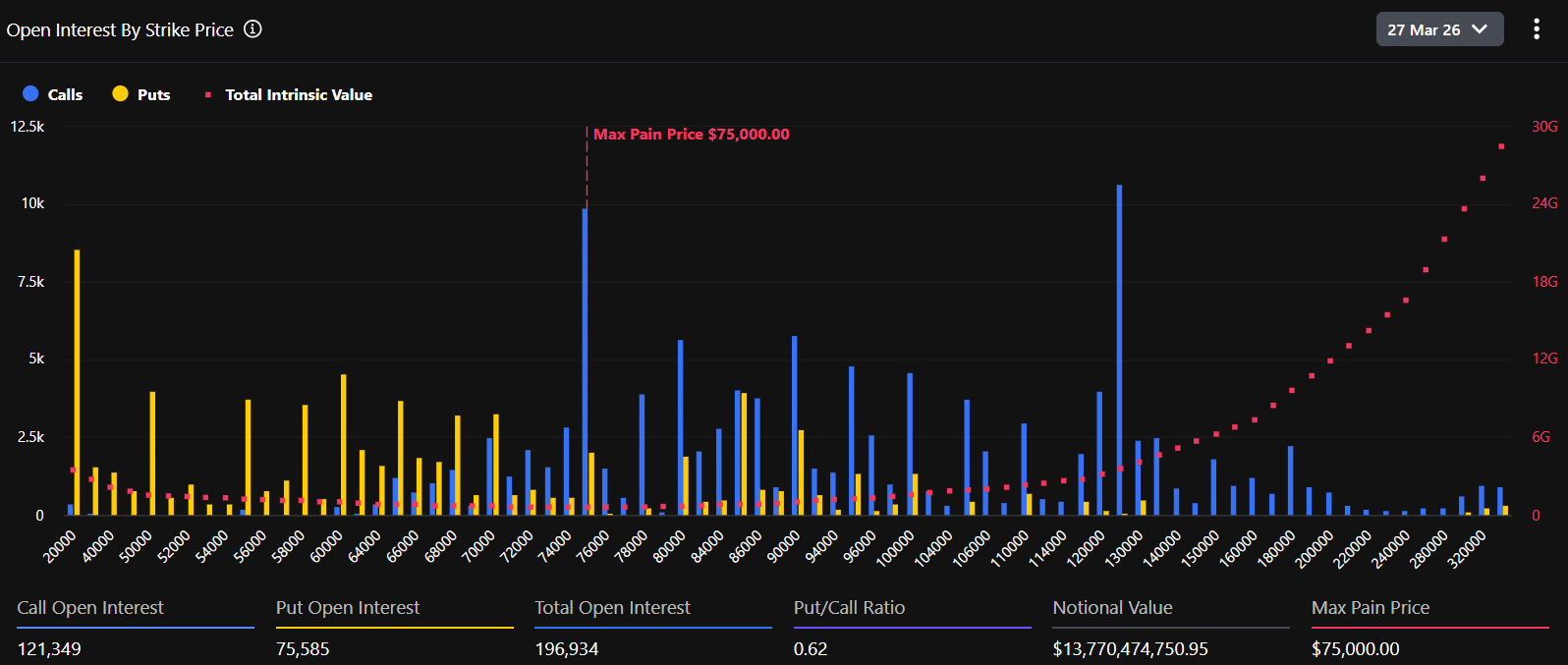
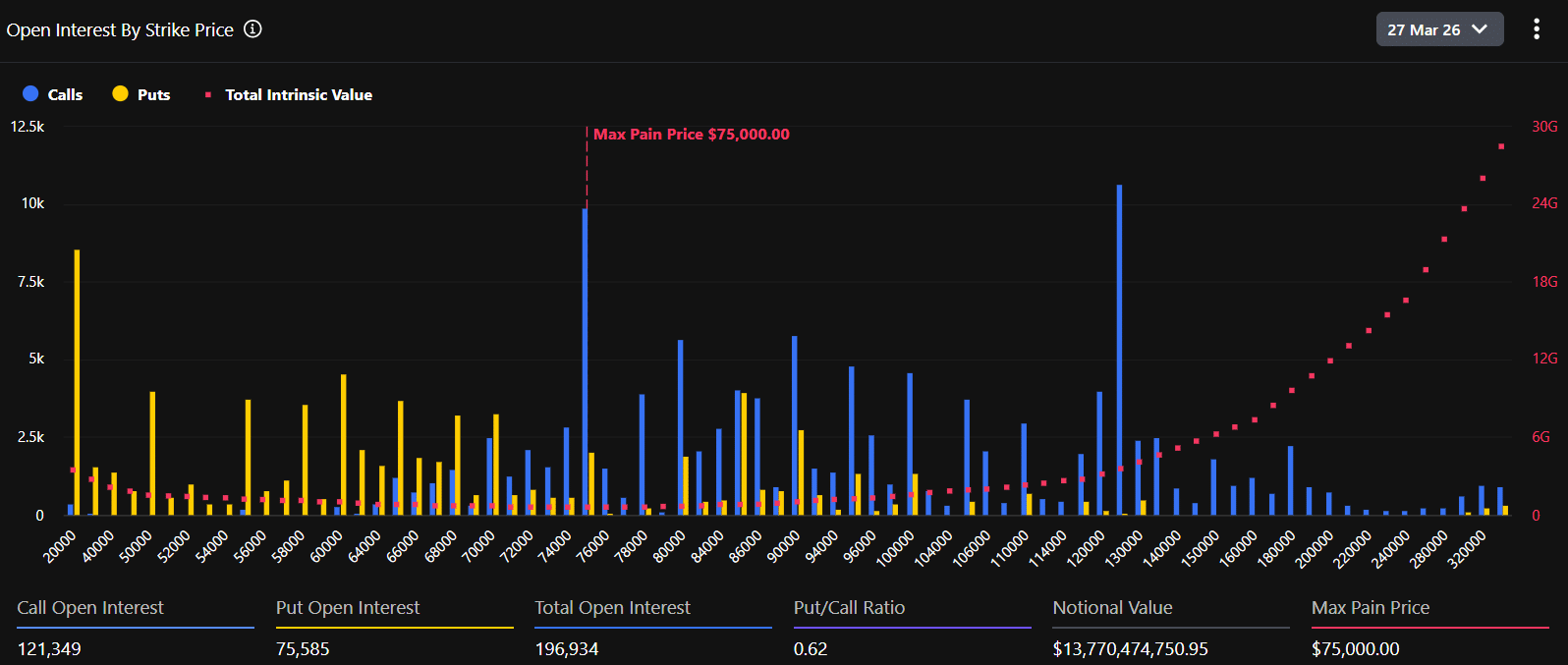
Source: Deribit

Once roughly $14 billion in Options expired, the price began to stabilize as forced hedging flows faded and real demand started to show.

This shift explains the recent rebound. With expiry pressure gone, the market now reacts to fresh positioning, allowing recovery to build under a more natural structure.

Relief rally or structural recovery?

As macro pressure eased and expiry constraints lifted, the market was already stretched to the downside, which made the rebound more responsive.

Sentiment had collapsed into ‘Extreme Fear,’ with the index dropping to 13 on the 27th of March after touching near 10 earlier. At the time of writing, it sat at 8, implying an improved sentiment.

This level of fear matters because it signals that most sellers had already acted, leaving little marginal supply to push Bitcoin’s price lower. Once that exhaustion sets in, even small improvements in conditions can trigger a sharp return of bids.

That is precisely what followed. As panic faded, institutional demand stepped in, with March recording roughly $1.2 billion in ETF inflows across four consecutive weeks. This interaction explains the rebound.

Exhausted selling met steady demand, allowing the price to stabilize and build a more credible recovery base.


Final Summary

  • Bitcoin’s rebound reflects expiry relief and extreme fear exhaustion, yet sustainability depends on whether Spot demand strengthens beyond short-covering flows.
  • Bitcoin shows improving sentiment and ETF support, but the broader crypto market still needs consistent demand to confirm a durable recovery.


Related Questions

QWhat were the main factors that led to the recent rebound in Bitcoin's price?

AThe rebound was primarily driven by the expiration of roughly $14 billion in options, which removed forced hedging pressure, combined with extreme fear exhaustion among sellers and renewed institutional demand evidenced by $1.2 billion in ETF inflows over four consecutive weeks.

QHow did the options expiry on March 27th impact Bitcoin's price movement?

ATraders clustered around the $75,000 max-pain level ahead of the March 27th expiry, which suppressed price movement and kept Bitcoin pinned despite underlying demand. Once the options expired, the price began to rebound as this positioning pressure faded.

QWhat does the 'Extreme Fear' sentiment level indicate about market conditions?

AThe 'Extreme Fear' sentiment, with the index dropping to 13 and even near 10, indicated that most sellers had already acted, leaving little marginal supply to push prices lower. This exhaustion often precedes a sharp return of bids when conditions slightly improve.

QIs the current market recovery considered a relief rally or a structural recovery according to the article?

AThe article suggests it is currently a relief rally driven by expiry relief and fear exhaustion, but questions its sustainability. A structural recovery would require consistent spot demand strengthening beyond short-covering flows.

QWhat role did geopolitical events play in the crypto market's volatility?

ATensions around the Strait of Hormuz disrupted market sentiment and triggered sharp, reactive swings in the broader crypto market, contributing to the period of high volatility and risk-off behavior.

Related Reads

U.S.-Iran Ceasefire: How Much of a Bitcoin Rally Can a Truce Agreement Support?

Headline: "U.S.-Iran Truce: How Much Can a Ceasefire Agreement Propel Bitcoin's Rebound?" On June 15th, Bitcoin rebounded to around $67,255, marking its first return to the $67,000 level since falling below $60,000 earlier in June. Ethereum and Solana also saw significant gains. The immediate driver for this market-wide recovery in crypto and global risk assets was the signing of a U.S.-Iran ceasefire memorandum, with a formal ceremony scheduled for June 19th. The agreement, which includes reopening the Strait of Hormuz, caused oil prices to plunge roughly 5%, easing inflation expectations and boosting prospects for Federal Reserve rate cuts. This macroeconomic shift fueled a rally in U.S. equities, with the Dow Jones hitting a record high. SpaceX's spectacular post-IPO performance further energized market sentiment. However, on-chain and derivatives data from Glassnode suggest this move is more indicative of a technical rebound from deeply oversold conditions rather than a confirmed trend reversal. The crypto market is undergoing noticeable capital rotation. While Bitcoin ETFs recently saw their worst outflows on record, the bleeding has slowed significantly. Meanwhile, new altcoin ETFs for assets like XRP and Solana are attracting substantial inflows, causing Bitcoin's market dominance to drop to 58%. Despite the rebound, the Crypto Fear & Greed Index remains in "Extreme Fear" territory at 22. The price quickly retreated after touching the $67,000 resistance level, indicating selling pressure persists. Analysis shows short-term speculative supply has been heavily washed out, with holder structure shifting toward a more long-term profile. While panic is subsiding and some on-chain metrics point to accumulation at lower prices, the market currently lacks the strong, sustained institutional buying needed to establish a new bullish trend.

Foresight News8m ago

U.S.-Iran Ceasefire: How Much of a Bitcoin Rally Can a Truce Agreement Support?

Foresight News8m ago

Copper, the Gold of 2026

Copper: The New Gold for 2026? Market focus has shifted from AI chips to underlying infrastructure, with copper emerging as a key narrative. Its role is evolving beyond "Dr. Copper"—a traditional indicator of economic cycles—due to structural demand growth from AI data centers (requiring massive electrical infrastructure), grid expansion, EVs, and re-industrialization. Estimates suggest data centers alone could require 300,000 tons of copper by 2050. The core bullish thesis is not just demand but a severe supply constraint. New copper mines take ~17 years to develop, while ore grades are declining and new discoveries are scarce, potentially leading to a 30% supply deficit by 2035. This supply rigidity, coupled with strategic importance, is giving copper a "gold-like" scarcity narrative. Major macro investors, including Stanley Druckenmiller, are allocating to copper as a hedge against dollar weakness and for its exposure to energy transition and geopolitics. Traders like Pierre Andurand have projected prices could reach $40,000/ton. Capital inflows are visible in surging futures trading volumes. Copper mining stocks act as leveraged plays on copper prices. Companies like Freeport-McMoRan (FCX) and Southern Copper (SCCO), as well as Chinese miners like CMOC, have seen significant volatility, offering high upside but also steep drawdowns, reflecting operational and geopolitical risks. While copper remains cyclical and won't fully replicate gold's monetary role, its long-term fundamentals have shifted. Its new scarcity premium, driven by a tightening supply structure and expanding electrical demand, suggests its "goldification" is just beginning.

marsbit15m ago

Copper, the Gold of 2026

marsbit15m ago

pump.fun's New Feature Brings 'Black Mirror' Into Reality

The article begins by recounting a dark fictional story from *Black Mirror* (Season 7, Episode 1 "Common People"), where a man is forced to perform humiliating tasks online to pay for his wife's life-sustaining medical subscription. It then draws a parallel to a new real-world feature on the crypto platform pump.fun called "Pump.fun Go," which allows users to post and complete paid bounty tasks. This feature gained mainstream attention, often negatively, through extreme examples. A prominent case involved a bounty of 40 SOL (~$2,600) offered to permanently tattoo "$bountywork" on one's forehead. An Indian man completed the task, stating the money "changed his life," and later earned significantly more from a related meme coin. Another bounty paid 200 SOL (~$14,000) for a "bounty.fun" forehead tattoo, with the participant simply stating, "We need the money." The article highlights how this system can amplify darkness, citing the dev behind $Bountywork who spent thousands on bounties for attention-grabbing stunts like eating bugs or drinking hot sauce for small sums. It compares this to past tragic live-streaming incidents where people harmed themselves for money, noting regulation cannot stop those in desperate need. However, it also points to positive, altruistic bounties that have emerged, such as organizing anti-work rallies in New York, performing random acts of kindness for strangers, organizing community food drives, or even helping an elderly person cross the street. The piece concludes by acknowledging the platform reflects both the dark and light sides of human nature when actions are given a price, hoping for more of the latter.

marsbit21m ago

pump.fun's New Feature Brings 'Black Mirror' Into Reality

marsbit21m ago

Trading

Spot
Futures

Hot Articles

What is $BITCOIN

DIGITAL GOLD ($BITCOIN): A Comprehensive Analysis Introduction to DIGITAL GOLD ($BITCOIN) DIGITAL GOLD ($BITCOIN) is a blockchain-based project operating on the Solana network, which aims to combine the characteristics of traditional precious metals with the innovation of decentralized technologies. While it shares a name with Bitcoin, often referred to as “digital gold” due to its perception as a store of value, DIGITAL GOLD is a separate token designed to create a unique ecosystem within the Web3 landscape. Its goal is to position itself as a viable alternative digital asset, although specifics regarding its applications and functionalities are still developing. What is DIGITAL GOLD ($BITCOIN)? DIGITAL GOLD ($BITCOIN) is a cryptocurrency token explicitly designed for use on the Solana blockchain. In contrast to Bitcoin, which provides a widely recognized value storage role, this token appears to focus on broader applications and characteristics. Notable aspects include: Blockchain Infrastructure: The token is built on the Solana blockchain, known for its capacity to handle high-speed and low-cost transactions. Supply Dynamics: DIGITAL GOLD has a maximum supply capped at 100 quadrillion tokens (100P $BITCOIN), although details regarding its circulating supply are currently undisclosed. Utility: While precise functionalities are not explicitly outlined, there are indications that the token could be utilized for various applications, potentially involving decentralized applications (dApps) or asset tokenization strategies. Who is the Creator of DIGITAL GOLD ($BITCOIN)? At present, the identity of the creators and development team behind DIGITAL GOLD ($BITCOIN) remains unknown. This situation is typical among many innovative projects within the blockchain space, particularly those aligning with decentralized finance and meme coin phenomena. While such anonymity may foster a community-driven culture, it intensifies concerns about governance and accountability. Who are the Investors of DIGITAL GOLD ($BITCOIN)? The available information indicates that DIGITAL GOLD ($BITCOIN) does not have any known institutional backers or prominent venture capital investments. The project seems to operate on a peer-to-peer model focused on community support and adoption rather than traditional funding routes. Its activity and liquidity are primarily situated on decentralized exchanges (DEXs), such as PumpSwap, rather than established centralized trading platforms, further highlighting its grassroots approach. How DIGITAL GOLD ($BITCOIN) Works The operational mechanics of DIGITAL GOLD ($BITCOIN) can be elaborated on based on its blockchain design and network attributes: Consensus Mechanism: By leveraging Solana’s unique proof-of-history (PoH) combined with a proof-of-stake (PoS) model, the project ensures efficient transaction validation contributing to the network's high performance. Tokenomics: While specific deflationary mechanisms have not been extensively detailed, the vast maximum token supply implies that it may cater to microtransactions or niche use cases that are still to be defined. Interoperability: There exists the potential for integration with Solana’s broader ecosystem, including various decentralized finance (DeFi) platforms. However, the details regarding specific integrations remain unspecified. Timeline of Key Events Here is a timeline that highlights significant milestones concerning DIGITAL GOLD ($BITCOIN): 2023: The initial deployment of the token occurs on the Solana blockchain, marked by its contract address. 2024: DIGITAL GOLD gains visibility as it becomes available for trading on decentralized exchanges like PumpSwap, allowing users to trade it against SOL. 2025: The project witnesses sporadic trading activity and potential interest in community-led engagements, although no noteworthy partnerships or technical advancements have been documented as of yet. Critical Analysis Strengths Scalability: The underlying Solana infrastructure supports high transaction volumes, which could enhance the utility of $BITCOIN in various transaction scenarios. Accessibility: The potential low trading price per token could attract retail investors, facilitating wider participation due to fractional ownership opportunities. Risks Lack of Transparency: The absence of publicly known backers, developers, or an audit process may yield skepticism regarding the project's sustainability and trustworthiness. Market Volatility: The trading activity is heavily reliant on speculative behavior, which can result in significant price volatility and uncertainty for investors. Conclusion DIGITAL GOLD ($BITCOIN) emerges as an intriguing yet ambiguous project within the rapidly evolving Solana ecosystem. While it attempts to leverage the “digital gold” narrative, its departure from Bitcoin's established role as a store of value underscores the need for a clearer differentiation of its intended utility and governance structure. Future acceptance and adoption will likely depend on addressing the current opacity and defining its operational and economic strategies more explicitly. Note: This report encompasses synthesised information available as of October 2023, and developments may have transpired beyond the research period.

368 Total ViewsPublished 2025.05.13Updated 2025.05.13

What is $BITCOIN

Discussions

Welcome to the HTX Community. Here, you can stay informed about the latest platform developments and gain access to professional market insights. Users' opinions on the price of BTC (BTC) are presented below.

活动图片













