Crypto market cap falls to 8-month low, analysts see more pain ahead

cointelegraphPublished on 2025-12-19Last updated on 2025-12-19

Abstract

The total crypto market capitalization has fallen to an eight-month low of $2.93 trillion, erasing all gains made this year and declining 33% from its October all-time high. Analysts predict further short-term declines, citing macroeconomic pressures and reduced investor risk appetite. The Bank of Japan’s rate hike to 0.75% added to market uncertainty, though Bitcoin saw a brief 2.3% rise. Social sentiment reflects extreme fear, with the Crypto Fear & Greed Index at 16. Despite the bearish trend, some analysts view the pullback as a potential buying opportunity for fundamentally strong projects, noting that high fear levels historically precede market bounces.

The total crypto market capitalization has fallen to an eight-month low, wiping out all gains this year, as analysts remain bearish in the short-term.

Total market capitalization fell to $2.93 trillion in late trading on Thursday, its lowest level since April, according to CoinGecko.

The total market value of crypto has declined by around 33% since its all-time high of around $4.4 trillion in early October and is down almost 14% since the beginning of this year, prompting many analysts and observers to claim the bear market is underway.

It fell to a 2025 low of $2.5 trillion on April 9 before recovering to all-time highs six months later. The crypto market cap has been largely range-bound since March 2024, and it has now returned to the middle of that range.

Bank of Japan hikes rates

MN Fund co-founder Michaël van de Poppe predicted on Friday that more short-term pain is likely and the trend will continue downward until the Bank of Japan makes its decision on interest rates.

Japan’s central bank raised rates to 0.75% Friday morning, and while some analysts have said this will be bad news for crypto, Bitcoin (BTC) climbed by 2.3%.

Source: Michaël van de Poppe

“Wouldn’t be surprised if BTC continues to cascade and gets itself into a form of capitulation in the next 24 hours, as the trend clearly is down,” van de Poppe said. “That would mean -10/20% move on altcoins, which then should be bouncing quite quickly.”

Pullback presents buying opportunities

The recent decline in total market capitalization “reflects a broader correction driven by macroeconomic pressures and reduced risk appetite among investors,” Nick Ruck, director of LVRG Research, told Cointelegraph.

“While short-term volatility persists, this pullback presents potential accumulation opportunities in fundamentally strong projects as the sector continues to mature and attract institutional capital,” he said.

Social sentiment at rock bottom

Blockchain analytics platform Santiment reported on Friday that crypto sentiment was at fear levels again, with bearish commentary on social media following another minor pump and dump on Thursday.

“Commentary is mainly showing fear after Bitcoin bounced to $90.2K yesterday, and then quickly retraced to $84.8K,” it stated.

Related: Crypto has everything needed for a bull market, so why is the market down?

Santiment noted that historically, it is a strong sign when retail is pushing the bearish narrative harder than the bullish.

“Prices move opposite to the crowd’s expectations, so this volatility, being marked by fear, is a good signal for those who are patient enough to ride this out.”
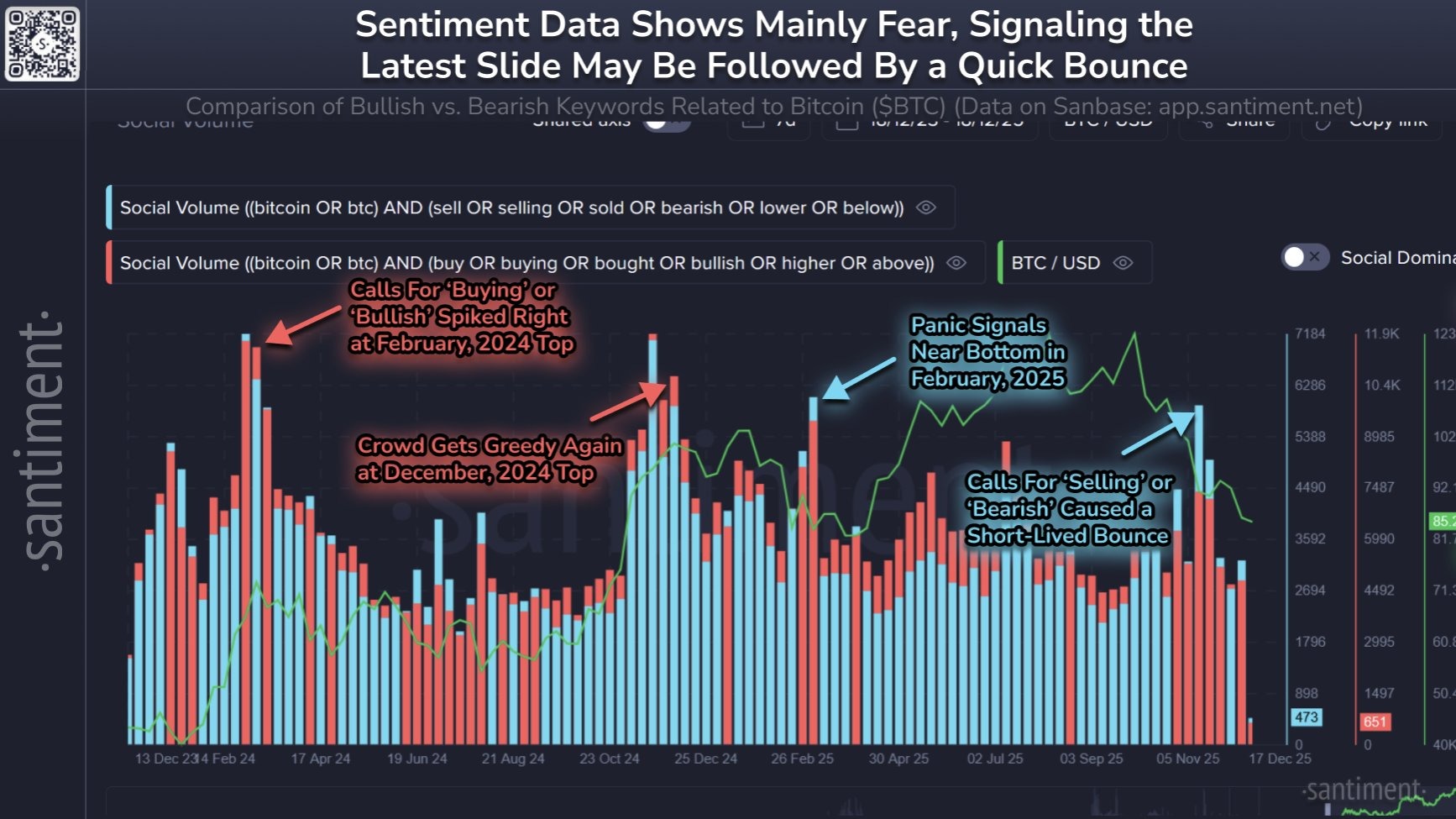
Social sentiment at bear market levels could cause a quick bounce. Source: Santiment


Meanwhile, the crypto Fear & Greed Index was buried at 16, indicating “extreme fear,” and has remained below 30 in “fear” territory since the beginning of November.

Magazine: Bitcoin’s critical level is $82.5K, Ethereum ‘not done yet’: Trade Secrets

Related Questions

QWhat is the current total crypto market capitalization and how does it compare to its all-time high?

AThe total crypto market capitalization has fallen to $2.93 trillion, which is its lowest level in eight months. This represents a decline of around 33% from its all-time high of approximately $4.4 trillion in early October.

QAccording to analysts, what is the primary reason for the recent decline in the crypto market?

AAccording to Nick Ruck of LVRG Research, the decline 'reflects a broader correction driven by macroeconomic pressures and reduced risk appetite among investors.'

QWhat did the Bank of Japan do with interest rates, and how did Bitcoin initially react?

AThe Bank of Japan raised its interest rates to 0.75%. Despite some analysts predicting this would be bad news for crypto, Bitcoin's price initially climbed by 2.3%.

QWhat is the current reading of the crypto Fear & Greed Index, and what does it indicate?

AThe crypto Fear & Greed Index is at a reading of 16, which indicates 'extreme fear.' It has remained below 30, in 'fear' territory, since the beginning of November.

QWhy does analyst Michaël van de Poppe believe the current market fear could be a positive signal?

AVan de Poppe, along with data from Santiment, suggests that prices often move opposite to the crowd's expectations. Therefore, high levels of fear and bearish sentiment can be a strong contrarian indicator and a good signal for patient investors, potentially leading to a quick bounce.

Related Reads

Tiger Research: Three Strategies for Financial Institutions to Keep Up with the Tokenization Wave

Tiger Research's in-depth report analyzes the strategic choices for financial institutions entering the rapidly growing Real-World Asset (RWA) tokenization market. With the market projected to be worth $25-36 billion and a lack of complete regulatory frameworks in many jurisdictions, institutions face three options: waiting for domestic legislation, using regulatory sandboxes for limited experiments, or moving first into established overseas markets to gain a competitive edge. Tokenization is not magic; it requires meticulous preparation. Before entry, institutions must strategically plan across six core areas: choosing a jurisdiction, obtaining necessary licenses, defining the asset type, targeting the appropriate investor base, selecting settlement currencies, and designing operational requirements like custody and governance. The report outlines two main operational paths. The first is a direct jurisdictional path, establishing a legal presence in mature markets like Hong Kong, Singapore, or the U.S., often leveraging local licensed platforms to accelerate market entry. The second is a chain-native path, using platforms like Ondo or Plume that are built with regulatory compliance embedded, allowing for faster, more flexible market access without being tied to a specific jurisdiction. Ultimately, the report advises against waiting for perfect regulation. The preparation process can take 6-12 months and requires thorough legal review. Using the example of a mid-sized securities firm, it details steps from evaluating existing entities to final execution. The core message is that accumulating real-world operational experience is paramount, as the market is moving ahead and will not wait for latecomers.

Foresight News48m ago

Tiger Research: Three Strategies for Financial Institutions to Keep Up with the Tokenization Wave

Foresight News48m ago

Unitree's IPO Frenzy: The Real Mystery is How It Will Spend the 42 Billion Raised

Unitree, a Chinese robotics company, is set for a public listing after its IPO registration was approved by regulators. The company, which started with quadruped robots and has expanded into humanoids, plans to raise approximately 4.2 billion yuan through its offering. The article traces Unitree's rapid growth from its founding in 2016 to its current status. It highlights key milestones like the 2021 CCTV Spring Festival Gala performance, the 2023 launch of its affordable Go2 robot dog and the H1 humanoid robot, and a series of subsequent product launches. By 2025, the company reported revenue of 1.71 billion yuan, profitability, and sales exceeding 5,500 humanoid robots. As the first publicly-listed humanoid robot company on China's STAR Market, Unitree's main challenges are sustaining growth and deploying its newly raised capital effectively. The humanoid robot sector in China is crowded, with over 140 companies. Competitors include UBTech (focusing on industrial and consumer markets), Fourier, and international players like Tesla Optimus and 1X NEO. The article outlines three critical challenges for Unitree: establishing a strong second product line beyond its quadruped robots, maintaining its price advantage while ensuring quality, and successfully advancing its embodied AI capabilities through partnerships like the one with NVIDIA for the H2 Plus platform. Unitree's likely strategy involves a "developer tools + industry benchmarks" approach: using low-cost models like the R1 and G1 to build developer adoption and volume, leveraging high-end platforms for AI training, and securing pilot projects in sectors like logistics and manufacturing to build case studies. The company's future success hinges on converting its current momentum in shipments and pilot programs into sustainable, large-scale commercial contracts as the broader market evolves.

marsbit2h ago

Unitree's IPO Frenzy: The Real Mystery is How It Will Spend the 42 Billion Raised

marsbit2h ago

Trading

Spot
活动图片