Crypto ATMs face 60-day removal order in U.S. city – Report

ambcryptoPublished on 2026-04-01Last updated on 2026-04-01

Abstract

Haverhill, Massachusetts, has proposed a ban on all cryptocurrency ATMs, citing risks of financial fraud, money laundering, and lack of consumer protection. Mayor Melinda E. Barrett's ordinance, which received strong council support, requires removal of all machines within 60 days or a $300 daily fine per machine. The city has about 415 crypto ATMs. Bitcoin Depot, the largest operator, faces particular scrutiny after revenue losses, a CEO change, and a lawsuit from the state Attorney General. Similar actions are occurring in other cities like South Hadley, Waltham, and Gloucester, while New Hampshire has passed legislation to reimburse scam victims.

Haverhill, a city in Massachusetts, United States, is moving ahead with a plan to ban cryptocurrency ATMs entirely.

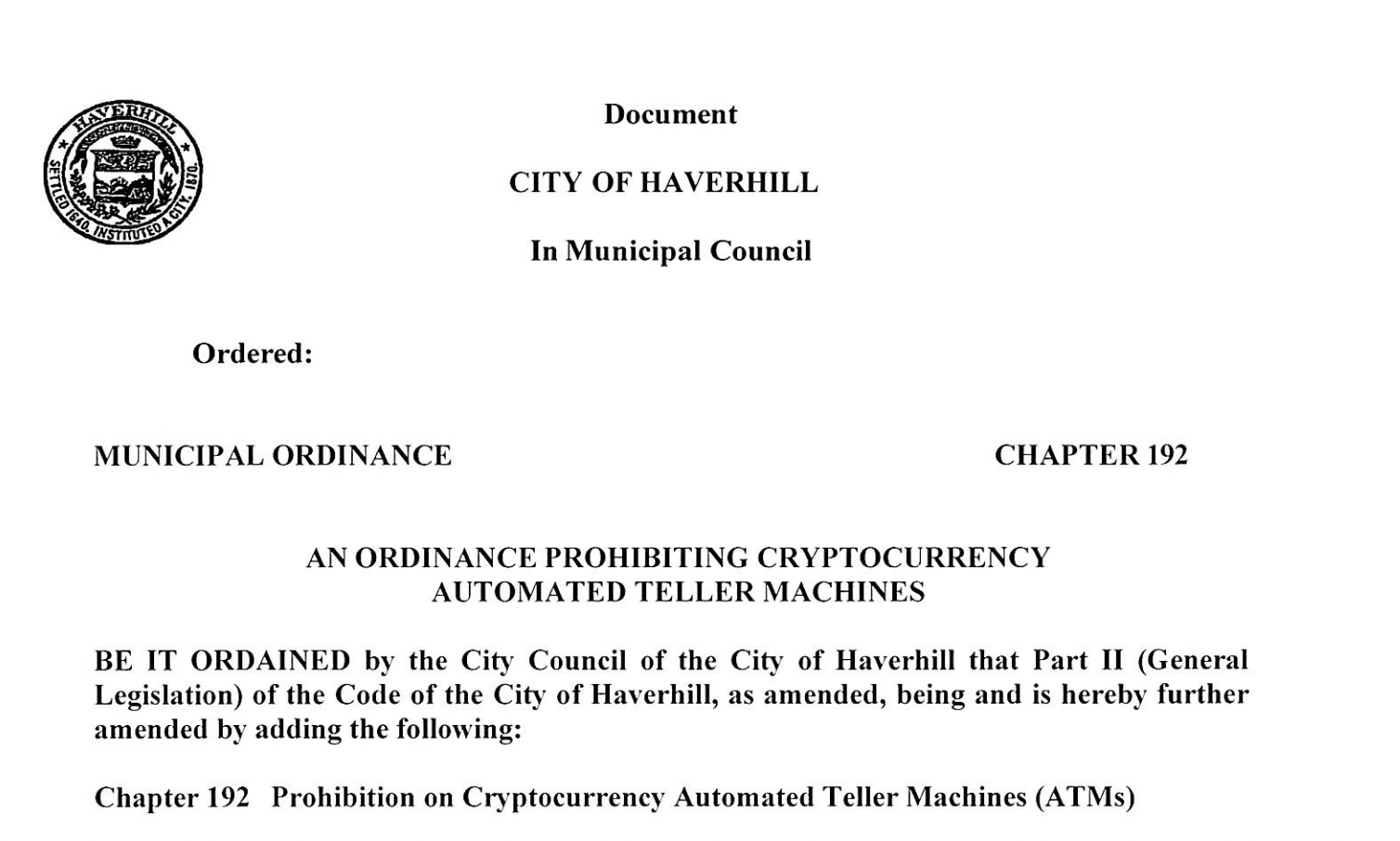
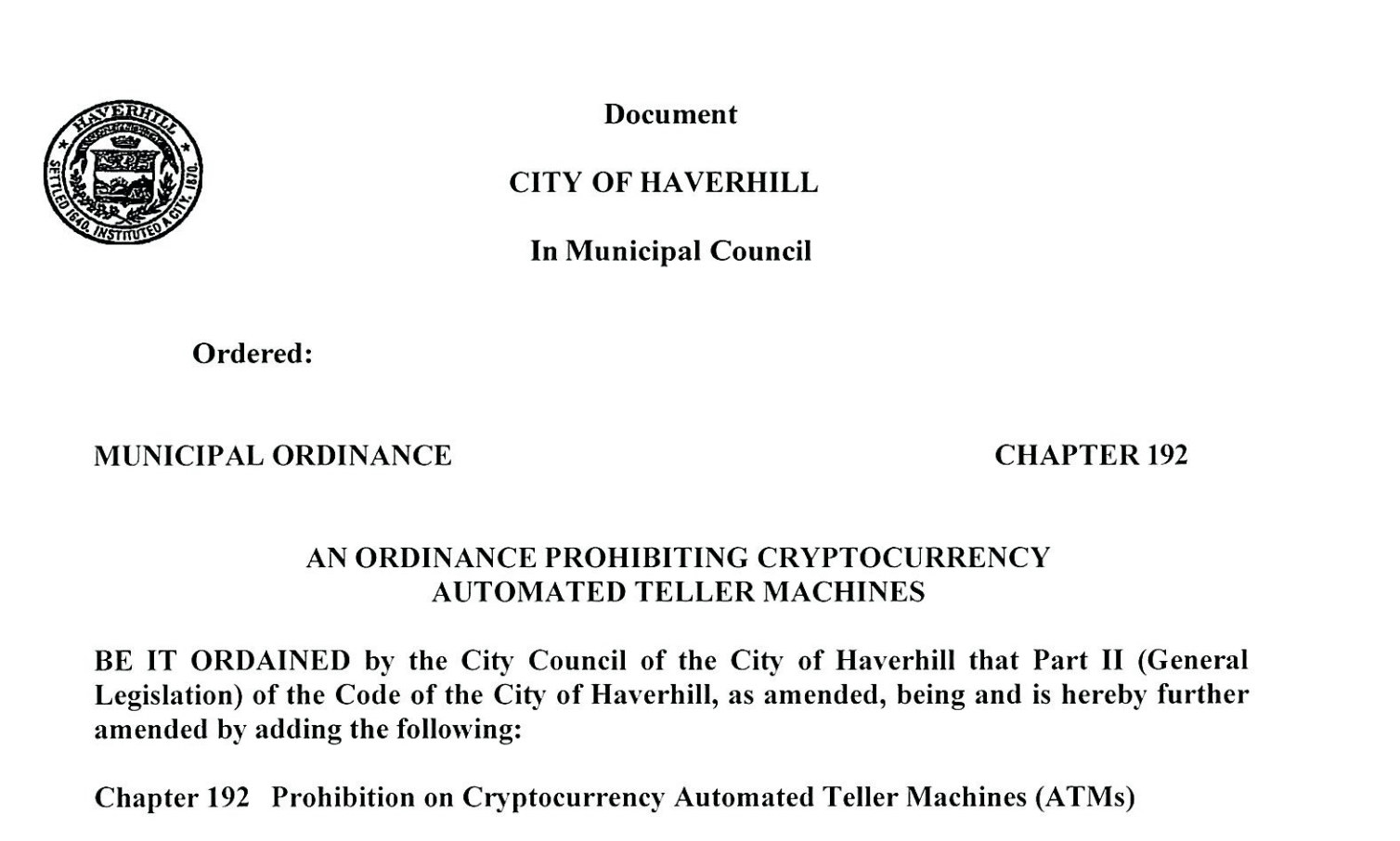
Melinda E. Barrett, the mayor of Haverhill, has proposed an ordinance to the City Council adding a new chapter to the Massachusetts city’s legal code.
Source: events.haverhillma.gov

Massachusetts city to ban crypto ATMs

Proposed on the 17th of March, the ordinance has already received 11 votes in favour, showing widespread agreement on the matter.

Indeed, citing the reasons behind this ban, the mayor argued,

Unregulated Cryptocurrency ATMs pose risks to consumers, including financial fraud, money laundering, and lack of recourse for users.

This has resulted in the elderly and gullible tech users losing money to scams and fraud. Additionally, the lack of “federal and state consumer protection and regulatory oversight” has prompted the mayor to propose this law.

As per the law, all existing machines within the city must be removed and completely shut down within 60 days. If not, then a fine of $300 per day per machine will be imposed on the violators.

With about 415 crypto ATMs in and around Haverhill, according to CoinATMRadar, this move is crucial for residents’ protection from fraudsters.

Why is Bitcoin Depot being targeted the most?

Needless to say, Bitcoin [BTC] Depot leads the Crypto ATM space as the biggest operator. This makes the ATM most exposed to crypto scams due to high transaction volume and usage.

In fact, according to its quarterly report, Bitcoin Depot has seen a streak of revenue losses since the end of Q3 in 2025.

Amidst these concerning numbers, Scott Buchanan stepped down as the CEO. Following this, Alex Holmes, a former CEO of MoneyGram, was appointed the new CEO of Bitcoin Depot.

Additionally, in February 2026, Massachusetts Attorney General Andrea Joy Campbell sued Bitcoin Depot. She alleged that scammers used the company’s ATM to defraud residents.

Yet, despite such developments, Bitcoin Depot’s stock surged by 7.39% in the last trading session to reach $2.18. However, the bigger concern remains as the stock has seen a drop of over 91% in the past 6 months.

Haverhill – Not the only boat in the sea of crypto scams

Now, as these crypto ATM scams continue to operate, New Hampshire has passed bipartisan legislation to protect the victims. According to the law, victims of crypto ATM scams will recive reimbursed, provided they report the fraud within 14 days.

This coincided with a massive incident that took place in October 2025. As reported by the Police, a South Hadley business owner had rented out a crypto ATM for $200 per month.

During this time, a scammer impersonated him and targeted his employees.

This, in turn, resulted in a loss of over $11,000.

Following this incident, South Hadley officials stepped in. They imposed a complete ban on crypto ATMs – a similar approach was made by Waltham and Gloucester.


Final Summary

  • Crypto ATMs, once seen as a tool to bring crypto to everyday use, are now acting as a source of scams and fraud.
  • Haverhill is not the only one to take this step: South Hadley, New Hampshire, Waltham, Gloucester, and many more cities are going ahead with this.


Trending Cryptos

Related Questions

QWhich U.S. city is moving to ban cryptocurrency ATMs and what is the deadline for removal?

AHaverhill, Massachusetts is moving to ban cryptocurrency ATMs, and all existing machines must be removed within 60 days.

QWhat are the primary reasons cited by Haverhill's mayor for proposing the ban on crypto ATMs?

AMayor Melinda E. Barrett cited risks to consumers, including financial fraud, money laundering, and a lack of recourse for users, as well as the absence of federal and state consumer protection and regulatory oversight.

QWhich company is the largest crypto ATM and has been specifically targeted by legal action in Massachusetts?

ABitcoin Depot is the largest crypto ATM operator and was sued by Massachusetts Attorney General Andrea Joy Campbell in February 2026 over allegations that scammers used its ATMs to defraud residents.

QWhat financial penalty will violators face if they do not remove their crypto ATMs in Haverhill?

AViolators who do not remove their crypto ATMs within 60-day deadline will be fined $300 per day per machine.

QBesides Haverhill, name at least two other Massachusetts cities that have imposed a complete ban on crypto ATMs.

ABesides Haverhill, the cities of South Hadley, Waltham, and Gloucester have also imposed a complete ban on crypto ATMs.

Related Reads

Will the Ethereum Foundation Evolve into a 'Mascot'? Diversified Organizations Are Fragmenting Its Functions

The Ethereum Foundation (EF) is undergoing significant internal turmoil and functional erosion. Following its largest-ever layoff of 54 staff (20% of its workforce) and a major organizational restructuring announced in June, its Protocol Support Team has been officially dissolved. This comes alongside the high-profile resignation of key figures like co-executive director Xiaowei Wang, bringing senior departures this year to at least eight. Criticism of EF's rigid structure, opaque decision-making, and perceived lack of a clear value narrative for ETH has intensified within the community. The layoffs have catalyzed the emergence of independent, non-profit organizations like Ethlabs and Ethereum Institutional, founded by former EF researchers and members. These entities are now taking on core functions such as protocol research/development and institutional adoption, effectively fragmenting the EF's traditional leadership role. Concurrently, EF's security team is adapting to technological change, deploying specialized AI agents to audit Ethereum's codebase, which successfully discovered a critical vulnerability (CVE-2026-34219). While EF states AI complements rather than replaces researchers, it signals a potential future shift in its operational model. Faced with these challenges—internal restructuring, talent drain, the rise of competing organizations, and AI integration—the Ethereum Foundation appears to be stepping back from a central commanding role. Analysts and community observers speculate it may increasingly transition towards a symbolic "ecosystem mascot" function, while decentralized initiatives drive Ethereum's future growth and institutional adoption.

marsbit15m ago

Will the Ethereum Foundation Evolve into a 'Mascot'? Diversified Organizations Are Fragmenting Its Functions

marsbit15m ago

Nearly a Hundred Players Rush into Embodied Data: With 4.47 Billion Yuan in Financing in One Year, Who Can Really Make Money by 'Selling Data'?

The domestic embodied AI data industry has attracted nearly 100 players, with 70 focused on data collection and 27 on data infrastructure. In the past year, 15 independent embodied data service providers raised approximately 4.47 billion yuan. Despite this growth, the sector remains early-stage, fragmented, and faces significant challenges. Data collection methods are diverse, categorized into four main routes: teleoperation of real robots, human demonstration without a robot (using motion capture, exoskeletons, etc.), simulation synthesis, and distillation from internet videos. Most companies (43%) adopt hybrid approaches, combining multiple routes, as no single method can meet all training needs. Teleoperation alone is pursued by 31% of players, often by state-owned platforms and robot companies, while newer firms favor asset-light, no-hardware human demonstration. Independent data service providers now form the largest player group (40%), indicating the emergence of a distinct industry segment rather than just a subsidiary function for robot makers. Two-thirds of all players are "embodied-native" startups, while one-third are companies that pivoted from fields like AI data annotation, which are more prevalent in the data infrastructure layer. Current annual industry capacity is estimated at 1.6-1.8 million hours plus 70-80 million data points, with a short-term goal to increase this 15-20 fold within 1-3 years. Data collection factories are spread across 20 provinces in China, concentrated in the Yangtze River Delta, Beijing-Tianjin-Hebei, and Pearl River Delta regions. Financially, the 4.47 billion yuan raised in the past year pales compared to the 43.8 billion yuan raised by the broader embodied intelligence sector in just the first half of 2026, highlighting that data remains a less "sexy" bet for investors. The 15 funded independent providers show clear stratification: a top tier led by a unicorn (Lightwheel Intelligence, 3.1 billion yuan), a middle tier of 11 firms raising tens to hundreds of millions, and an early-stage tier of 3 companies. Sixty-nine investment institutions have participated, but none have made concentrated bets, reflecting uncertainty about viable business models. Over half of these funded companies are less than a year old, most are at pre-A or A rounds, and profitability remains largely unproven. In summary, the embodied data industry has become an independent track creating jobs and local economic activity. However, it is still nascent, with unformed consensus, unsolved problems, and unproven business models. The coming 1-2 years will be a critical validation window to see if companies can build sustainable, profitable businesses purely by "selling data."

marsbit3h ago

Nearly a Hundred Players Rush into Embodied Data: With 4.47 Billion Yuan in Financing in One Year, Who Can Really Make Money by 'Selling Data'?

marsbit3h ago

Dialogue with Multicoin Partner: The Crypto Market Has Bottomed Out, Favoring Three Cryptocurrencies in This Cycle

In a recent interview, Multicoin Capital managing partner Tushar Jain shared his views on the crypto market. He believes the market has bottomed and is at an inflection point, citing that negative news no longer causes significant price declines and application adoption continues to grow. Jain remains highly bullish on Solana, viewing it as the correct architectural choice for internet capital markets, particularly for spot and tokenized security trading. He is also positive on Hyperliquid, noting its leadership in decentralized derivatives trading. His investment approach focuses on concentrating capital in top convictions rather than equal allocation. A distinct opportunity he highlights is Zcash (ZEC), which he sees as a return to the industry's cypherpunk ethos and a potential top-five asset by market cap. For assets like Zcash without cash flows, his valuation framework is based on relative market cap ranking. Regarding investment strategy, Jain employs a "three-part" entry method to avoid timing pitfalls and emphasizes long-term "active management" over "active trading." He outlines four sources of investment edge: informational, analytical, behavioral/psychological, and structural. On portfolio management, the fund uses Bitcoin as its "cash," selling assets into Bitcoin during market euphoria to reduce beta risk and using Bitcoin to buy dips. Sales occur only if a better opportunity arises, the investment thesis breaks, or valuations become excessively overheated. While respectful of Ethereum's resilience, he questions its unclear scaling roadmap. Finally, Jain reaffirms his commitment to the thesis that blockchains will form the foundational architecture for future capital markets.

marsbit3h ago

Dialogue with Multicoin Partner: The Crypto Market Has Bottomed Out, Favoring Three Cryptocurrencies in This Cycle

marsbit3h ago

Trading

Spot

Hot Articles

What is an order book?

An order book is one of the first things you see on the HTX trading interface.

1.1k Total ViewsPublished 2022.12.01Updated 2024.01.25

What is an order book?

How to Buy ORDER

Welcome to HTX.com! We've made purchasing Orderly (ORDER) simple and convenient. Follow our step-by-step guide to embark on your crypto journey.Step 1: Create Your HTX AccountUse your email or phone number to sign up for a free account on HTX. Experience a hassle-free registration journey and unlock all features.Get My AccountStep 2: Go to Buy Crypto and Choose Your Payment MethodCredit/Debit Card: Use your Visa or Mastercard to buy Orderly (ORDER) instantly.Balance: Use funds from your HTX account balance to trade seamlessly.Third Parties: We've added popular payment methods such as Google Pay and Apple Pay to enhance convenience.P2P: Trade directly with other users on HTX.Over-the-Counter (OTC): We offer tailor-made services and competitive exchange rates for traders.Step 3: Store Your Orderly (ORDER)After purchasing your Orderly (ORDER), store it in your HTX account. Alternatively, you can send it elsewhere via blockchain transfer or use it to trade other cryptocurrencies.Step 4: Trade Orderly (ORDER)Easily trade Orderly (ORDER) on HTX's spot market. Simply access your account, select your trading pair, execute your trades, and monitor in real-time. We offer a user-friendly experience for both beginners and seasoned traders.

3.9k Total ViewsPublished 2024.08.25Updated 2026.06.02

How to Buy ORDER

Discussions

Welcome to the HTX Community. Here, you can stay informed about the latest platform developments and gain access to professional market insights. Users' opinions on the price of ORDER (ORDER) are presented below.

活动图片












