Consensus Live | Avenir Group, Tiger, AMINA, and CoinRoutes Discuss Institutional Capital Efficiency and Financial Infrastructure Evolution

marsbitPublished on 2026-02-11Last updated on 2026-02-11

Abstract

At Consensus Hong Kong 2026, the institutional investment narrative is structurally shifting toward multi-asset allocation, yet cross-system frictions are diluting capital efficiency. Avenir Group, in partnership with Tiger Brokers, AMINA Bank, and CoinRoutes, led a roundtable on next-generation institutional trading infrastructure. Key consensus emerged: the industry must transition from an asset-centric to a capital-centric framework to optimize efficiency in a multi-asset environment. Panelists highlighted challenges including fragmented capital utilization due to segregated systems, misaligned clearing cycles causing idle capital, and the need for natively compliant, scalable infrastructure. Avenir Group and partners signed an MOU to explore collaborative solutions, emphasizing that future competitiveness hinges on unified capital management and cross-asset operational capabilities within regulatory frameworks.

At Consensus Hong Kong 2026, the narrative focus of institutional investors is undergoing a structural shift. As regulatory frameworks mature, crypto assets are accelerating their integration into institutional portfolios, moving beyond exploratory allocations. However, this transition towards multi-asset allocation has highlighted a new theme: although portfolios are expanding across asset classes, cross-system friction is diluting capital efficiency.

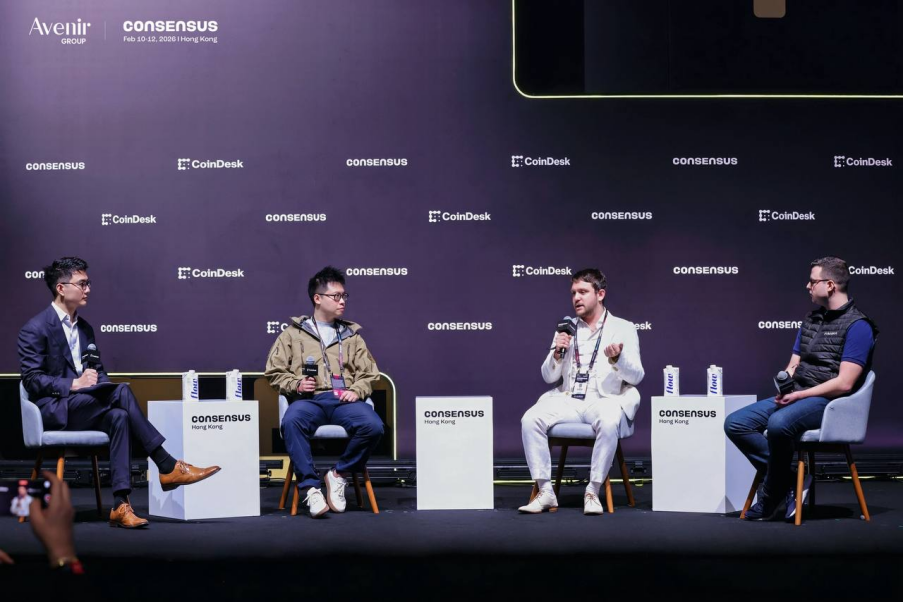
Avenir Group, an investment group dedicated to promoting the integration of traditional finance and digital assets, has observed that as the scale of institutional participation grows, the completeness of infrastructure is increasingly impacting institutional capital efficiency. As an official partner of Consensus Hong Kong 2026, Avenir Group initiated a roundtable discussion titled "Next-Generation Institutional Trading Infrastructure." Industry leaders from global leading tech brokerage Tiger Brokers, Swiss FINMA-regulated crypto bank AMINA Bank AG (“AMINA Bank”), and leading multi-asset institutional trading platform CoinRoutes systematically deconstructed the reasons behind constrained capital efficiency in a multi-asset environment and jointly explored potential evolutionary directions.
Industry Consensus: A Foundational Restructuring from "Asset-Oriented" to "Capital-Oriented"

During the discussion, a core consensus was reached: the industry must shift from an "Asset-Centric" infrastructure framework to a "Capital-Centric" framework.

In the past, an asset-centric model, optimized for single asset classes, could meet demands. However, in the complex era of multi-asset markets, this model may lead to a certain degree of capital efficiency drain. When institutions manage traditional and digital assets in parallel, the inherent differences between these assets—from price volatility to clearing and settlement cycles—result in hidden capital occupation and execution friction. These are no longer mere operational inconveniences but can become significant structural constraints affecting overall capital efficiency.

Roundtable guests shared deep insights from different parts of the value chain:

· Holistic Capital Efficiency Utilization: Felix Huang Shuojun, Global Partner at Tiger Brokers International, pointed out that traditional markets improve capital utilization through margin interoperability; however, the inclusion of digital assets disrupts this synergy. Existing systems are often designed around "asset isolation" rather than "overall capital efficiency," making it difficult for institutions to achieve cross-asset capital allocation within a unified framework.

· Efficient Execution and Liquidity Linkage: Ian Weisberger, CEO and Co-Founder of CoinRoutes, added that misaligned clearing rhythms leave substantial funds idle during trading gaps. What institutions urgently need is unified execution capability across markets and for multi-leg strategies, as well as flexible rotation of positions and risk across different asset classes.

· Compliance-First Infrastructure: Myles Harrison, Chief Product Officer at AMINA Bank, emphasized that compliance is not the opposite of efficiency but a prerequisite for the safe operation of the system. The pain point lies in the industry's lack of a natively multi-asset supportive infrastructure that also possesses high transparency and scalability, thereby unlocking capital potential within a global compliance framework.

Jacob Zhong, Managing Partner of Strategic Investment and Cooperation at Avenir Group, stated: "Synthesizing industry insights, the direction of infrastructure evolution has become relatively clear. As institutional participation in multi-asset environments deepens, the market increasingly requires an infrastructure capable of unified cross-asset capital allocation, synchronized trading execution and clearing rhythms, and embedding compliance capabilities natively into the system (rather than as an afterthought patch). In this direction, more integrated and regulation-adaptive infrastructure is gradually becoming a crucial support for enhancing capital efficiency and enabling cross-asset operations at scale."

Building the Ecosystem Together: Advancing Financial Infrastructure Evolution Through Collaborative Action

At the conclusion of the thematic discussion, Avenir Group, Tiger Brokers, AMINA Bank, and CoinRoutes formally signed a Memorandum of Understanding (MOU) to explore potential future cooperation.

The integration of traditional finance and digital assets is not merely a technical or product-level consolidation but a progressive, systematic compliance engineering project. As multi-asset allocation becomes the norm, the competitive focus among institutions is shifting—it no longer depends solely on market access capabilities but on the systemic ability to manage and flexibly allocate capital under a compliance framework.

Avenir Group looks forward to collaborating with a broader range of financial institutions and technology partners. By fostering dialogue and cooperation across the entire ecosystem, Avenir Group aims to join hands with industry partners to jointly promote a more synergistic and scalable infrastructure path, gradually turning the enhancement of capital efficiency from an industry consensus into verifiable practice.

About Avenir Group

Avenir Group is a pioneering investment group focused on driving the integration of traditional finance and digital assets, building the financial infrastructure of the future. The group adopts an integrated "Investment—Incubation—Operation" strategy, with a core investment portfolio focusing on digital asset management, trading and financial services platforms, payment finance (PayFi) infrastructure, and real-world asset (RWA) tokenization, providing the industry with institutional-grade products and services, and continuously promoting financial innovation and the development of emerging technologies. As the largest institutional holder of Bitcoin ETFs in Asia, Avenir Group expands its business globally, covering Hong Kong, Singapore, Tokyo, London, San Francisco, and more. Leveraging robust capital strength and professional operational capabilities, the group is committed to becoming a strategic hub connecting Eastern and Western capital, driving efficient global capital flow and collaboration. Learn more: https://avenirx.com


Related Questions

QWhat is the main shift in the narrative focus for institutional investors at Consensus Hong Kong 2026, as discussed by Avenir Group and partners?

AThe narrative focus is shifting structurally from exploratory allocation of crypto assets to their accelerated integration into institutional portfolios, highlighting the theme that cross-system friction is diluting capital efficiency despite multi-asset expansion.

QAccording to the roundtable, what fundamental change is needed in infrastructure frameworks to improve capital efficiency in multi-asset environments?

AThe industry must transition from an 'Asset-Centric' infrastructure framework to a 'Capital-Centric' one to enable unified capital scheduling across assets, synchronized execution and settlement rhythms, and natively embedded compliance capabilities.

QWhat specific capital efficiency challenge did Felix Huang Shuojun from Tiger International highlight regarding digital assets?

AHe pointed out that while traditional markets improve capital utilization through margin interoperability, the inclusion of digital assets disrupts this synergy. Existing systems designed for 'asset isolation' rather than 'overall capital efficiency' hinder unified cross-asset capital scheduling.

QHow did Ian Weisberger of CoinRoutes and Myles Harrison of AMINA Bank contribute to the discussion on infrastructure needs?

AIan Weisberger emphasized the need for unified execution capabilities across markets and flexible rotation of positions and risk between asset classes, citing idle funds due to misaligned settlement cycles. Myles Harrison stressed the necessity for native multi-asset infrastructure with high transparency and scalability that operates within global compliance frameworks to unlock capital potential.

QWhat action did Avenir Group and its partners take following the roundtable discussion, and what is their broader goal?

AThey signed a strategic Memorandum of Understanding (MOU) to explore future collaboration. Avenir Group aims to work with financial institutions and tech partners to promote dialogue and cooperation, advancing more synergistic and scalable infrastructure paths to turn capital efficiency consensus into verifiable practice.

Related Reads

Strategy's Loss in the Second Quarter Reaches $8.22 Billion Amid Bitcoin Decline

Strategy, the largest corporate holder of Bitcoin, reported a net loss of $8.22 billion for the second quarter. This loss was primarily driven by an $8.32 billion unrealized loss on its Bitcoin holdings due to a decline in the asset's price during the period. Despite these paper losses, the company increased its Bitcoin holdings to 843,775 BTC, a 25% growth since the start of the year. As part of a new monetization strategy, Strategy sold approximately $218.4 million worth of Bitcoin, mainly to fund dividends for preferred shareholders, with $216 million of that sold after Q2 ended. The company also built a $3.75 billion cash reserve, which it claims is sufficient to cover over two years of dividend and interest payments, aiming to insulate itself from Bitcoin's volatility while meeting obligations. Following the earnings release, Strategy's stock (MSTR) rose 4.7% in regular trading but corrected slightly after-hours. This pattern reflects how the company's accounting results are heavily tied to Bitcoin's price swings, even as its long-term strategy remains unchanged. The report indicates that Strategy is maintaining its core strategy of accumulating Bitcoin while building a financial buffer. This quarterly loss follows a recognizable pattern, with the company posting significant unrealized losses in previous quarters (e.g., $12.4 billion in Q4 2025 and ~$12.5 billion in Q1 2026) due to fair-value accounting. A key technical shift is its new monetization program, which introduces periodic selling pressure on the market, transitioning Strategy from a pure accumulator to a participant that occasionally adds supply. A critical question remains: how long can the cash reserve cover dividend obligations if a Bitcoin price downturn persists beyond two years?

cryptonews.ru21m ago

Strategy's Loss in the Second Quarter Reaches $8.22 Billion Amid Bitcoin Decline

cryptonews.ru21m ago

Will Terrorist Durov Ban Russian Officials?

Telegram founder Pavel Durov publicly reacted to being labeled a "terrorist" by Russian authorities, stating the designation came after he refused demands for mass surveillance and censorship on the platform. In a Telegram post, he highlighted that this status formally bans him from "publishing information online." Durov concluded with a statement widely circulated: Russian officials "clearly don't understand who can ban whom on the internet." This remark suggests Durov could potentially restrict official Russian government and officials' channels on Telegram, which continue to operate on the platform despite its formal blocking in Russia. The situation parallels previous, slow-moving state directives, like switching officials to domestic cars, contrasted with the current push to migrate all government communication to the Russian-made messenger MAX by 2030. However, reports indicate many officials still use Telegram via workarounds, fearing surveillance on MAX, while alternatives like BiP and KakaoTalk recently became inaccessible in Russia without a VPN. Durov has not specified any immediate actions against state channels. His statement is an initial response, with further developments depending on the authorities' reaction. The dynamic differs from 2020 when Russian regulators lifted a block on Telegram; now, Durov implies control from within the platform itself over the official accounts that persisted through that earlier blockade.

cryptonews.ru21m ago

Will Terrorist Durov Ban Russian Officials?

cryptonews.ru21m ago

DeepSeek V4 Official Version Arrives, New Capabilities Emerge, Value-for-Money King Enters the Fray

On July 31st, DeepSeek officially launched the public API beta for its DeepSeek-V4-Flash model. A key highlight is its performance on multiple Agent benchmark tests, reportedly nearing or even surpassing the level of the V4-Pro preview version from three months ago. Notably, the Flash model achieves this with significantly smaller scale (130B active parameters vs. Pro's 490B), suggesting that post-training optimization and data quality may be as crucial as raw model size. DeepSeek emphasized that the V4-Flash-0731 uses the same model architecture and size as its preview version, with improvements attributed solely to "re-trained post-training." The update also marks the official debut of DeepSeek's self-developed Agent framework, "Harness." The move signals DeepSeek's strategic push to position its cost-effective Flash model as a competitive base for Agent applications—scenarios requiring autonomous planning, tool usage, and complex task execution—where inference speed and cost are critical. By natively supporting OpenAI's Responses API format and adapting for code-generation scenarios, DeepSeek aims not just to be a cheaper alternative but to establish its own ecosystem in the Agent era. This release follows DeepSeek's record-breaking ~$50 billion fundraising round roughly two months prior, underscoring market confidence in its technology and commercialization prospects. The company is reportedly preparing for another funding round at a valuation of approximately $71 billion. The Flash model's advancement represents a step in fulfilling the high expectations that come with this valuation, setting the stage for the impending release of the V4-Pro official version and intensifying competition in the global Agent landscape.

marsbit25m ago

DeepSeek V4 Official Version Arrives, New Capabilities Emerge, Value-for-Money King Enters the Fray

marsbit25m ago

Trading

Spot
活动图片