Coinbase to debut prediction markets, tokenized stocks on Dec. 17: Report

cointelegraphPublished on 2025-12-12Last updated on 2025-12-12

Abstract

Coinbase, the largest US crypto exchange, is reportedly launch prediction markets and tokenized stocks on December 17, according to a Bloomberg report. The announcement will coincide with a livestream event to showcase new products. This follows earlier reports that Coinbase was preparing landing pages for these offerings in partnership with prediction market operator Kalshi. On the same day as the report, Coinbase joined the Coalition for Prediction Markets (CPM), a group announced by Kalshi and Crypto.com. The prediction market sector is experiencing significant growth, with weekly volumes reaching nearly $4 billion recently. Rival exchanges, including Crypto.com and the CFTC-approved Gemini, are also expanding into this space.

Coinbase, the largest US crypto exchange by trading volume, is days away from officially unveiling its push into prediction markets and tokenized stocks, according to Bloomberg.

Coinbase plans to announce that next week it will launch prediction markets and tokenized equities, Bloomberg reported on Thursday, citing anonymous sources familiar with the matter.

The exchange will hold a Dec. 17 livestream to showcase new products, though the report says it hasn’t disclosed whether prediction markets and tokenized stocks will be among them.

The news comes nearly a month after tech researcher Jane Manchun Wong reported that Coinbase was preparing landing pages for tokenized equities and Kalshi-provided prediction markets. However, the company has yet to officially release the products.

Coinbase enters a prediction market coalition with Kalshi

Bloomberg’s report came on the same day Coinbase became a member of the Coalition for Prediction Markets (CPM), a group of prediction market operators announced by Kalshi and Crypto.com.

“At Coinbase, our mission is to deliver financial freedom to the world — and prediction markets by nature democratize fact finding and the seeking of truth,” Coinbase’s chief policy officer Faryar Shizad said.

He also underscored the CPM’s ambition to engage with policymakers to ensure continued access to these markets for people in the US.

Source: Tarek Mansour

Founded in 2018 by MIT graduates Tarek Mansour and Luana Lopes Lara, Kalshi enables users to trade outcomes on real-world events just like financial assets.

The platform has emerged as a major prediction market operator alongside rivals such as Polymarket and Opinion, with weekly trading volumes of about $1 billion, according to Dunedata figures on Dune Analytics.

Coinbase’s push into prediction markets comes amid a boom in the sector, with weekly trading volumes hitting a record last week near $4 billion, though some experts have questioned the accuracy of the reported figures.
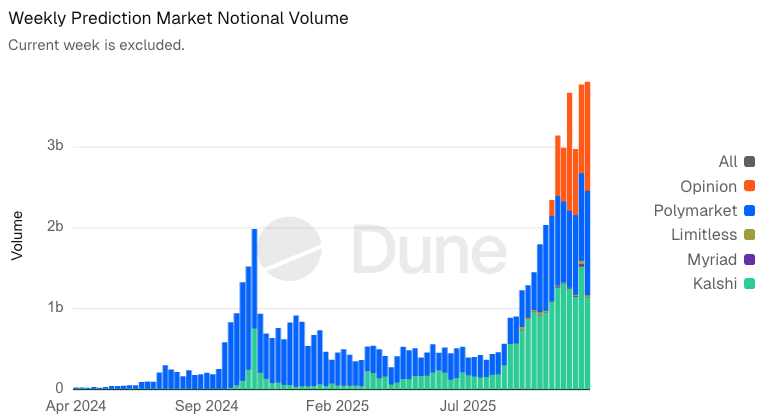
Weekly trading volumes on prediction markets. Source: Dune

Rival exchanges have been racing to roll out prediction markets, with Crypto.com in October announcing a dedicated platform set for integration with Trump Media.

Related: CFTC gives prediction markets leeway on data and record-keeping rules

On Wednesday, the Winklevoss twins-founded exchange Gemini scored approval from the Commodity Futures Trading Commission to offer prediction markets in the US.

Cointelegraph approached Coinbase for comment regarding its prediction markets and tokenized securities push, but had not received a response by publication.



Trending Cryptos

Related Reads

ECB's Schnabel says central bank money 'should move to blockchain'

ECB Executive Board member Isabel Schnabel stated that central bank money "must move onto the blockchain." She argued that stablecoins lack the independent ability to scale liquidity during financial stress—a gap only a central bank can fill. Her proposed solution involves tokenization, which she says can make transactions faster, safer, and more programmable, but only if the safest asset (central bank money) is on the same "rails" as other tokenized assets. This marks a notable shift for the Eurosystem, which had previously viewed Distributed Ledger Technology (DLT) mainly as a tool for regulating stablecoins and crypto, not as infrastructure to adopt directly. The first step is Project Pontes, launching in September. It will initially synchronize the ECB’s existing TARGET services with private DLT platforms. Eventually, it aims to enable settlement finality on a Eurosystem-managed DLT platform with smart contract functionality and 24/7 operation. The long-term strategy is Project Appia, tasked with developing the architecture, standards, and legal framework for a genuine European tokenized asset market by 2028. Trials have already processed around €1.6 billion, and since March 2026, the ECB accepts DLT-based assets as collateral. While not directly impacting Bitcoin's price, these developments signal that a major G7 central bank is preparing to settle transactions on-chain, lending legitimacy to the underlying infrastructure of crypto markets. The ECB's move to avoid "disintermediation" by private tokenization shows that debates in central bank boardrooms are now aligning with discussions long followed in the crypto space.

cryptonews.ru1h ago

ECB's Schnabel says central bank money 'should move to blockchain'

cryptonews.ru1h ago

Ripple Labs Warns of a New Challenge for Blockchains

Ripple Labs is preparing the XRP Ledger for quantum threats but now emphasizes a broader challenge: ensuring financial infrastructure can adapt simultaneously to quantum computing and artificial intelligence. Senior Director of Engineering Ayo Akinyele states the goal is not merely anticipating a "Q-Day" but building infrastructure capable of preemptively adopting new security mechanisms without network disruption. The shift to post-quantum cryptography involves more than swapping algorithms; it requires flexible infrastructure, improved key management, and clear upgrade paths. Financial systems were not designed with quantum computers in mind, necessitating a rethink of transaction, identity, asset, and data protection. This is underscored by significant investments, such as the $2 billion U.S.-IBM quantum factory initiative and a 2030 U.S. government mandate for post-quantum cryptography adoption. AI introduces distinct risks by driving automation and autonomous economic activity, increasing demand for an always-on, internet-oriented payment infrastructure. AI agents could soon conduct transactions independently, creating new security requirements. Ripple Labs advocates for proactive, orderly preparation rather than a crisis-driven transition, having outlined a four-phase strategy aiming for a full XRP Ledger transition by 2028, now expanded to address both quantum and AI-driven challenges.

cryptonews.ru1h ago

Ripple Labs Warns of a New Challenge for Blockchains

cryptonews.ru1h ago

Trading

Spot

Hot Articles

Discussions

Welcome to the HTX Community. Here, you can stay informed about the latest platform developments and gain access to professional market insights. Users' opinions on the price of US (US) are presented below.

活动图片