Coinbase Q1 Earnings Report: Nearly $4 Billion Loss, Trading Volume Halved. Can AI + RWA Turn Things Around?

链捕手Publié le 2026-05-08Dernière mise à jour le 2026-05-08

Résumé

Coinbase's Q1 2026 earnings report revealed a net loss of $394 million, largely driven by $482 million in unrealized losses on its crypto asset holdings. Total revenue fell 31% year-over-year to $1.41 billion. Transaction revenue declined 40% to $756 million, reflecting a market-wide slump in crypto trading volumes. Consumer trading was particularly weak, down 48%, though Coinbase's global spot market share rose to a record 8.6%. Key bright spots included institutional trading revenue, which grew 37%, and a surge in derivatives activity following the Deribit acquisition. Subscription and services revenue of $584 million was more resilient, with stablecoin revenue up 11% to $305 million. Adjusted EBITDA remained positive at $303 million. Ahead of earnings, Coinbase announced a 14% workforce reduction (~700 employees) to accelerate its transition to an "AI-native" organizational model. Strategically, the company is pursuing its "Everything Exchange" vision, expanding into derivatives and predictive markets. Its partnership with Circle on USDC remains a core revenue moat, with over 25% of the stablecoin's $80 billion supply held on its platform. The company is actively engaged in shaping stablecoin legislation like the CLARITY Act. Despite significant losses and cyclical pressures, Coinbase is positioning itself as a broader on-chain financial infrastructure provider.

On May 7th, after the US stock market closed, Coinbase released its first-quarter financial report for 2026. The data showed the company's total revenue was $1.41 billion, a year-on-year decrease of 31%.

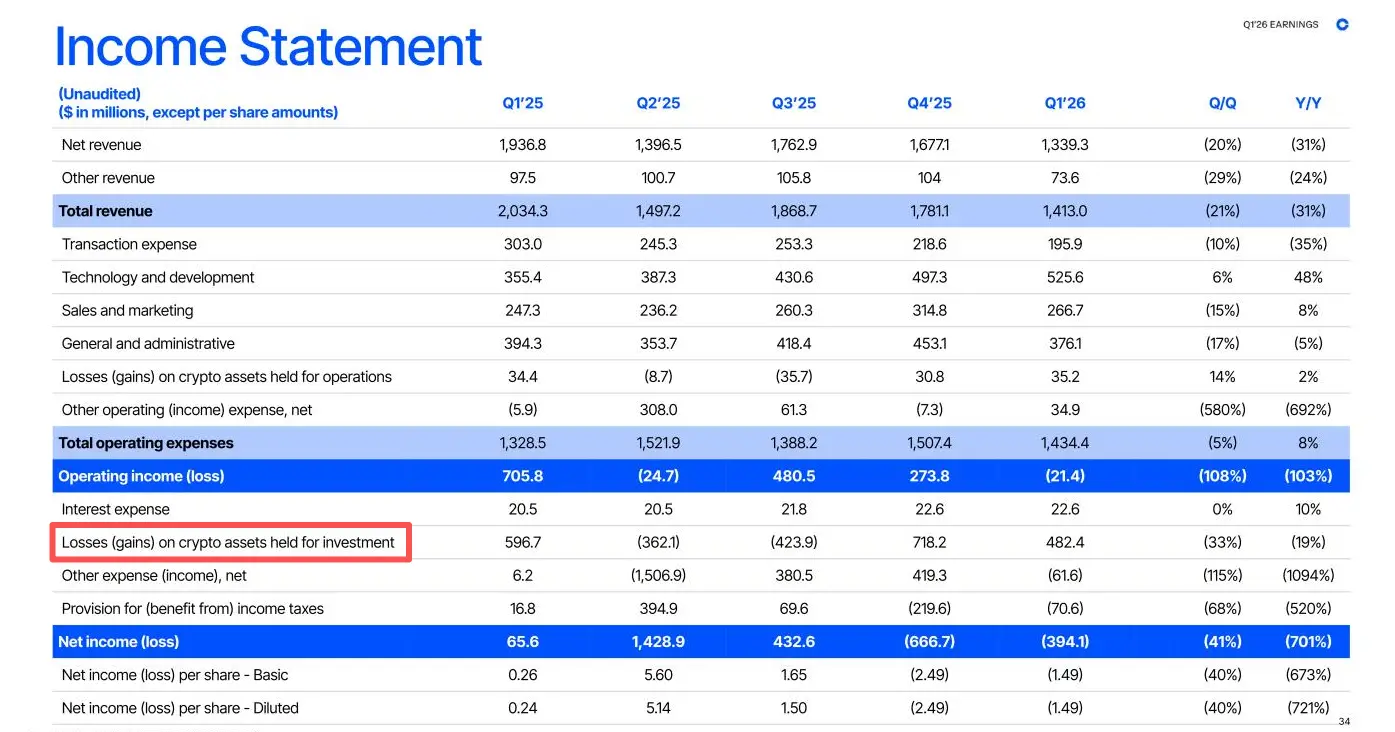
Dragged down by unrealized losses on held crypto assets, the company recorded a net loss of $394 million, with a loss per share of $1.47. In contrast, the company achieved a net profit of $66 million in the same period last year.

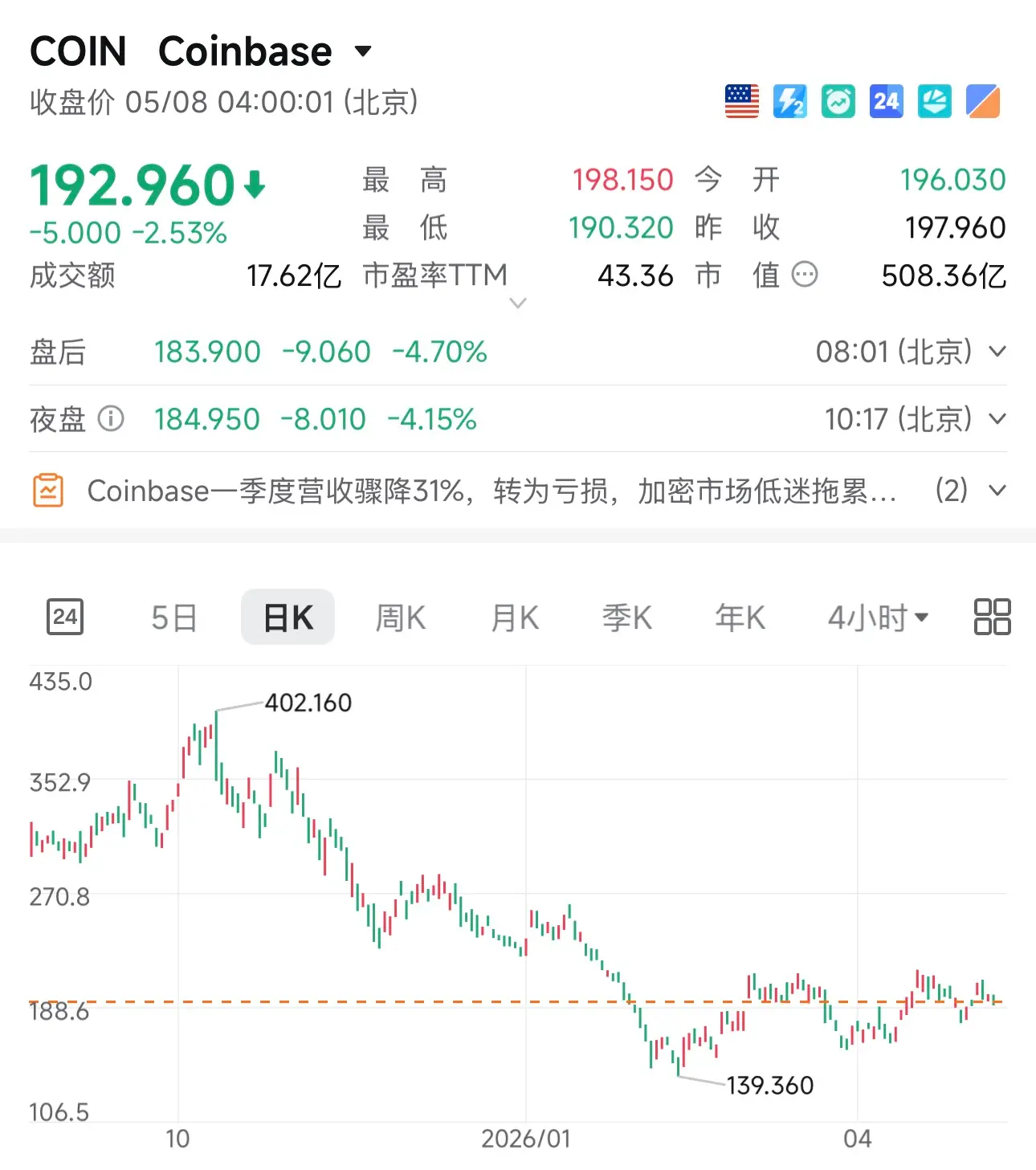
Following the earnings release, Coinbase's stock price fell approximately 4.7% in after-hours trading. The cumulative decline for the year-to-date has now exceeded 15%.
Transaction Revenue Down 40%, Institutional and Stablecoin Business as Bright Spots

Most of Coinbase's loss this quarter came from paper losses.

Behind the net loss of $394 million is an unrealized loss of $482 million from the company's investment crypto assets. This loss is accounted for with market price fluctuations and does not represent an actual cash outflow.

Excluding this portion, the company's adjusted net loss was only $45.6 million, and adjusted EBITDA remained positive at $303 million, with an operating loss of approximately $21.4 million.
The crypto market was generally weak in Q1. The price of Bitcoin fell from over $97,000 in early January to around $63,000 in early February, hovering below $70,000 by the end of the period. Market sentiment shifted rapidly, and retail trading activity contracted significantly. According to CoinGlass data, global crypto spot trading volume in Q1 was approximately $1.94 trillion, down about 44% year-on-year.

As a result, the company's total transaction revenue declined 40% to $756 million, with consumer transaction revenue at $567 million, a 48% year-on-year drop. Despite the halving of trading volume, Coinbase's global crypto spot market share rose to a record high of 8.6%, ranking fourth among global spot exchanges.

The institutional side, however, showed a completely different trend. The company's institutional transaction revenue reached $136 million, a 37% year-on-year increase. More notably, the derivatives business stood out, with derivatives trading volume growing 169% year-on-year, benefiting from the consolidation of Deribit acquired in August 2025. The collateral pledged by derivatives clients also surged from $27.4 million at the end of last year to $333 million at the end of this quarter, an increase of more than 10 times.

In terms of subscription and services revenue, the company recorded $584 million for the quarter, a 14% year-on-year decline, a significantly smaller drop than the transaction business. This segment's share of total net revenue increased to 44%. Notably, stablecoin revenue was $305 million, up 11% year-on-year, one of the few bright spots this quarter. Total assets on the platform stood at $294.4 billion at the end of the quarter.

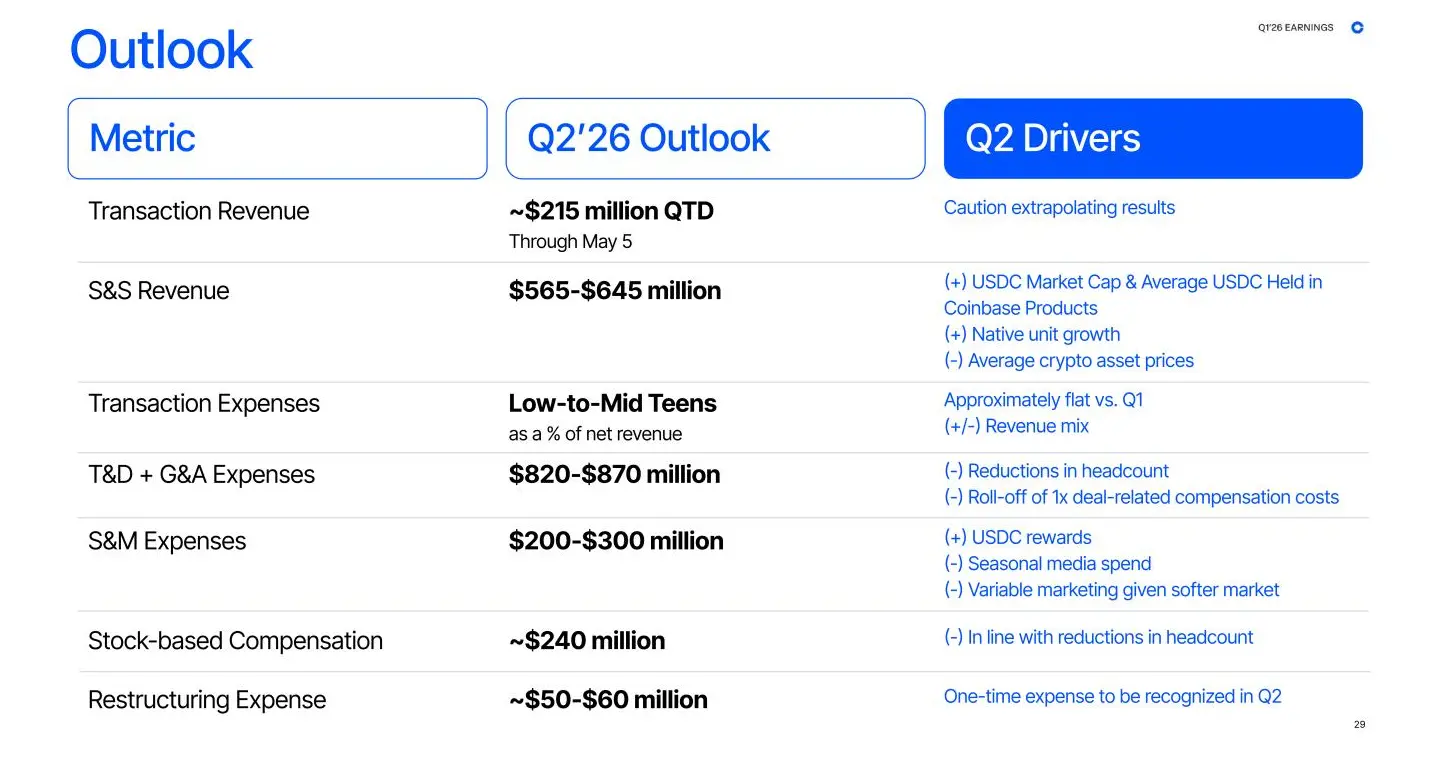
For Q2, management's outlook is generally cautious. The company disclosed that transaction revenue through May 5th was approximately $215 million, but management emphasized that current market volatility is high and this figure does not represent the trend for the entire quarter. The guidance range for subscription and services revenue is $565 million to $645 million, with the midpoint slightly above Q1's $584 million, indicating management's continued confidence in this revenue line. Restructuring expenses related to the recent layoffs, amounting to $50 to $60 million, will be recognized in Q2. Cost pressure is expected to ease significantly thereafter.
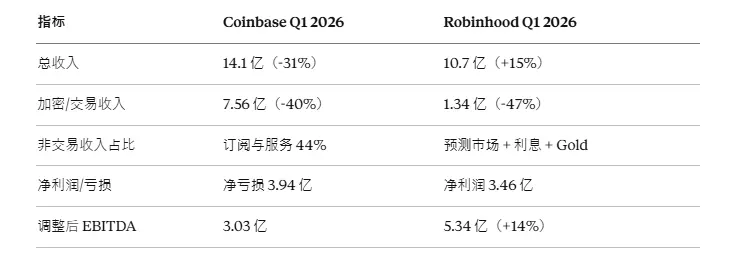
It is worth noting that Robinhood's Q1 earnings report presented a different picture. Its total revenue increased 15% year-on-year to $1.07 billion, with a net profit of $346 million and adjusted EBITDA reaching $534 million.

Examining the structure, the quality of this growth warrants scrutiny. Crypto-related revenue also declined 47% to $134 million. The company mainly filled the gap with three business segments: revenue from prediction market contracts skyrocketed 320%, becoming the largest incremental source; net interest income grew 24% to $359 million; and Gold subscription service revenue grew 32% to $50 million.

Additionally, Robinhood secured the role of sole initial trustee for the Trump account, investing approximately $100 million in related setup costs.

This quarter, Robinhood sustained growth through the policy tailwinds of prediction markets and the Trump account, while Coinbase bet on a longer-term transformation under the pressure of halved trading volumes.
Defensive Moves: Laying Off 700 Employees, What Is the Company Restructuring?

On May 5th, just two days before the earnings release, Coinbase announced cutting approximately 700 jobs, representing about 14% of its global workforce.

CEO Brian Armstrong stated that this restructuring aims to bring the company back to startup speed and accelerate the transition to an AI-native organization. The goal is to refactor Coinbase into an organization with intelligence at its core, augmented by humans at the edges.

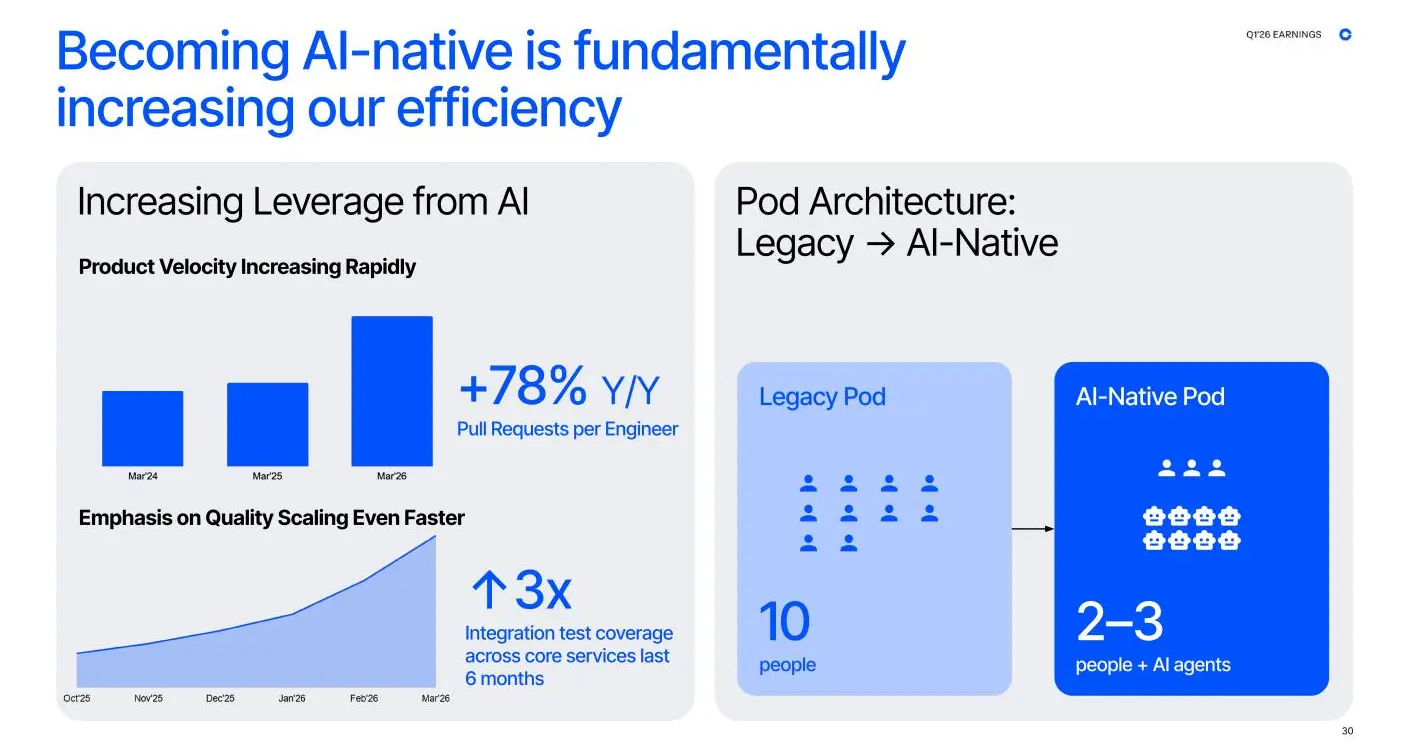
Coinbase defines this approach as "AI-native"—not just introducing AI tools into the existing organization, but redesigning the company's operational model from the ground up. Company data shows a 78% year-on-year increase in engineer pull requests per capita. Team structures have been reorganized from traditional 10-person pods to AI-Native pods consisting of 2-3 people plus AI agents. Core service integration test coverage tripled within six months.
However, the financial implications need to be carefully considered. Omar, a partner at crypto venture capital firm Dragonfly, estimates that this layoff could save the company approximately $225 million in annual salary costs. But the full-year 2026 expense guidance indicates that, excluding the impact of increased USDC rewards, expenses will be roughly flat year-on-year. In other words, a significant portion of the cost savings from layoffs is offset by investments in user incentive programs.

It is also worth noting that over the past year or so, OpenAI has poached at least six senior marketing executives from Coinbase, including former CMO Kate Rouch, Sarah Russell, and others. Sarah Wolf, head of marketing for the Base chain, moved to Anthropic. Coinbase officially characterized these departures as normal personnel movement, but it is noteworthy that while the company is using AI to restructure its organization and reduce headcount, it is also supplying AI companies with marketing talent who best understand branding and growth.

When asked about potential future layoffs, CFO Alesia Haas stated, "We can't predict the future, but as a public company, we will always do what is best for the company."

Offensive Moves: Building On-Chain Financial Infrastructure

The "Everything Exchange" Blueprint

At the end of last year, Armstrong proposed the strategic goal of an "Everything Exchange"—transforming Coinbase from a primarily spot crypto platform into a comprehensive multi-asset platform encompassing derivatives, commodities, futures, and prediction market contracts, allowing users to avoid switching between different platforms.

Q1 data shows strong growth in derivatives, prediction markets, and decentralized exchanges. On the Base chain, stablecoin transactions initiated by AI agents already account for 90% of total chain transaction volume. Derivatives trading volume reached a record high, with contract business exceeding spot trading for the first time.

With initial results showing, the company has continued to double down recently, including: investing in Centrifuge to secure the tokenization infrastructure for RWA; taking a stake in Kemet to integrate institutional derivatives channels; launching the stablecoin credit fund CUSHY; obtaining the OCC national trust charter to clear the compliance hurdle for institutional custody; and partnering with AWS to integrate wallet infrastructure and the x402 protocol into Amazon Bedrock's AgentCore payment system, enabling AI agents to autonomously complete micropayments using USDC.

The Stablecoin Moat

Beyond expanding trading categories, the stablecoin business constitutes a deeper revenue moat for Coinbase.

According to Coinbase's revenue-sharing agreement with Circle, 100% of the earnings generated by USDC held on the Coinbase platform go to Coinbase, while off-platform USDC earnings are split approximately 50/50 between the two parties.

USDC's market capitalization has now reached a record high of approximately $80 billion, with over 25% held on the Coinbase platform. The balance on the platform has grown nearly 10-fold compared to three years ago. As USDC adoption continues to expand, Coinbase's share of the pie grows proportionally.

However, this revenue stream is not without risks. This quarter, the average interest rate declined by 67 basis points, negatively impacting stablecoin revenue by approximately $57.5 million. Changes in the interest rate environment may weaken the resilience of this revenue line.

CFO Alesia Haas emphasized during the earnings call, "Our USDC contract automatically renews every three years, and it renews in perpetuity. This contract cannot be terminated." CLO Paul Grewal added immediately, "We expect to continue our partnership with Circle on the same terms going forward."

These statements were clearly addressing market concerns about stablecoin regulation legislation. Regarding the CLARITY Act, Coinbase has engaged in a prolonged game of chess:

  • In January, it withdrew support due to unfavorable earnings provisions, causing the Senate to delay the vote;
  • In March, it rejected a new draft again, causing Circle's stock price to plummet 20% in a single day;
  • In early May, a compromise text emerged, prohibiting "pay for hold" but retaining space for rewards tied to real activities. Armstrong replied "Mark it up" on X, and Grewal also publicly expressed being "very confident" about the bill passing this summer.

The true value of this game is that Coinbase is not just complying with rules but participating in shaping them. The legal teams, compliance processes, and regulatory communication capabilities required to repackage yield products constitute a resource barrier that smaller exchanges cannot replicate in the short term.

In other words, once the CLARITY Act is enacted, the advantages of leading platforms will be solidified by legislation. Regulatory clarity is beneficial for the entire industry, but the deepest beneficiaries will always be the few capable of sitting at the negotiation table.

However, it is noteworthy that after the bill passes, there will be a 12-month rule-making phase, and the final boundaries are yet to be defined, leaving uncertainties.

Conclusion

With trading volume halved and a net loss of $394 million, Coinbase's earnings report once again reminds the market that the company remains strongly tied to the crypto cycle. There is no shortage of skeptical voices questioning whether the AI narrative represents a genuine transformation or merely a wrapper for declining business performance.

Brian Armstrong has repeatedly emphasized, "All finance will eventually move on-chain." As crypto increasingly resembles traditional finance, Coinbase is also striving to make itself look more like a mature financial infrastructure company. This might be the answer it is offering in the current cycle.


Cryptos en tendance

Questions liées

QWhat were the key factors contributing to Coinbase's Q1 2026 net loss of $394 million?

ACoinbase's Q1 2026 net loss of $394 million was primarily driven by $482 million in unrealized losses on its investment portfolio of crypto assets due to market price declines. Excluding this mark-to-market impact, the adjusted net loss was $45.6 million.

QHow did Coinbase's consumer and institutional trading revenues perform in Q1 2026, and what is the 'Everything Exchange' strategy?

AIn Q1 2026, Coinbase's consumer transaction revenue fell 48% to $567 million, while institutional transaction revenue grew 37% to $136 million. The 'Everything Exchange' strategy aims to transform Coinbase from a primarily spot crypto platform into a multi-asset platform covering derivatives, commodities, futures, and prediction markets, creating a one-stop financial platform.

QWhat cost-saving measure did Coinbase announce alongside its earnings, and what is its broader organizational transformation goal?

ACoinbase announced a layoff of approximately 700 employees, about 14% of its workforce, aimed at saving an estimated $225 million in annual compensation costs. The broader goal is to accelerate its transformation into an 'AI-native' organization, fundamentally redesigning operations around AI agents to increase speed and efficiency.

QWhy is USDC stablecoin revenue significant for Coinbase, and what are the associated risks?

AUSDC revenue is a significant and growing income stream for Coinbase, reaching $305 million in Q1 (up 11% YoY). Its importance stems from a revenue-sharing agreement with Circle. However, this revenue faces risks from potential regulatory changes like the CLARITY Act, which could restrict yield products, and from sensitivity to interest rate fluctuations, which negatively impacted Q1 revenue by approximately $57.5 million.

QHow does Coinbase's Q1 2026 performance and outlook compare to its competitor Robinhood's?

ACoinbase's Q1 performance was challenged, with total revenue down 31% and a net loss, largely due to crypto market weakness. In contrast, Robinhood reported 15% revenue growth and a net profit of $346 million. However, Robinhood's crypto revenue also fell 47%; its growth was fueled by other segments like prediction markets and net interest income, while Coinbase is investing heavily in long-term infrastructure and diversification.

Lectures associées

GPT conçoit GPT

OpenAI a dévoilé son premier puce, Jalapeño, destinée à l'inférence des grands modèles linguistiques. Ce mouvement ne vise pas principalement à concurrencer Nvidia, mais marque une étape stratégique où OpenAI cherche à maîtriser l'ensemble du processus de production de l'intelligence artificielle, des modèles aux puces, en passant par les centres de données et l'énergie. Alors que l'écart entre les modèles se réduit, le vrai fossé se creuse au niveau de la puissance de calcul, des coûts d'inférence et de l'efficacité système. Chaque jeton (Token) généré représente un coût, et OpenAI, avec ses produits à forte demande comme ChatGPT, supporte une « taxe de calcul » importante sur le matériel externe. Jalapeño est conçu pour réduire cette « taxe d'inférence » en optimisant les coûts opérationnels quotidiens. Un détail crucial est le cycle de conception de seulement neuf mois, accéléré par l'utilisation par OpenAI de ses propres modèles d'IA pour aider à concevoir et optimiser la puce. Cela crée un cycle vertueux : de meilleurs modèles conçoivent de meilleures puces, qui réduisent le coût d'exécution des modèles futurs, permettant plus d'utilisateurs et de données pour affiner les prochaines générations de puces. OpenAI ne cherche pas à devenir un fournisseur de matériel comme Nvidia. Son approche s'apparente plutôt à celle d'Apple : construire un écosystème fermé et intégré où les modèles, les produits (ChatGPT, API), les puces et les infrastructures sont optimisés conjointement pour contrôler l'ensemble de la chaîne de valeur de l'IA. À long terme, cela pourrait repositionner les entreprises de modèles en tant que joueurs majeurs de l'infrastructure IA, aux côtés des fournisseurs de matériel traditionnels.

marsbitIl y a 16 mins

GPT conçoit GPT

marsbitIl y a 16 mins

Le directeur exécutif intérimaire de l'Ethereum Foundation s'exprime : Quelle est notre mission ?

Le directeur exécutif intérimaire de l'Ethereum Foundation (EF) définit la mission de l'organisation : garantir qu'Ethereum reste une infrastructure véritablement sans autorisation, résistante à la censure, privée, sécurisée et ouverte, soutenant la coordination souveraine à grande échelle. L'EF n'existe pas pour sa propre importance, sa popularité ou pour soutenir des applications spécifiques. Son rôle central est d'éliminer les faiblesses et les risques d'extraction, de contrôle par des cartels ou des États, et de surveillance. Cela implique de renforcer toutes les couches : le protocole, l'accès, les utilisateurs et les institutions. L'EF mènera par l'exemple en adoptant les paiements en ETH. Les priorités clés incluent : * **Lutte contre le MEV nuisible** : Un enjeu central pour préserver la neutralité. L'EF se concentrera sur la réduction des barrières à la construction de blocs, la garantie de l'inclusion et l'exploration de solutions ouvertes pour le flux d'ordres. * **Confidentialité** : Essentielle pour éviter une plateforme de surveillance. La vie privée inconditionnelle doit précéder toute divulgation sélective. * **Staking** : Doit rester sans autorisation, privé et diversifié pour éviter la concentration des risques. * **Interfaces d'accès** : Doivent maximiser l'autonomie des utilisateurs, pas compromettre les valeurs fondamentales pour une adoption facile. L'EF vise aussi à saisir des opportunités comme faire d'Ethereum la première infrastructure anti-quantique, un "argent numérique" privé, une plateforme pour des agents IA souverains, et une base pour une extension scalable qui préserve l'autonomie. Concernant les départs récents, l'EF les traite avec respect et discrétion, sans commentaires publics sur les cas individuels. Elle gère également le spin-off de certaines activités. Le financement externe sera accordé uniquement si le travail est crucial, aligné sur la mission de l'EF, et ne crée pas de dépendances ou de risques d'appropriation indue. L'EF n'est pas neutre sur la direction d'Ethereum. Elle est engagée à construire un système de neutralité crédible et collaborera avec tous ceux qui partagent cet objectif fondamental.

marsbitIl y a 41 mins

Le directeur exécutif intérimaire de l'Ethereum Foundation s'exprime : Quelle est notre mission ?

marsbitIl y a 41 mins

La directrice exécutive intérimaire de l'Ethereum Foundation prend la parole : Quelle est notre mission ?

L'auteur, directeur exécutif conjoint par intérim de l'Ethereum Foundation (EF), définit la mission claire de l'EF : garantir qu'Ethereum reste une infrastructure véritablement sans permission et souveraine, résistante à la censure, libre, ouverte, privée et sécurisée. L'article souligne ce que l'EF n'est pas : elle ne cherche pas sa propre importance, à plaire aux spéculateurs ou à promouvoir chaque application. L'EF se concentre sur l'élimination des vulnérabilités. Elle doit renforcer Ethereum aux niveaux du protocole, de l'accès, de l'utilisateur et institutionnel. Les priorités incluent : migrer les salaires de l'EF vers l'ETH, lutter contre les MEV (Maximal Extractable Value) nuisibles pour préserver la neutralité, rendre la confidentialité par défaut essentielle, garantir un jalonnement (staking) sans permission et diversifié, et sécuriser les interfaces d'accès pour l'autonomie des utilisateurs. L'EF doit aussi saisir des opportunités : devenir la première infrastructure mondiale résistante aux attaques quantiques, créer une pile de protocole entièrement vérifiable et sans extraction de données, faire d'Ethereum une monnaie numérique privée et digne, soutenir les portefeuilles personnels avec agents IA, et permettre une adoption institutionnelle sans compromettre les valeurs fondamentales. Concernant les départs, l'EF traite les questions de personnel avec respect et discrétion, sans débats publics, reconnaissant le droit aux désaccords et aux forks. Enfin, l'EF rationalise ses activités. Certains travaux seront externalisés via des sociétés dérivées (spin-offs). Le financement externe sera accordé uniquement si le travail est crucial pour la mission de l'EF, réduit la dépendance et évite la capture, et non par convenance ou amitié. L'EF est résolue à soutenir les caractéristiques fondamentales d'Ethereum (CROP : sans permission, résistant à la censure, ouvert, privé) pour en faire une infrastructure neutre et durable.

链捕手Il y a 54 mins

La directrice exécutive intérimaire de l'Ethereum Foundation prend la parole : Quelle est notre mission ?

链捕手Il y a 54 mins

Dernière année de doctorat, un changement de direction mène à une offre d'OpenAI : mon parcours d'entretiens a été rempli de « surprises »

Yong Zheng-Xin, doctorant à l’Université Brown, annonce rejoindre OpenAI en tant qu’Astra Fellow pour se consacrer à la recherche sur la sécurité de l’IA (AI Safety). Après avoir changé de domaine de recherche en dernière année de thèse, passant des grands modèles multilingues à la sécurité de l’IA, il partage six observations surprenantes tirées de sa recherche d’emploi. Premièrement, seuls un ou deux articles de recherche ont réellement compté pour obtenir des entretiens. Deuxièmement, les processus de recrutement sont très variés, incluant parfois des tests pratiques, des design systems ou des mises en situation avec des agents IA. Troisièmement, les périodes d’essai rémunérées, parfois d’une semaine, sont de plus en plus courantes dans les startups d’IA. Quatrièmement, le timing est crucial sur le marché du travail actuel, les opportunités évoluant rapidement. Cinquièmement, les offres de conversion après un stage sont rares pour les postes de recherche. Enfin, de nombreux entretiens portent sur des compétences générales en IA plutôt que sur la spécialité du candidat, même pour des rôles en sécurité IA. Zheng-Xin souligne que cette expérience lui a permis de rejoindre OpenAI malgré son changement d’orientation tardif, démontrant qu’une expertise ciblée et une adaptation aux besoins des équipes peuvent ouvrir des portes, indépendamment du nombre de publications.

marsbitIl y a 1 h

Dernière année de doctorat, un changement de direction mène à une offre d'OpenAI : mon parcours d'entretiens a été rempli de « surprises »

marsbitIl y a 1 h

Trading

Spot
Futures

Articles tendance

Comment acheter 4

Bienvenue sur HTX.com ! Nous vous permettons d'acheter 4 (4) de manière simple et pratique. Suivez notre guide étape par étape pour commencer votre parcours crypto.Étape 1 : Création de votre compte HTXUtilisez votre adresse e-mail ou votre numéro de téléphone pour ouvrir un compte sur HTX gratuitement. L'inscription se fait en toute simplicité et débloque toutes les fonctionnalités.Créer mon compteÉtape 2 : Choix du mode de paiement (rubrique Acheter des cryptosCarte de crédit/débit : utilisez votre carte Visa ou Mastercard pour acheter instantanément 4 (4).Solde :utilisez les fonds du solde de votre compte HTX pour trader en toute simplicité.Prestataire tiers :pour accroître la commodité d'utilisation, nous avons ajouté des modes de paiement populaires tels que Google Pay et Apple Pay.P2P :tradez directement avec d'autres utilisateurs sur HTX.OTC (de gré à gré) : nous offrons des services personnalisés et des taux de change compétitifs aux traders.Étape 3 : stockage de vos 4 (4)Après avoir acheté vos 4 (4), stockez-les sur votre compte HTX. Vous pouvez également les envoyer ailleurs via un transfert sur la blockchain ou les utiliser pour trader d'autres cryptos.Étape 4 : tradez des 4 (4)Tradez facilement 4 (4) sur le marché Spot de HTX. Il vous suffit d'accéder à votre compte, de sélectionner la paire de trading, d'exécuter vos trades et de les suivre en temps réel. Nous offrons une expérience conviviale aux débutants comme aux traders chevronnés.

442 vues totalesPublié le 2025.10.20Mis à jour le 2026.06.02

Comment acheter 4

Discussions

Bienvenue dans la Communauté HTX. Ici, vous pouvez vous tenir informé(e) des derniers développements de la plateforme et accéder à des analyses de marché professionnelles. Les opinions des utilisateurs sur le prix de 4 (4) sont présentées ci-dessous.

活动图片