Claude Code just announced a massive cut to prompt tokens, and immediately after, Opus 5 was caught red-handed doing the exact opposite!?
And this reversal wasn't just a small one: it was a whopping 72% increase. (lol)
These seemingly contradictory numbers come from official Anthropic sources and tests by a netizen.
A couple of days ago, Anthropic announced they had deleted over 80% of the system prompt content for models like Opus 5 and Fable 5.
Then, right on its heels, netizen Chen Cheng (@chenchengpro) conducted a little 'packet sniffing'—
The guy intercepted and counted the actual system prompts received by different models, only to find that Opus 5's prompt was actually 72% longer compared to Opus 4.8??
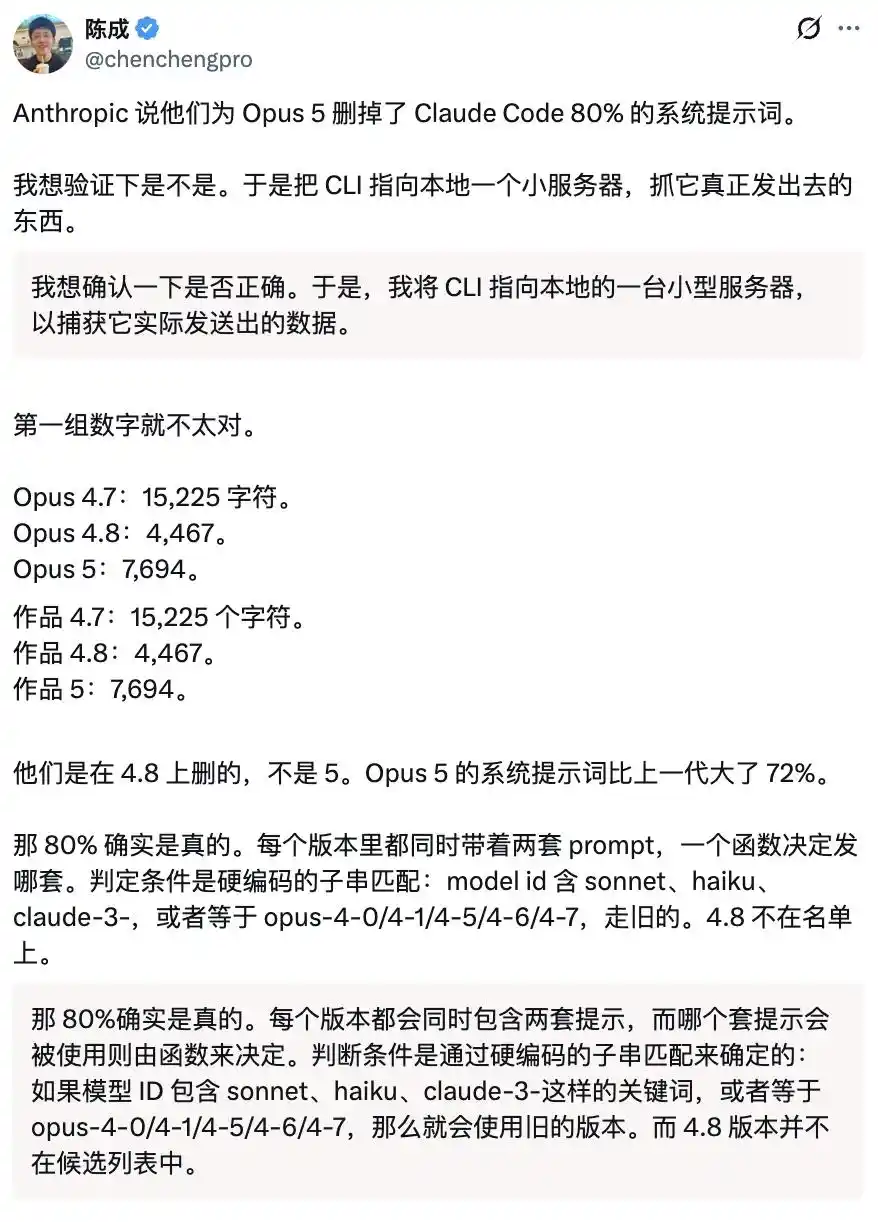
One slashes 80%, the other grows 72%.
Anthropic, are you guys putting your prompts on a diet, or are you secretly sneaking in extra snacks behind our backs......
Claude Code Prompt Overhaul: Official Team Goes on a Deleting Spree, Slashing 80%
Let's first talk about what Anthropic actually deleted.
According to the official post, early Claude Code had numerous explicit, even absolute, rules written into the system prompt to prevent the model from making mistakes.
For example, default to not writing comments, not writing multi-paragraph docstrings, not creating plans or analysis documents unless the user requests it.
In other words, wherever the model was prone to trip up, humans would patch in a rule!!
Over time, the system prompt behind Claude Code became more and more like a thick “Employee Handbook.”
This method was certainly useful for early models, but as Claude's capabilities improved, problems gradually emerged......
The most direct one was that instructions from different places easily conflicted with each other.
Faced with this overlapping and contradictory information, Claude would have to spend effort figuring out whose instructions to follow before even starting work!!

So, Anthropic simply performed “major surgery” on Claude Code's prompts.
One very obvious change happened regarding commenting and documentation rules.
The previous long list of rules like 'default to not writing comments' and 'absolutely do not write multi-paragraph docstrings' has now been compressed into a single sentence—
Write code that matches the style of the surrounding code, maintaining consistency with its comment density, naming conventions, and common practices.
Translating for friends: first look at how this project originally writes code, then use your own judgment based on the actual situation~
Of course, there are many similar changes.
The bottom line is, Anthropic deleted over 80% of the system prompt content in newer generation models like Opus 5 and Fable 5......
It's worth noting that according to Anthropic's programming evaluations, this large-scale deletion did not lead to any measurable performance degradation, so no need to worry too much.
(But I still want to ask... you cut 80% of the prompt, and the model's work didn't get worse at all, really???)
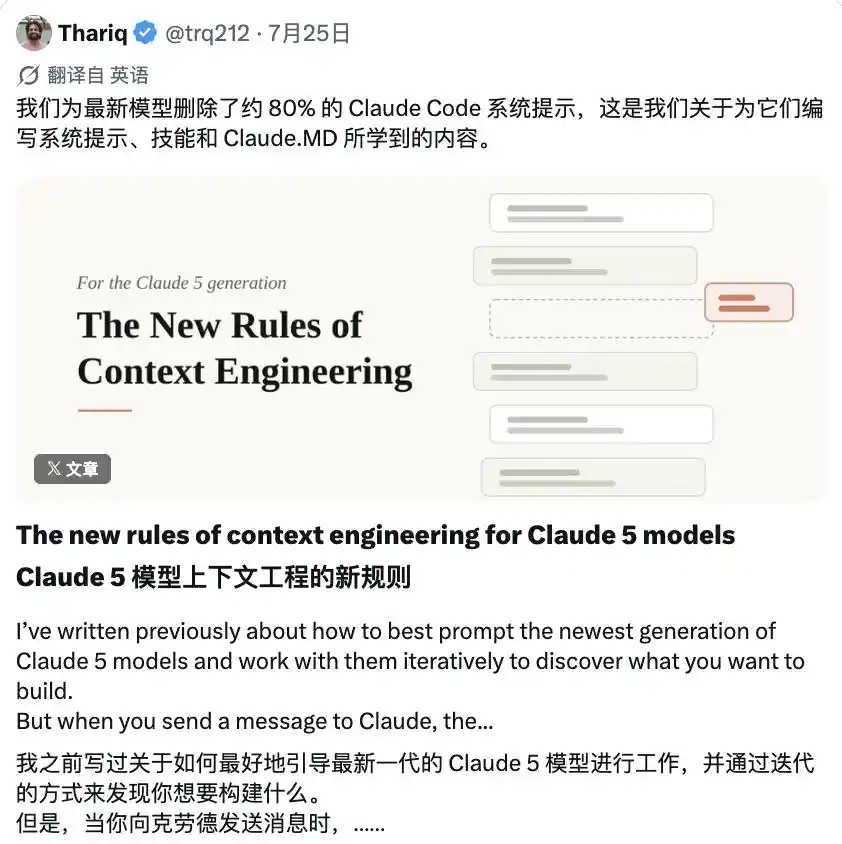
Alongside this super slimming, the context engineering rules for Claude Code were almost completely overhauled.
For developers using Claude Code or developing Agents based on Claude, Anthropic also provided several more specific adjustment suggestions.
I've also helped friends do a light summary—
Trim CLAUDE.md: Only keep the project's special rules. Information Claude can discover from the code itself can be deleted.
Break long instructions into Skills: Save processes like code review, testing, and publishing separately, and load them only when needed.
Delete duplicate instructions: Write a rule only once. Content already written in tool descriptions doesn't need to be repeated in the system prompt or CLAUDE.md.
Reduce tool call examples: Clearly explain parameter meanings, options, and return results. Reduce fixed call examples.
Provide executable references directly: Developers can give Claude test cases, existing code, HTML prototypes, or other project files as reference, reducing long text descriptions.
In summary, Anthropic's new approach can be boiled down to one sentence—
Give Claude less of a nitpicky employee handbook, and spend more effort designing clear tools, environment, and task boundaries!!
What a轰轰烈烈的 (grand and vigorous) prompt token layoff......
Netizen's Packet Sniffing: Why Did Opus 5 Grow Another 72%???
Up to this point, Claude Code's prompt token layoff seems quite successful.
But a developer netizen, looking at the "over 80%" figure given by Anthropic, suddenly had a very simple question—
Did it really get cut that much? (Good question.jpg)
So, netizen Chen Cheng (@chenchengpro) pointed the Claude Code CLI to a local server, intercepted all the actual system prompts received by different models, and captured them.
Then, a rather dramatic set of data appeared:
Opus 4.7: 15225 characters
Opus 4.8: 4467 characters
Opus 5: 7694 characters
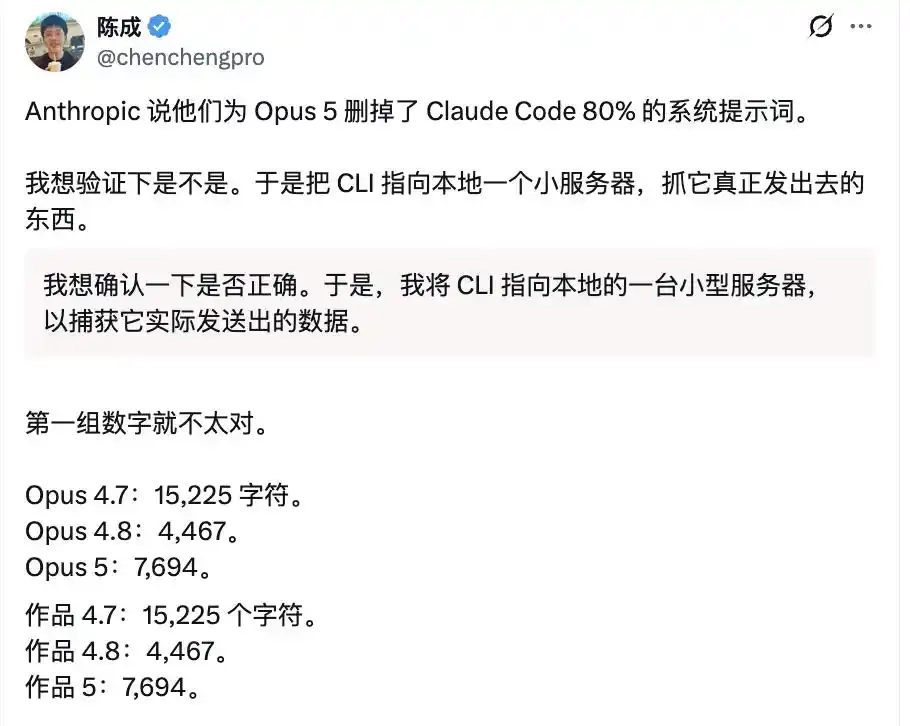
Yes, from Opus 4.7 to Opus 4.8, Claude Code's system prompt did indeed suffer a 'big cleaver' cut.
The original 15225-character prompt content was slashed down to 4467 characters, losing a huge chunk.
However, with the latest Opus 5, the plot suddenly reversed—
The actual system prompt it received grew from 4467 characters to 7694 characters, a whopping ~72% increase compared to Opus 4.8!!!
So, Claude Code's prompt slimming definitely happened, but this large-scale deletion mainly occurred in the Opus 4.8 phase.
After Opus 5's release, Anthropic added quite a bit of content back into the trimmed-down prompt......
Let's dig deeper! Keep investigating!
Continuing to look into Claude Code's implementation, attentive netizens discovered another key detail—
Each version actually contains two sets of Prompts, and a function decides which set to finally send to the model based on the model ID.
Models like Sonnet, Haiku, Claude 3, and some older Opus models use the more detailed old Prompt; newer models like Opus 5, Fable 5 use the significantly trimmed new Prompt.
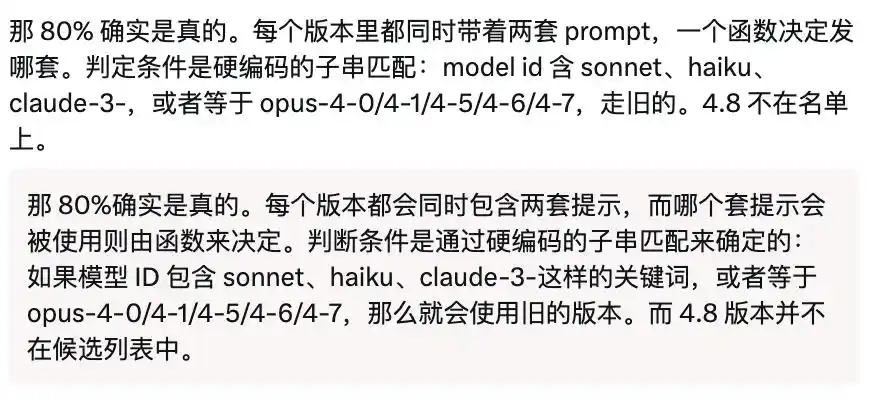
In other words, Claude Code did remove a lot of old, cumbersome operational rules for new models.
But with Opus 5, the model developed some new behavioral habits, forcing Anthropic to add back more targeted constraints.
Looking at it this way, the official "deleted over 80%" and the developer's measured "Opus 5 increased 72%" can both be true simultaneously.
The former number describes the overall change as Claude Code moved from the old prompt system to the new one; the latter number compares Opus 5 with its immediate predecessor, Opus 4.8.
Even after growing back some, Opus 5's 7694 characters are still only about half of Opus 4.7's.
So the question arises again:
What exactly did Anthropic write into those extra few thousand characters for Opus 5?
Upon further breakdown, attentive netizens found it mainly added two sections exclusive to Opus 5:
Delivering work: Rules on how to control task scope, report progress, and deliver results.
Corrections: Limits on the model repeatedly explaining and correcting its own previous mistakes.
These two parts together account for about 3755 characters, basically covering the difference between Opus 5 and Opus 4.8~
As for why Opus 5 needed these additions back, it's mainly related to the model becoming more proactive—
According to Anthropic's published prompt guidelines, Opus 5 prefers to report progress while executing tasks, generates longer responses and documents typically, and is more willing to call sub-Agents, expand task scope, and repeatedly verify results.
For complex, long-running tasks, these habits can indeed be useful.
But if a user just wants to change a few lines of code, and Opus 5 still assembles a sub-Agent team and performs multiple rounds of checks, token consumption and wait times will also increase......
Therefore, the new prompt added more targeted requirements: when is it suitable to call sub-Agents, how frequently to report progress, at what scope should the task stop, and how to control the final output length.
At this point, the seemingly contradictory data from earlier makes sense.
What Claude Code deleted this time were mostly the cumbersome operational details left over for older models. The 72% that Opus 5 grew back is mainly used to constrain the proactive behaviors of the newer, more capable model.
The more the model can work independently, the fewer places humans need to hand-hold it. But as the model gains more initiative, where it can take the lead and at what point it should stop still needs a line drawn in advance.
Looking at it this way, Claude Code's prompts did indeed get slimmer, but Opus 5 just gained weight in a different place.
Indeed, even AI can't escape this rule: old bad habits are reduced, but new ones will precisely grow somewhere else. (doge)
Reference links:
[1]https://x.com/chenchengpro/status/2081339012632215684
[2]https://claude.com/blog/the-new-rules-of-context-engineering-for-claude-5-generation-models
This article is from the WeChat public account "QbitAI", author: Focus on Frontier Technology