Indepth ResearchNews

Provide in-depth research reports and independent analysis, leveraging data, technology, and economic insights to deliver a comprehensive examination of the blockchain ecosystem, project potential, and market trends.

Dylan Patel: SemiAnalysis, Praised by Jensen Huang, is Founded by a 'Beekeeper and Forum Warrior'

Dylan Patel, founder of the independent research firm SemiAnalysis, has an unconventional background. Growing up in rural Georgia, he later worked as a beekeeper in Minnesota. His entry into semiconductors began as a self-taught "forum warrior," engaging anonymously in online tech communities from a young age. In May 2020, he started the SemiAnalysis blog on WordPress, later moving it to Substack as a paid subscription service. The firm has since evolved from a one-person operation into a global company with around 60 employees, featuring a dedicated chip teardown lab. Its revenue, reaching $20 million last year, is projected to surpass $100 million this year. SemiAnalysis is highly regarded in the AI and semiconductor industry for its deep technical analysis. NVIDIA founder Jensen Huang has publicly praised its reports. In a notable instance, a critical report on AMD's MI300X GPU software shortcomings prompted a 90-minute call with CEO Lisa Su, who thanked Patel for the "constructive feedback." A later report acknowledged AMD's subsequent improvements. The firm's analyses have significant market impact. For example, a June report discussing potential memory configuration changes in NVIDIA's next-generation servers was cited as a factor in pressure on memory-related stocks. Patel plans to establish a venture capital firm, having already made personal investments in about 20 startups. SemiAnalysis combines roles as a consultancy, model platform, and tech lab, focusing on the practical bottlenecks in AI infrastructure.

Odaily星球日报06/19 01:03

Dylan Patel: SemiAnalysis, Praised by Jensen Huang, is Founded by a 'Beekeeper and Forum Warrior'

Odaily星球日报06/19 01:03

Ethereum Q1 Report: On-chain Activity Hits Record High, Tokenized Assets Lead the Industry

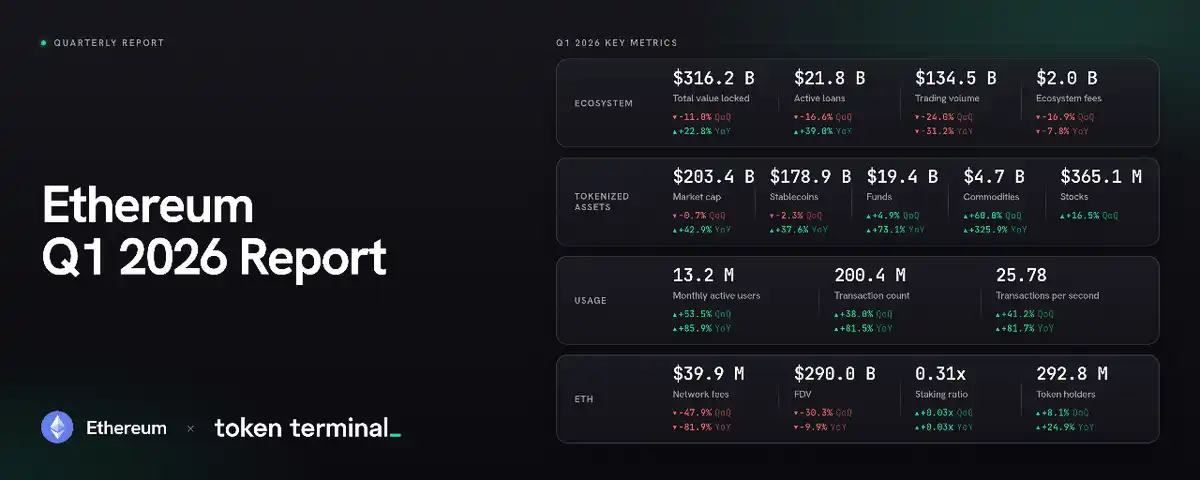
Ethereum Q1 2026 Report: On-chain activity hits record high, tokenized assets lead the industry. In Q1 2026, Ethereum's network experienced a unique divergence: on-chain activity soared while USD-denominated metrics declined. Monthly active users reached 13.2 million, transactions hit 200.4 million, and TPS averaged 25.78, all setting new highs. However, total value locked (TVL) fell 11.0% to $316.2B, DEX volume dropped 24.0% to $134.5B, and ETH's fully diluted market cap fell 30.3% to $290B. A key driver was the Blob Parameter Fork (BPO#2) in January, which increased data capacity and caused a sharp 47.9% drop in layer-1 transaction fees despite higher usage. Etherean's tokenized asset market cap reached $203.4B, up 42.9% year-over-year. While stablecoins ($178.9B) saw a slight dip, tokenized funds ($19.4B, +73.1% YoY), commodities ($4.7B, +325.9% YoY), and stocks ($365.1M) grew strongly. Ethereum dominates cross-chain comparisons, holding 71% of TVL, 79.2% of active loans, 61.8% of stablecoins, and 73% of tokenized funds among top chains. The report highlights a "Jevons Paradox" scenario: network expansion reduces per-transaction costs but unleashes latent demand, driving long-term growth. Ethereum's strategy mirrors Amazon's early focus on scale over profit. Its open, neutral foundation is seen as critical for institutional adoption, as evidenced by growing activity from firms like BlackRock and JPMorgan. The roadmap targets further scalability, aiming for thousands of TPS by 2029 to solidify its role as a global financial settlement layer.

marsbit06/19 01:00

Ethereum Q1 Report: On-chain Activity Hits Record High, Tokenized Assets Lead the Industry

marsbit06/19 01:00

Deconstructing Notion's Growth: From a Note-taking Tool to 100 Million Users—How Notion Built a Triple Growth Flywheel Through Product, Templates, and Community

Notion's growth from a niche note-taking tool to a platform with 100 million users is powered by three interconnected flywheels: Product-Led Growth (PLG), a Template Economy, and Community-Driven Growth. First, Notion's PLG strategy relies on a highly flexible, "plastic" product that users can adapt to countless personal and team workflows. Its freemium model lowers the barrier to entry, while features like page sharing and collaboration drive organic, usage-based viral growth as users naturally invite others. Second, the Template Economy solves the "blank page" problem. Templates, created by both Notion and its community, transform abstract product capabilities into concrete, copyable solutions for specific scenarios (e.g., project management, content calendars). This dramatically lowers activation costs for new users and fuels SEO-driven discovery. Third, a vibrant Community acts as a distributed growth engine. Users and official Ambassadors create tutorials, share use cases, and host local events. This community not only educates users but also fosters a sense of identity around pursuing "better ways of working," strengthening loyalty and enabling global, low-cost expansion. Together, these flywheels create a self-reinforcing ecosystem: a great product attracts users who create templates and community content, which in turn attracts more users and deepens engagement. This system allowed Notion to scale from individuals to teams and enterprises through a bottom-up adoption path. Looking ahead, AI integration promises to accelerate these flywheels further by making templates smarter and the platform a potential AI-native work operating system. Ultimately, Notion's defensible advantage is not just its features, but this deeply entrenched network of user assets, creators, and community trust.

marsbit06/18 12:03

Deconstructing Notion's Growth: From a Note-taking Tool to 100 Million Users—How Notion Built a Triple Growth Flywheel Through Product, Templates, and Community

marsbit06/18 12:03

Ethereum 2026 Q1 Review: On-Chain Activity Hits Record Highs, Tokenized Assets Lead the Industry

Ethereum Q1 2026 Review: Record On-Chain Activity, Tokenized Assets Lead the Industry. Despite a price correction impacting USD-denominated metrics, Ethereum's on-chain usage hit all-time highs in Q1 2026. Monthly active addresses surged 85.9% year-over-year to 13.2 million, while L1 transactions and throughput also set new records. This growth occurred alongside a significant 47.9% quarterly drop in L1 transaction fees, demonstrating the impact of network scaling via upgrades like the Blob Parameter Fork. The ecosystem maintained its dominance in decentralized finance (DeFi), holding 71% of the total value locked among top chains and 79.2% of active borrowing. Ethereum solidified its position as the primary platform for tokenized real-world assets (RWAs), with a total market cap of $203.4B. It holds leading shares in stablecoins (61.8%), tokenized funds (73%), and tokenized commodities (84%) across major chains. Key developments included the ERC-8004 standard for AI agents and heightened institutional engagement at forums. Major financial institutions like BlackRock, JPMorgan, and a European banking consortium announced new tokenized products on Ethereum throughout the period. The report draws parallels to the early internet, suggesting Ethereum is sacrificing short-term fee revenue for long-term network expansion and adoption. Its strategy focuses on becoming a neutral, open settlement layer for global finance, with scaling roadmaps aiming for tens of thousands of TPS by 2029.

marsbit06/18 09:52

Ethereum 2026 Q1 Review: On-Chain Activity Hits Record Highs, Tokenized Assets Lead the Industry

marsbit06/18 09:52

Uncovering the 'God of Investment Research' Behind Citrini: Perpetual Substack Chart-Topper, a Single Report Evaporated Trillions from US Stocks

Revealing the "Research God" Behind Citrini: A Non-Finance Founder Shaking Up Markets Citrini, an independent research firm consistently ranked #1 on Substack's finance charts with nearly 250,000 subscribers, has gained significant attention in the current bull market. Its founder, James van Geelen, holds dual degrees in biology and psychology from UCLA, with a background as an emergency medical technician and a healthcare entrepreneur before founding Citrini. The firm is known for its deep, narrative-driven analyses focusing on long-term "super trends" like AI, geopolitics, and macro policy. Citrini made headlines in February with its report "The 2028 Global Intelligence Crisis," a thought experiment on AI's potential societal impact. Despite being labeled a scenario analysis, it triggered a widespread sell-off in software and related stocks, briefly wiping hundreds of billions from the US market. Other notable reports include an on-the-ground analysis of the Strait of Hormuz and accurate calls on the copper foil industry's importance for AI/semiconductors. Geelen champions "second-order thinking," focusing on the indirect consequences of events. His investment style is thematic and often contrarian, seeking opportunities others miss. Citrini operates with a founder-driven, anonymous elite team model, recently adding specialists in macroeconomics and semiconductor analysis. The firm also manages a model portfolio, Citrindex, which has reportedly achieved over 200% cumulative returns.

marsbit06/18 09:12

Uncovering the 'God of Investment Research' Behind Citrini: Perpetual Substack Chart-Topper, a Single Report Evaporated Trillions from US Stocks

marsbit06/18 09:12

The Brutal Truth Behind CARDS' $535M FDV: Only $43M in Net Revenue and Halved Profit Margins

The article titled "The Brutal Truth Behind CARDS' $535 Million FDV: Only $43 Million Net Revenue, Profit Margins Halved" provides a critical analysis of Collector Crypt (CC), a platform combining physical collectible cards with NFTs in a gacha-style system. Key findings include: * CC has generated $635 million in total user deposits. However, 90.6% ($576 million) is instantly returned to users via automatic card buybacks, resulting in only $43 million in net platform revenue (6.7% retention). * Activity is highly concentrated among dozens of high-frequency wallets, with an average of only ~420 daily active players. * There is minimal secondary market activity for the cards (under $5 million total), indicating the platform functions more as a gambling casino than a collector's marketplace. eBay sales as a percentage of gacha volume have declined for six consecutive quarters. * Despite a tripling in transaction volume, net profit margins have been halved from 11.2% to 5.8% as activity shifts to higher-priced card packs with lower margins. * Value captured by the CARDS token is minimal: only $140,000 (from burns and recent buybacks), representing just 3.4% of CC's cumulative net revenue. In contrast, wallets linked to operational infrastructure have off-ramped $45.7 million in USDC. * The token's ~$535 million Fully Diluted Valuation (FDV) represents a 7.3x multiple of annualized net revenue. Only 20.5% of the token supply is floating, with 72% allocated to insiders and locked until November 2027. The conclusion is that CC has found product-market fit as a high-speed gambling platform for a niche user base, not as a growing collector economy. The token currently captures a negligible share of the platform's revenue.

Foresight News06/18 08:09

The Brutal Truth Behind CARDS' $535M FDV: Only $43M in Net Revenue and Halved Profit Margins

Foresight News06/18 08:09

LIT Token Hits Six-Month High: How Long Can the Buyback Flywheel Keep Burning Fuel?

The LIT token of decentralized perpetual exchange Lighter surged to a six-month high above $1.90 on June 18th, with a market cap of $425 million. After a price correction earlier this year, the recent rebound is attributed to its core "buyback flywheel" mechanism. All protocol fee revenue is used for programmatic, hourly market buybacks of LIT. Since its TGE in December 2025, approximately 15 million LIT (6% of circulating supply) has been repurchased for around $21 million. Additional price support comes from the LLP (Lighter Liquidity Pool), where providers must stake LIT worth 10% of their deposited USDC, locking significant token supply. However, challenges persist. Trading volume has declined amidst a sluggish market, with total volume at $1.68 trillion, significantly lower than leading competitor Hyperliquid's $4.37 trillion. While Lighter focuses on perpetual contracts, RWA, and Pre-IPO markets, Hyperliquid has expanded into prediction markets and boasts a U.S. spot ETF, attracting institutional investment and influencer endorsements like from Arthur Hayes. In contrast, LIT currently lacks similar high-profile backing. With 75% of LIT's total 1 billion supply still locked (team and investor tokens begin a 3-year linear unlock in December 2026), there is no immediate unlock selling pressure. The token's future performance hinges on sustaining trading volume growth, successful product iteration, and executing its transparent buyback strategy against a dominant competitor.

Foresight News06/18 06:32

LIT Token Hits Six-Month High: How Long Can the Buyback Flywheel Keep Burning Fuel?

Foresight News06/18 06:32

Polymarket's Sixth Anniversary: Bathroom, Exile, and Homecoming

Polymarket, a prediction market platform, recently celebrated its sixth anniversary. Born during New York's COVID-19 lockdown, founder Shayne Coplan built the initial product from his bathroom. The platform allows users to trade on the outcomes of real-world events, aiming to aggregate information faster than traditional media or polls. Its early years involved navigating regulatory challenges, most notably a 2022 CFTC order and penalty for offering unregistered event contracts, which led to a ban on U.S. users. Despite this "exile," the platform persisted, gaining significant traction during major news events like the 2024 U.S. presidential election, where its markets often preceded mainstream narratives. A pivotal shift occurred in 2025. Following the conclusion of a DOJ/CFTC investigation, Polymarket strategically acquired a CFTC-regulated exchange (QCX) to re-enter the U.S. market legally. It secured a massive strategic investment from Intercontinental Exchange (ICE), NYSE's parent company, and formed high-profile partnerships with sports leagues like the NHL, UFC, and MLB, as well as media outlets including Google and the Wall Street Journal. Now valued in the tens of billions, Polymarket stands at the intersection of crypto, finance, media, and sports. Its journey reflects a constant tension between innovative information aggregation and regulatory scrutiny, evolving from a fringe crypto experiment into a mainstream, albeit still contested, financial and data infrastructure.

marsbit06/18 04:12

Polymarket's Sixth Anniversary: Bathroom, Exile, and Homecoming

marsbit06/18 04:12

活动图片