BTCC Exchange Wins Best Centralized Exchange (Community Choice) at BeInCrypto 100 Awards 2025

TheNewsCryptoPublished on 2025-12-12Last updated on 2025-12-12

Abstract

BTCC, the world's longest-serving cryptocurrency exchange, has been awarded Best Centralized Exchange (Community Choice) at the BeInCrypto 100 Awards 2025. This award, determined by user votes, recognizes BTCC's 14-year commitment to security, transparency. The exchange serves over 10 million global users and achieved a record $1.15 trillion in trading volume in Q3 2025. To celebrate, BTCC is launching a trading competition with a 10 million USDT prize pool and a special giveaway for its community.

Vilnius, Lithuania, December 12th, 2025, Chainwire

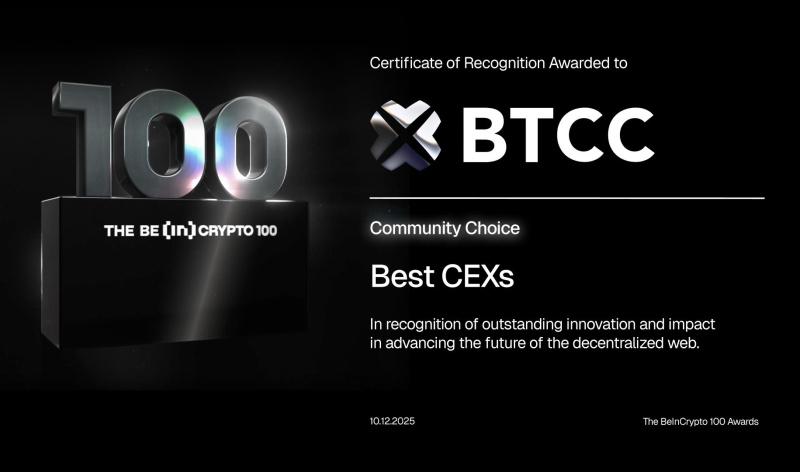
BTCC, the world’s longest-serving cryptocurrency exchange, has been named Best Centralized Exchange in the Community Choice category at The BeInCrypto 100 Awards 2025. The award was announced during a live virtual ceremony on December 10, 2025.

The BeInCrypto 100 Awards is an annual event celebrating the leaders, products, and initiatives shaping the future of Web3, organized by BeInCrypto, a reputable independent news and media platform, in partnership with Binance Square. In the “Best Centralized Exchanges” category, BTCC received the highest number of votes from global cryptocurrency users.
“Winning the community vote for ‘Best Centralized Exchange’ is incredibly meaningful,” said Aaryn Ling, Head of Branding at BTCC. “This award reflects the trust that our 10 million users place in BTCC every day. It validates our 14-year commitment to transparency, security, and putting our community first.”

A Track Record That Speaks for Itself

BTCC’s recognition is supported by strong operational metrics throughout 2025. The platform now offers over 400 futures trading pairs and more than 460 spot trading pairs, providing comprehensive access to the latest and most popular markets for over 10 million global users. In Q3 2025 alone, BTCC achieved a record of $1.15 trillion in both futures and spot trading volume, marking 20% quarter-over-quarter growth.

Underpinning these achievements is BTCC’s 14-year security record. Since its founding in 2011, the exchange has maintained a zero-incident track record with no security breaches, a rare distinction in an industry where trust and security are paramount.

The BeInCrypto award caps a year of industry recognition for BTCC. The exchange earned triple honors from FXEmpire in 2025 as the Lowest Fee Crypto Exchange, Best Fiat-to-Crypto Trading Platform, and Best Crypto Exchange in the USA. BTCC’s growing mainstream presence is further reflected in its partnership with NBA All-Star Jaren Jackson Jr., the 2023 Defensive Player of the Year, as global brand ambassador, connecting the mass public audience with crypto accessibility.

Community Celebration: 10M USDT Flagship Campaign and Giveaway

To mark the occasion, BTCC is launching a trading competition featuring a 10 million USDT prize pool, among the larger offerings in recent exchange-led events. The competition is open to global participants. Additional details will be provided on BTCC’s official X account.

Additionally, BTCC is thanking the community with a special giveaway for their continued support, offering 1,000 USDT to 10 winners. Full details are now available on BTCC’s X account (@BTCCexchange).

Looking ahead to 2026, BTCC plans to expand its spot and futures offerings, introduce additional platform features, and increase engagement with global communities, continuing its development strategy following this year’s activities.

About BTCC

Founded in 2011, BTCC is a leading global cryptocurrency exchange serving over 10 million users across 100+ countries. Partnered with 2023 Defensive Player of the Year and 2x NBA All-Star Jaren Jackson Jr. as global brand ambassador, BTCC delivers secure, accessible crypto trading services with an unmatched user experience.

Official website: https://www.btcc.com/en-US

X: https://x.com/BTCCexchange

Contact

Aaryn Ling
press@btcc.com

Related Reads

Anthropic Cries Wolf: Is the AGI Threat Real, or Just an IPO Story?

Anthropic has published an article titled "When AI builds itself," discussing the emerging concept of "recursive self-improvement," where AI begins to actively participate in designing, training, testing, and optimizing its own subsequent versions. The company presents internal data showing that by May 2026, over 80% of code merged into its codebase was written by Claude, its AI model. Claude's capabilities have expanded to handling complex, open-ended engineering tasks, achieving a 76% success rate in such areas, and even contributing to research processes, such as optimizing code performance and conducting AI safety experiments. Anthropic outlines an evolution from human-driven development to AI-assisted workflows, culminating in the current stage where AI agents can autonomously write, run, and delegate code. The company cautions that the path toward a "closed loop," where AI continuously improves itself, is becoming visible. It calls for coordinated global mechanisms to potentially slow or pause frontier AI development to allow safety research and societal structures to catch up. However, the timing of this warning coincides with Anthropic's preparations for an IPO, framing the narrative not just as a safety concern but also as a demonstration of Claude's advanced capabilities and its integral role in accelerating Anthropic's own R&D—creating a potential "flywheel" effect for competitive advantage. This contrasts with OpenAI's recent, more policy-oriented discussion of the same risks, highlighting the competitive dynamics in the AI industry as companies position themselves in both the technological and regulatory landscape.

marsbit21m ago

Anthropic Cries Wolf: Is the AGI Threat Real, or Just an IPO Story?

marsbit21m ago

BIT Research: ETF Purchases Have Slowed, Strategy (MicroStrategy) Has Slowed, What Else Can Drive Bitcoin's Rise?

Market Refocus on Inflation and Rate Expectations Weighs on Bitcoin Currently, the market is in a phase of macro-repricing dominated by inflation and interest rate expectations. Bitcoin, which previously benefited from easy liquidity and low inflation, is seeing its core bullish drivers weaken. These drivers were market expectations for interest rate cuts and strong inflows from Bitcoin ETFs and institutions like MicroStrategy (referred to as "Strategy" in the text). The logic has shifted. Recent high inflation data (e.g., CPI hitting 3.8% in a May 2026 report) has caused the market to sharply reduce its rate cut expectations for 2025 and even price in potential hikes. This is a key constraint for Bitcoin, as it lacks cash flows and is highly sensitive to rate expectations. Concurrently, institutional capital flows have slowed significantly. Following the hot CPI data, Bitcoin ETFs saw accelerated outflows, with around $4.3 billion leaving over a period. MicroStrategy's ability to keep adding substantial Bitcoin to its balance sheet is also diminishing. Together, ETF and MicroStrategy holdings total roughly $110 billion, but their momentum as growth engines is cooling. In summary, Bitcoin's current pressure stems not from its own fundamentals but from a changing macro environment. As long as inflation stays elevated, Bitcoin is likely to remain in a consolidating phase. However, historically, inflation eventually peaks. Once it recedes and rate cut expectations rebuild, institutional capital could return, potentially fueling a new and more robust recovery phase for Bitcoin.

marsbit29m ago

BIT Research: ETF Purchases Have Slowed, Strategy (MicroStrategy) Has Slowed, What Else Can Drive Bitcoin's Rise?

marsbit29m ago

Earning 1000 Trillion in Half a Year, 'Pocketing' 20 Million per Capita: This Round of Wealth Creation in the Korean Stock Market is Unprecedented in Scale

The South Korean stock market is experiencing an unprecedented wealth surge in 2026, with household equity and fund asset values soaring by over 1,000 trillion KRW (~$730bn) year-to-date. This translates to an average per capita wealth increase of roughly 20 million KRW, fueled by a historic 109% rally in the KOSPI index. The boom is driven by three converging forces: an AI-driven semiconductor supercycle boosting giants like Samsung and SK Hynix; the government's "Value-Up" market reforms addressing long-standing corporate governance issues; and aggressive real estate regulations that have locked capital within financial markets, preventing profits from flowing back into property. This has triggered a wealth effect, boosting high-end consumption significantly. However, the gains are highly concentrated. The two semiconductor behemoths account for over half the index's value, but retail investors own relatively low stakes in them, systematically missing the biggest rallies. Wealth and consumption benefits are skewed towards luxury goods and imported cars, bypassing mainstream retail. Further risks stem from excessive leverage, with high trading volume in leveraged ETFs, and a market sentiment heavily reliant on the AI sector's fortunes and speculative rumors. While this cycle marks a potential shift from real estate to equities as a primary wealth generator for Koreans, its sustainability, amid structural imbalances and leverage, remains a critical test.

marsbit34m ago

Earning 1000 Trillion in Half a Year, 'Pocketing' 20 Million per Capita: This Round of Wealth Creation in the Korean Stock Market is Unprecedented in Scale

marsbit34m ago

Trading

Spot
Futures
活动图片