BitMine Enters Ethereum Staking With $451 Million ETH Deposit

bitcoinistPublished on 2025-12-29Last updated on 2025-12-29

Abstract

BitMine, a major Ethereum treasury firm, has initiated a staking strategy by depositing 154,176 ETH (worth approximately $451 million) into Ethereum’s proof-of-stake system. This move allows the company to earn passive income from its substantial holdings. According to on-chain analyst EmberCN, BitMine currently possesses 4.066 million ETH. If all of it were staked at an estimated 3.12% APY, the firm could generate around $371 million in annual interest. Despite recent declines in its stock price (BMNR), which fell nearly 4% in the last trading session and 43% over three months, BitMine continues to accumulate ETH. The firm had planned to begin staking in Q1 2026 via its Made-in-America Validator Network (MAVAN) and is testing institutional staking providers with a portion of its Ether.

Ethereum treasury firm Bitmine has started staking its Ether tokens, depositing roughly $451 million worth of ETH into Ethereum’s proof-of-stake (PoS) system on Saturday, December 27. This appears to be a fresh strategy from the digital asset treasury (DAT) firm, which has managed to stay relevant in a nascent, uncertain sector of the cryptocurrency industry.

How Much Would BitMine Make From Ethereum Staking?

In the early hours of Saturday, December 27, on-chain analyst EmberCN revealed that BitMine has finally started attempting to stake its Ether holdings to earn interest income. The largest Ethereum treasury firm deposited 74,880 ETH (equivalent to $219 million) into an Ethereum PoS contract.

In a later, separate transaction, BitMine went on to deposit 79,296 ETH (worth about $232 million) into Ethereum PoS staking. This brings the firm’s total stake in the ETH network to 154,176 ETH (roughly $451 million) in the past day and so far.
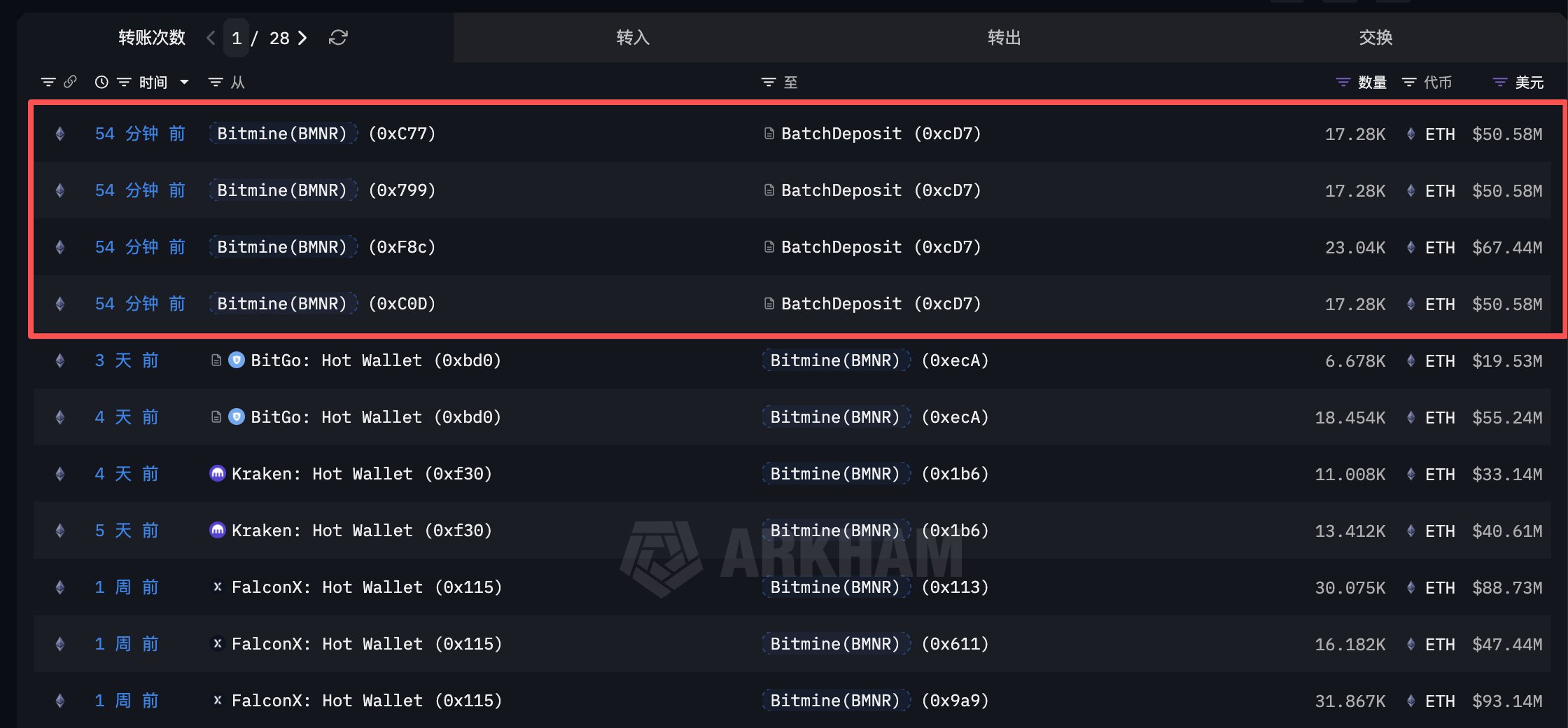
Source: @EmberCN on X

EmberCN added in the post on X:

They [BitMine] now hold 4.066 million ETH, with an approximate APY of 3.12%. If all of it were staked, they could earn about 126,800 ETH in interest over a year, which at the current price of $2,927 would be worth $371 million.

Earlier in November, Bitmine had disclosed its plans to start Ether staking in 2026’s first quarter through a dedicated in-house setup called the Made-in America Validator Network (MAVAN). At the time, the Ethereum treasury firm stated it had selected three institutional staking providers for a pilot program, using a small portion of its ETH to test performance, security, and operational quality before scaling.

Meanwhile, the treasury firm has not stopped accumulating Ether tokens despite the not-so-optimistic signs in the crypto market. The recent buying spree took BitMine’s Ethereum holdings to a whopping 4.066 million ETH.

As it appears, staking presents an opportunity for the largest corporate ETH holder to earn passive income from its Ethereum holdings, especially as the general market continues to underperform. With crypto prices in a downward trend, shares of most DATs have not been able to enjoy the required tailwind to soar to new heights.

BMNR 2025 Price Recap

As of this writing, the BitMine stock (ticker: BMNR) is valued at around $28.31 per share, closing with an almost 4% decline on the last trading day. A broader look at the stock shows that the past few months have been rough for the digital asset treasuries sector.

According to data from TradingView, BMNR’s value has dropped by nearly 43% in the past three months. However, its is worth noting that the stock has grown by almost 2.5x in the past year.

The price of BMNR on the daily timeframe | Source: BMNR chart on TradingView


Related Reads

Crypto Market Makers Are Collectively Seeking Change as Money Becomes Harder to Earn

**Summary: Crypto Market Makers Adapt as Margins Shrink** Leading crypto market maker GSR exemplifies a broader industry shift, moving beyond traditional market-making to become a full-service "Web3 investment bank." Its recent strategic acquisitions—including an SEC-registered broker-dealer, rebranded as GSR Securities—and purchases of token advisory firms aim to create an integrated platform covering token design, fundraising, listing, liquidity provision, and asset management. This includes launching an ETF and investing in tokenization platforms like Libeara, backed by a strategic investment from Standard Chartered's SC Ventures. This transformation is not unique to GSR. Other major players like Keyrock, B2C2, Wintermute, and DWF Labs are also expanding geographically, pursuing regulatory licenses (especially under frameworks like MiCA in the EU), and diversifying into over-the-counter (OTC) trading, asset management, and real-world asset tokenization. The driving force behind this collective pivot is a rapidly changing market. Profits from traditional altcoin market-making are declining due to fewer viable projects, reduced client budgets, increased competition, and smarter, more demanding clients. Simultaneously, regulatory pressures are mounting, making compliance a baseline cost. Extreme market events further expose teams lacking robust risk controls. Consequently, the crypto market-making business model is evolving from one reliant on information asymmetry and volatility to a more institutionalized, regulated, and service-diverse industry. Survival now depends on building systemic capabilities beyond mere liquidity provision.

marsbit29m ago

Crypto Market Makers Are Collectively Seeking Change as Money Becomes Harder to Earn

marsbit29m ago

Market Adjusts Following Google's $84.7 Billion Fundraising, AI Valuations Now Focus on Payback Speed

After Alphabet's announcement of an $84.75 billion equity financing round, market focus for AI investment is shifting from pure growth narratives to capital efficiency and payback periods. The core argument is that AI is being re-priced from a software-like growth story into a heavy-asset infrastructure cycle, requiring massive capital expenditure (CapEx) on chips, data centers, and power grids. While Alphabet's financing itself is not a distress signal—part of it is for administrative purposes like tax obligations on stock compensation—it highlights the enormous capital demands of AI infrastructure. This demand extends beyond tech giants to pure-play AI model companies (like OpenAI, Anthropic), data center REITs, and utilities. Major tech firms are projected to spend heavily on AI data centers in 2026, signaling a broad-based capital cycle the market must absorb. Consequently, valuation logic is changing. Investors are moving away from questions about who has the strongest AI narrative and are now prioritizing clear visibility into orders, stable cash flows, and the cost of capital. This has led to recent pressure on high-multiple AI software and semiconductor stocks, while "picks-and-shovels" hardware, data center, and power assets with firmer near-term demand may see relative support. The key going forward will be monitoring whether rising CapEx guidance across companies is matched by a timely monetization of AI investments into revenue and cash flow. The market's tolerance for high spending depends on demonstrable returns. While the long-term AI thesis remains intact, the valuation framework has fundamentally shifted to emphasize capital discipline and payback speed.

marsbit36m ago

Market Adjusts Following Google's $84.7 Billion Fundraising, AI Valuations Now Focus on Payback Speed

marsbit36m ago

Trading

Spot
Futures

Hot Articles

Discussions

Welcome to the HTX Community. Here, you can stay informed about the latest platform developments and gain access to professional market insights. Users' opinions on the price of ETH (ETH) are presented below.

活动图片













