Bitcoin Undeterred: Trump’s 15% Global Tariff Hike Fails To Rattle Crypto

bitcoinistPublished on 2026-02-22Last updated on 2026-02-22

Abstract

Bitcoin remained stable despite former President Trump's announcement of increasing a global tariff from 10% to 15%, effective immediately. The cryptocurrency market showed minimal reaction, with Bitcoin holding around $68,000 and Ether largely unchanged. The tariff hike, implemented under temporary trade laws, is capped at 15% and limited to 150 days, potentially preventing it from becoming a permanent measure. Traders treated the news as a short-term event rather than a sustained economic shock, with no significant sell pressure observed. While the move raises concerns about consumer costs and trade tensions, its immediate market impact appears limited. Crypto investors are monitoring whether the policy expands beyond current legal constraints.

Bitcoin held its ground over the weekend as US President Donald Trump said late Saturday that he was increasing a recently announced global tariff from 10% to 15% and that the new rate would take effect immediately.

The move came after the US Supreme Court ruled to limit the legal authority previously used to impose broad import levies.

Bitcoin Unmoved

Cryptocurrencies barely budged on the news. Bitcoin hovered around the $68,000 mark while Ether showed little change, and smaller tokens lost under 1% in aggregate according to market trackers. Reports note that traders only saw a brief wobble before prices steadied, suggesting the shock was short lived.

BTCUSD now trading at $68,028. Chart: TradingView

Legal Limits And What They Mean

Based on reports, the shift to alternative trade laws limits how far a president can go with such tariffs. The statutes cited allow a temporary tariff capped at 15% and typically apply to countries where the US runs a trade deficit for a defined period of up to 150 days.

Legal experts say those constraints could keep the measure from becoming a permanent tax rise on imports.
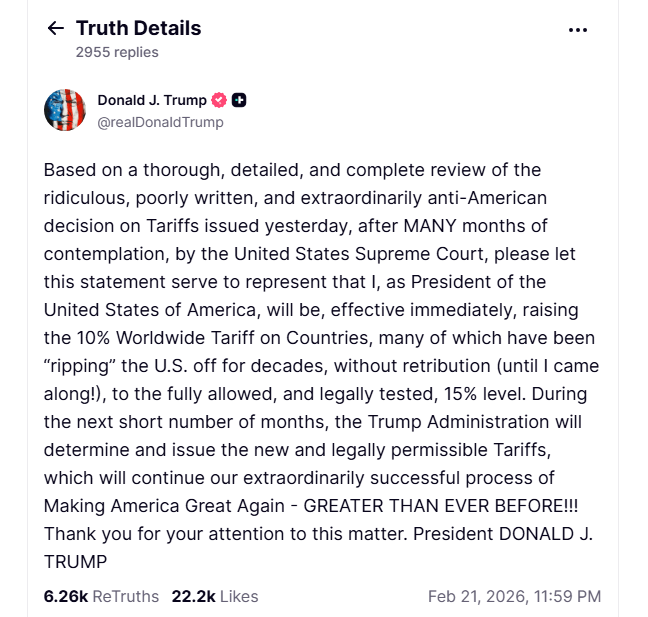
Trump said on his Truth Social platform:

“As President of the United States of America, I will be, effective immediately, raising the 10% worldwide tariff on countries, many of which have been ‘ripping’ the US off for decades, without retribution, until I came along, to the fully allowed, and legally tested, 15% level.”

How Traders Might Be Thinking

Some investors appear to have treated the announcement as a headline event rather than the start of a lasting economic shock.

Volume patterns showed no sustained sell pressure, and risk appetite in crypto markets returned quickly. Reports say the earlier court ruling, which narrowed the executive branch’s emergency powers for tariffs, may have removed some uncertainty — at least for now.

Market sentinels will watch closely in the days ahead. If the White House tries to stretch the temporary authority or expand the list of targeted countries, that could change the tone in both crypto and equity markets.

Bigger Picture For The Economy

Raising an across-the-board tariff, even temporarily, raises questions about costs for businesses and consumers.

Import duties are often passed down the chain in the form of higher prices or tightened margins, and global trading partners are likely to push back diplomatically and legally.

Some foreign leaders and industry groups quickly criticized the move, warning it could slow growth and raise consumer bills.

Far from a market-draining shock, this episode so far reads like a high-profile policy stunt with limited immediate market effect.

That could change if the measure is stretched beyond the legal limits that lawmakers and courts have pointed to. For now, crypto traders seem to have chosen to watch and wait while prices remain near recent highs.

Featured image from Unsplash, chart from TradingView

Related Questions

QWhat was the immediate market reaction of Bitcoin and other cryptocurrencies to Trump's announcement of increasing the global tariff to 15%?

ACryptocurrencies barely budged on the news. Bitcoin hovered around $68,000, Ether showed little change, and smaller tokens lost under 1% in aggregate. Traders only saw a brief wobble before prices steadied.

QWhat legal constraints, as mentioned in the article, limit the impact of the tariff hike announced by Trump?

AThe shift to alternative trade laws limits the tariff to a temporary measure capped at 15%, applicable for up to 150 days to countries where the US runs a trade deficit. Legal experts say these constraints could prevent it from becoming a permanent tax rise.

QHow did traders interpret the tariff announcement, according to the article?

ASome investors treated the announcement as a headline event rather than the start of a lasting economic shock. There was no sustained sell pressure, and risk appetite in crypto markets returned quickly.

QWhat potential consequences does the article suggest an across-the-board tariff hike could have on the broader economy?

ARaising an across-the-board tariff could lead to higher prices or tightened margins for businesses and consumers as import duties are passed down the chain. It could also prompt diplomatic and legal pushback from global trading partners, potentially slowing growth and raising consumer bills.

QUnder what condition could the market's calm reaction to the tariff news change, as per the article?

AThe market's reaction could change if the White House tries to stretch the temporary authority beyond its legal limits or expands the list of targeted countries, which could alter the tone in both crypto and equity markets.

Related Reads

La Liga Team Bets $1 Million Against Themselves Before Match: Does Using Prediction Markets for Insurance Comply with Sports Regulations?

A Spanish La Liga club, reportedly Osasuna, purchased insurance against relegation and was linked to a transaction of over $1 million on the prediction market platform Kalshi, betting against its own victory in a crucial season-ending match. While Osasuna confirmed buying €1.2 million insurance for a potential €6 million payout in case of relegation through broker Howden, it did not confirm involvement with Kalshi. The reported trade involved intermediaries like Game Point Capital and Greenlight Commodities, with quant firm Susquehanna as the counterparty. This incident highlights the blurring line between financial hedging and gambling in prediction markets. Such markets allow trading on future event outcomes, like sports results. In the US, Kalshi operates as a regulated event contract market under the CFTC. However, Spanish authorities recently initiated penalties against Kalshi and Polymarket, considering their activities unlicensed gambling. The case raises core questions about prediction markets: who can trade, how insider information is handled, and whether participants can influence outcomes, especially in sports where results are human-driven. While leagues like La Liga and Serie A have partnered with Polymarket in North America, the regulatory clash and potential for conflicts of interest, as seen in this club's alleged transaction, present significant challenges as prediction markets evolve toward institutional risk management.

Foresight News31m ago

La Liga Team Bets $1 Million Against Themselves Before Match: Does Using Prediction Markets for Insurance Comply with Sports Regulations?

Foresight News31m ago

From Shouting 150 Dollars to Liquidating HYPE in Just Three Days, How Much Credibility Does Arthur Hayes Have Left?

How much of Arthur Hayes's market credibility remains? Recently, the "godfather of crypto perpetual swaps" and BitMEX co-founder has faced public criticism, including accusations from on-chain investigator ZachXBT about creating exit liquidity for his followers. Starting last week, Hayes executed multiple sudden sell-offs. He had repeatedly publicly predicted the HYPE token would reach $150. After a $100,000 bet defending Hyperliquid on June 1st, he announced just three days later that he had completely sold his HYPE and NEAR holdings, successfully exiting near the peak. He also sold ZEC and WLD. His sale of WLD appeared to be a classic "pump and dump" maneuver. On June 3rd, he publicly set a $10 target for WLD, causing its price to surge over 35%. By June 6th, he announced he had sold his WLD, citing "anomalous" SpaceX pre-IPO price action, which triggered a sharp price drop. On June 9th, Hayes published a lengthy article explaining his actions, citing factors like rising energy costs and a potential AI bubble burst. Consequently, his family office, Maelstrom, now holds positions in US energy producers and only core crypto assets BTC and ETH, having sold AI-related stocks and non-core cryptocurrencies. This pattern is not new. In 2025, he similarly touted HYPE before selling it at what turned out to be a cycle peak, only to repurchase it at the next cycle's low. Similar scenarios played out with tokens like ETHFI and ENA. Long-term observers have developed a strategy: ignore Hayes's public statements but closely monitor his on-chain actions—be cautious following his buys, but decisively follow his sells. If he continues these tactics, especially as seen with the WLD case, his market credibility risks being permanently damaged. As Hayes himself admitted in his latest article, "I remain an unapologetic gambler."

marsbit49m ago

From Shouting 150 Dollars to Liquidating HYPE in Just Three Days, How Much Credibility Does Arthur Hayes Have Left?

marsbit49m ago

Fundraising is Like a Strange Dance: The 'Absurd Drama' of Silicon Valley Founders' Capital Raises

The article details a series of absurd and revealing anecdotes shared by Silicon Valley founders about their venture capital fundraising experiences, sparked by Greg Isenberg's story of pitching to a sleeping a16z partner. Founders describe surreal pitch meetings: one faced a barefoot, peanut-eating investor who offered triple the requested amount after 30 seconds; another performed a pitch in a VC's parked car; a founder discovered his audience understood no English beyond "yes." These stories highlight the often irrational and performative nature of fundraising. Beyond the absurdity, darker power imbalances are exposed. Stories include investors suggesting founders fire co-founders for their equity, blatant market misjudgments, disrespectful behavior from LPs, and discriminatory remarks. A debate also emerges around "Sequoia's" practice of splitting a round into two valuations. However, the thread isn't solely critical. Positive counter-narratives celebrate supportive VCs who offered crucial advice during crises, respected founders' timelines, and showed simple gestures of respect—like a partner personally fetching coffee before a major pitch. Ultimately, the collective sharing acts as a pressure release, illustrating that fundraising is a complex dance of power, trust, and sometimes sheer theater. It underscores that beyond capital, mutual respect and integrity remain the most enduring foundations of the founder-investor relationship.

marsbit1h ago

Fundraising is Like a Strange Dance: The 'Absurd Drama' of Silicon Valley Founders' Capital Raises

marsbit1h ago

Trading

Spot
Futures

Hot Articles

What is $BITCOIN

DIGITAL GOLD ($BITCOIN): A Comprehensive Analysis Introduction to DIGITAL GOLD ($BITCOIN) DIGITAL GOLD ($BITCOIN) is a blockchain-based project operating on the Solana network, which aims to combine the characteristics of traditional precious metals with the innovation of decentralized technologies. While it shares a name with Bitcoin, often referred to as “digital gold” due to its perception as a store of value, DIGITAL GOLD is a separate token designed to create a unique ecosystem within the Web3 landscape. Its goal is to position itself as a viable alternative digital asset, although specifics regarding its applications and functionalities are still developing. What is DIGITAL GOLD ($BITCOIN)? DIGITAL GOLD ($BITCOIN) is a cryptocurrency token explicitly designed for use on the Solana blockchain. In contrast to Bitcoin, which provides a widely recognized value storage role, this token appears to focus on broader applications and characteristics. Notable aspects include: Blockchain Infrastructure: The token is built on the Solana blockchain, known for its capacity to handle high-speed and low-cost transactions. Supply Dynamics: DIGITAL GOLD has a maximum supply capped at 100 quadrillion tokens (100P $BITCOIN), although details regarding its circulating supply are currently undisclosed. Utility: While precise functionalities are not explicitly outlined, there are indications that the token could be utilized for various applications, potentially involving decentralized applications (dApps) or asset tokenization strategies. Who is the Creator of DIGITAL GOLD ($BITCOIN)? At present, the identity of the creators and development team behind DIGITAL GOLD ($BITCOIN) remains unknown. This situation is typical among many innovative projects within the blockchain space, particularly those aligning with decentralized finance and meme coin phenomena. While such anonymity may foster a community-driven culture, it intensifies concerns about governance and accountability. Who are the Investors of DIGITAL GOLD ($BITCOIN)? The available information indicates that DIGITAL GOLD ($BITCOIN) does not have any known institutional backers or prominent venture capital investments. The project seems to operate on a peer-to-peer model focused on community support and adoption rather than traditional funding routes. Its activity and liquidity are primarily situated on decentralized exchanges (DEXs), such as PumpSwap, rather than established centralized trading platforms, further highlighting its grassroots approach. How DIGITAL GOLD ($BITCOIN) Works The operational mechanics of DIGITAL GOLD ($BITCOIN) can be elaborated on based on its blockchain design and network attributes: Consensus Mechanism: By leveraging Solana’s unique proof-of-history (PoH) combined with a proof-of-stake (PoS) model, the project ensures efficient transaction validation contributing to the network's high performance. Tokenomics: While specific deflationary mechanisms have not been extensively detailed, the vast maximum token supply implies that it may cater to microtransactions or niche use cases that are still to be defined. Interoperability: There exists the potential for integration with Solana’s broader ecosystem, including various decentralized finance (DeFi) platforms. However, the details regarding specific integrations remain unspecified. Timeline of Key Events Here is a timeline that highlights significant milestones concerning DIGITAL GOLD ($BITCOIN): 2023: The initial deployment of the token occurs on the Solana blockchain, marked by its contract address. 2024: DIGITAL GOLD gains visibility as it becomes available for trading on decentralized exchanges like PumpSwap, allowing users to trade it against SOL. 2025: The project witnesses sporadic trading activity and potential interest in community-led engagements, although no noteworthy partnerships or technical advancements have been documented as of yet. Critical Analysis Strengths Scalability: The underlying Solana infrastructure supports high transaction volumes, which could enhance the utility of $BITCOIN in various transaction scenarios. Accessibility: The potential low trading price per token could attract retail investors, facilitating wider participation due to fractional ownership opportunities. Risks Lack of Transparency: The absence of publicly known backers, developers, or an audit process may yield skepticism regarding the project's sustainability and trustworthiness. Market Volatility: The trading activity is heavily reliant on speculative behavior, which can result in significant price volatility and uncertainty for investors. Conclusion DIGITAL GOLD ($BITCOIN) emerges as an intriguing yet ambiguous project within the rapidly evolving Solana ecosystem. While it attempts to leverage the “digital gold” narrative, its departure from Bitcoin's established role as a store of value underscores the need for a clearer differentiation of its intended utility and governance structure. Future acceptance and adoption will likely depend on addressing the current opacity and defining its operational and economic strategies more explicitly. Note: This report encompasses synthesised information available as of October 2023, and developments may have transpired beyond the research period.

363 Total ViewsPublished 2025.05.13Updated 2025.05.13

What is $BITCOIN

Discussions

Welcome to the HTX Community. Here, you can stay informed about the latest platform developments and gain access to professional market insights. Users' opinions on the price of BTC (BTC) are presented below.

活动图片














