Bitcoin Hashrate Continues To Fall, Now Lowest Since September

bitcoinistPublished on 2026-01-20Last updated on 2026-01-20

Abstract

Bitcoin's network hashrate, a key indicator of total mining computational power, has continued its recent decline. The 7-day average hashrate has now dropped to 978.8 EH/s, its lowest level since early September. This follows an all-time high set in mid-October, after which miners began to decommission equipment as BTC's price turned bearish. Despite a recent price recovery to around $93,000, miner sentiment remains weak. This sustained drop in hashrate is now directly impacting Bitcoin's mining difficulty. With average block times currently at 10.43 minutes—slower than the target 10 minutes—the network is estimated to see a 4.15% reduction in difficulty in its next automated adjustment. This adjustment, still a few days away, could change if miner activity shifts. The declining hashrate reflects a broader trend of reduced miner optimism and operational scaling back.

On-chain data shows the Bitcoin Hashrate has continued to decline, with its 7-day average value hitting lows not seen since early September.

Bitcoin Hashrate Has Been Sliding Down

The Bitcoin “Hashrate” refers to a measure of the total amount of computing power that the miners as a whole have connected to the network. It’s denoted in units of hashes per second (H/s) or, more practically, in exahashes per second (EH/s). This indicator can be useful for gauging the sentiment shared by the miners. Growth in the network Hashrate can signal that this cohort is either responding to a period of profitability or expanding in anticipation of future price action. On the other hand, a decline can signal a weakening of sentiment.

As the chart below from Blockchain.com shows, the 7-day average value of the Bitcoin Hashrate has been following the latter kind of trajectory in recent months.
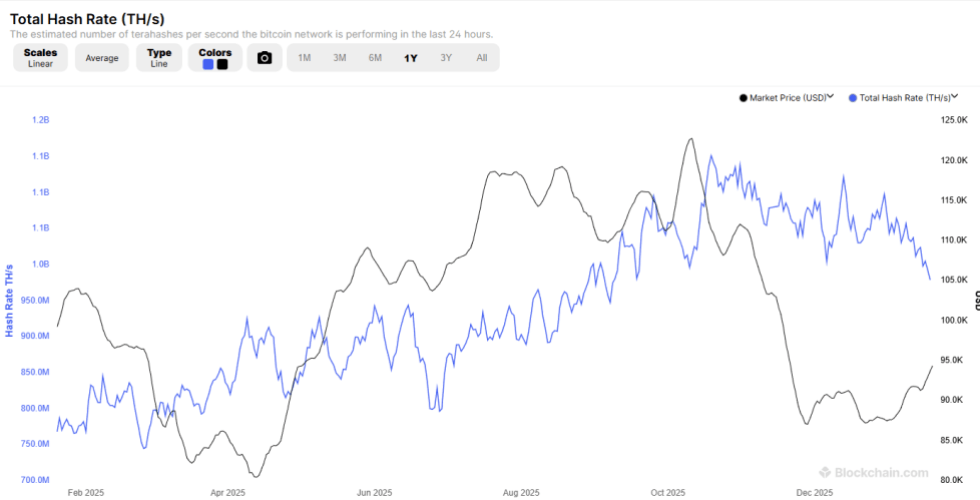
The trend in the 7-day average value of the indicator over the last 12 months | Source: Blockchain.com

The Hashrate set a new all-time high (ATH) in mid-October, but miners moved to decommissioning power as the cryptocurrency’s price went through its bearish shift in that month. Recently, BTC has shown some recovery, but that doesn’t appear to have changed opinion among the miners, as the metric’s value has only continued to go down.

Currently, the 7-day average Bitcoin Hashrate is sitting at 978.8 EH/s, which is the lowest level since the first half of September. The recent low levels are on a path to affect another BTC-network-related metric: the Difficulty. The Difficulty is a feature built into the blockchain that controls how hard it is for miners to mine blocks. This metric automatically changes its value about every two weeks based on how fast miners have been performing their duty since the last adjustment.

Satoshi coded in a simple rule for the network to follow: block time should converge to 10 minutes. If miners take an average time faster than this to find a block, the chain raises its Difficulty in the next adjustment. Similarly, a decrease instead happens if the validators are slower at their job.

As miners have reduced their computing power over the last few months, their pace has been going down, and the network has been adjusting the Difficulty lower.

With the Hashrate decline only continuing recently, the network is once again moving toward another relaxation in Difficulty, as data from CoinWarz suggests.
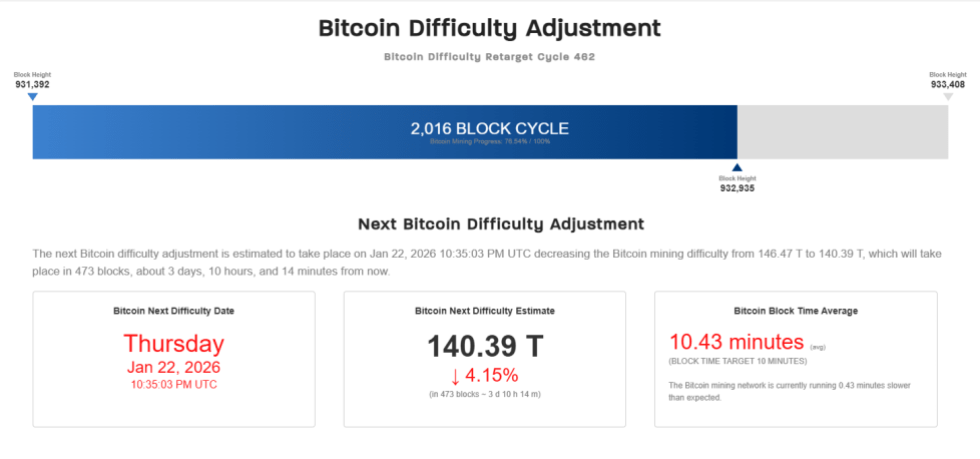
The details related to the upcoming Difficulty adjustment | Source: CoinWarz

The average Bitcoin block time has stood at 10.43 minutes since the last adjustment, which is notably slower than the standard rate. As a result, the network is estimated to reduce the Difficulty by 4.15%.

With the adjustment still being a few days away, however, this figure could change depending on whether miners expand or decommission in the coming days.

BTC Price

At the time of writing, Bitcoin is floating around $93,000, up 2.5% in the last seven days.

Looks like the price of the coin has plummeted over the past day | Source: BTCUSDT on TradingView


Trending Cryptos

Related Questions

QWhat does the Bitcoin Hashrate measure and why is it significant?

AThe Bitcoin Hashrate measures the total amount of computing power that miners have connected to the network, denoted in hashes per second (H/s) or exahashes per second (EH/s). It is significant because it gauges miner sentiment: growth indicates profitability or expansion in anticipation of price increases, while a decline signals weakening sentiment.

QWhat recent trend has been observed in the 7-day average Bitcoin Hashrate?

AThe 7-day average Bitcoin Hashrate has been declining, recently hitting 978.8 EH/s, which is the lowest level since the first half of September.

QHow does the decline in Hashrate affect Bitcoin's Difficulty?

AThe decline in Hashrate slows down the pace of block mining, causing the network to adjust the Difficulty lower. Currently, it is estimated to decrease by 4.15% in the upcoming adjustment due to the average block time being 10.43 minutes, slower than the standard 10 minutes.

QWhat is the relationship between block time and Difficulty adjustment in Bitcoin?

ASatoshi Nakamoto designed the Bitcoin network to target a 10-minute block time. If miners take less than 10 minutes on average to find blocks, Difficulty increases in the next adjustment; if they take longer, Difficulty decreases to maintain the target block time.

QWhat is Bitcoin's current price and recent performance mentioned in the article?

AAt the time of writing, Bitcoin is floating around $93,000, up 2.5% in the last seven days, though it has plummeted over the past day.

Related Reads

Kevin Warsch's Fed Decision Nears: Here's Why TD Securities Thinks the Dollar Could Still Fall

The upcoming Federal Reserve decision under Chair Kevin Warsh is widely expected to result in no change to interest rates for the fifth consecutive meeting, with market-implied probability at 95-98%. Bitcoin has already reacted to this uncertainty, briefly dropping before stabilizing near $63,660, extending its July losses. TD Securities argues that despite this consensus, markets are still mispricing the risk of a rate hike. The bank contends that the dollar is poised to fall once the Fed confirms a hold, as current pricing reflects an exaggerated probability of tightening driven by geopolitical risk premiums, not likely Fed action. This potential mispricing represents one of the largest gaps between market expectations and actual Fed policy in a decade. Post-decision, TD forecasts further dollar weakening, expecting a roughly 2% decline by late 2026, as the Fed is seen maintaining rates absent clear evidence of sustained inflation and labor market strength. For Bitcoin, the Fed's tone is critical. A hold accompanied by dovish signals, strong AI investment forecasts, and positive upcoming PCE inflation data could support a move toward $68,000-$70,000. Conversely, unexpectedly hawkish communication risks pushing prices back toward the $58,000-$60,000 range. A weaker dollar, as predicted by TD, could also provide a supportive backdrop for Bitcoin and other risk assets.

cryptonews.ru8m ago

Kevin Warsch's Fed Decision Nears: Here's Why TD Securities Thinks the Dollar Could Still Fall

cryptonews.ru8m ago

What Happens When Two Miners Find a Block in the Same Second? How the 'Orphan Race' Unfolds

Bitcoin mining is a race without a real-time referee. A newly mined block must physically propagate across the global peer-to-peer network before consensus is reached on the chain's tip. This takes seconds, sometimes longer on congested connections. If a second miner finds a valid block before learning of a competing one, they build on their last-known version and broadcast their own block. For a short time, two equally valid blocks exist at the same height, creating a temporary chain split. The network resolves this not by voting or timestamps, but by Proof-of-Work: the chain that accumulates the most work becomes canonical. Blocks on the losing side are "orphaned" or "stale." Their miners lose the block reward and fees, though unconfirmed transactions return to the mempool. Usually, a single subsequent block resolves the tie. A notable two-block reorganization occurred on March 24, 2026. Antpool and Foundry USA mined competing versions of block 941,881 seconds apart. ViaBTC extended Antpool's chain, while Foundry extended its own, creating a one-block split. Foundry then pulled ahead by mining six consecutive blocks, making its chain the heaviest. All nodes switched to Foundry's chain, orphaning blocks from Antpool and ViaBTC. While such multi-block reorganizations are rare, the underlying race condition is common. Analysis shows about 9.2% of block intervals in a sample period were under 60 seconds, each representing a potential short-lived race. Fast relay networks have reduced propagation delays, making prolonged splits rarer. However, the event highlighted a trend of hash rate concentration, where well-resourced pools have a higher chance of winning any specific race and mining consecutive blocks, marginalizing smaller miners.

cryptonews.ru18m ago

What Happens When Two Miners Find a Block in the Same Second? How the 'Orphan Race' Unfolds

cryptonews.ru18m ago

AmericanFortress proposed a scheme to protect crypto wallets from quantum threats

AmericanFortress has published a preprint detailing ZKPoSP, a cryptographic scheme designed to protect hierarchically deterministic (HD) cryptocurrency wallets from potential quantum attacks without requiring users to change their addresses. The proposed scheme replaces classical digital signatures with non-interactive zero-knowledge (NIZK) proofs, aiming to maintain compatibility with existing address formats. The company also introduced the QBIP32 scheme, intended to generate a signing scalar, a separate quantum-resistant proof, and a chain code in a single function call. According to the authors, QBIP32 can be applied to various elliptic curves of prime order, including secp256k1 and Ed25519. The post-quantum security of the scheme is described as "conjectured," relying on the quantum resistance of the underlying hash functions and NIZK proofs. However, for the scheme to function in a given blockchain network (like Bitcoin, Ethereum, or Solana), nodes would need to support verification of these new proofs instead of standard signatures—a capability currently not implemented. An implementation in Rust using RISC Zero reportedly takes 12–13 seconds to generate a proof and 9–10 milliseconds to verify it. The publication follows other industry efforts to address quantum threats, including reports from Galaxy on vulnerable assets, new hardware wallets like the PQ1, and consortiums like the Bitcoin Security Consortium pledging funding for post-quantum cryptography research. This new work specifically focuses on HD wallets and positions ZKPoSP/QBIP32 as a general mechanism for multiple curves and networks.

cryptonews.ru28m ago

AmericanFortress proposed a scheme to protect crypto wallets from quantum threats

cryptonews.ru28m ago

Trading

Spot

Hot Articles

What is $BITCOIN

DIGITAL GOLD ($BITCOIN): A Comprehensive Analysis Introduction to DIGITAL GOLD ($BITCOIN) DIGITAL GOLD ($BITCOIN) is a blockchain-based project operating on the Solana network, which aims to combine the characteristics of traditional precious metals with the innovation of decentralized technologies. While it shares a name with Bitcoin, often referred to as “digital gold” due to its perception as a store of value, DIGITAL GOLD is a separate token designed to create a unique ecosystem within the Web3 landscape. Its goal is to position itself as a viable alternative digital asset, although specifics regarding its applications and functionalities are still developing. What is DIGITAL GOLD ($BITCOIN)? DIGITAL GOLD ($BITCOIN) is a cryptocurrency token explicitly designed for use on the Solana blockchain. In contrast to Bitcoin, which provides a widely recognized value storage role, this token appears to focus on broader applications and characteristics. Notable aspects include: Blockchain Infrastructure: The token is built on the Solana blockchain, known for its capacity to handle high-speed and low-cost transactions. Supply Dynamics: DIGITAL GOLD has a maximum supply capped at 100 quadrillion tokens (100P $BITCOIN), although details regarding its circulating supply are currently undisclosed. Utility: While precise functionalities are not explicitly outlined, there are indications that the token could be utilized for various applications, potentially involving decentralized applications (dApps) or asset tokenization strategies. Who is the Creator of DIGITAL GOLD ($BITCOIN)? At present, the identity of the creators and development team behind DIGITAL GOLD ($BITCOIN) remains unknown. This situation is typical among many innovative projects within the blockchain space, particularly those aligning with decentralized finance and meme coin phenomena. While such anonymity may foster a community-driven culture, it intensifies concerns about governance and accountability. Who are the Investors of DIGITAL GOLD ($BITCOIN)? The available information indicates that DIGITAL GOLD ($BITCOIN) does not have any known institutional backers or prominent venture capital investments. The project seems to operate on a peer-to-peer model focused on community support and adoption rather than traditional funding routes. Its activity and liquidity are primarily situated on decentralized exchanges (DEXs), such as PumpSwap, rather than established centralized trading platforms, further highlighting its grassroots approach. How DIGITAL GOLD ($BITCOIN) Works The operational mechanics of DIGITAL GOLD ($BITCOIN) can be elaborated on based on its blockchain design and network attributes: Consensus Mechanism: By leveraging Solana’s unique proof-of-history (PoH) combined with a proof-of-stake (PoS) model, the project ensures efficient transaction validation contributing to the network's high performance. Tokenomics: While specific deflationary mechanisms have not been extensively detailed, the vast maximum token supply implies that it may cater to microtransactions or niche use cases that are still to be defined. Interoperability: There exists the potential for integration with Solana’s broader ecosystem, including various decentralized finance (DeFi) platforms. However, the details regarding specific integrations remain unspecified. Timeline of Key Events Here is a timeline that highlights significant milestones concerning DIGITAL GOLD ($BITCOIN): 2023: The initial deployment of the token occurs on the Solana blockchain, marked by its contract address. 2024: DIGITAL GOLD gains visibility as it becomes available for trading on decentralized exchanges like PumpSwap, allowing users to trade it against SOL. 2025: The project witnesses sporadic trading activity and potential interest in community-led engagements, although no noteworthy partnerships or technical advancements have been documented as of yet. Critical Analysis Strengths Scalability: The underlying Solana infrastructure supports high transaction volumes, which could enhance the utility of $BITCOIN in various transaction scenarios. Accessibility: The potential low trading price per token could attract retail investors, facilitating wider participation due to fractional ownership opportunities. Risks Lack of Transparency: The absence of publicly known backers, developers, or an audit process may yield skepticism regarding the project's sustainability and trustworthiness. Market Volatility: The trading activity is heavily reliant on speculative behavior, which can result in significant price volatility and uncertainty for investors. Conclusion DIGITAL GOLD ($BITCOIN) emerges as an intriguing yet ambiguous project within the rapidly evolving Solana ecosystem. While it attempts to leverage the “digital gold” narrative, its departure from Bitcoin's established role as a store of value underscores the need for a clearer differentiation of its intended utility and governance structure. Future acceptance and adoption will likely depend on addressing the current opacity and defining its operational and economic strategies more explicitly. Note: This report encompasses synthesised information available as of October 2023, and developments may have transpired beyond the research period.

1.1k Total ViewsPublished 2025.05.13Updated 2025.05.13

What is $BITCOIN

Discussions

Welcome to the HTX Community. Here, you can stay informed about the latest platform developments and gain access to professional market insights. Users' opinions on the price of BTC (BTC) are presented below.

活动图片