Bitcoin Bottom In? This Key Metric Signals BTC May Have Reached Its Floor

bitcoinistPublished on 2026-03-07Last updated on 2026-03-07

Abstract

A key metric suggests Bitcoin may have reached a local price bottom. Market expert Crypto Tice highlights that the Bitcoin Total Supply in Profit indicator is flashing signals historically associated with the end of selling pressure and structural capitulation. This indicates supply is being absorbed by stronger hands, weak holders have been flushed out, and long-term investors are not selling. Tice describes this as a "once-in-a-cycle entry point," noting that when supply flips from loss-heavy to profit-ready, markets often see explosive upward moves. Meanwhile, data shows negative funding rates, indicating defensive sentiment among futures traders, but a rising Coinbase Premium Gap suggests increased buying from U.S. investors.

A major narrative that is making serious waves in the entire cryptocurrency sector is the fact that the Bitcoin price may have reached a bottom. In the midst of this persistent speculation about the leading crypto asset, a key metric is taking the spotlight, providing insights regarding whether BTC has reached a bottom.

Why Bitcoin May Have Hit A Bottom

While the price of Bitcoin has experienced a slight rebound, discussions about whether the flagship crypto asset has hit a bottom are turning in the sector at a rapid rate. Crypto Tice, a market expert and investor, has outlined that a key BTC metric has historically determined the price bottom.

After a brief bounce, Bitcoin may be showing early signs of stabilization, as the Bitcoin Total Supply in Profit metric presently indicates that the market may be nearing or has already achieved a local bottom. The indicator is starting to flash indications that have historically been linked to times of tiredness in selling activity after weeks of continuous downside pressure and unsettled confidence throughout the cryptocurrency sector.

According to Crypto Tice, BTC has hit the bottom, and crypto participants have failed to see it. Looking at the data from the metric, the crypto king has officially shifted into historical bottom territory, marking an important moment for the market as a whole.
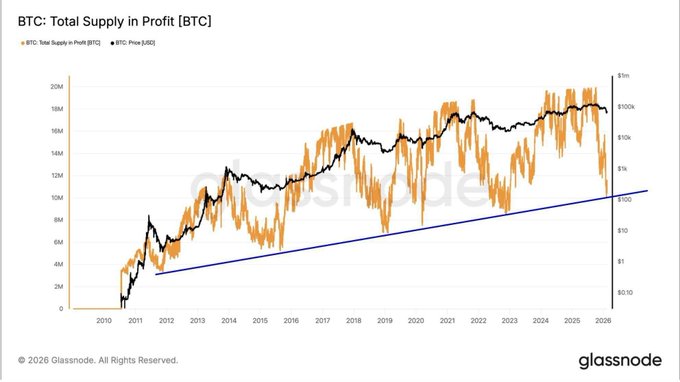
Source: Chart from Crypto Tice on X

Extreme levels of these indicators may indicate times when supply is being absorbed by stronger hands, and panic selling starts to diminish. Currently, supply at a loss is peaking, weak hands have been flushed, long-term holders are not selling, and liquidity is compressing. Crypto Tice stated this is not subtle or speculative; it is structural capitulation and accumulation in real time.

Furthermore, when supply flips from loss-heavy to profit-ready zones, the expert highlighted that markets do not drift; they undergo an explosive upward move. As a result, the expert sees the current structure as an ideal opportunity to enter the market, calling it a “once-in-a-cycle entry point.” Bitcoin is approaching a moment that will spur the next breakout, and doubters will be watching on the sidelines.

BTC Traders Are Leaning Toward A Defensive Side

Technical analyst and host of the Crypto Banter show, Kyle Doops, shared on the X platform that the Bitcoin tape looks a bit split right now. The expert analysis is based on the Funding Rates, which seem to have been in a negative direction.

Data shows that the BTC Funding rates are still in the negative zone, meaning that futures traders are constantly leaning toward a defensive side. However, at the same time, the Coinbase Premium Gap just experienced an upswing.

It is worth noting that BTC is now trading higher on Coinbase than on other crypto exchanges. Such a scenario often implies that investors in the United States, both retail and institutional, are stepping up. In the meantime, derivatives are still cautious, and spot buyers are quietly picking some up.

BTC trading at $71,104 on the 1D chart | Source: BTCUSDT on Tradingview.com

Related Questions

QWhat key metric is signaling that Bitcoin may have reached its bottom?

AThe Bitcoin Total Supply in Profit metric is signaling that the market may be nearing or has already achieved a local bottom.

QAccording to Crypto Tice, what is the current market structure representing?

ACrypto Tice stated that the current structure represents 'structural capitulation and accumulation in real time' and is a 'once-in-a-cycle entry point.'

QWhat does a negative BTC Funding Rate indicate about futures traders?

AA negative BTC Funding Rate indicates that futures traders are leaning toward a defensive or cautious side.

QWhat does an upswing in the Coinbase Premium Gap suggest about U.S. investors?

AAn upswing in the Coinbase Premium Gap suggests that investors in the United States, both retail and institutional, are stepping up their buying activity.

QWhat historical pattern is observed when the supply flips from loss-heavy to profit-ready zones?

AHistorically, when the supply flips from loss-heavy to profit-ready zones, markets do not drift but instead undergo an explosive upward move.

Related Reads

Humanity Loses $31 Million, a Private Key Causes Token Price to Plunge 90%

On June 9th, the digital identity project Humanity Protocol suffered a major security breach resulting in over $31 million stolen from hundreds of wallets holding its H token. The attack was caused by the compromise of a private key belonging to a foundation member, leading the team to advise users against interacting with its bridge or liquidity pools. Following the incident, the price of the H token plummeted by over 90%, from around $0.70 to a low of $0.052, wiping out a significant portion of its market capitalization. The attacker allegedly minted 100 million new H tokens and began selling them for BNB. Humanity Protocol, founded in 2024, aimed to verify human users through palm-print biometrics and zero-knowledge proofs on Polygon CDK. Despite raising $50 million across two funding rounds and achieving a unicorn valuation, the project faced prior controversies. Shortly after its June 2025 token launch, reports emerged that only about 1 million of its 9 million registered IDs had completed biometric verification, suggesting 88% might be bots. Furthermore, allegations surfaced that the project might be a rebranded "shell" of a Chinese access control company, raising concerns about data privacy and authenticity. The project's founder, Terence Kwok, has a controversial business history. His previous venture, Tink Labs, burned through $170 million in funding before collapsing in 2020. The breach highlights the persistent critical risk of private key management in crypto. With no user compensation plan detailed in the initial response, the incident deals a severe blow to trust in a project already struggling with credibility issues.

Foresight News15m ago

Humanity Loses $31 Million, a Private Key Causes Token Price to Plunge 90%

Foresight News15m ago

How to Conduct Deep Research Using Claude's Dynamic Workflows

The article "How to Use Claude's Dynamic Workflows for Deep Research" discusses overcoming the pitfalls of technical research, where both humans and AI can get overwhelmed by information, leading to vague conclusions. It introduces Claude Code's new "Dynamic Workflows" feature, which automatically designs and executes task-specific workflows before starting a task, unlike simpler "planning modes." This approach incorporates validation, result convergence, and adversarial verification from the outset. The core of Dynamic Workflows is six predefined scheduling patterns that address how to decompose tasks and synthesize results: 1. **Classify-and-Act (Routing):** An agent classifies the task and routes it to the most suitable specialist agent for execution. It's precise and efficient but struggles with ambiguous tasks. 2. **Fan-out & Merge:** The task is split into parallel, independent subtasks whose results are later merged. It's fast and isolates contexts but is more expensive and challenging to synthesize. 3. **Adversarial Verification:** Multiple "challenger" agents critique a worker agent's conclusion, requiring majority approval. This counters confirmation bias and self-assessment errors but relies on verifiable facts. 4. **Generate & Filter:** Multiple agents generate many candidate solutions, which are then filtered against a rubric to output only the best. It fosters diversity but depends heavily on the filter's quality. 5. **Tournament:** Multiple agents compete on the same task, with pairwise comparisons eliminating contestants over rounds to select the best. This offers stable relative judgment but is complex. 6. **Loop:** An agent iteratively attempts a task, learning from errors and adjusting until a stop condition is met. It handles tasks with unknown scope but risks infinite loops without proper design. The author compares their own custom deep-research system, which involved multi-agent analysis and deduplication but lacked goal-oriented convergence, to Claude's built-in workflow. The official workflow adds critical layers: initial problem decomposition, credibility assessment of sources, cross-agent voting to delete weak conclusions (not just averaging), and output tightly focused on the user's original goals and actionable recommendations. This structurally addresses common AI issues like goal drift, premature stopping, context pollution, and output bias. In summary, Dynamic Workflows represent a shift from smarter single conversations to a structured research process, compressing what used to require many dialogues into 3-4 interactions, albeit at higher token cost. The author notes remaining challenges for their specific domain (blockchain research): the need for fact-based verification over official documentation, depth in truly novel interdisciplinary thinking, the practical validation of proposed solutions, and tailoring information density to the audience.

marsbit25m ago

How to Conduct Deep Research Using Claude's Dynamic Workflows

marsbit25m ago

When LPs Teach Me Investment with Doubao: A Self-Narrative of a Private Equity GP Switching Careers

When LPs Use Doubao to Teach Investing: A Transition Story of a Private Equity GP AI is making life increasingly difficult for small private equity fund managers, as a former GP of an offshore dollar fund reveals. The fund, managing tens of millions in US stocks, outperformed the Nasdaq but struggled with fundraising. Its traditional Cayman SPC/BVI structure failed to attract major Asian LPs, who now prefer Hong Kong LPF or Singapore VCC frameworks. The rise of AI-powered quantitative strategies has further squeezed the space for funds like his, which relied on subjective, discretionary investing. AI tools have leveled the information playing field, empowering LPs—often high-net-worth individuals, entrepreneurs, or family offices—to analyze investments themselves using chatbots like Doubao. This has eroded trust in GPs' expertise, leading to more frequent challenges over investment decisions and even withdrawals, especially during market rallies when retail investors sometimes outperform funds. Friction arises not necessarily from AI's capabilities but from how LPs use it. Many rely on conversational AI for validation rather than rigorous analysis, sometimes receiving misleading or hallucinated advice. While AI democratizes research, effective investing still requires discerning real insight from plausible-sounding output. Ultimately, AI is unlikely to fully replace GPs. Asset management remains a trust-based service. However, the industry must adapt. The future may see "human私募" (private equity) learning from AI and focusing more on providing value beyond pure analysis—perhaps by mastering the emotional intelligence and trust-building that machines cannot replicate.

Odaily星球日报53m ago

When LPs Teach Me Investment with Doubao: A Self-Narrative of a Private Equity GP Switching Careers

Odaily星球日报53m ago

Wang Chuan: After Investing in Storage Stocks and Seeing a Thirty-Fold Return, How to Remain Unanxious (Part 7) - A Quarter-Century Cycle

Wang Chuan: Reflections on Investment Anxiety and Market Cycles After Observing a 30x Gain in a Storage Stock (Part 7) – A Quarter-Century Cycle This article examines the cyclical nature and inherent risks in technology hardware investments, using the storage and semiconductor sectors as examples. It criticizes the misleading practice of "annualized" Net Dollar Retention (NDR) rates, where short-term growth is extrapolated unrealistically. A key concept explored is "reflexivity" – demand driven by panic, exploration, and liquidity during market booms, which can vanish just as quickly when conditions reverse. This reflexivity exists both in product demand and among speculative stock buyers, creating powerful feedback loops that inflate prices during upturns and exacerbate crashes during downturns. The author highlights a major risk for hardware sectors: unlike assets with defined cycles (e.g., Bitcoin's halving), there's no guarantee of a swift recovery post-crash. Companies like Micron, Intel, and Cisco took roughly a quarter-century to surpass their 2000 highs, enduring drawdowns exceeding 80%. This is attributed to the "bullwhip effect" in supply chains, where demand collapses instantly but过剩产能 persists, and a migration of narrative-driven capital. High-valuation stories吸引 speculative funds during growth phases, but these funds quickly depart for the next hot narrative once growth slows, leaving behind stronger companies with much lower valuations. The piece warns of dangerous mental models formed during bull markets: 1) equating current strong demand with perpetual high growth, and 2) believing that making fast, large profits is easy. Citing巴菲特, the author notes that easy money undermines rationality, likening speculators to Cinderella at a ball with a clock that has no hands. The current phase presents an asymmetric risk-reward scenario: potential for further gains exists, but the downside risk is an 80%+ drawdown and a multi-decade wait for breakeven, which reflexive speculators cannot tolerate. The hypothetical investor "老王" (Lao Wang), who achieved a 30x return, is used to illustrate potential pitfalls. Leverage could lead to a wipeout during a sharp correction. Even without leverage, ingrained beliefs in easy money would likely lead him to double down after losses, expecting a quick rebound. Instead, he might face a protracted decline, depleting his resources through frantic trading as the high-growth narrative fades. The conclusion references Schopenhauer, comparing those who have seen multiple market cycles to an audience seeing the same magic trick repeatedly—once the illusion is understood, its power is gone.

marsbit1h ago

Wang Chuan: After Investing in Storage Stocks and Seeing a Thirty-Fold Return, How to Remain Unanxious (Part 7) - A Quarter-Century Cycle

marsbit1h ago

Trading

Spot
Futures

Hot Articles

What is $BITCOIN

DIGITAL GOLD ($BITCOIN): A Comprehensive Analysis Introduction to DIGITAL GOLD ($BITCOIN) DIGITAL GOLD ($BITCOIN) is a blockchain-based project operating on the Solana network, which aims to combine the characteristics of traditional precious metals with the innovation of decentralized technologies. While it shares a name with Bitcoin, often referred to as “digital gold” due to its perception as a store of value, DIGITAL GOLD is a separate token designed to create a unique ecosystem within the Web3 landscape. Its goal is to position itself as a viable alternative digital asset, although specifics regarding its applications and functionalities are still developing. What is DIGITAL GOLD ($BITCOIN)? DIGITAL GOLD ($BITCOIN) is a cryptocurrency token explicitly designed for use on the Solana blockchain. In contrast to Bitcoin, which provides a widely recognized value storage role, this token appears to focus on broader applications and characteristics. Notable aspects include: Blockchain Infrastructure: The token is built on the Solana blockchain, known for its capacity to handle high-speed and low-cost transactions. Supply Dynamics: DIGITAL GOLD has a maximum supply capped at 100 quadrillion tokens (100P $BITCOIN), although details regarding its circulating supply are currently undisclosed. Utility: While precise functionalities are not explicitly outlined, there are indications that the token could be utilized for various applications, potentially involving decentralized applications (dApps) or asset tokenization strategies. Who is the Creator of DIGITAL GOLD ($BITCOIN)? At present, the identity of the creators and development team behind DIGITAL GOLD ($BITCOIN) remains unknown. This situation is typical among many innovative projects within the blockchain space, particularly those aligning with decentralized finance and meme coin phenomena. While such anonymity may foster a community-driven culture, it intensifies concerns about governance and accountability. Who are the Investors of DIGITAL GOLD ($BITCOIN)? The available information indicates that DIGITAL GOLD ($BITCOIN) does not have any known institutional backers or prominent venture capital investments. The project seems to operate on a peer-to-peer model focused on community support and adoption rather than traditional funding routes. Its activity and liquidity are primarily situated on decentralized exchanges (DEXs), such as PumpSwap, rather than established centralized trading platforms, further highlighting its grassroots approach. How DIGITAL GOLD ($BITCOIN) Works The operational mechanics of DIGITAL GOLD ($BITCOIN) can be elaborated on based on its blockchain design and network attributes: Consensus Mechanism: By leveraging Solana’s unique proof-of-history (PoH) combined with a proof-of-stake (PoS) model, the project ensures efficient transaction validation contributing to the network's high performance. Tokenomics: While specific deflationary mechanisms have not been extensively detailed, the vast maximum token supply implies that it may cater to microtransactions or niche use cases that are still to be defined. Interoperability: There exists the potential for integration with Solana’s broader ecosystem, including various decentralized finance (DeFi) platforms. However, the details regarding specific integrations remain unspecified. Timeline of Key Events Here is a timeline that highlights significant milestones concerning DIGITAL GOLD ($BITCOIN): 2023: The initial deployment of the token occurs on the Solana blockchain, marked by its contract address. 2024: DIGITAL GOLD gains visibility as it becomes available for trading on decentralized exchanges like PumpSwap, allowing users to trade it against SOL. 2025: The project witnesses sporadic trading activity and potential interest in community-led engagements, although no noteworthy partnerships or technical advancements have been documented as of yet. Critical Analysis Strengths Scalability: The underlying Solana infrastructure supports high transaction volumes, which could enhance the utility of $BITCOIN in various transaction scenarios. Accessibility: The potential low trading price per token could attract retail investors, facilitating wider participation due to fractional ownership opportunities. Risks Lack of Transparency: The absence of publicly known backers, developers, or an audit process may yield skepticism regarding the project's sustainability and trustworthiness. Market Volatility: The trading activity is heavily reliant on speculative behavior, which can result in significant price volatility and uncertainty for investors. Conclusion DIGITAL GOLD ($BITCOIN) emerges as an intriguing yet ambiguous project within the rapidly evolving Solana ecosystem. While it attempts to leverage the “digital gold” narrative, its departure from Bitcoin's established role as a store of value underscores the need for a clearer differentiation of its intended utility and governance structure. Future acceptance and adoption will likely depend on addressing the current opacity and defining its operational and economic strategies more explicitly. Note: This report encompasses synthesised information available as of October 2023, and developments may have transpired beyond the research period.

363 Total ViewsPublished 2025.05.13Updated 2025.05.13

What is $BITCOIN

Discussions

Welcome to the HTX Community. Here, you can stay informed about the latest platform developments and gain access to professional market insights. Users' opinions on the price of BTC (BTC) are presented below.

活动图片