Bhutan goes for gold, announces sovereign-backed RWA token

cointelegraphPublished on 2025-12-11Last updated on 2025-12-11

Abstract

Bhutan's Gelephu Mindfulness City (GMC) has announced the launch of TER, a sovereign gold-backed digital token. The token, issued on the Solana blockchain, is backed by physical gold deposits custodied by government-regulated DK Bank. Matrixdock serves as the technology partner for the tokenization process. This initiative is part of Bhutan's broader strategy to adopt blockchain technology, hedge against currency inflation, and modernize its economy. The country has been mining Bitcoin since 2019 and currently holds a significant crypto reserve. It has partnered with DK Bank and Binance Pay to enable crypto payments for tourism, with over 1,000 local businesses now accepting digital currencies.

Gelephu Mindfulness City (GMC), a special administrative zone of Bhutan, announced on Wednesday that it is launching a sovereign gold-backed digital token called TER.

The physical gold deposits will be custodied by DK Bank, a digital asset bank regulated by the government of Bhutan, and issued on the Solana Blockchain network, according to GMC’s announcement.

Matrixdock, a real-world asset tokenization (RWA) platform, is the technology partner responsible for tokenizing the real-world asset on the blockchain.
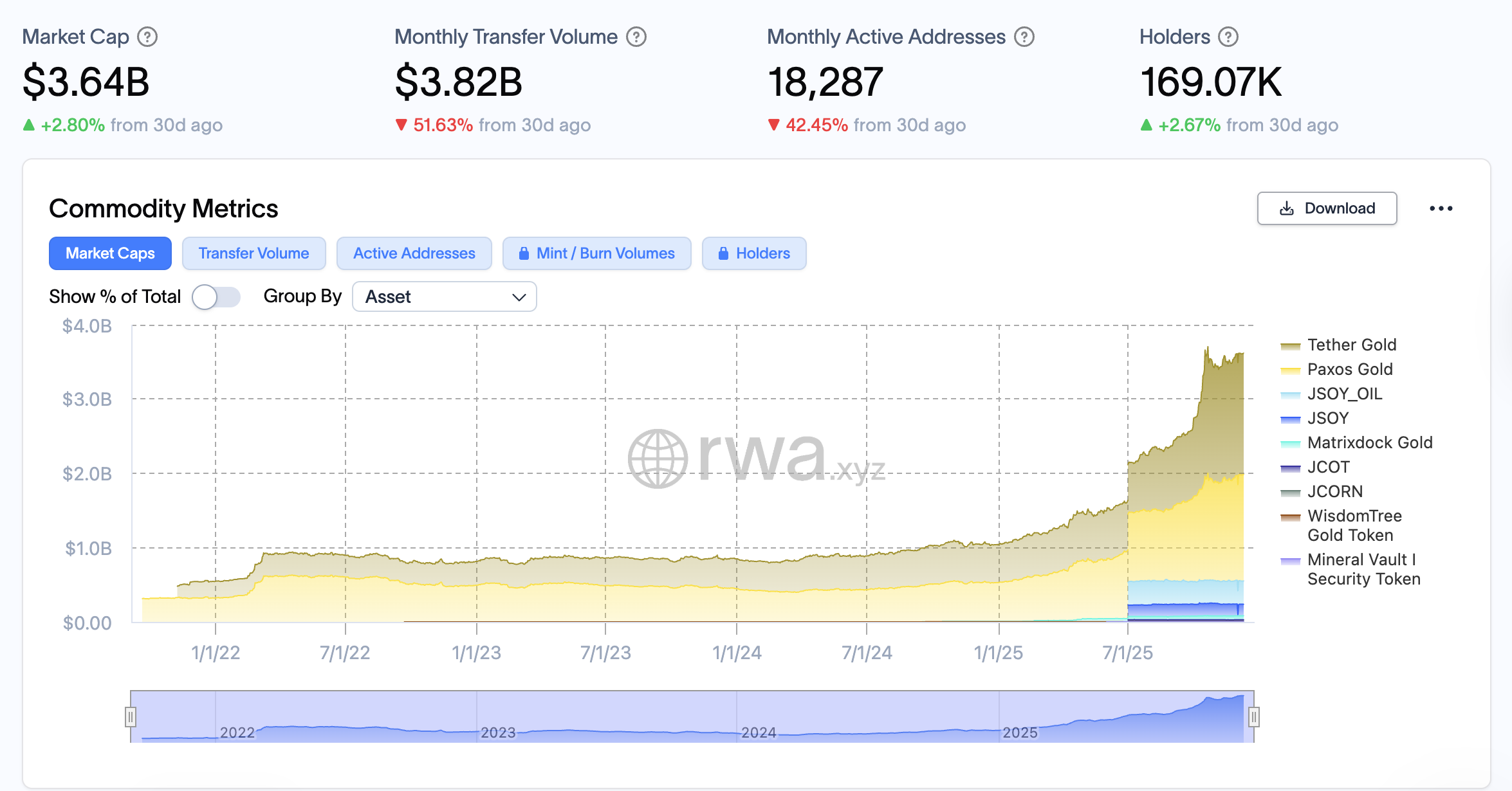
An overview of the tokenized commodities sector, which is dominated by tokenized gold products. Source: RWA.XYZ

In the first phase, the tokens will be held in custody at the bank, with the exact rollout dates still unclear. “Purchasing TER tokens is structured to be as secure and familiar as acquiring physical gold from a major financial institution,” notes the announcement.

Cointelegraph reached out to DK Bank and representatives of GMC, but had not received a response at the time of publication.

The rollout of a sovereign-backed tokenized gold product is a hedge against currency inflation in the digital age and another step in the country’s blockchain adoption strategy, according to GMC’s announcement.

Related: Bhutan stakes $970K ETH via Figment in validator push

Bhutan gets ahead of the curve by adopting crypto and blockchain tech

The government of Bhutan has embraced cryptocurrency and blockchain technology as a way to modernize the country’s payment system and boost the tourism sector, with the goal of becoming a regional cryptocurrency hub.

Bhutan has been mining Bitcoin (BTC) since 2019 with hydroelectric power, and the country holds nearly 6,000 BTC, valued at over $540 million at the time of this writing, according to Arkham Intelligence.

In January, the GMC announced a digital asset reserve containing BTC, Ether (ETH), and BNB (BNB), which later expanded to include modest sums of memecoins and other altcoins.
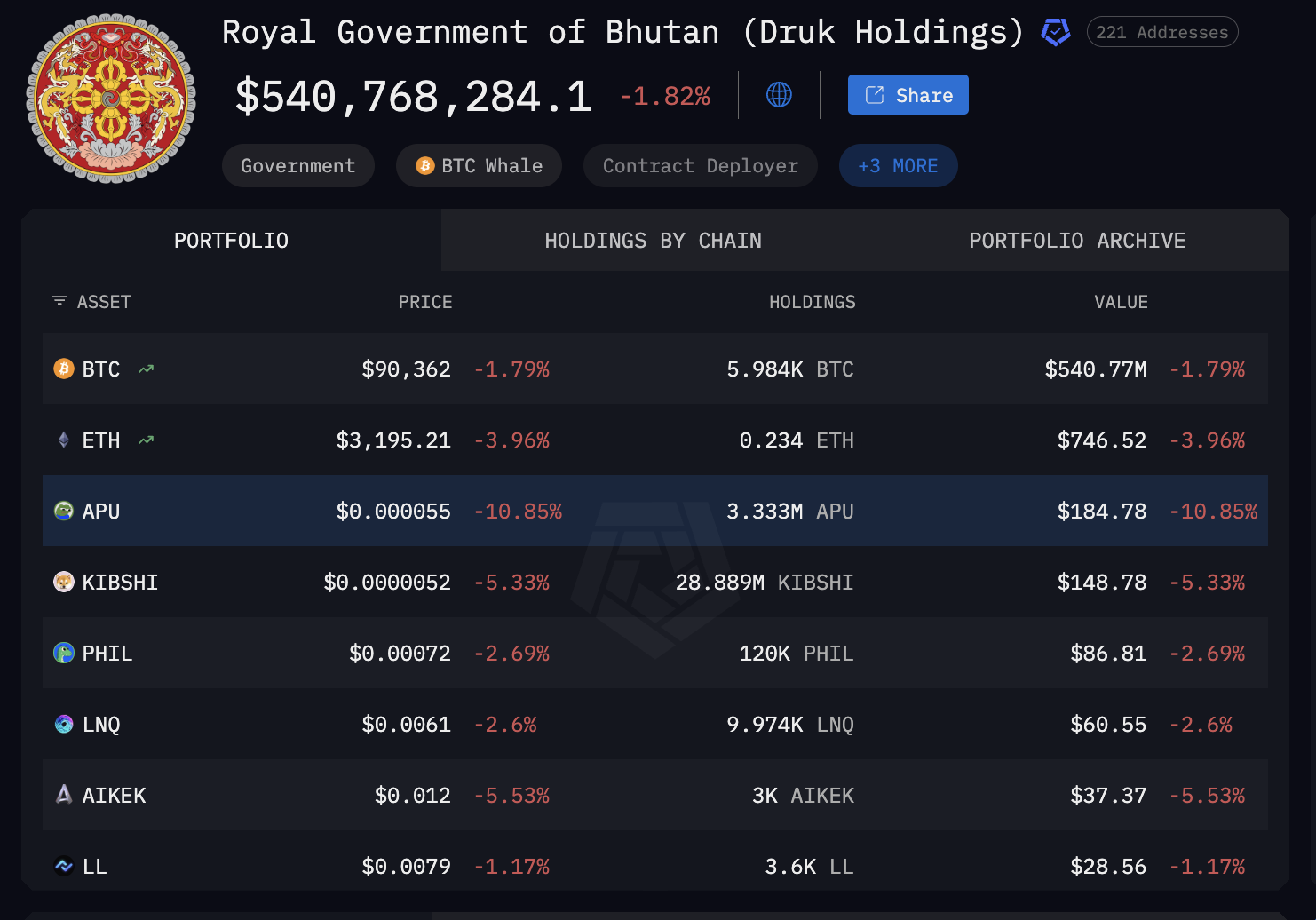
Government of Bhutan’s crypto holdings. Source: Arkham Intelligence

Bhutan partnered with DK Bank and Binance Pay in May to provide tourists with a method to pay for hotels, tour guides and tickets using over 100 cryptocurrencies.

Over 1,000 businesses in Bhutan accept crypto payments through the partnership with Binance Pay and DK Bank.

Damcho Rinzin, the director of Bhutan’s Department of Tourism, said the adoption of crypto payments helps the country’s tourism industry, which has struggled due to a lack of robust payment infrastructure.

Magazine: Bitcoin to suffer if it can’t catch gold, XRP bulls back in the fight: Trade Secrets

Related Reads

The Value Distribution of Stablecoins

**Summary: The Value Distribution of Stablecoins** The article argues that stablecoins are evolving from mere trading tools into broader channels for dollar access. It divides the stablecoin ecosystem into four layers to analyze how value is distributed: 1. **Issuance Layer:** Mints stablecoins, holds reserve assets, and captures the spread between reserve yield and user costs (e.g., Tether, Circle). This layer currently earns the largest profit margin. 2. **Infrastructure Layer:** Connects stablecoins to the traditional financial system, handling fiat on/off-ramps, banking integration, compliance (KYC/AML), and asset management (e.g., Bridge, BVNK). This is the "unglamorous" but critical work, building the essential bridges between crypto and real-world finance. 3. **Acquiring/Distribution Layer:** Integrates stablecoins into merchant systems, manages payment flows, and provides enterprise financial software (e.g., Stripe, Coinbase). They act as the access point for businesses. 4. **Application Layer:** The end-users and businesses that ultimately use stablecoins for payments, settlements, or as a store of value. They benefit from convenience but have little pricing power. The core thesis is that while the issuance layer currently dominates profits, the often-overlooked **infrastructure layer holds significant long-term potential**. The real challenge and barrier to mass adoption is not the on-chain transfer of stablecoins (which is simple), but the complex "last mile" integration into existing business workflows, banking systems, and regulatory frameworks across different countries. Companies in this layer are currently in a "land grab" phase, investing heavily to build networks, secure bank partnerships, and establish compliance pathways. While their position is currently pressured by the profitable issuers above and distribution platforms below, the article suggests that if stablecoins become a default financial rail for businesses, the infrastructure providers who have done the hard work of integration will ultimately gain strong pricing power and become entrenched, essential players.

marsbit4h ago

The Value Distribution of Stablecoins

marsbit4h ago

The Value Distribution of Stablecoins

The Value Distribution of Stablecoins The article argues that stablecoins are evolving from a mere trading tool into a broad "dollar channel." It analyzes the industry's value chain through four layers: 1. **Issuance Layer (e.g., Tether, Circle):** The top layer that mints stablecoins, holds reserve assets, and captures the thickest interest rate spread. 2. **Infrastructure Layer (e.g., Bridge, BVNK):** Connects stablecoins to the traditional financial system, handling critical but complex "dirty work" like fiat on/off-ramps, banking integration, compliance (KYC/AML), and cross-border settlement. 3. **Acquiring/Distribution Layer (e.g., Stripe, Coinbase):** Embeds stablecoins into merchant systems, manages payment flows, and integrates with enterprise software. 4. **Application Layer:** End-users and businesses that ultimately use stablecoins for payments, settlement, or storing value. The author posits that while the issuance layer currently captures the most profit, the most overlooked and potentially critical layer is infrastructure. The core challenge for stablecoin adoption isn't the on-chain transfer (which is simple), but bridging the gap between blockchain and the real-world financial system. This involves solving practical problems for businesses: fiat conversion, reconciliation, tax handling, and user onboarding. Infrastructure companies are currently in a difficult "land-grab" phase—building networks, securing banking relationships, and achieving compliance country-by-country. They face pressure from both the profitable issuance layer above and distribution platforms below. However, the author suggests this layer is building a crucial moat. Once stablecoins become a default business rail, the infrastructure players who have done the hard work of integration may gain significant, durable value and pricing power.

链捕手4h ago

The Value Distribution of Stablecoins

链捕手4h ago

How to Do Research Well: Deliberately Practice the Real Skills That Matter

No one truly teaches you how to do research. You're often given a desk, a pre-selected problem, and vague instructions to "create something new." Consequently, many people reverse-engineer the job based on visible outputs—papers, posts, announcements—learning only how to *appear* like a researcher rather than how to *become* one. True research capability is built from stacking small, trainable skills, nearly all of which can be developed through deliberate practice. **Pick Your Own Problem:** Most researchers absorb problems from advisors or trends, lacking the underlying reasoning. Choosing a problem you genuinely care about, as John Schulman advises, leads to original work. Develop "taste" like a muscle: predict experiment outcomes, guess paper results from methods, and track which findings remain important over time. **Upgrade Your Inputs:** Relying on shared reading lists (arXiv hot lists, filtered group chats) leads to unoriginal conclusions. Undervalued old literature often holds crucial insights (e.g., MoE, LSTM, backpropagation). Richard Sutton's "The Bitter Lesson" or Claude Shannon's 1952 talk on creative thinking are more predictive than lengthy modern surveys. Breadth matters as much as depth: draw from neuroscience, mechanism design, hardware knowledge, and honest statistics. Read papers directly, especially appendices and limitations sections. **Write Everything Down:** As Paul Graham noted, writing exposes flaws in seemingly mature ideas. Writing is the cheapest defense against self-deception. Following Feynman's principle, Darwin programmatically wrote down facts contradicting his theory to combat memory bias. Maintain a detailed log of hypotheses, setups, predictions, results, and updated understandings. Reviewing past logs fosters essential humility.

marsbit6h ago

How to Do Research Well: Deliberately Practice the Real Skills That Matter

marsbit6h ago

Trading

Spot
Futures

Hot Articles

How to Buy USOIL

Welcome to HTX.com! We've made purchasing WTI Crude USOil/ CL (USOIL) simple and convenient. Follow our step-by-step guide to embark on your crypto journey.Step 1: Create Your HTX AccountUse your email or phone number to sign up for a free account on HTX. Experience a hassle-free registration journey and unlock all features.Get My AccountStep 2: Go to Buy Crypto and Choose Your Payment MethodCredit/Debit Card: Use your Visa or Mastercard to buy WTI Crude USOil/ CL (USOIL) instantly.Balance: Use funds from your HTX account balance to trade seamlessly.Third Parties: We've added popular payment methods such as Google Pay and Apple Pay to enhance convenience.P2P: Trade directly with other users on HTX.Over-the-Counter (OTC): We offer tailor-made services and competitive exchange rates for traders.Step 3: Store Your WTI Crude USOil/ CL (USOIL)After purchasing your WTI Crude USOil/ CL (USOIL), store it in your HTX account. Alternatively, you can send it elsewhere via blockchain transfer or use it to trade other cryptocurrencies.Step 4: Trade WTI Crude USOil/ CL (USOIL)Easily trade WTI Crude USOil/ CL (USOIL) on HTX's spot market. Simply access your account, select your trading pair, execute your trades, and monitor in real-time. We offer a user-friendly experience for both beginners and seasoned traders.

625 Total ViewsPublished 2026.05.25Updated 2026.05.25

How to Buy USOIL

HTX Learn: Learn USDD to Share 1000 USDT​

To enhance your understanding of USDD, we are rolling out various rewarding events. Join them now and bring home generous rewards through learning and trading.

27.7k Total ViewsPublished 2026.05.25Updated 2026.05.25

HTX Learn: Learn USDD to Share 1000 USDT​

Discussions

Welcome to the HTX Community. Here, you can stay informed about the latest platform developments and gain access to professional market insights. Users' opinions on the price of A (A) are presented below.

活动图片