Banks oppose stablecoin yield deal – Can CLARITY Act find 60 votes?

ambcryptoPublished on 2026-07-24Last updated on 2026-07-24

Abstract

The Bank Policy Institute (BPI) has opposed the latest draft of the CLARITY Act, criticizing its provisions on stablecoin yield and illicit finance. The banking industry sought a total ban on stablecoin yield, but the bill's compromise only prohibits passive yield on idle balances. This opposition has influenced lawmakers, reducing tentative Republican Senate support to potentially 49 votes. With the 60-vote threshold needed, securing sufficient Democratic support appears difficult as some pro-crypto Democrats also oppose the bill due to ethics and illicit finance concerns. Senate Majority Leader John Thune expressed doubt the bill can pass before the August recess. Market odds for the bill's passage in 2026 have fallen, leaving its future uncertain.

U.S banking trade group, the Bank Policy Institute (BPI), has opposed the newly released CLARITY Act draft, flagging gaps on key issues.

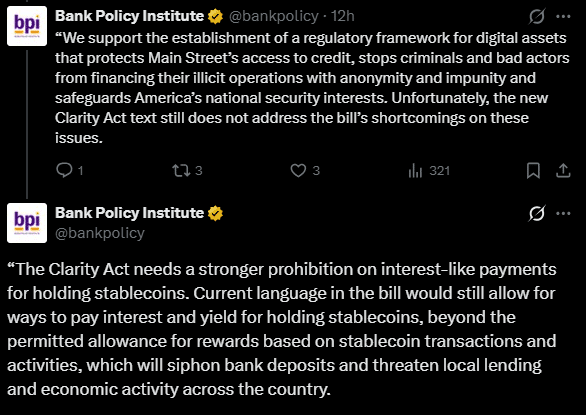
In a statement on Thursday, the 23rd of July, the BPI said the bill still has “shortcomings” on stablecoin yield and illicit finance provisions that should be “strengthened.”
Source: X

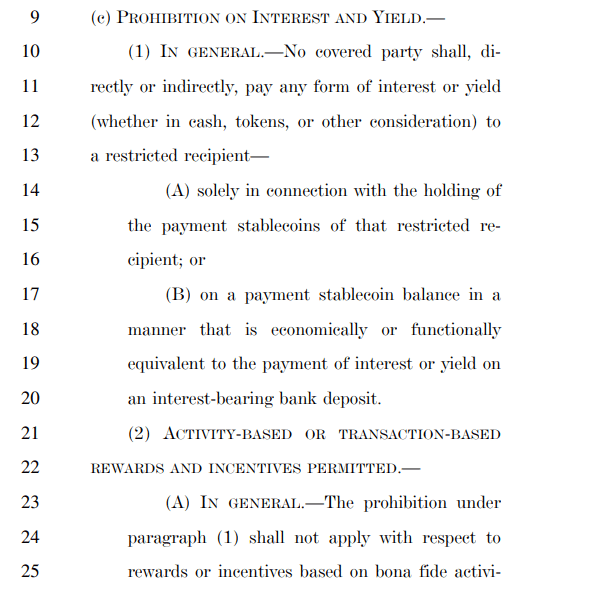
The banking industry has been opposed to the earlier stablecoin yield compromise that only allowed incentives based on account activity, not idle balances.

This passive yield ban sought to address banks’ capital flight concerns. The compromise is captured in the new draft (Section 404).
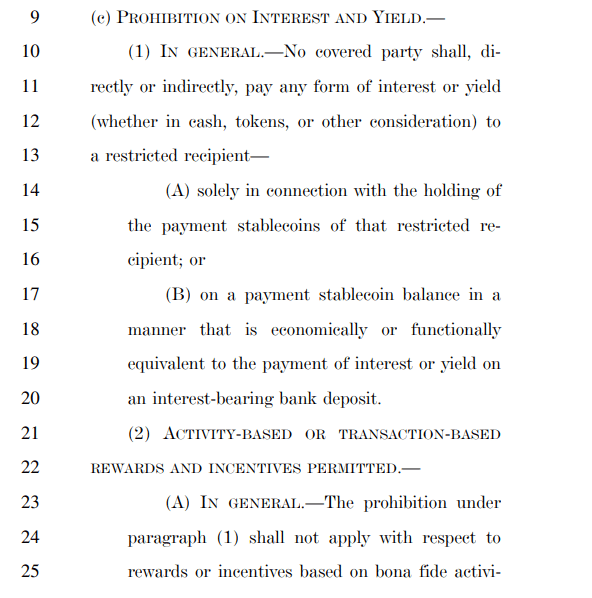
Source: U.S Senate

Unfortunately, the banking industry sought a total ban on any form of stablecoin yield or incentive.

Unsurprisingly, the banking sector has lobbied some lawmakers, including Sen. John Curtis (R-Utah) and Sen. John Cornyn (R-Texas), who now share the banks’ concerns over the crypto bill.

Will the CLARITY Act win the needed 60 votes?

This is bad news for Republicans and the crypto industry.

Before the death of Sen. Lindsey Graham this month, the Republicans had 53 members. Besides, another member, Kentucky’s Senator Mitch McConnell, has been sick for over a month, bringing their headcount to 51.

If Sen. Curtis and Cornyn withhold support for the bill, the Republican support will drop to 49.

In other words, they’ll need 11 Senate Democrats to support the bill to hit the 60-vote threshold. Unfortunately, some pro-crypto Democrats like Sen. Angela Alsobrooks and Ruben Gallego have opposed the bill due to inadequate provisions on ethics and illicit finance, among other issues.

This complicates the 60-vote target if a deal isn’t reached to win over all the key holdouts. On top of this, the timing and Majority Leader’s outlook don’t help the bill’s progress.

Only two weeks remain before the Senate breaks for the August recess. Most analysts had warned that if the bill is not passed by August, it will be as good as dead.

For his part, the U.S. Senate Majority Leader John Thune warned that the bill may fail to pass before the August recess.

I don’t think we’ll be able to get them done. I would like to get at least Clarity started. We’ll see where the votes are.

In response, White House Chief Crypto Advisor Patrick Witt urged Thune to schedule the vote and stop waiting for Democrats.

You’d be waiting forever (for Democrats). Nobody thought that we could actually produce an ethics provision that had real teeth, and that included the President.

For Witt, the new ethics provision addresses Democrats’ concerns.
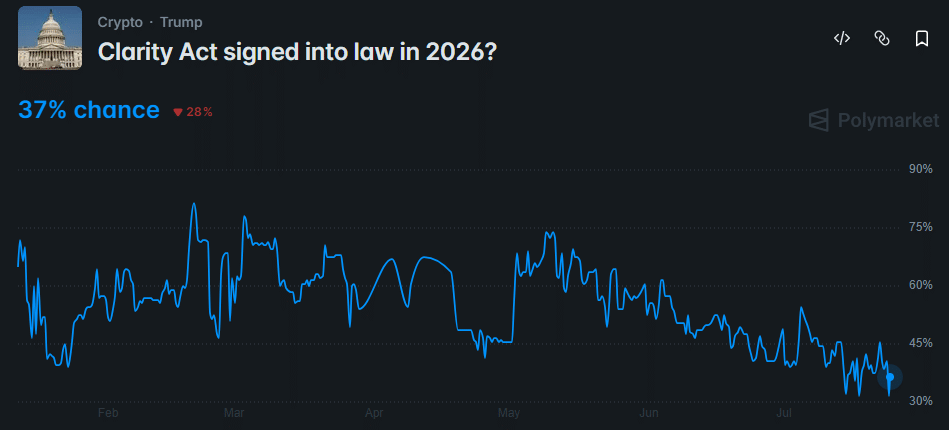
Source: Polymarket

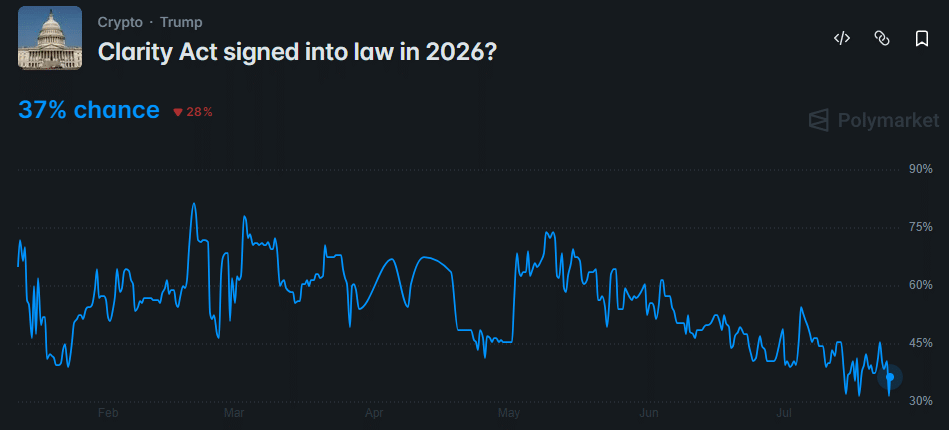
Market expectations for the bill’s passage in 2026 briefly dropped to 32% on Friday. Whether the passage odds will improve in the next two weeks remains uncertain.


Final Summary

  • Tentative Senate backing for the crypto bill has dropped below 50.
  • Majority Leader John Thune doubted the CLARITY Act’s chance of passage before the August recess

Related Questions

QWhat is the main concern raised by the Bank Policy Institute (BPI) regarding the CLARITY Act draft?

AThe Bank Policy Institute (BPI) has opposed the CLARITY Act draft, citing shortcomings on key issues, particularly regarding stablecoin yield provisions and illicit finance controls, which they believe need to be strengthened. They specifically oppose the compromise that allows incentives based on account activity but bans passive yield on idle balances, seeking a total ban on any form of stablecoin yield or incentive instead.

QHow might Senators Curtis and Cornyn's stance affect the Republican support count for the CLARITY Act?

AIf Senators John Curtis (R-Utah) and John Cornyn (R-Texas) withhold their support for the CLARITY Act, Republican support in the Senate would drop from 51 to 49 votes. This is due to recent events like Senator Lindsey Graham's death and Senator Mitch McConnell's illness, which have already reduced their numbers. With only 49 Republican votes, the bill would need 11 Senate Democrats to reach the 60-vote threshold for passage.

QWhy are some pro-crypto Democrats like Senators Alsobrooks and Gallego opposing the bill?

ASome pro-crypto Democrats, including Senators Angela Alsobrooks and Ruben Gallego, are opposing the CLARITY Act due to concerns over inadequate provisions on ethics and illicit finance, among other issues. Their opposition complicates the bill's path to achieving the necessary 60 votes in the Senate.

QWhat did Senate Majority Leader John Thune say about the bill's chances of passing before the August recess?

AU.S. Senate Majority Leader John Thune expressed doubt that the CLARITY Act would pass before the August recess, stating, 'I don’t think we’ll be able to get them done. I would like to get at least Clarity started. We’ll see where the votes are.' He highlighted the tight timeline, with only two weeks remaining before the recess.

QHow did the market's expectation for the bill's passage in 2026 change recently, according to the article?

AMarket expectations for the CLARITY Act's passage in 2026 briefly dropped to 32% on the Friday mentioned in the article. This decline reflects the growing uncertainty and political challenges surrounding the bill's progress as key deadlines approach.

Related Reads

Strive Executive: Rethinking the Bitcoin Price Flywheel

In this article, the author discusses the future trajectory of Bitcoin's price, moving beyond the traditional "power law" model that has described its long-term price appreciation with diminishing returns. The core argument is that Bitcoin is maturing, evidenced by declining volatility and shallower market drawdowns. This maturation, often seen as leading to permanently lower returns, is framed as a precursor to a new, potentially explosive phase. The author draws an analogy to metal fatigue, where cracks propagate in three stages: initial irregular formation, a predictable middle phase describable by a power law (Paris' law), and a final rapid acceleration leading to fracture. Similarly, Bitcoin's monetization is seen in three phases: 1) Discovery (high volatility/returns), 2) Maturation (declining volatility/returns, improving risk-adjusted metrics), and 3) System-driven monetization. The key insight is that Phase 2 sets the stage for Phase 3. Lower volatility makes Bitcoin a more attractive asset for large-scale capital allocation (due to improved Sharpe ratios) and, crucially, a higher-quality collateral for loans. As perceived credit risk falls, the financial system can safely extend more dollar-denominated credit against Bitcoin holdings. This creates a self-reinforcing "flywheel": lower volatility → more capital allocation & cheaper credit → increased demand for fixed-supply Bitcoin → price rise → higher collateral value enabling more credit → continued price pressure. The conclusion posits that even if Bitcoin adoption eventually plateaus (reaching an S-curve saturation), the expansion of capital and credit chasing a fixed supply could cause its USD price to re-accelerate, breaking above the long-term power-law trajectory and entering the "third region" of rapid, system-driven monetization.

marsbit5h ago

Strive Executive: Rethinking the Bitcoin Price Flywheel

marsbit5h ago

OpenAI Reveals Its Own Jalapeño Chip: Accelerator 1.5–2 Times More Efficient Than Nvidia

On August 25, 2026, OpenAI unveiled initial test results for its proprietary inference accelerator, the Jalapeño. Benchmarks on SemiAnalysis's InferenceX platform showed that systems using Jalapeño delivered 1.5–1.9 times more computations per watt at peak throughput and reduced latency by 1.7–3.6 times compared to systems based on Nvidia's GB200 and GB300, tested on models like GPT-OSS-120B. Designed specifically for OpenAI's own workloads, the 700W-rated chip was developed in nine months with partners Broadcom (silicon/network) and Celestica (boards/racks). It's the first in a planned multi-year platform. Deployment is slated for late 2026, backed by an OpenAI-Broadcom agreement to deploy 10 GW of custom accelerators through 2029. This move shifts a major portion of OpenAI's daily inference, crucial for services like ChatGPT and its API, away from Nvidia's universal GPUs. By controlling this hardware architecture, OpenAI aims to directly reduce the per-query cost of its massive service traffic, converting what was previously supplier profit (noting Nvidia's high margins) into internal savings and computational capacity. While OpenAI will still rely on external suppliers for training cutting-edge models and for parts of inference, Jalapeño represents a strategic industry trend where hyperscalers design custom chips once inference volume becomes predictable. However, this specialization risks future inflexibility if AI architectures shift and creates dependency on its manufacturing partners.

cryptonews.ru6h ago

OpenAI Reveals Its Own Jalapeño Chip: Accelerator 1.5–2 Times More Efficient Than Nvidia

cryptonews.ru6h ago

Trading

Spot
活动图片