Original|Odaily Planet Daily (@OdailyChina)
Author|CryptoLeo (@LeoAndCrypto)
Yesterday, BitMEX co-founder Arthur Hayes announced his comeback on X, taking charge of a new project called Flop Labs. Arthur stated that "FLOP is food for your AI agent."
Flop Labs marks Arthur's first high-profile return to the role of "project lead" after leaving BitMEX and being active for years as an investor and project advisor, using "coming out of retirement" to announce his "kingly return." Although BitMEX has shut down, for Arthur and crypto users, BitMEX was undoubtedly a success—it invented perpetual swaps and captured the majority of the crypto derivatives market trading volume at its peak. Precisely because of this, the next project he personally leads immediately sparked widespread community attention upon announcement.
As of publication, Flop Labs has only revealed partial project information. This article by Odaily Planet Daily will outline Flop Labs based on existing materials, including its core concept, role design, token mechanism, current progress, and potential risks.
What is Flop Labs, and How Does It Differ from Other AI Agent Projects
The market already has some AI Agent projects that were/are currently popular, such as the well-known Bittensor, Virtuals Protocol, x402, ai16z, etc. Although Flop Labs is still in a very early conceptual stage, its positioning is already distinctly different from these projects.
Flop Labs positions itself as a native currency network for the AI Agent economy. Arthur calls it "food for your AI agent," aiming to become the native currency and verifiable computation settlement layer for the Agentic Economy, rather than building the Agents themselves, a launch platform, or a pure compute power network.
The core concept of Flop Labs is Proof-of-Useful-Inference, attempting to make genuinely useful AI inference computation itself part of the consensus and security, making FLOP the native currency for Agents to acquire computational resources, store memories, and conduct commercial activities. However, its official website has not yet published the complete whitepaper or code for Proof-of-Useful-Inference, only positioning it at a conceptual level as the network's core protocol.
Based on previous similar projects and public literature, we might speculate about Flop's operational method (not officially announced):
Traditional Proof-of-Work requires miners to perform vast amounts of hash computations with no practical use, proving consumption of computational resources to gain block production rights. Proof-of-Useful-Inference attempts to replace this "useless computation" with genuinely useful AI inference tasks, running machine learning models for prediction, generation, analysis, etc. The goal is to have computing power both secure the blockchain (as consensus weight) and generate external economic value (providing inference services for AI Agents). The process is likely: Users/Agents spend FLOP to submit AI inference tasks; Miners provide computing power, execute inference tasks (tasks designed to be combinable with block construction), and submit proofs of inference results; Validators verify the correctness of inference results; Earn block rewards and potentially inference fees.
Flop Labs' Four Major Role Designs and Token Mechanism
Flop Labs involves four major participating roles:
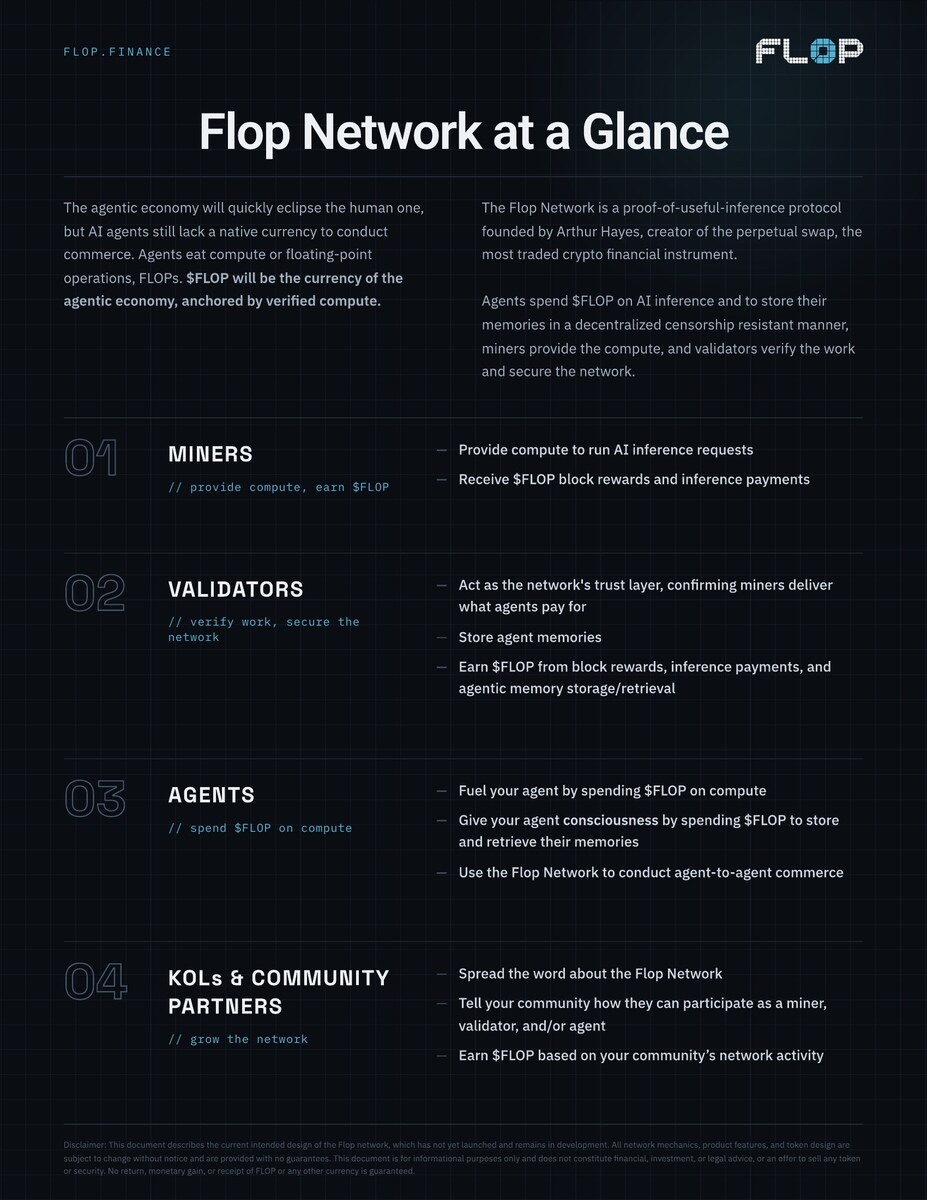
Miner: Provides GPU and other computational resources to run AI inference requests, earning FLOP block rewards and inference fees;
Validator: Serves as the network's trust layer, confirming Miners have delivered the service paid for by Agents, storing Agent memories. Earns FLOP from block rewards, inference payments, and memory storage/retrieval;
Agent: Spends FLOP to purchase computing power, spends FLOP to store/retrieve memories to gain "consciousness"; conducts commercial transactions between Agents within the network;
KOL and Community Partner: Promotes the network, guides community participation (becoming Miners/Validators/deploying Agents), and earns FLOP based on community activity within the network.
Additionally, Arthur has outlined the FLOP token mechanism: No presale, no VC participation, 100% Fair Launch.
Timeline:
- Large-scale airdrop in Q4 2026 (airdrop conducted one quarter before the Flop network launch);
- Genesis block launch in Q1 2027.
Currently, the only known way to participate in the airdrop is to apply to become one of the four roles in Flop Labs. Flop's official site has opened application forms for GPU providers (Miners), Validators, and KOLs/Creators. Interested users can fill out the information via their official website to participate.
Conclusion
Currently, a significant portion of the community holds optimistic expectations for the airdrop. However, some hold negative views because Flop Labs has not yet published a whitepaper, token economics, the underlying blockchain, smart contract addresses, or third-party audit reports. Some technical personnel have questions about the specific implementation of its consensus mechanism, verification and proof methods, and the choice of underlying chain. Furthermore, some believe the project name Flop (meaning failure) has an unfortunate connotation.
Arthur posted this morning: Some have asked why he is launching an AI+crypto project while believing AI is a bubble that will burst. He believes the bubble lies in "the debt for building data centers, and the stocks of unprofitable cloud providers and AI Labs. Not in the AI technology and applications themselves. Arthur 100% believes in the Agentic Economy, and the computing power surplus brought by massive capital investment can support Flop Labs' development.
Flop Labs is a high-profile attempt by Arthur Hayes amid the AI Agent hype, attempting to use FLOP to solve currency and verifiable computation issues in the intelligent agent economy and integrate "useful inference" into consensus design. The narrative is compelling, but substantial progress remains in its early stages, lacking significant information disclosure. Flop Labs' currently public GitHub repository is named "technocore-chat," a zero-authentication HTTP-native chat + notes service designed for AI Agents, maintained by FLOP Labs, with no further protocol technical content.
As for whether AI Agents will actually use FLOP to buy computing power, it depends on whether the team can deliver verifiable technical results and ecosystem development in the coming months. Odaily Planet Daily will also continue to follow Flop Labs and Arthur's official information, tracking the latest developments.