Arthur Hayes argues new Fed liquidity tool “RMP” masks renewed money printing

cointelegraphPublished on 2025-12-19Last updated on 2025-12-19

Abstract

Arthur Hayes, former BitMEX CEO, argues the Federal Reserve's new "Reserve Management Purchases" (RMP) program is effectively a disguised form of quantitative easing (QE). He claims that by purchasing short-term Treasury bills and managing liquidity, the Fed is financing government spending while avoiding the political stigma of QE. Hayes warns this is highly inflationary and erodes the purchasing power of ordinary citizens, while benefiting holders of scarce assets like Bitcoin, gold, and silver. The article notes the Fed recently cut rates and announced $40 billion in short-term Treasury purchases, which Chair Jerome Powell framed as a technical adjustment. However, analysts suggest mixed signals may dampen a sustained Bitcoin rally. Polymarket data indicates a high probability of no further rate cuts in January.

Arthur Hayes, co-founder and former CEO of crypto exchange BitMEX, argued in a Substack essay published Friday that the Federal Reserve’s new “reserve management purchases” (RMP) program is effectively a rebranded form of quantitative easing.

Hayes argues that by buying short-term Treasury bills and recycling liquidity through money markets, the Fed is effectively financing government spending while avoiding the political stigma of quantitative easing, even as officials frame the program as a technical liquidity operation.

“The RMP is a thinly disguised way for the Fed to cash the government’s checks. This is highly inflationary from both a financial and real goods/services perspective,” he wrote.
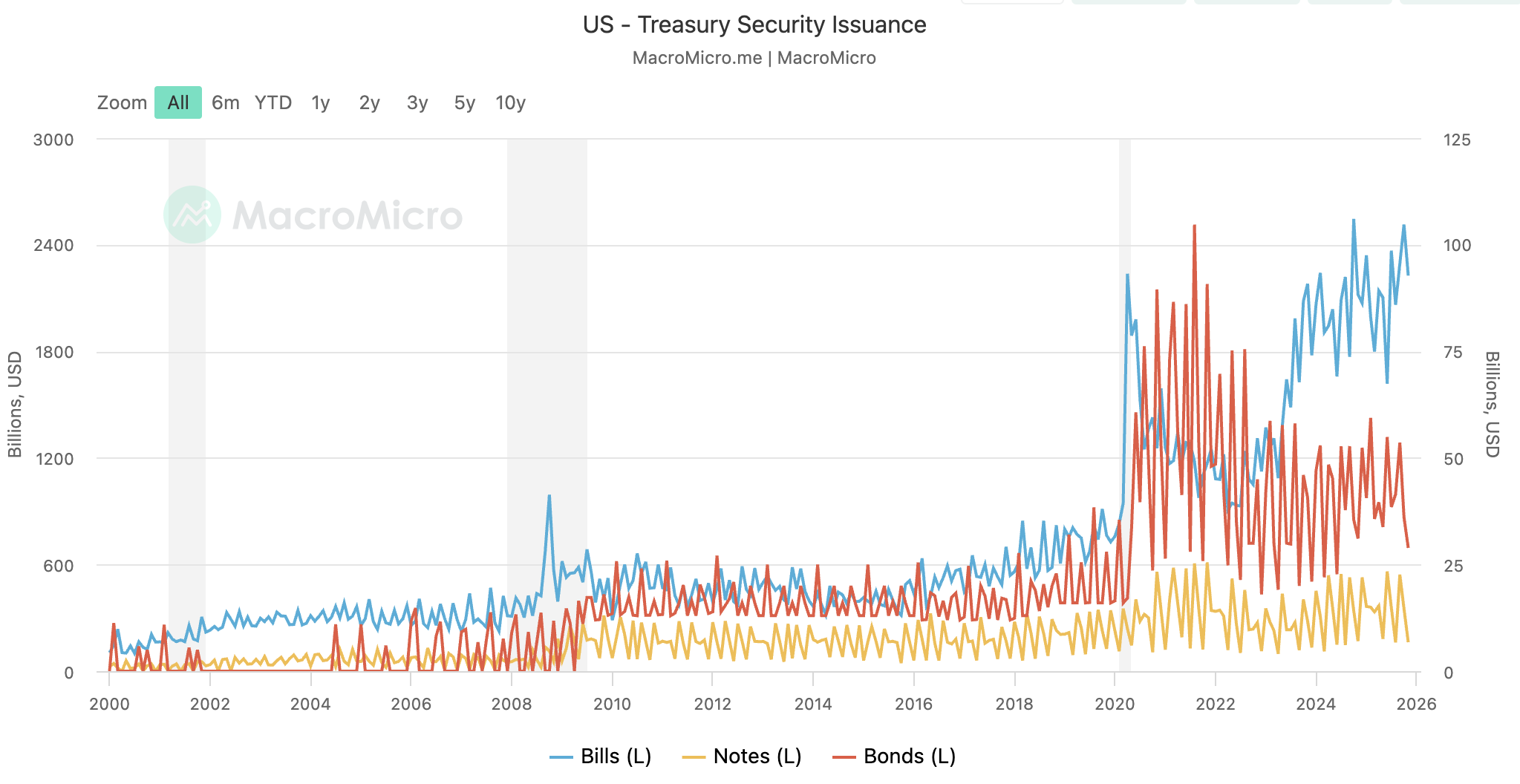
US Treasury issuance by maturity. Source: MacroMicro

Hayes said policies like RMP expand fiat liquidity and, in his view, favor scarce assets such as Bitcoin, gold and silver.

I love QE because it means money printing, and thankfully I own financial assets like gold, gold/silver mining stocks, and Bitcoin that rise faster than the pace of fiat money creation.

At the same time, he warned that people without assets are harmed, as money creation erodes purchasing power, weakens wages relative to prices and shifts wealth toward asset holders.

“Unfortunately, in the here and now for most of humanity, money printing destroys their dignity as productive humans,” he wrote. “When the government intentionally debases the currency, it destroys the link between energy inputs and economic outputs.”

Related: Bitcoin rebounds on Japan rate hike as Arthur Hayes sees dollar at 200 yen

Polymarket points to pause after December rate cut

On Dec. 10, the Federal Open Market Committee (FOMC) cut interest rates by 25 basis points and announced purchases of short-term Treasury securities, a move Fed Chair Jerome Powell said was “solely for the purpose of maintaining an ample supply of reserves” and separate from the stance of monetary policy.

The Fed said the purchases would initially total about $40 billion in the first month and could remain elevated for several months to ease near-term pressures in money markets, particularly around seasonal fluctuations such as tax payments.

Despite the interest rate cut and the announcement of short-term Treasury purchases, analysts said mixed signals from Powell were likely to dampen a sustained Bitcoin rally until the rate-cutting cycle resumes in 2026.

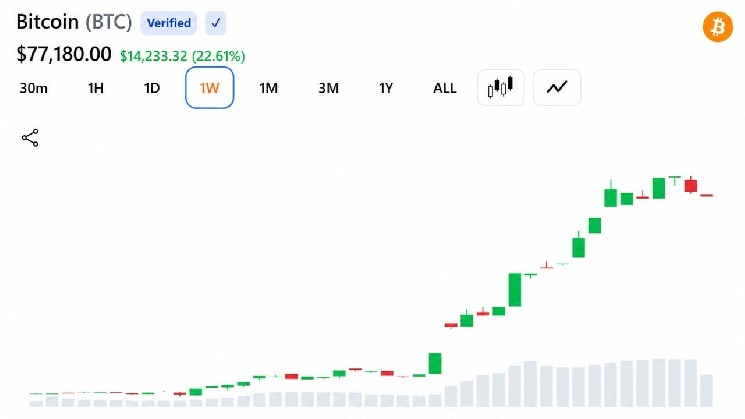
The price of Bitcoin was about $92,695 on Dec. 10, according to Yahoo Finance data. It is was trading around $87,300 at time of writing.

At the time of writing, Polymarket traders were overwhelmingly pricing in no change to Fed policy in January, with the probability of rates staying unchanged at about 77%, while odds of another 25 basis point cut sit near 21% and larger moves are viewed as highly unlikely.
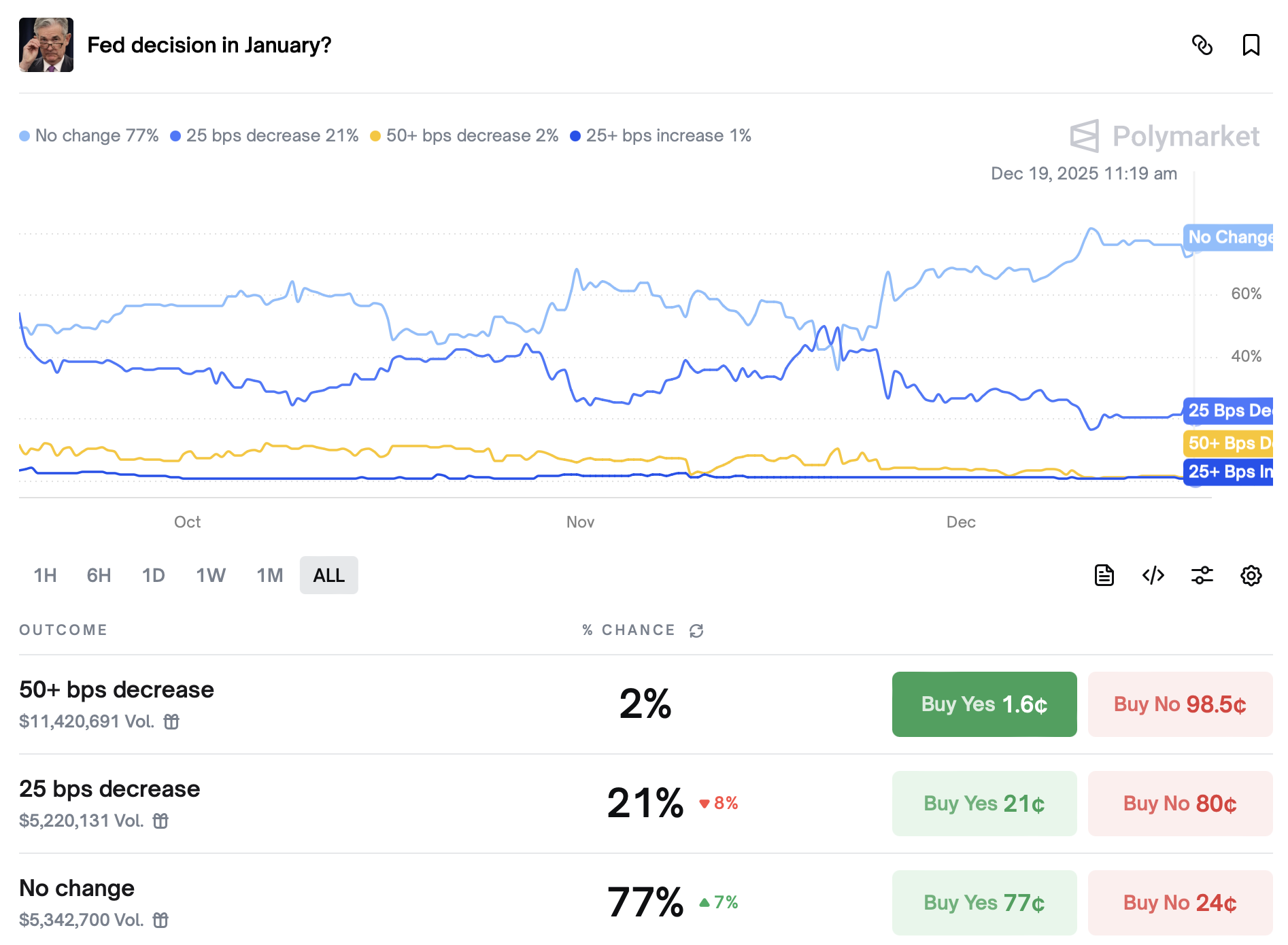
Odds of Fed rate cut in Jan. Source: Polymarket

Powell’s term is set to expire in May 2026. US President Donald Trump, who has publicly pushed for the next Fed chair to pursue aggressive interest rate cuts, is preparing to interview finalists to succeed him, with National Economic Council Director Kevin Hassett widely viewed as the frontrunner.

Magazine: Big questions: Would Bitcoin survive a 10-year power outage?

Related Questions

QWhat is Arthur Hayes' main argument regarding the Federal Reserve's new RMP program?

AArthur Hayes argues that the Fed's Reserve Management Purchases (RMP) program is effectively a rebranded form of quantitative easing (QE) that allows the Fed to finance government spending while avoiding the political stigma associated with QE.

QAccording to Hayes, what is the inflationary impact of the RMP program?

AHayes states that the RMP is 'highly inflationary from both a financial and real goods/services perspective' because it expands fiat liquidity.

QWhich assets does Hayes believe benefit from policies like RMP and QE?

AHayes believes that scarce assets such as Bitcoin, gold, and silver mining stocks benefit from these policies, as they tend to rise faster than the pace of fiat money creation.

QWhat was the Fed's stated reason for initiating the purchases of short-term Treasury securities?

AFed Chair Jerome Powell stated that the purchases were 'solely for the purpose of maintaining an ample supply of reserves' and were a technical liquidity operation, separate from the stance of monetary policy.

QWhat is the market's expectation for the Fed's January policy meeting, according to Polymarket data?

AAccording to Polymarket, traders are pricing in a 77% probability of no change to interest rates in January, with only a 21% chance of another 25 basis point cut.

Related Reads

Founder of Baixing.com: The Notion That Large Language Models Will Devour Everything, I Believe Half of It

Founder of Baixing.com: I Only Half-Believe the Saying “Large Language Models Will Devour Everything” Author: Wang Jianshuo, Founder of Baixing.com Many proclaim that large models are everything, but the author is skeptical. He argues that such sweeping claims often stem from a limited understanding of the future. Drawing parallels to past technologies like electricity and the internet—which were predicted to “devour everything” but didn’t—he suggests that large language models (LLMs) are better seen as a foundational base. Like electricity, this base is essential for modern development, but its real value emerges only when applied to specific scenarios through various “machines” or “tools” (e.g., Claude Code for programming, Claude Design for design). The author acknowledges that LLMs may indeed replace many existing software systems built on rigid rules, workflows, and forms (e.g., CRMs, SaaS tools), as these are precisely what LLMs excel at processing. However, he emphasizes that beyond software, elements like customer data, execution capabilities (e.g., booking a flight), trust, and physical-world interactions will not be “devoured.” Instead, he foresees that after streamlining existing software, LLMs will open up a larger space for innovative, next-generation applications. These new tools will likely feature fluid interfaces and rely less on fixed rules, unleashing greater creativity. The author cautions against short-sightedness, recalling how in 2004 many believed internet giants like Sina, Sohu, and NetEase would monopolize the market—only to be proven wrong by subsequent disruptions. In conclusion, while LLMs are a crucial foundation and a current focal point, the true mainstream of this wave lies in the diverse applications built atop them to solve concrete problems. The phrase “devour everything” is imprecise; the real opportunity lies in identifying and leveraging the areas where LLMs do bring transformative change.

marsbit13m ago

Founder of Baixing.com: The Notion That Large Language Models Will Devour Everything, I Believe Half of It

marsbit13m ago

Founder of Baixing.com: I Only Half Believe in the Notion that Large Language Models Devour Everything

The founder of Baixing Wang states that while large language models (LLMs) are an extremely important foundational technology—akin to electricity or the internet—he only "half believes" the notion that they will "consume everything." He argues that LLMs provide a base layer of intelligence, but real-world value and transformation come from integrating this intelligence into specific applications and devices designed for particular scenarios—like how electricity powers various appliances from washing machines to TVs. He agrees LLMs will likely consume or replace a significant portion of existing rule-based, workflow-driven software (e.g., many SaaS systems, CRMs), as these are precisely what LLMs excel at handling. However, numerous other elements—such as customer data, execution capabilities (e.g., booking a flight), trust, and physical-world interactions—will not be consumed. Wang emphasizes that after LLMs absorb certain software layers, they will open up a much larger space for innovation: new types of "streaming" software with less rigid interfaces, where fixed rules are managed by AI. This next wave of applications built on top of the stable LLM foundation is where the true mainstream opportunity lies. He cautions against the short-sightedness of declaring any technology as all-consuming, drawing parallels to past premature predictions about internet giants monopolizing the web. The key is to find opportunities within the areas LLMs do transform.

链捕手18m ago

Founder of Baixing.com: I Only Half Believe in the Notion that Large Language Models Devour Everything

链捕手18m ago

Trading

Spot
活动图片