An Internal Memo Exposes OpenAI's Most Real Anxieties and Ambitions

marsbitPubblicato 2026-04-14Pubblicato ultima volta 2026-04-14

Introduzione

An internal memo from OpenAI's Chief Revenue Officer, Denise Dresser, reveals the company's strategic priorities and competitive anxieties as the enterprise AI market matures. The document outlines a shift from competing solely on model capability to winning on integration, platform strategy, and becoming "hardest to replace." Key priorities for Q2 include: the model layer, the agent platform, expanding market reach via Amazon, selling the full tech stack, and controlling deployment. The goal is to evolve from a point solution to an enterprise AI "operating system" by deeply embedding into customer workflows, creating switching costs, and securing multi-year, nine-figure deals. The memo contains a direct and unusually sharp critique of rival Anthropic, accusing it of building a narrative on "fear" and "restriction," suffering from compute shortages leading to user experience issues, and overstating its annualized revenue by $8 billion due to accounting methods. This public criticism is seen as a calculated move for investor narratives, internal mobilization, and external signaling. For the Chinese AI market, the memo highlights a gap in competition stages. While domestic players still focus on benchmarks and price wars, the next phase will be won on deployment, platform integration, and ecosystem. It also underscores the critical importance of data sovereignty and trust, suggesting that compliant, auditable, on-premise solutions could be a major differentiator in regulated...

By | Emphasizing Next

Throughout history, so-called "all-staff letters" have always been meant for external audiences.

Last weekend, a strategic memo from OpenAI's Chief Revenue Officer, Denise Dresser, sent to all employees, was exposed by the foreign media outlet "The Verge". Four pages, five priorities, and a rather scathing analysis of competitors.

This is not just an internal mobilization order; it更像是一次经过精心设计的对外信号释放。有策略地攻击竞争对手,有意地传递市场叙事,顺带给内部团队打一针鸡血。

01 "Capability Alone Is No Longer Enough"

The tone set at the beginning of the memo is intriguing. Dresser writes that enterprise AI is entering a "more mature phase," and what customers want is no longer just how smart the model is, but fit. Specifically, whether AI can truly integrate into their workflows, knowledge systems, and daily operations.

Over the past two years, OpenAI has swept the market with the capability advantages of the GPT series. But the era of competing on basic model capabilities is ending. As the capability gap between all major players narrows rapidly, the marginal utility of the "our model is the strongest" card is diminishing.

The procurement logic of enterprise customers is beginning to return to the classic path of To B software. They are more concerned with "whether this AI can truly run, run stably, and run long-term within my organization."

This is a sign of market maturity and a strategic shift in focus that OpenAI must complete.

02 Five Priorities

The memo lists five Q2 priorities: Win the model layer, win the agent platform, expand the market with Amazon, sell the full technology stack, and master deployment rights.
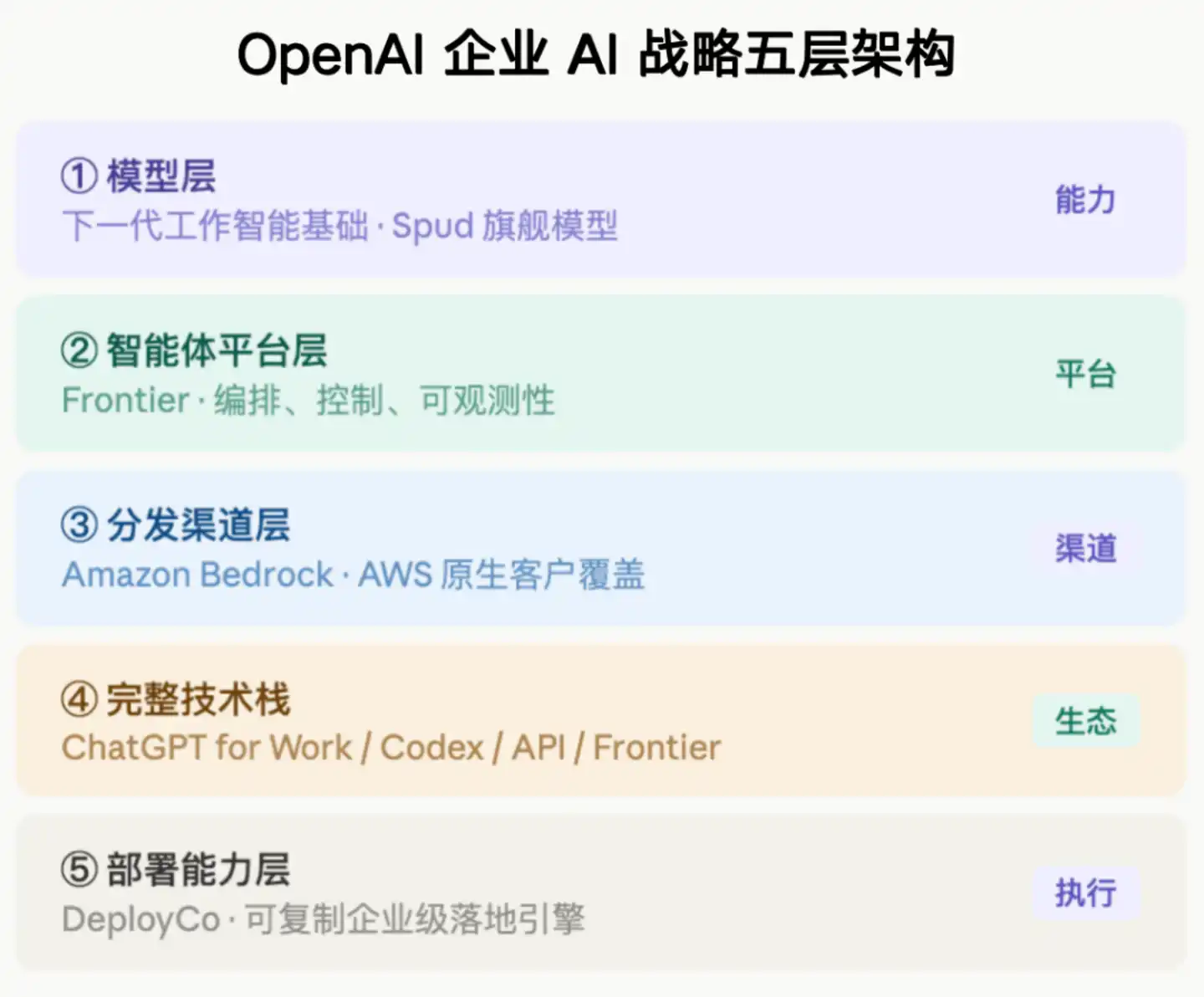
At first glance, these are five lines, but they point to the same goal: transitioning from the "most usable AI" to the "hardest to replace AI".

This is a typical platform transformation logic. Single-point products compete on performance; platforms compete on ecosystem and switching costs. One sentence in the memo is quite blunt: As customers connect more workflows to this system, "OpenAI will become harder to replace and will be more at the core of work."

OpenAI wants to be the operating system for enterprise AI. Just like Microsoft made Windows the underlying layer of all enterprise IT infrastructure. The word Dresser repeatedly emphasizes in the text is "platform." She says customers want a platform, not point solutions. ChatGPT for Work is the entry point for knowledge work, Codex is for the developer side, API is the integration engine, Frontier is the agent orchestration layer, and Amazon runtime is the production-grade stateful runtime. Five products, five entry points; theoretically, customers entering through any door will eventually be guided into the complete ecosystem.

The problem is, the story of a "platform company" sounds good, but few have truly succeeded historically. Platforms require network effects, switching costs, and ecosystem lock-in—things not built by a memo alone.

The memo mentions that "multi-year, multi-product, nine-figure deals are increasing." Nine figures means at least one hundred million dollars. The increase in such deals indicates that enterprise customers' bets on OpenAI are no longer at the "try it out" level but involve real strategic binding.

03 The Passage Attacking Anthropic

There is a passage in the memo that directly names Anthropic, with quite strong wording. It says their narrative is built on "fear, restrictions, and the notion that a select few should control AI"; it says their strategic mistakes in computing power are already reflected in the product—customers are experiencing rate limiting, low availability, and unstable performance; the most重磅的一条说Anthropic对外宣称的$300亿年化营收被高估了$80亿,因为他们把与Amazon和Google的收入分成按“总额”而非“净额”计入。

This practice of directly naming competitors is indeed rare in Chinese corporate culture. Executives of domestic giants, when expressing themselves externally, usually use迂回措辞 like "some players in the industry" or "certain products." Directly naming and criticizing with specific figures would be considered too aggressive in the domestic context and could easily trigger public backlash.

But in Silicon Valley, this is a normal operation,背后有几重逻辑。

First, the need for investor narratives. A company valued at tens of billions of dollars will be questioned if it cannot clearly explain why it is a better bet than its competitors. Pointing out specific weaknesses of competitors is an effective way to signal "we have底气" to the outside world.

Second, the need for internal mobilization. The audience of the memo is all employees. Specific comparisons like "their computing power is insufficient, customers have felt the rate limiting" are much more effective than preaching big道理, allowing the sales team to have something concrete to say in the next client meeting.

Third, this memo was likely expected to be leaked. Dresser couldn't have not known that in a company of several hundred people, a four-page strategic document would eventually appear in the media. "External messaging" itself might have been the purpose: to let the market know that we believe Anthropic's $30 billion figure is inflated, we have evidence, welcome verification.

That financial accusation deserves separate mention. The core of the argument that Anthropic's annualized revenue is overestimated by $8 billion is a dispute over accounting standards: should revenue sharing be accounted for on a gross or net basis? There is no absolute right or wrong on this issue, but if Anthropic确实 uses gross numbers in external宣传, there is a misleading component. Such disputes are often amplified before a company goes public; if Anthropic推进IPO later, investor due diligence will scrutinize this area carefully.

04 Insights for the Chinese Market

The value of this memo for China's AI industry lies in its clear depiction of what the next battlefield for enterprise AI competition looks like.

The first dimension: The gap in competition stages.

The competition among domestic large models currently mainly remains at the stage of "running leaderboards, comparing parameters, and price wars." This document reveals the next stage of competition dimensions, moving from capability competition to deployment competition, platform competition, and ecosystem competition. Whoever can help enterprise customers achieve replicable, scaled deployment the fastest, whose products can be most deeply embedded into customers' actual workflows, will truly win the enterprise market.

Dresser specifically mentioned DeployCo in the memo, a deployment engine专门负责帮企业落地AI. This is almost a blank slate in China. Many domestic AI companies sell a model API or a set of platforms, but the task of "helping customers truly use it and make it" has not been done systematically by any company. Many enterprise AI projects stall at the POC (Proof of Concept) stage and cannot scale, essentially due to this deployment capability gap.

Domestically, the closest to this logic might be Alibaba's DingTalk + Tongyi combination (embedding directly into enterprise workflows through DingTalk), and Huawei's overall IT solution capabilities on the government and enterprise side. But overall, the "enterprise deployment capability" and "platform ecosystem construction" of domestic AI products still have considerable room for improvement.

The second dimension: The particularity of data sovereignty and trust.

A word反复强调 in the memo is "trust." Enterprises need systems that are trustworthy, reliable, and sustainable to build upon. A large number of domestic enterprises, especially in fields like finance, government affairs, and healthcare, are far more sensitive to data sovereignty than the欧美市场. Transmitting data to third-party cloud services itself is a policy red line.

The model established through OpenAI's cooperation with Amazon, "running within the customer's own AWS environment, within the existing governance framework," is precisely responding to this concern. This provides an idea for domestic AI vendors: if they can differentiate themselves in the direction of "true private deployment, auditable data pipelines, and compliant industry solutions," it might have more commercial value than "my model is smarter than yours." Because in highly regulated industries, the ability to land compliantly is itself a barrier.

05 Finally: A Signal Worth Heeding

There is a sentence in the memo: "The opportunity ahead is enormous, and our biggest constraint right now is not demand, but capacity."

This situation is almost the reverse in China. The dilemma faced by many domestic AI companies is "having computing power, models, technology, but找不到愿意真正付费的企业客户". The chasm between "customers are willing to try" and "customers are willing to make multi-year, large-scale payments" is the real沟壑 that the domestic enterprise AI market needs to cross.

When OpenAI says "the biggest constraint is capacity," domestic peers might need to ask themselves: What is our biggest constraint? Is it technology? The product? Sales capability? Or the confidence and willingness of the entire market to invest in AI commercialization?


Domande pertinenti

QWhat are the five key priorities outlined in the internal memo from OpenAI's Chief Revenue Officer?

AThe five key priorities are: win the model layer, win the agent platform, expand the market with Amazon, sell the full technology stack, and control deployment.

QAccording to the memo, what is the main shift in enterprise AI customer demands that OpenAI must address?

AEnterprise customers are no longer just focused on model intelligence but on adaptability—how well AI can be integrated into their workflows, knowledge systems, and daily operations.

QHow does the memo characterize OpenAI's strategic goal beyond being the 'best AI'?

AThe strategic goal is to transition from being the 'best AI' to becoming the 'hardest to replace AI' by building an ecosystem with high switching costs and platform lock-in.

QWhat specific criticism did the memo level against Anthropic, and what was the financial allegation?

AThe memo criticized Anthropic's narrative as based on 'fear, restrictions, and the idea that a few elites should control AI,' and alleged that their claimed $30 billion annualized revenue was overestimated by $8 billion due to accounting practices using gross instead of net figures for revenue sharing.

QWhat key challenge does the memo highlight for the Chinese AI market compared to OpenAI's situation?

AWhile OpenAI's main constraint is 'capacity' (meeting demand), the Chinese AI industry faces a reverse challenge: finding enterprise customers willing to make long-term, large-scale payments, despite having ample compute and technology.

Letture associate

Playnance’s $GCOIN Lists on KoinBX Amid Rapid Growth in India

Playnance's native token, $GCOIN, has been listed on the cryptocurrency exchange KoinBX as of June 18. This move aims to enhance accessibility for its rapidly growing community, particularly in India, where the blockchain-powered Web3 iGaming ecosystem has gained significant traction. Over 130 partners in Playnance's "Be the Boss" program have built communities engaging thousands of active players in the region. The "Be the Boss" model allows participants to create and manage their own gaming communities, earning rewards tied to community activity. CEO Pini Peter noted India's high engagement, with community leaders successfully building player networks. One partner, Dr. Nicolas, reported earning over $57,000 through the program in recent months, highlighting both the financial rewards and the opportunity to grow an engaged community. $GCOIN serves as the ecosystem's core utility token, incentivizing participation and aligning the interests of players and community leaders ("Bosses"). The listing on KoinBX is part of Playnance's strategy to expand globally, increasing the token's utility and accessibility by combining community ownership, gamified engagement, and blockchain-based incentives. Founded in 2020, Playnance is a Web3 iGaming infrastructure company focused on creating live, non-custodial, on-chain products to onboard mainstream users. It currently processes approximately one million transactions daily, aiming to simplify the user experience while maintaining full on-chain transparency.

TheNewsCrypto16 min fa

Playnance’s $GCOIN Lists on KoinBX Amid Rapid Growth in India

TheNewsCrypto16 min fa

STRC Hits Historic Low, Saylor's Perpetual Motion Machine Grinds to a Halt

STRC, the perpetual preferred stock issued by MicroStrategy to fund its Bitcoin purchases, hit a historic low of $85.32, a 17% discount to its $100 par value. Designed as a "digital credit engine" to trade stably near par and enable continuous share issuance for buying Bitcoin, its plunge signals a breakdown in this model. Three key factors drove the decline: 1. Bitcoin's price fell over 50% from its peak, trading around $63,000 amid hawkish Fed signals. 2. MicroStrategy's cash reserves were depleted after a $1.5 billion convertible note repayment, slashing the dividend coverage for STRC's 11.5% yield to ~7 months. The company then sold 32 BTC to cover dividends—Michael Saylor's first Bitcoin sale since 2022—damaging the "never sell" narrative. 3. A competing Bitcoin-backed preferred stock, Strive's SATA, offers a higher yield (~13%) and daily dividends, drawing investors away from STRC. The drop triggers a negative cycle: STRC below par halts ATM share issuances, cutting off a key funding source for Bitcoin buys and potentially forcing more BTC sales for dividends, further eroding confidence. While Saylor argues the model is mathematically sound—needing only 2.3% annual Bitcoin growth to sustain itself—the market is testing the resilience of the leveraged Bitcoin treasury strategy in a bear market. The STRC price now reflects rising skepticism about this financial machinery's durability during downturns.

marsbit36 min fa

STRC Hits Historic Low, Saylor's Perpetual Motion Machine Grinds to a Halt

marsbit36 min fa

A Guide to Grayscale’s ‘Bottom Fishing’: Using Cash Flow to Assess Cryptocurrency Value

**Title:** Grayscale's Guide to Bottom-Fishing: Valuing Cryptoassets Using Cash Flows **Summary:** This report by Grayscale Research presents a fundamental valuation framework for cryptocurrency assets, moving beyond pure speculation to analyze those with underlying cash flows. It distinguishes between "commodity-like" assets (e.g., Bitcoin) and "cash-flow" assets, primarily within DeFi. Using the leading decentralized lending protocol Aave as a case study, the analysis applies traditional financial methodologies like Discounted Cash Flow (DCF) and Price-to-Earnings (P/E) multiples. Key findings indicate that AAVE tokens are currently undervalued. Despite recent challenges, the protocol's strong revenue growth, ~50% net profit margin, and diversified treasury support a fundamental valuation range of $80-$100 per token (compared to a ~$75 market price at the time of writing). In a base-case scenario driven by stablecoin adoption and regulatory clarity, the fair value could rise to around $175 within a year. The report emphasizes that protocol success does not automatically translate to token value. It critically examines the "value capture" mechanisms—such as buybacks, burns, and staking rewards—that channel protocol profits to token holders. Furthermore, it addresses the legal and governance complexities of Decentralized Autonomous Organizations (DAOs), noting their difference from traditional corporate equity but highlighting how robust, transparent governance can align protocol economics with holder interests. The conclusion is that the crypto market is maturing, with capital increasingly flowing towards projects with demonstrable fundamentals, real adoption, and disciplined capital allocation, creating opportunities for value-based investors.

marsbit1 h fa

A Guide to Grayscale’s ‘Bottom Fishing’: Using Cash Flow to Assess Cryptocurrency Value

marsbit1 h fa

After semiconductors lead the gains, are funds buying into AI orders or a macroeconomic rebound?

After US-Iran talks led to a temporary ceasefire and framework for reopening the strategic Strait of Hormuz, U.S. stocks rose on June 18, with the Nasdaq gaining 1.9%. The semiconductor and AI hardware sectors outperformed. This rally stemmed primarily from reduced geopolitical risk, which lowered oil prices and inflation expectations, easing discount rate pressure on high-valuation growth stocks like tech. The key question is not whether tech rebounded, but the nature of the rebound. The market appears to be selectively repricing AI infrastructure plays rather than broadly chasing AI narratives. Gains were concentrated in chips, optical interconnects, memory, and domestic manufacturing—segments tied to tangible data center build-outs and capital expenditure. Intel's ~10% surge, fueled by a Trump statement about potential Apple collaboration, exemplifies this mixed dynamic. It reflects policy catalysts and domestic manufacturing sentiment more than confirmed fundamentals. Meanwhile, strong earnings from companies like Astera Labs (revenue up 93% YoY) provided concrete evidence of AI-driven demand in hardware. In essence, the rally represents a risk-premium recalibration. Lower Middle East tensions opened a valuation repair window, and capital flowed first into AI infrastructure segments with visible near-term revenue streams. The sustainability of this move hinges on upcoming Q2 earnings, specifically continued strength in cloud provider capex, AI server orders, and hardware company guidance. Policy hopes alone are insufficient; the cycle needs validation from orders and financials.

marsbit1 h fa

After semiconductors lead the gains, are funds buying into AI orders or a macroeconomic rebound?

marsbit1 h fa

Trading

Spot
Futures
活动图片