Altcoin ETF Market Reshuffle: XRP in Focus, Why Are LTC and DOGE Being Abandoned by the Market?

金色财经Published on 2025-12-10Last updated on 2025-12-10

Abstract

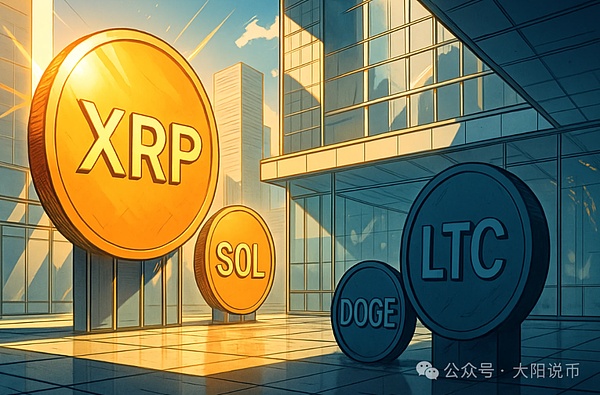
The first batch of four altcoin ETFs (Litecoin, XRP, Solana, Dogecoin) launched in the U.S. in November 2025, revealing a sharply divided market. XRP emerged as the clear winner, with over $600 million in net inflows and price appreciation, attributed to its clear regulatory status, utility in cross-border payments, and competitive fees. Solana also attracted over $600 million in inflows, but its price fell nearly 30%, showing that ETF demand can be overshadowed by broader market sentiment, though its staking yield remained a draw. Litecoin and Dogecoin were largely ignored, with combined inflows under $8 million due to lack of new narratives, high fees, and limited functionality. The divergence highlights two distinct investor groups: traditional institutions withdrew over $40 billion from Bitcoin and Ethereum ETFs amid market volatility, while crypto-native investors viewed the dip as an opportunity to enter new altcoin ETFs. This debut underscores that ETF approval alone isn’t a guarantee of success; long-term viability depends on real-world utility, regulatory clarity, and ecosystem strength. The altcoin ETF era marks a shift from speculative hype toward institutional value assessment, with only assets possessing strong fundamentals likely to thrive in an increasingly crowded market.

In November 2025, the first four altcoin ETFs (Litecoin, XRP, Solana, Dogecoin) were approved for listing in the U.S. Against the backdrop of massive losses in Bitcoin and Ethereum ETFs during the same period, their performance was starkly different, revealing a new era of market divergence.

Key Highlights: A Tale of Two Extremes in the Debut Performance

XRP

The clear winner, with net inflows exceeding $600 million, it was the only asset whose price increased. Its success stems from a clear regulatory status, practical value as a cross-border payment infrastructure, and competitive fee structures.

Solana

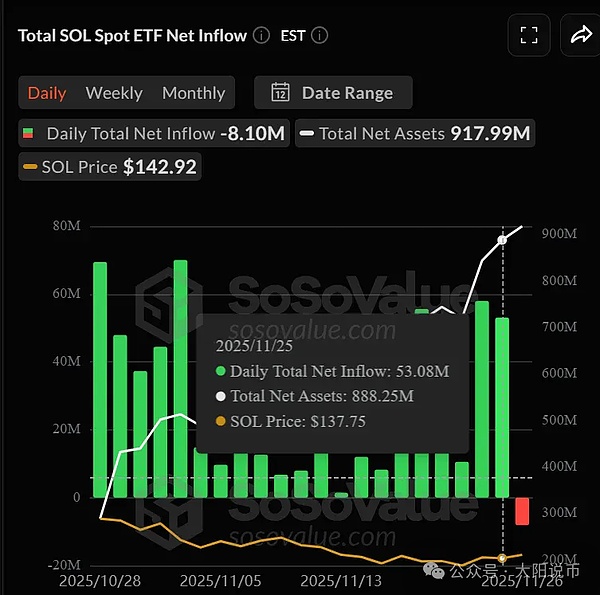
The awkward runner-up, also attracting over $600 million in inflows, yet its price plummeted nearly 30%. This exposed the limited effect of ETF inflows in the face of systemic market panic, though its offered staking rewards remain a unique attraction.
Litecoin and Dogecoin

Forgotten by the market, with combined inflows of less than $8 million. A lack of new narratives, high fees, and insufficient functionality made them unattractive to institutional investors.

Underlying Logic: Investors in Two Parallel Worlds

The most contradictory market phenomenon in November was this: Bitcoin and Ethereum ETFs saw net outflows of over $40 billion, while altcoin ETFs saw net inflows of $13 billion. This wasn't a rotation of funds but reflected a fundamental difference between investors in the "traditional finance world" and the "crypto-native world":
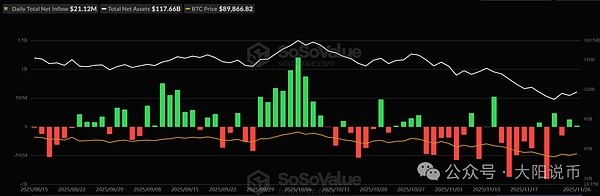
Traditional Institutions Are Retreating

Triggered by risk controls during the market flash crash, they took massive profits by exiting BTC/ETH ETFs.

Crypto-Native Institutions Are Entering

They viewed the market adjustment as an opportunity to allocate to new instruments (altcoin ETFs), executing their established plans.

Future Implications: ETFs Are Not a Panacea, But a "Litmus Test"

This debut shows that the "new product effect" of ETFs has a time limit. Once the initial hype subsides, the asset's inherent practical value, regulatory clarity, and ecosystem fundamentals will become the decisive factors attracting capital.

By 2026, hundreds of crypto ETFs could emerge in the U.S. market. However, it's foreseeable that only a few assets with real value and strong narratives will stand out, while a large number of uncompetitive products will face elimination. The launch of altcoin ETFs marks crypto's transition from speculative narratives into a new phase where institutions use real capital to screen for value.


Related Questions

QWhich cryptocurrency ETF was the clear winner in terms of net inflows and price performance upon their US debut in November 2025, and why?

AThe XRP ETF was the clear winner, attracting over $600 million in net inflows and being the only one to experience a price increase. Its success is attributed to its clear regulatory status, utility as a cross-border payment infrastructure, and competitive fee structure.

QDespite significant inflows, why did the Solana ETF's price drop nearly 30% after its launch?

AThe Solana ETF's price dropped nearly 30% despite over $600 million in inflows because the ETF inflows were not enough to counteract a broader, systemic market panic. However, its ability to offer staking rewards remained a unique attraction for investors.

QWhat was the combined net inflow for the Litecoin and Dogecoin ETFs, and what were the primary reasons for their poor performance?

AThe combined net inflow for the Litecoin and Dogecoin ETFs was less than $8 million. They performed poorly due to a lack of new compelling narratives, high management fees, and insufficient perceived utility, making them unattractive to institutional investors.

QWhat does the simultaneous massive outflow from Bitcoin/ETH ETFs and inflow into altcoin ETFs in November 2025 reveal about different investor groups?

AThis divergence reveals a fundamental difference between 'Traditional Finance (TradFi) World' and 'Crypto-Native World' investors. TradFi institutions were retreating, taking profits and triggered by risk controls during a market crash, while crypto-native institutions saw the market adjustment as an opportunity to deploy capital into new altcoin ETF products according to their plans.

QAccording to the article, what will be the decisive factors for an asset's success in the future crypto ETF landscape beyond the initial 'new product effect'?

ABeyond the initial hype, the decisive factors for success will be an asset's practical utility, regulatory clarity, and fundamental strength of its ecosystem. The ETF acts as a 'litmus test,' and only assets with real value and powerful narratives will thrive in the long term.

Related Reads

The Value Distribution of Stablecoins

**Summary: The Value Distribution of Stablecoins** The article argues that stablecoins are evolving from mere trading tools into broader channels for dollar access. It divides the stablecoin ecosystem into four layers to analyze how value is distributed: 1. **Issuance Layer:** Mints stablecoins, holds reserve assets, and captures the spread between reserve yield and user costs (e.g., Tether, Circle). This layer currently earns the largest profit margin. 2. **Infrastructure Layer:** Connects stablecoins to the traditional financial system, handling fiat on/off-ramps, banking integration, compliance (KYC/AML), and asset management (e.g., Bridge, BVNK). This is the "unglamorous" but critical work, building the essential bridges between crypto and real-world finance. 3. **Acquiring/Distribution Layer:** Integrates stablecoins into merchant systems, manages payment flows, and provides enterprise financial software (e.g., Stripe, Coinbase). They act as the access point for businesses. 4. **Application Layer:** The end-users and businesses that ultimately use stablecoins for payments, settlements, or as a store of value. They benefit from convenience but have little pricing power. The core thesis is that while the issuance layer currently dominates profits, the often-overlooked **infrastructure layer holds significant long-term potential**. The real challenge and barrier to mass adoption is not the on-chain transfer of stablecoins (which is simple), but the complex "last mile" integration into existing business workflows, banking systems, and regulatory frameworks across different countries. Companies in this layer are currently in a "land grab" phase, investing heavily to build networks, secure bank partnerships, and establish compliance pathways. While their position is currently pressured by the profitable issuers above and distribution platforms below, the article suggests that if stablecoins become a default financial rail for businesses, the infrastructure providers who have done the hard work of integration will ultimately gain strong pricing power and become entrenched, essential players.

marsbit4h ago

The Value Distribution of Stablecoins

marsbit4h ago

The Value Distribution of Stablecoins

The Value Distribution of Stablecoins The article argues that stablecoins are evolving from a mere trading tool into a broad "dollar channel." It analyzes the industry's value chain through four layers: 1. **Issuance Layer (e.g., Tether, Circle):** The top layer that mints stablecoins, holds reserve assets, and captures the thickest interest rate spread. 2. **Infrastructure Layer (e.g., Bridge, BVNK):** Connects stablecoins to the traditional financial system, handling critical but complex "dirty work" like fiat on/off-ramps, banking integration, compliance (KYC/AML), and cross-border settlement. 3. **Acquiring/Distribution Layer (e.g., Stripe, Coinbase):** Embeds stablecoins into merchant systems, manages payment flows, and integrates with enterprise software. 4. **Application Layer:** End-users and businesses that ultimately use stablecoins for payments, settlement, or storing value. The author posits that while the issuance layer currently captures the most profit, the most overlooked and potentially critical layer is infrastructure. The core challenge for stablecoin adoption isn't the on-chain transfer (which is simple), but bridging the gap between blockchain and the real-world financial system. This involves solving practical problems for businesses: fiat conversion, reconciliation, tax handling, and user onboarding. Infrastructure companies are currently in a difficult "land-grab" phase—building networks, securing banking relationships, and achieving compliance country-by-country. They face pressure from both the profitable issuance layer above and distribution platforms below. However, the author suggests this layer is building a crucial moat. Once stablecoins become a default business rail, the infrastructure players who have done the hard work of integration may gain significant, durable value and pricing power.

链捕手4h ago

The Value Distribution of Stablecoins

链捕手4h ago

How to Do Research Well: Deliberately Practice the Real Skills That Matter

No one truly teaches you how to do research. You're often given a desk, a pre-selected problem, and vague instructions to "create something new." Consequently, many people reverse-engineer the job based on visible outputs—papers, posts, announcements—learning only how to *appear* like a researcher rather than how to *become* one. True research capability is built from stacking small, trainable skills, nearly all of which can be developed through deliberate practice. **Pick Your Own Problem:** Most researchers absorb problems from advisors or trends, lacking the underlying reasoning. Choosing a problem you genuinely care about, as John Schulman advises, leads to original work. Develop "taste" like a muscle: predict experiment outcomes, guess paper results from methods, and track which findings remain important over time. **Upgrade Your Inputs:** Relying on shared reading lists (arXiv hot lists, filtered group chats) leads to unoriginal conclusions. Undervalued old literature often holds crucial insights (e.g., MoE, LSTM, backpropagation). Richard Sutton's "The Bitter Lesson" or Claude Shannon's 1952 talk on creative thinking are more predictive than lengthy modern surveys. Breadth matters as much as depth: draw from neuroscience, mechanism design, hardware knowledge, and honest statistics. Read papers directly, especially appendices and limitations sections. **Write Everything Down:** As Paul Graham noted, writing exposes flaws in seemingly mature ideas. Writing is the cheapest defense against self-deception. Following Feynman's principle, Darwin programmatically wrote down facts contradicting his theory to combat memory bias. Maintain a detailed log of hypotheses, setups, predictions, results, and updated understandings. Reviewing past logs fosters essential humility.

marsbit6h ago

How to Do Research Well: Deliberately Practice the Real Skills That Matter

marsbit6h ago

Trading

Spot
Futures

Hot Articles

What is DOGE M

Doge Matrix ($doge m): The New Breed of Community-Driven Cryptocurrency Introduction In the ever-evolving landscape of cryptocurrency, new projects constantly emerge, each aiming to capture the interest of investors and enthusiasts alike. One of the latest entrants to this domain is Doge Matrix, represented by the ticker symbol $doge m. This project has attracted attention thanks to its roots in the popular meme culture surrounding Dogecoin, establishing its place within the web3 space. This article aims to provide a comprehensive analysis of Doge Matrix, covering its overview, creator, investors, functionality, timeline, and notable aspects. What is Doge Matrix ($doge m)? Doge Matrix is a community-driven cryptocurrency project that seemingly builds upon the widespread appeal of Dogecoin, a digital currency known for its Shiba Inu mascot and its meme origins. While the overarching objectives of Doge Matrix are not extensively defined, it is characterized by a commitment to harnessing community involvement and support. Unlike traditional cryptocurrencies that often emphasize utility or intrinsic value through underlying technologies, Doge Matrix positions itself within a space that embraces the cultural phenomenon of cryptocurrencies, particularly appealing to those who resonate with the ethos of meme-based assets. Drawing on the strengths of the Dogecoin community, Doge Matrix operates as part of a broader ecosystem, inviting participation and engagement from users who share an interest in cryptocurrency and the digital landscape. Who is the Creator of Doge Matrix ($doge m)? The identity of the creator of Doge Matrix remains unknown. This lack of transparency is not an uncommon occurrence in the cryptocurrency space, where some projects are launched without revealing the identities of their founders. The absence of information regarding the founding team can raise questions among potential investors about the project’s accountability and direction. Who are the Investors of Doge Matrix ($doge m)? As it stands, there is no publicly available information detailing the investors or investment foundations that back Doge Matrix. The project appears to rely primarily on community support rather than institutional investment. This model aligns with the community-driven nature of the initiative, fostering an environment where the direction of the project is shaped by its participants rather than being dictated by a select few financial backers. How Does Doge Matrix ($doge m) Work? The specifics regarding the operational mechanisms of Doge Matrix are somewhat vague, reflecting a broader trend of projects in the meme coin space where innovative functionalities are not always clearly articulated. Nonetheless, Doge Matrix seems designed to tap into the existing cryptocurrency ecosystem by encouraging user participation while tapping into the familiar cultural references associated with Dogecoin. Its potentially unique characteristics derive from community interactions rather than technological advancements, emphasizing shared experiences and collaboration among token holders. While the exact innovations have not been explicitly outlined, the project appears to create a space where community members can engage, share ideas, and propel the project's potential forward. Timeline of Doge Matrix ($doge m) Reflecting on the project’s timeline reveals notable events that have defined its journey thus far: November 25, 2024: Doge Matrix reached its all-time high value, marking a significant milestone in its early history. January 1, 2025: Conversely, Doge Matrix hit its all-time low value, illustrating the volatility often associated with cryptocurrencies, especially in the early stages of a project's lifecycle. Ongoing: The project continues to be actively traded and supported by its community, although specific future milestones or objectives have yet to be disclosed. Key Points About Doge Matrix ($doge m) Community Focus At the heart of Doge Matrix is a commitment to community engagement. The project thrives on the premise of collaboration and shared objectives among its members, emphasizing the importance of collective effort. Unlike centralized projects that often have a defined leadership structure, Doge Matrix at present showcases a more fluid approach to governance, where every community member's voice matters. Volatility The cryptocurrency market is notorious for its volatility, and Doge Matrix is no exception. Its price history reflects significant fluctuations between high and low values, which is typical of many new cryptocurrencies but underscores the risks associated with investment in emerging tokens. Lack of Detailed Information One of the most striking features about Doge Matrix is the scarcity of detailed information regarding its technological underpinnings and operational mechanisms. This ambiguity necessitates that potential investors conduct thorough due diligence before engaging with the project. Conclusion In summary, Doge Matrix ($doge m) illustrates a new wave of cryptocurrency projects that lean heavily on community engagement and cultural relevance. While lacking in certain specifics—such as clear leadership, defined objectives, and detailed functionality—the project has managed to generate interest within the crypto community, leveraging the established appeal of meme culture. As with any investment in the cryptocurrency space, understanding the inherent risks and conducting comprehensive research is essential for potential participants. Doge Matrix stands as a reminder of the dynamic, sometimes unpredictable nature of the crypto industry, marked by constant evolution and enthusiasm for community-driven initiatives.

3.8k Total ViewsPublished 2025.02.03Updated 2025.02.03

What is DOGE M

Discussions

Welcome to the HTX Community. Here, you can stay informed about the latest platform developments and gain access to professional market insights. Users' opinions on the price of DOGE (DOGE) are presented below.

活动图片