Original | Odaily Planet Daily (@OdailyChina)
Author | DingDang (@XiaMiPP)

In the stablecoin industry chain, Circle and Stripe used to be a pair of partners with a very clear division of labor.
Circle was responsible for mapping US dollars from the real world onto the blockchain, minting them into the stablecoin USDC; Stripe, through its global internet payment network, enabled these digital dollars to flow in real commercial scenarios. One was responsible for producing the money, the other for making it circulate. This alliance was almost naturally complementary in the past few years.
But two recent events, when viewed together, create a subtle feeling: these two companies seem to be slowly moving towards the same place.
On February 11th, Stripe announced the launch of x402 payment functionality on Base. This feature enables developers to charge AI agents directly using USDC. Stablecoins are no longer just pricing tools on exchanges; in the wave of AI Agents, they will become the payment medium for transactions between machines.
In the same week, Bridge, a stablecoin infrastructure company under Stripe, received preliminary approval for a trust bank charter from the U.S. Office of the Comptroller of the Currency (OCC). This means Bridge could potentially, as a regulated financial institution, begin advancing businesses such as stablecoin issuance, custody, and reserve management.
On one side, Stripe is building new payment scenarios using USDC; on the other side, it is building its own stablecoin financial infrastructure.
The Stablecoin Industry Chain of the Old Era
If you break down the stablecoin world, the industry chain is not actually complicated.
The bottom layer is the issuance layer. Institutions like Circle are responsible for mapping real-world dollar reserves onto the blockchain, minting them into stablecoins, such as USDC. The layer above is the settlement layer, handled by blockchain networks which take on the role of fund accounting and clearing. Moving up further is the payment layer. Internet payment infrastructure like Stripe embeds stablecoins into real commercial transactions, allowing on-chain funds to enter scenarios like e-commerce, SaaS, or cross-border trade. At the top is the application layer. Various specific financial activities happen here, from DeFi to AI Agent payments.
When stablecoins were just tools for the crypto market, participants in this industry chain always had their own distinct roles: issuers were responsible for "minting coins," payment platforms were responsible for "collecting money," blockchains handled settlement, and developers focused on application scenarios.
As early as 2014, Stripe was one of the first mainstream payment processors to support Bitcoin payments. However, due to issues like excessive Bitcoin price volatility, long transaction confirmation times, and unpredictable fees, this business attempt was eventually scaled back in 2018. Bitcoin was more like a speculative asset than a currency suitable for internet payments.
The emergence of stablecoins恰好 filled this gap. The price stability, programmability, and on-chain settlement capabilities of USDC made it closer to Stripe's ideal "internet-native currency." In 2022, Stripe re-entered the crypto space and chose to support USDC payments. This step not only brought stablecoins back into the mainstream payment system but also objectively drove the rapid growth of USDC's circulation scale, with its circulating market capitalization once exceeding $55 billion.
Under this synergistic relationship, Circle provided stable digital dollars, and Stripe provided the global payment network. Together, they pushed USDC to grow from a crypto trading tool to a market approaching $70 billion.
On-chain data also confirms the scale effect brought by this synergy. According to Artemis data, the scale of on-chain USDC transactions in January exceeded 8.4 trillion, while the total scale of on-chain transactions for the entire stablecoin market was 10 trillion. That is, in terms of transaction count, USDC accounts for 84% of the total market share.
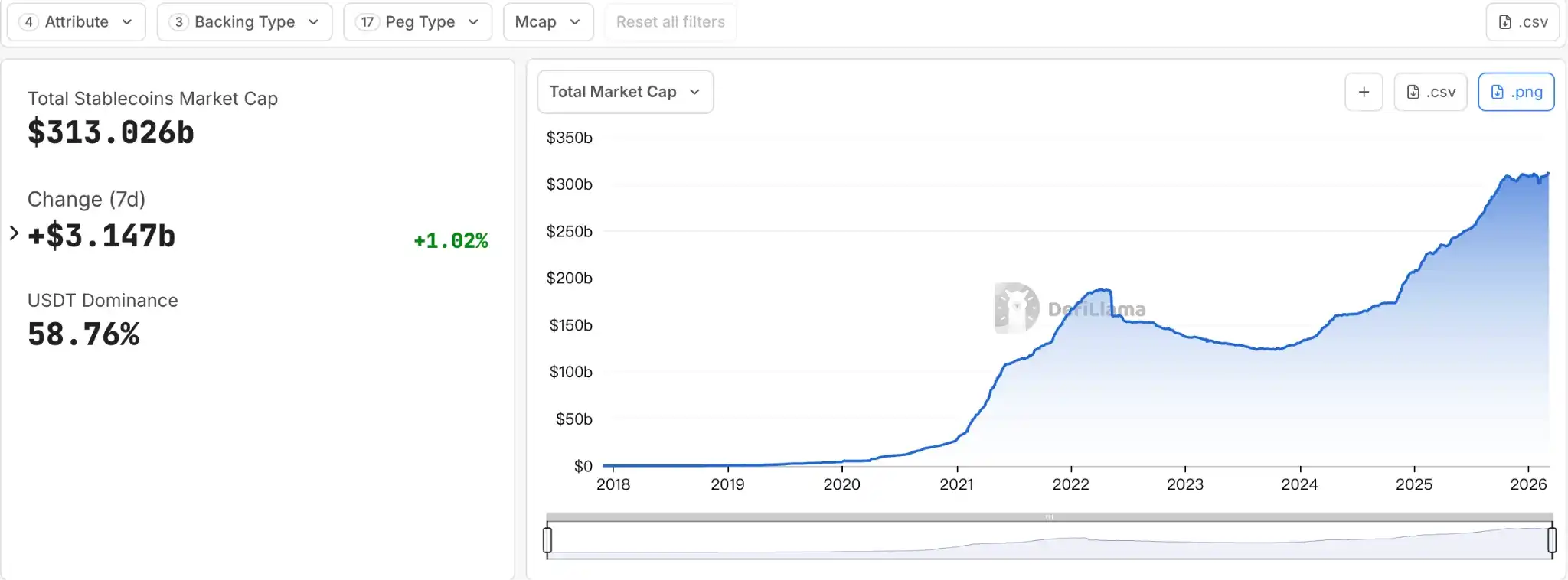
At the same time, the external regulatory environment has also undergone significant changes. With the formal landing of the "GENIUS Act," stablecoins—once a financial experiment operating in a regulatory gray area—are gradually being incorporated into the legal financial system. Today, the stablecoin market size exceeds $300 billion. In the future, the scale carried by this market could be a trillion-dollar-level financial network.
Stablecoins are no longer just internal tools for the crypto market but are beginning to be seen as part of the next generation of financial infrastructure. When a market grows from a crypto tool into financial infrastructure, the industrial logic often changes accordingly.
When Stablecoins Become Infrastructure
In any financial system, truly stable profits often do not come from a single link but from the control of key nodes. Whoever can control the轨道 (track) of fund flow can define the rules.
If stablecoins are only the underlying asset, while payment gateways, developer tools, and commercial scenarios are all controlled by other platforms, then the profits the issuer can ultimately obtain are actually very limited. Conversely, if one controls the payment network or settlement system, then one can continuously capture value at every step of the fund flow.
Therefore, as stablecoins begin to evolve from a crypto asset into financial infrastructure, an almost inevitable trend begins to emerge: industry roles originally分散 (scattered) across different layers begin to try to extend upstream and downstream, bringing more links into their own systems.
This process is not unfamiliar in financial history. From banking systems to credit card networks, to internet payment platforms, mature financial systems often eventually go through similar stages—from role dispersion to structural integration.
Now, this wind of industrial integration is also beginning to blow into the world of stablecoins.
If the stablecoin industry chain is viewed as a vertical structure, then over the past few years, Circle and Stripe have stood at opposite ends of this chain. But now, they are both moving towards the middle.
Circle: Not Wanting to Be Just a "Money Printer"
In the on-chain ecosystem, the circulation efficiency and usage frequency of USDC have long been impossible to ignore. In the latest stablecoin flow report, the velocity of USDC circulation is almost 5 times that of USDT.
However, relying solely on issuing stablecoins is not a particularly imaginative business model in itself.
The main revenue sources for stablecoin issuers are roughly divided into two parts: first, the interest income generated by the reserve assets, and second, the related fees generated during the issuance and redemption of stablecoins. But as the scale of stablecoins continues to grow, this portion of profits often still needs to be shared with ecosystem partners. For example, as one of the most important distribution channels for USDC, Coinbase receives nearly $1 billion in profit sharing from the USDC system annually. This means that even though the issuer undertakes the core "minting" role in the stablecoin system, its actual disposable profit space is still constrained by the ecosystem structure.
This also explains why, over the past two years, Circle's strategy has clearly extended to the application layer: it is no longer satisfied with仅仅 issuing stablecoins but is trying to build a complete stablecoin payment network.
Judging from currently public information, Circle's layout at the application layer is roughly a three-step process.
Step one, the L1 blockchain Arc designed for enterprises. It plays a "coordination layer" role at the application level, helping developers build payment, settlement, and other applications. Arc launched its testnet in October 2025 and has attracted 100+ companies to participate, processing over 166 million transactions. The mainnet is planned to launch within 2026.
Step two, with USDC as the core, use the Cross-Chain Transfer Protocol (CCTP) and gateway tools to solve liquidity fragmentation. At the application layer, help enterprises unify USDC from multiple chains onto Arc and CPN, achieving seamless distribution and application building.
Step three, and Circle's core application layer product, CPN (Circle Payments Network). Launched in May 2025, it is an "open standard" payment coordination network specifically designed for programmable, compliant, and auditable payments. So far, 55 financial institutions have registered, with another 74 financial institutions undergoing资格审查 (qualification review).
This layout shows that Circle is gradually evolving from a mere stablecoin issuer to building a整套 (complete set) of application infrastructure capable of carrying fund flows.
Stripe: The "Checkout Counter" Also Wants to Control the轨道 (Track)
Stripe is at the other end of the stablecoin system. As one of the world's most important internet payment infrastructures, Stripe controls huge merchant gateways. In 2025, the total payment volume processed on the Stripe platform reached $1.9 trillion, a year-on-year increase of 34%, equivalent to about 1.6% of global GDP. From Shopify to Amazon, the payment systems of a large number of internet merchants are built on Stripe's infrastructure. In a sense, Stripe does not produce currency, but it controls the entrance to currency flow.
But if in the future stablecoin issuers and blockchain networks jointly control the settlement layer, then payment platforms might be compressed into mere technical service providers.
This is also why Stripe has begun to systematically布局 (layout) across the industry chain's upstream and downstream in recent years.
In February 2025, Stripe completed the acquisition of the stablecoin infrastructure platform Bridge for $1.1 billion. Finally, on February 12th of this year, Bridge received conditional approval from the OCC. This is the most critical piece for Stripe's infrastructure ambitions.
At the same time, Stripe is also jointly incubating the L1 public chain Tempo with Paradigm, hoping to build a settlement chain specifically for internet finance. The public testnet went live in December 2025, and the mainnet is planned to launch within 2026.
Additionally, in 2025, Stripe acquired wallet infrastructure company Privy, providing users with embedded wallets and identity systems, thereby lowering the barrier for users to enter the on-chain financial system.
If you look at these actions together, a very clear trend emerges: Stripe is extending downward from the payment gateway, trying to master the underlying轨道 (track) on which stablecoins run.
Two Companies Meet in the Middle of the Industry Chain
Circle is extending from the issuance layer to the application layer, while Stripe is descending from the payment layer to the infrastructure. When both paths move towards the center of the industry chain simultaneously, the originally clear boundaries inevitably begin to overlap.
Against the backdrop of the reshaping stablecoin industry structure, it serves more as a reminder: the stablecoin competition is no longer just about "who issues more tokens." The truly important question in the future might be—who controls the轨道 (track) of stablecoin flow.
As issuance, settlement, payment, and application are重新整合 (re-integrated), the competition in the stablecoin world will also shift from "asset scale" to "financial network." And on this new track, Circle and Stripe, this pair of once highly complementary allies, have already begun to meet in the middle of the industry chain.
The story of stablecoins is also evolving from a crypto industry experiment to a reconstruction of financial networks.
Recommended Reading
《Latest Stablecoin Report: Real Distribution and Flow Are Far More Worth Attention Than Supply》
《Behind Circle's Strong Stock Rebound: AI, Prediction Markets, and Institutional Adoption》





















