DGAI Token Surges 93% Following Launch of Decentralized AI Network DGrid

cryptonews.ru2026-08-25 tarihinde yayınlandı2026-08-25 tarihinde güncellendi

Özet

The DGAI token surged by 93% following the launch of the native token for the DGrid decentralized AI network. Trading at approximately $0.73 on Tuesday, the token's market capitalization reached around $110 million with trading volume exceeding $165 million. The launch coincides with the expansion of the DGrid network, which connects users and developers to distributed nodes for AI inference processing. The DGAI token is used for payments, staking, and rewarding node operators. The network routes AI requests between models hosted on these nodes and employs a "Proof of Quality" mechanism to evaluate results. Node operators stake DGAI to earn rewards for providing computational resources, with penalties for poor performance or misconduct. DGrid also reported selling over 140 physical DClaw Box devices within hours, generating over $221,000 in revenue. These devices allow users to connect to AI models via DGrid's decentralized network of independently operated nodes.

The DGAI token of the DGrid AI project nearly doubled on its first day of trading following the launch of the native token for the decentralized AI network.

On Tuesday, DGAI was trading around $0.73, gaining nearly 93% over the past 24 hours. Its market capitalization stood at approximately $110 million, with trading volume exceeding $165 million, according to CoinGecko.
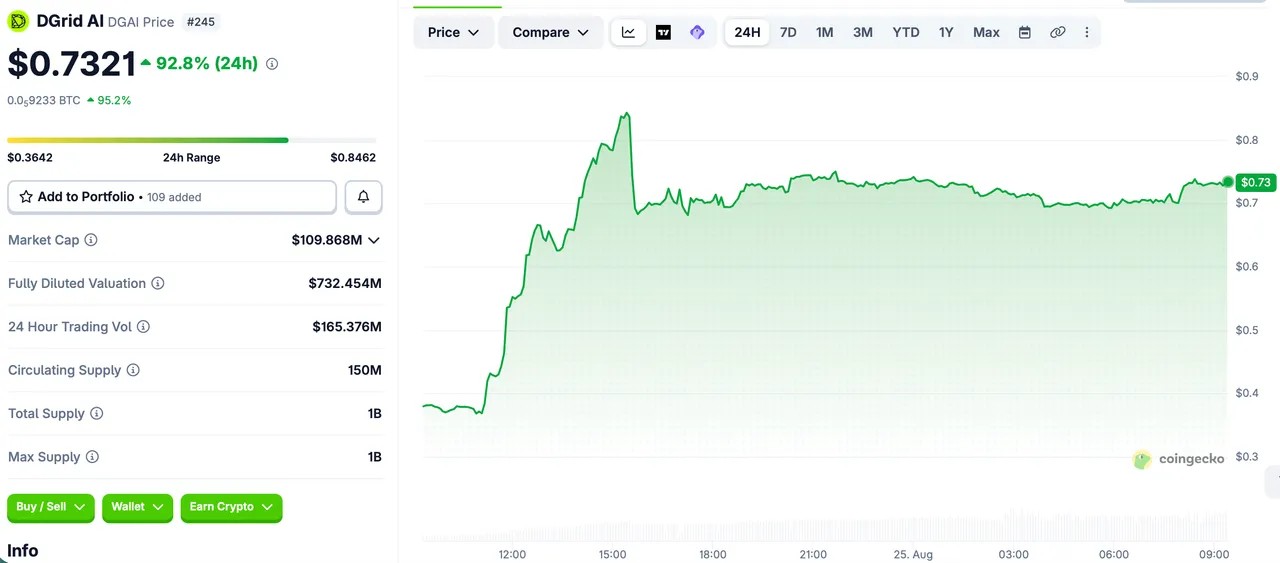
Source: CoinGecko

The launch of DGAI coincided with the expansion of the decentralized AI network DGrid. It connects users and developers with distributed nodes that process AI inference requests. The token is used for payments, staking, and rewarding node operators.

DGrid's litepaper states that the network routes AI requests between models hosted on distributed nodes and uses a "Proof of Quality" mechanism to evaluate results. Node operators stake DGAI and receive token rewards for providing computational resources. Penalties are stipulated for low performance or improper actions.

DGrid informed Cointelegraph that it sold over 140 DClaw Box devices in a few hours at 1580 $USDT each, generating over 221,000 $USDT in revenue.

DClaw Boxes are physical devices designed to run the DGrid DClaw personal AI agent. They connect users to AI models through a decentralized network of independently managed nodes, rather than through a single centralized provider.

Journal: Korean Bank Enlists Ripple for Payments, Pakistan Opens Crypto Licensing: Asia Express

end-content

İlgili Sorular

QWhat is the name of the token that surged 93% after the launch of its decentralized AI network?

AThe token is called DGAI, associated with the DGrid AI project.

QWhat was the trading price and market capitalization of DGAI on its first trading day?

AOn its first trading day, DGAI was trading at approximately $0.73 and had a market capitalization of around $110 million.

QWhat is the primary function of the DGrid network?

AThe DGrid network connects users and developers with distributed nodes that process AI inference requests, routing these requests between AI models hosted on the nodes.

QHow does the DGrid network use its native DGAI token?

AThe DGAI token is used for payments, staking, and rewarding node operators. Node operators lock up DGAI and receive token rewards for providing computational resources.

QWhat are DClaw Boxes and what purpose do they serve for the DGrid network?

ADClaw Boxes are physical devices that allow users to connect to the DGrid DClaw personal AI agent. They connect users to AI models via a decentralized network of independently managed nodes, avoiding reliance on a single centralized provider.

İlgili Okumalar

BPI: Digital Gold Least Popular Bitcoin Narrative, as Implementation Methods Defy Concepts

A national study by the Bitcoin Policy Institute (BPI) reveals that the "digital gold" narrative for Bitcoin holds little appeal for everyday Americans. The research, conducted with Cygnal and Neighborhood Bitcoin, involved surveys and focus groups with registered voters. Key barriers to adoption included concerns over control of the asset, security, accessibility, and ease of use. Messaging focused on personal control (e.g., "you decide how much") or Bitcoin as "freedom money" (savings that can't be frozen by banks or governments) resonated much more strongly than the "digital gold" concept. The study also found potential buyers are more influenced by stories from peers like friends, family, or financial advisors than by abstract narratives. After exposure to effective messages, the share of those "extremely" or "very" interested in owning Bitcoin rose from 19% to 24%. A separate Federal Reserve Bank of Cleveland research paper analyzed household data from 2018-2025. It found that expectations of Bitcoin's returns were a stronger driver of ownership than all demographic factors combined. For example, in 2021, Bitcoin holders expected a 22% annual return versus just 7% for non-holders. An experiment in 2025 showed that informing participants about Bitcoin's past performance (14.3% return) increased their planned crypto investments by 47% and raised their likelihood of purchasing by 23%. U.S. household crypto ownership grew from under 2% in 2018 to about 12% in 2025.

cryptonews.ru35 dk önce

BPI: Digital Gold Least Popular Bitcoin Narrative, as Implementation Methods Defy Concepts

cryptonews.ru35 dk önce

İşlemler

Spot
活动图片